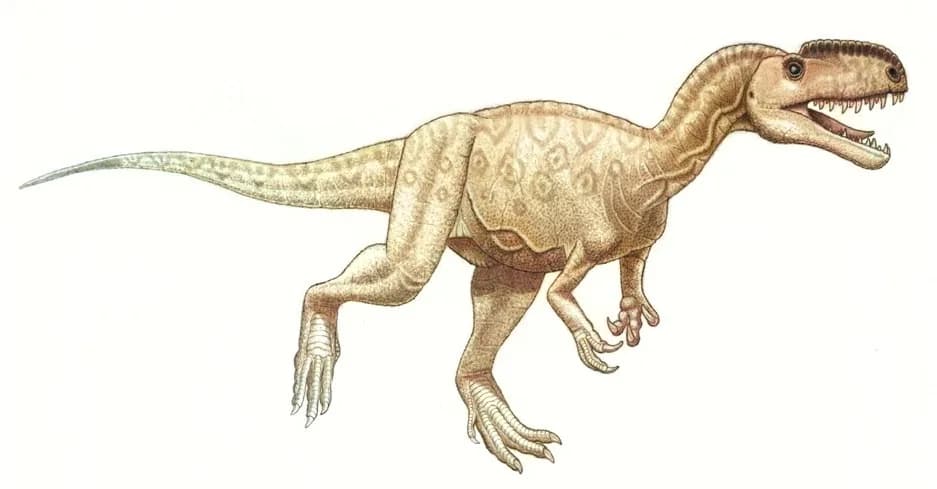
Lézard à crête unique
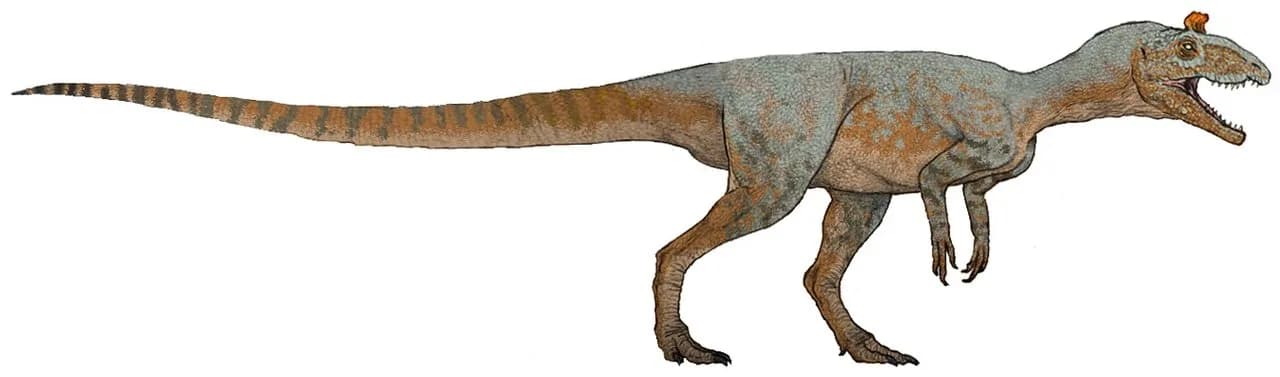
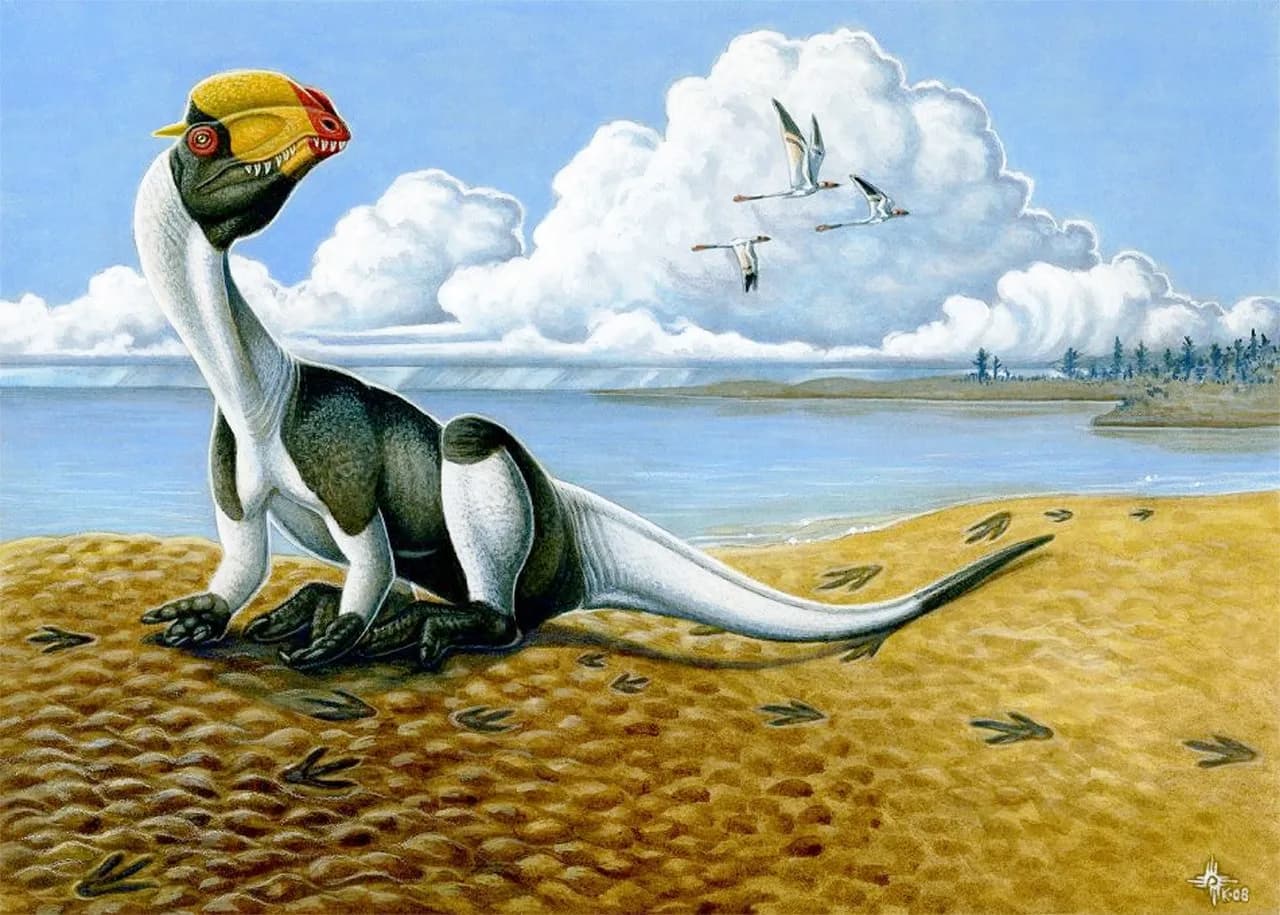
Monolophosaurus jiangi carries a head crest unique among theropods: a single median ridge running from snout to eyes, where Dilophosaurus carried two parallel ones. At 5.5 metres and around 475 kilograms, it hunted the Junggar Basin in Xinjiang 170 million years ago. Found in 1981, it waited thirteen years before being described.
Monolophosaurus lived during the Middle Jurassic period, approximately 170 million years ago, during the Bathonian-Callovian stage. This period corresponds to a time when the continents were still grouped together as a large supercontinent, with Pangaea just beginning to fragment. The global climate was warm and humid, with average temperatures well above those of today. Monolophosaurus lived in what is now the Junggar Basin, in the Xinjiang Autonomous Region of northwestern China. This medium-sized theropod shared its ecosystem with other Middle Jurassic dinosaurs, a period still relatively poorly known compared to the Late Jurassic or Cretaceous.
Monolophosaurus measured approximately 5 to 5.5 meters in total length and weighed between 450 and 500 kilograms, making it a medium-sized predator for its time. Its hip height reached about 1.5 meters, and its skull measured approximately 60 centimeters long. This theropod exhibited a body construction typical of basal allosauroids, with a robust body, powerful hind limbs adapted for bipedal locomotion, and proportionally short forelimbs equipped with sharp claws. Its long, muscular tail served as a natural counterbalance during movement, providing the dynamic equilibrium essential for an active predator.
An active carnivore, Monolophosaurus likely fed on small to medium-sized herbivores that populated the Middle Jurassic plains of China. Its sharp, recurved teeth, typical of carnivorous theropods, were perfectly suited for slicing through the flesh of its prey. The jaw, though less powerful than those of the great Cretaceous theropods, was robust enough to subdue reasonably sized prey. Among its potential targets were juvenile sauropods, primitive ornithopods, and possibly small stegosaurs. Its hunting strategy likely relied on a combination of speed and agility, exploiting its moderate size for rapid and efficient attacks against varied prey in its Jurassic environment.
Monolophosaurus inhabited the vast alluvial plains and wooded areas of the Junggar Basin, in present-day Xinjiang, northwestern China. During the Middle Jurassic, this region was characterized by a tropical to subtropical climate with abundant rainfall and lush vegetation composed of conifers, tree ferns, and cycads. The Wucaiwan Formation, where the holotype specimen was discovered, represents an ancient fluvio-lacustrine environment with meandering rivers and shallow lakes. This rich ecosystem offered numerous ecological niches, supporting a diverse community of dinosaurs and other reptiles. The sedimentary deposits of the region attest to a dynamic landscape with distinct seasons.
The anatomy of Monolophosaurus is dominated by its most distinctive feature: a large single bony crest rising along the midline of the skull, from the snout to the level of the eye sockets. This crest, formed by the fusion of the nasal and premaxillary bones, was likely hollow and traversed by air sinuses, making it surprisingly lightweight despite its imposing size. The internal structure of the crest included chambers connected to the nasal passages, suggesting a role in sound production or thermoregulation. The rest of the skull featured well-developed temporal fenestrae, allowing the insertion of powerful jaw muscles. The postcranial skeleton showed characteristics typical of basal tetanurans, with pneumatized vertebrae indicating an air sac system similar to that of modern birds.
The behavior of Monolophosaurus remains partly speculative, but its cranial crest provides noteworthy clues about its social interactions. The crest most likely served as a visual signal for intraspecific communication, playing a role in sexual selection and recognition between individuals of the same species. The hollow chambers inside the crest could have amplified vocalizations, allowing Monolophosaurus to produce resonant calls audible over great distances. As a medium-sized predator, it occupied an intermediate ecological niche in its ecosystem, possibly hunting alone or in small opportunistic groups. Its running speed, estimated between 25 and 35 km/h, gave it an advantage when pursuing agile prey on the open plains of the Middle Jurassic of China.
Monolophosaurus jiangi was discovered in 1981 during a joint Sino-Canadian expedition in the Wucaiwan Formation, Junggar Basin, Xinjiang region, in northwestern China. The holotype specimen (IVPP 84019) comprises a partially articulated skeleton including a remarkably well-preserved skull, cervical, dorsal, and caudal vertebrae, as well as pelvic and limb elements. The species was officially described and named in 1994 by Zhao Xijin and Philip Currie. The generic name means 'single-crested lizard,' referring to its distinctive cranial crest, while the specific name 'jiangi' honors Jiang, a worker who contributed to the discovery of the fossil. This specimen remains the only known individual of this species, but its exceptional preservation has allowed detailed analyses of its cranial morphology and phylogenetic relationships within the Tetanurae.
| Period | Jurassique moyen / Middle Jurassic |
| Era | Mésozoïque / Mesozoic |
| Age | 170 Ma |
| Location | Bassin du Junggar, Xinjiang, Chine / Junggar Basin, Xinjiang, China |
| Length | 5.5 m |
| Height | ~2 m |
| Weight | ~475 kg |
| Diet | Carnivore |
| Discovery | 1981 |
Monolophosaurus jiangi's crest — a single midline crest running from snout to eye sockets, formed by fusion of nasal and premaxillary bones — was probably hollow and connected to the nasal passages. This lightweight structure likely served as a visual signal for intraspecific communication and sexual selection, and may have amplified vocalizations. It immediately distinguishes this Middle Jurassic theropod from other crested species like Dilophosaurus, which had two crests.
Monolophosaurus jiangi measured approximately 5 to 5.5 meters in length with an estimated weight of 450 to 500 kilograms and a skull about 60 centimeters long. Discovered in 1981 during a Sino-Canadian expedition in the Wucaiwan Formation (Junggar Basin, Xinjiang), it was officially described only in 1994 by Zhao Xijin and Philip Currie. The holotype IVPP 84019 remains the only known individual.
Monolophosaurus jiangi inhabited the alluvial plains and wooded zones of the Junggar Basin (Xinjiang) about 170 million years ago, under a humid tropical to subtropical climate. The Wucaiwan Formation represents ancient fluvio-lacustrine environments with rivers and shallow lakes. Its potential prey included juvenile sauropods, primitive ornithopods, and small stegosaurs in this still relatively poorly documented Middle Jurassic ecosystem.
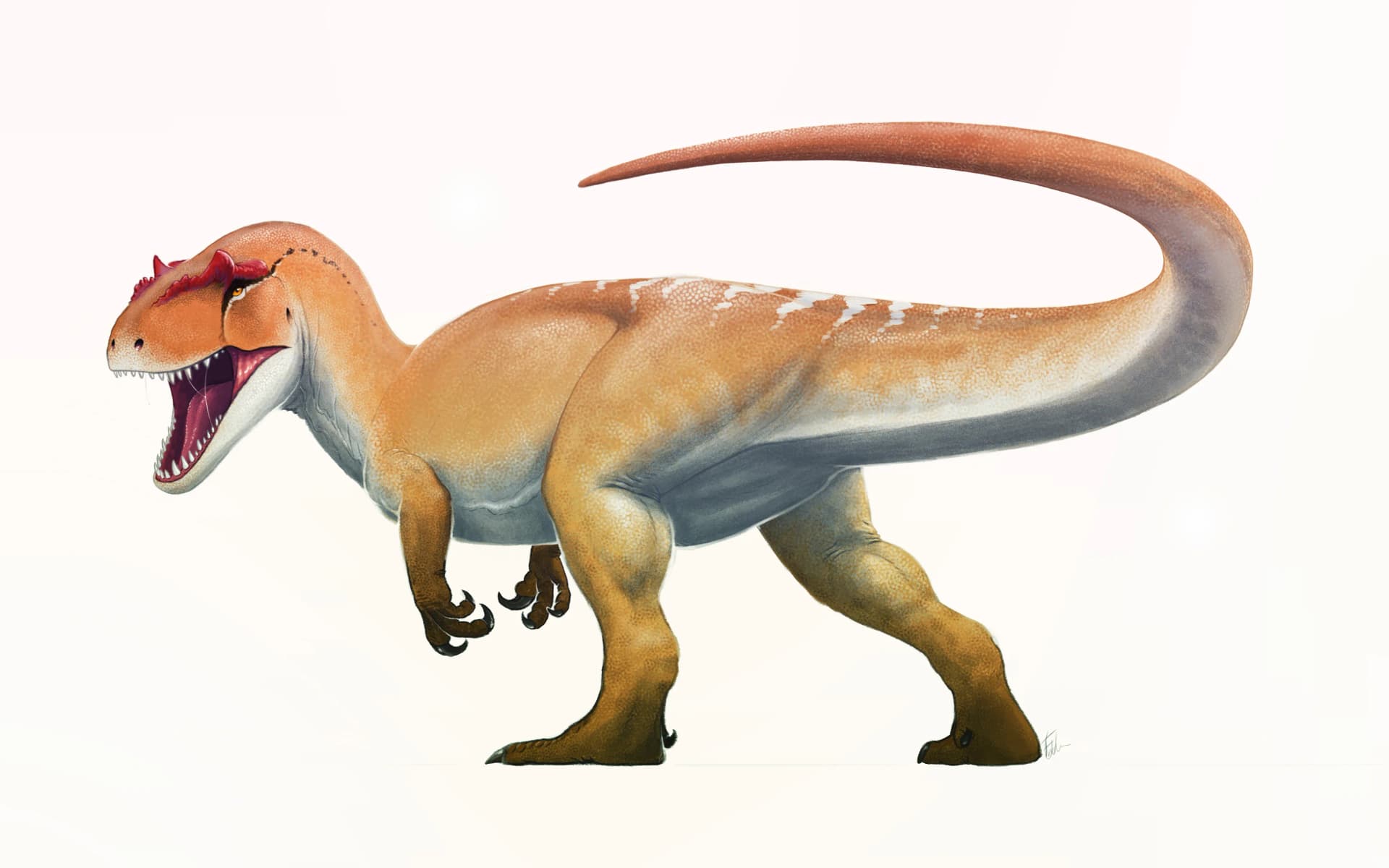
Monolophosaurus jiangi illustration
John Conway, CC BY-SA 3.0
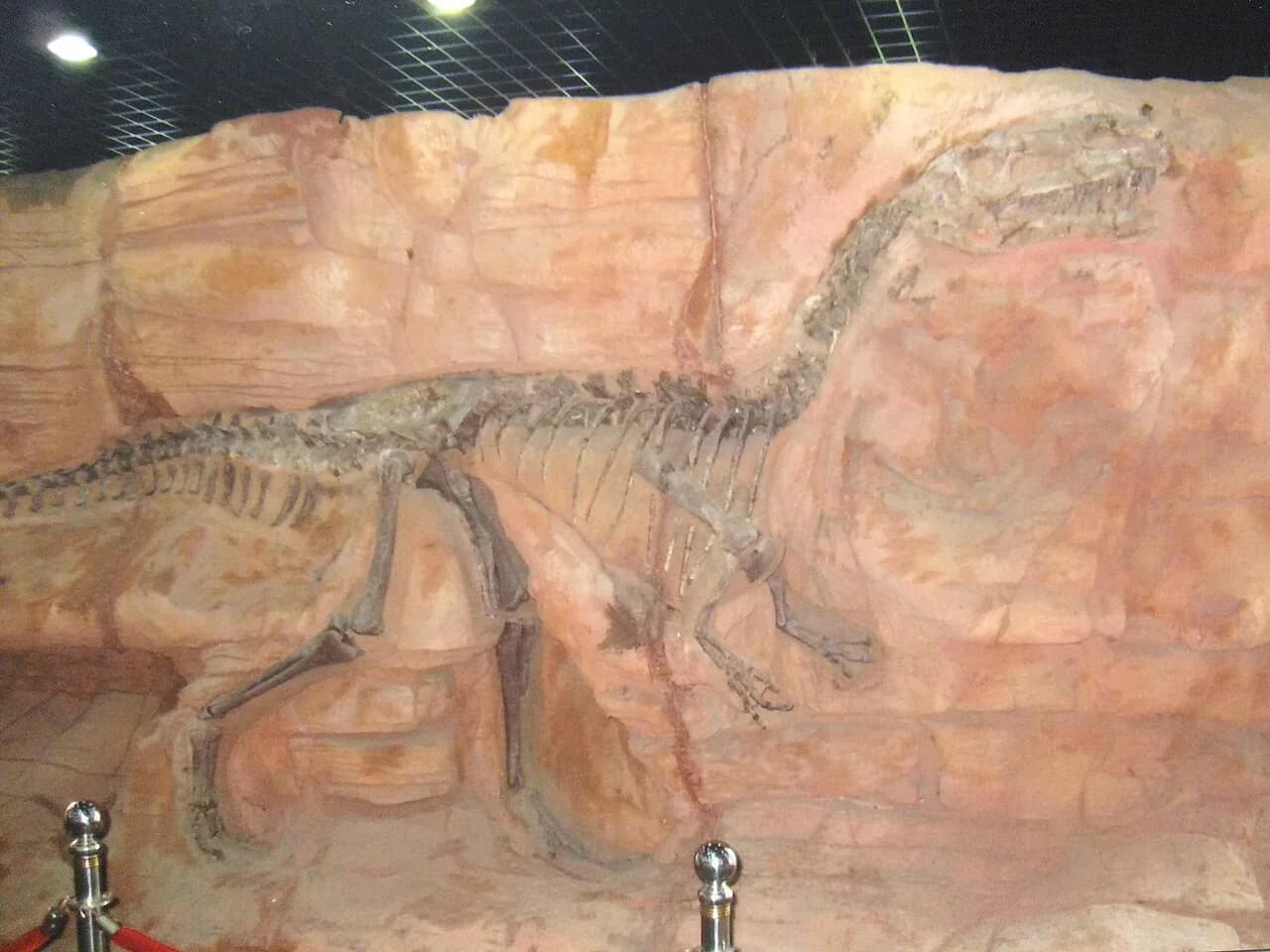
Monolophosaurus holotype skeleton
Wikimedia Commons