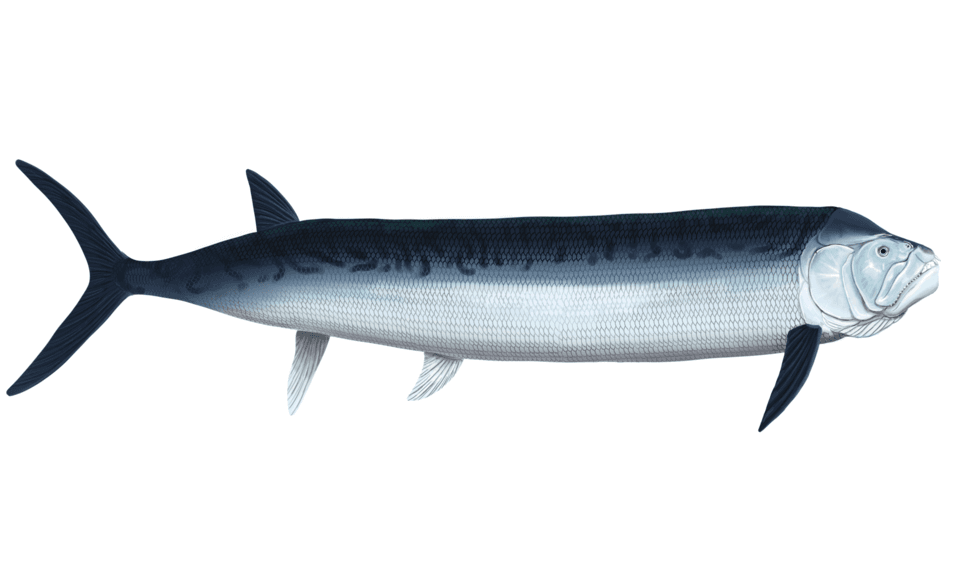
Xiphactinus
Xiphactinus audax was a predatory fish described in 1870, found in Kansas, Europe, Australia and Argentina between 112 and 66 million years ago. At 5 to 6 metres and 230 to 500 kilograms, it is known from the fish-within-a-fish fossil: a 4.2-metre specimen holding a 1.9-metre prey almost intact.
Xiphactinus lived during the Late Cretaceous, approximately 112 to 66 million years ago (late Albian to late Maastrichtian stages). This period corresponds to the peak of the Western Interior Seaway, a vast shallow epicontinental sea that divided North America into two distinct landmasses: Laramidia to the west and Appalachia to the east. Global climate was considerably warmer than today, with elevated ocean temperatures fostering exceptional marine biodiversity throughout the world's seas. Xiphactinus reigned supreme over these prey-rich waters, sharing its habitat with giant mosasaurs, plesiosaurs, and countless fish species that formed the backbone of a remarkably complex marine ecosystem. It perished during the Cretaceous-Paleogene mass extinction 66 million years ago.
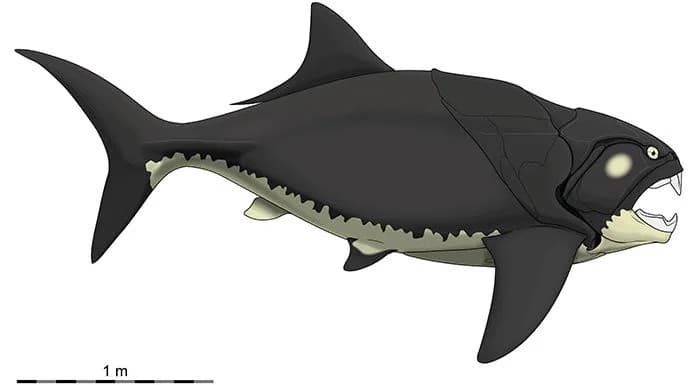
Xiphactinus ranked among the largest predatory bony fish of all time, rivaling the great white shark in length and arguably surpassing it in ferocity. Adults regularly reached 5 to 6 meters in length, with an estimated weight between 230 and 500 kilograms. Its body was elongated and streamlined, with a body depth of approximately 1.2 meters, giving it a massive and powerful silhouette perfectly suited for high-speed marine predation. Its deep, forked tail fin, attached to the body by a narrow peduncle, provided considerable swimming power and impressive acceleration capabilities. Its massive head represented a significant proportion of total body length, armed with powerful jaws bristling with fang-like teeth measuring several centimeters in length.
A voracious piscivorous predator, Xiphactinus occupied the very top of the bony fish food chain in the Late Cretaceous seas. At least twelve fossil specimens have been discovered with the remains of large undigested or partially digested prey in their stomachs, testifying to an insatiable appetite that knew few bounds. The most spectacular case is the world-famous 'fish-within-a-fish' specimen discovered by George F. Sternberg: a 4.2-meter Xiphactinus containing a nearly perfectly preserved 1.9-meter Gillicus arcuatus inside its stomach cavity. The prey, swallowed whole, apparently caused the predator's death by rupturing an internal organ while thrashing about. This gluttonous predation behavior closely mirrors that of modern tarpons and barracudas, which engulf their prey in a single explosive gulp.
Xiphactinus primarily inhabited the Western Interior Seaway, a warm, shallow epicontinental sea that stretched from the Gulf of Mexico to the Arctic Ocean, creating an exceptionally productive marine environment teeming with life at all trophic levels. These nutrient-rich waters harbored a diverse fauna including mosasaurs, plesiosaurs, sharks, sea turtles, and countless bony fish species forming the base of its diet. Juveniles preferred the shallow coastal margins, benefiting from protection against large predators and abundant food resources, while adults hunted in open waters far from shore. Fossils have also been found in Cretaceous formations in Europe, Australia, Venezuela, and Argentina, indicating a truly global distribution in the warm seas of the Late Cretaceous period.
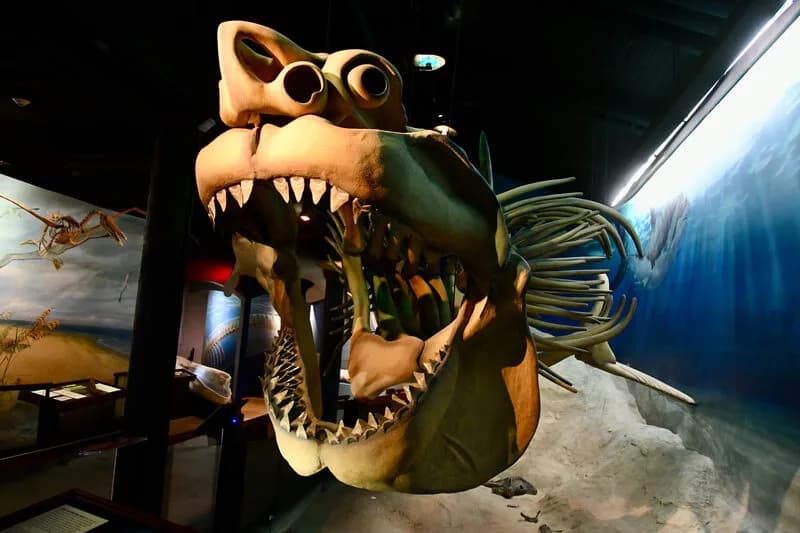
The anatomy of Xiphactinus was remarkably adapted for active predation in open waters of the Cretaceous seas. Its massive head, which earned it the nickname 'bulldog fish,' bore powerful jaws armed with fang-like teeth measuring several centimeters, ideal for seizing and holding slippery, struggling prey. Its pectoral fins were supported by solid, broad bony fin rays, giving it a distinctive winged appearance and excellent maneuverability during high-speed pursuits. Its spinal column contained over 100 vertebrae, providing remarkable flexibility for rapid directional changes while chasing prey through the water column. Its deep, forked caudal fin with a narrow peduncle generated powerful thrust perfectly suited for the explosive accelerations characteristic of marine ambush predators.
Xiphactinus was an active and aggressive hunter of the Cretaceous seas, likely combining ambush and short pursuit strategies to devastating effect on its prey. Geochemical studies published in 2020 suggest it was possibly endothermic (warm-blooded), which would make it one of the oldest known bony fish with this remarkable capability. This thermoregulation would have conferred a considerable advantage: a body temperature higher than the surrounding water, enabling superior bursts of speed and greater endurance than its ectothermic prey could hope to match. Its primary hunting strategy consisted of swallowing prey whole in a single powerful motion, as evidenced by the numerous fossils containing intact fish in the stomach cavity. However, this gluttony could prove fatal when overly large prey items caused lethal internal injuries during their final desperate struggles.
The first Xiphactinus fossils were discovered in the 1850s in the Niobrara Chalk of Kansas, and the type species X. audax was formally described by paleontologist Joseph Leidy in 1870. Kansas remains the most prolific site, particularly the Niobrara Chalk, Carlile Shale, and Greenhorn Limestone formations, which have yielded dozens of remarkably complete specimens. The most famous specimen in the world, the 'fish-within-a-fish,' was collected by George F. Sternberg in Gove County, Kansas, and is now displayed at the Sternberg Museum of Natural History in Hays. This spectacular fossil shows a 4.2-meter Xiphactinus with a nearly intact 1.9-meter Gillicus arcuatus in its stomach, providing an exceptional window into Cretaceous predator-prey interactions. Fossils have also been found in Georgia, Alabama, North Carolina, New Jersey, Alberta (Canada), Europe, Australia, Venezuela, and Argentina. Three species are currently recognized: X. audax, X. vetus, and X. australis.
| Period | Crétacé supérieur / Late Cretaceous |
| Era | Mésozoïque / Mesozoic |
| Age | 112-66 Ma |
| Location | Amérique du Nord (Kansas), Europe, Australie, Argentine / North America (Kansas), Europe, Australia, Argentina |
| Length | 5-6 m |
| Height | ~1.2 m |
| Weight | 230-500 kg |
| Discovery | 1870 |
No. Xiphactinus audax was a bony fish (class Actinopterygii, family Ichthyodectidae), not a dinosaur. This large marine predator of the Late Cretaceous measured 5 to 6 meters and weighed between 230 and 500 kilograms. It coexisted with dinosaurs 112 to 66 million years ago in the Western Interior Seaway, but belonged to the teleost bony fish group.
The specimen collected by George F. Sternberg in Gove County, Kansas, displayed at the Sternberg Museum of Natural History in Hays, shows a 4.2-meter Xiphactinus audax containing a nearly perfectly preserved 1.9-meter Gillicus arcuatus in its stomach. The prey, swallowed whole, apparently ruptured an internal organ while thrashing, causing the predator's death. At least twelve similar specimens are known.
A geochemical study published in 2020 suggested that Xiphactinus audax was possibly endothermic — capable of maintaining a body temperature above that of the surrounding water. If confirmed, Xiphactinus would be one of the oldest known endothermic bony fish. This thermoregulation would have given it speed bursts and endurance superior to those of its ectothermic prey.
Life reconstruction of Xiphactinus audax, the Cretaceous 'bulldog fish'
Wikimedia Commons
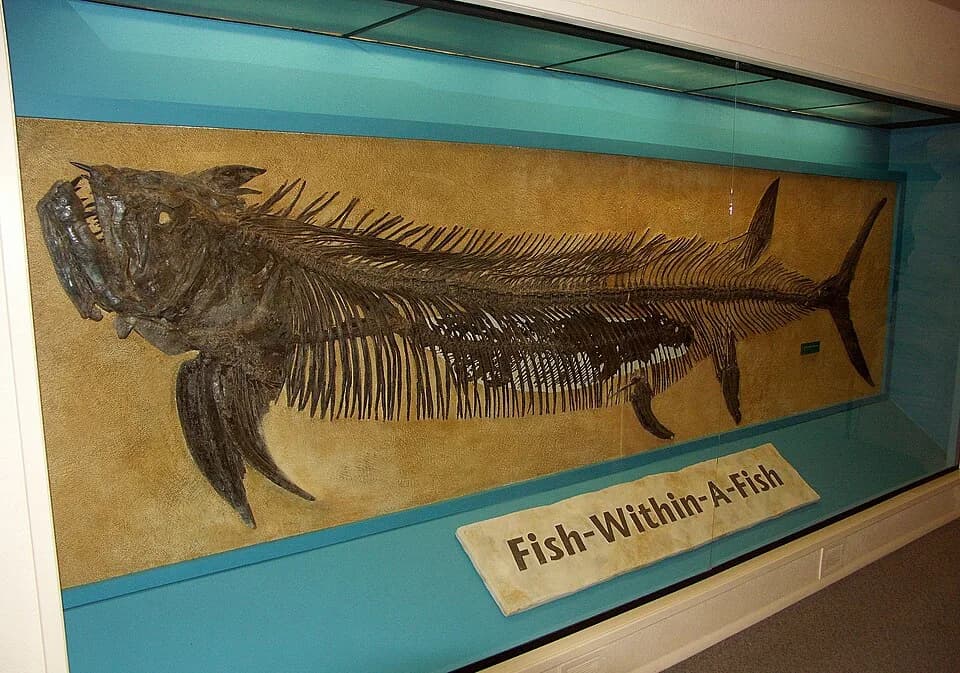
Complete fossil skeleton of Xiphactinus audax at the Sternberg Museum
Wikimedia Commons
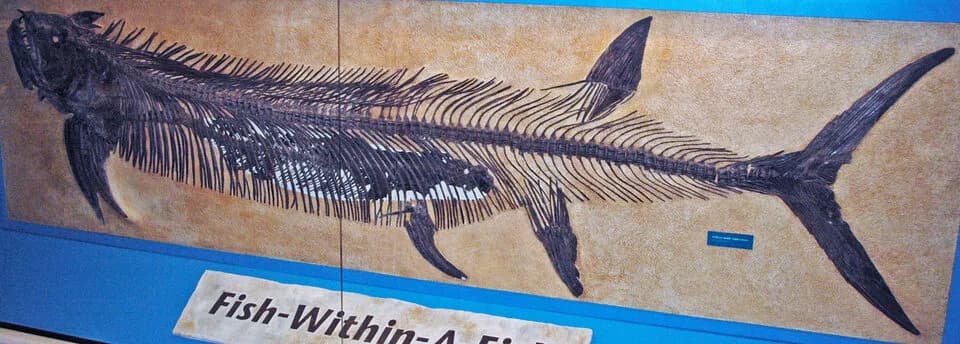
The famous 'fish-within-a-fish': Xiphactinus with a Gillicus in its stomach
James St. John / Wikimedia Commons