Wiwaxia
Wiwaxia corrugata remains unclassifiable after forty years of debate: mollusc, annelid or a lineage of its own, specialists do not settle it. This small animal, 2 to 5 centimetres long, carried rows of dorsal spines sturdy enough to deter Anomalocaris, the great Cambrian predator. It comes from the Burgess Shale and dates to 508 million years ago.
Wiwaxia lived during the Middle Cambrian, approximately 508 million years ago, in the same shallow seas as Hallucigenia and Opabinia. It is one of the most iconic creatures of the Cambrian Explosion and the Burgess Shale deposits of British Columbia. Wiwaxia belonged to a group of unclassifiable organisms that long baffled paleontologists: neither arthropod, nor mollusk, nor worm — a biological 'problematicum.' Recent studies place it either among primitive mollusks (related to chitons and scale worms) or in a stem group of lophotrochozoans. Its defensive scales and spines made it one of the best-armored creatures of the Cambrian seas.
Wiwaxia was a small, oval, and flattened organism measuring between 2 and 5 centimeters in length — roughly the size of a human thumb. Its soft body was covered in two types of defensive structures: rows of sclerites (flat, overlapping scales) covering the dorsal surface, and two rows of elongated spines standing vertically on its back, reaching up to 2 centimeters in length. Viewed from above, Wiwaxia resembled a small oval 'sea hedgehog' with its spines pointing upward. Its ventral surface was bare and soft, in direct contact with the marine substrate as it crawled along the seafloor.
Wiwaxia was probably a benthic grazer, feeding on microscopic algae, bacteria, and organic matter on the surface of the Cambrian seafloor. It possessed a radula — a rasping organ composed of rows of small teeth, characteristic of mollusks — which allowed it to scrape food from the substrate. The presence of this radula is one of the main arguments for its classification among primitive mollusks. Wiwaxia moved slowly across the seafloor, scraping microbial mats and algal biofilms much like modern chitons and gastropods do today in similar benthic habitats.
Wiwaxia lived on the shallow seafloors of the Cambrian seas, in the same environment as other famous organisms from the Burgess Shale. It crawled on the fine sediments at the base of the reef escarpment, protected by its armor of scales and spines from predators like Anomalocaris. The Cambrian benthic community it shared included Hallucigenia, Opabinia, Marrella, Pikaia, and hundreds of other species. Specimens of Wiwaxia have been found in fairly large numbers in the Burgess Shale, suggesting it was a common member of these seafloor communities during the Middle Cambrian period.
Wiwaxia's anatomy combined uniquely puzzling characteristics. Its oval, flattened body bore dorsal armor composed of sclerites — flat, overlapping, carbonated scales — arranged in longitudinal rows. Two rows of longer dorsal spines rose vertically, forming an effective defense against predators. The ventral surface was bare, with a simple muscular foot for locomotion similar to that of mollusks. Its mouth, located on the ventral side, possessed a radula with two rows of teeth, confirming a scraping feeding method. The absence of a shell, obvious eyes, and visible gills makes its classification difficult — it could be a primitive shell-less mollusk or a member of an extinct group close to annelid worms.
Wiwaxia was a slow benthic organism, crawling across the seafloor using its muscular ventral foot, much like a snail or chiton. Its armor of scales and spines constituted its primary defense against Cambrian predators. Fossils of Wiwaxia showing damage to their spines suggest interactions with predators — possibly failed attacks by Anomalocaris that were thwarted thanks to the defensive armor. Wiwaxia was probably continuously active, slowly grazing on microbial mats and encrusting algae on the marine substrate. Its small size combined with effective shielding made it a discreet but well-protected member of the Cambrian ecosystem.
Wiwaxia corrugata was first described in 1899 by George Frederick Matthew, based on isolated sclerites (scales) found in British Columbia. However, it was not until 1911 that Charles Walcott collected complete specimens from the Burgess Shale, and the detailed redescription was only published in 1985 by Simon Conway Morris. The genus name comes from Mount Wiwaxy in the Canadian Rockies, near the discovery site. Over 200 specimens are known from the Burgess Shale, and related species have been found in China (Chengjiang deposits) and Australia. The classification of Wiwaxia remains an active topic of debate in paleontology, with hypotheses oscillating between a position among mollusks, polychaete annelids, or a lophotrochozoan stem group.
| Period | Cambrien moyen / Middle Cambrian |
| Era | Paléozoïque / Paleozoic |
| Age | 508 Ma |
| Location | Schistes de Burgess, Colombie-Britannique / Burgess Shale, British Columbia |
| Length | 2-5 cm |
| Weight | < 1 g |
| Diet | Herbivore |
| Discovery | 1899 |
The classification of Wiwaxia corrugata remains an active debate. Its two-row radula, characteristic of mollusks, supports kinship with chitons and scale worms. Other studies suggest a link with polychaete annelids, or even a lophotrochozoan stem group. Known from the Burgess Shale (508 Ma, British Columbia) and Chengjiang deposits (China), it remains a biological 'problematicum' after 40 years of research.
Wiwaxia corrugata measured between 2 and 5 centimeters in length — roughly the size of a human thumb. Its oval, flattened body was covered with sclerites (flat, overlapping, carbonated scales) on the dorsal surface, with two rows of elongated spines reaching up to 2 centimeters. Fossils showing damage to these spines testify to predator attacks by creatures like Anomalocaris deflected by this armor.
Isolated sclerites of Wiwaxia corrugata were first described in 1899 by George Frederick Matthew in British Columbia. Charles Walcott collected the first complete specimens from the Burgess Shale in 1911, but the detailed scientific redescription was not published until 1985 by Simon Conway Morris. Over 200 specimens are known from the Burgess Shale. The name comes from Mount Wiwaxy in the Canadian Rockies.
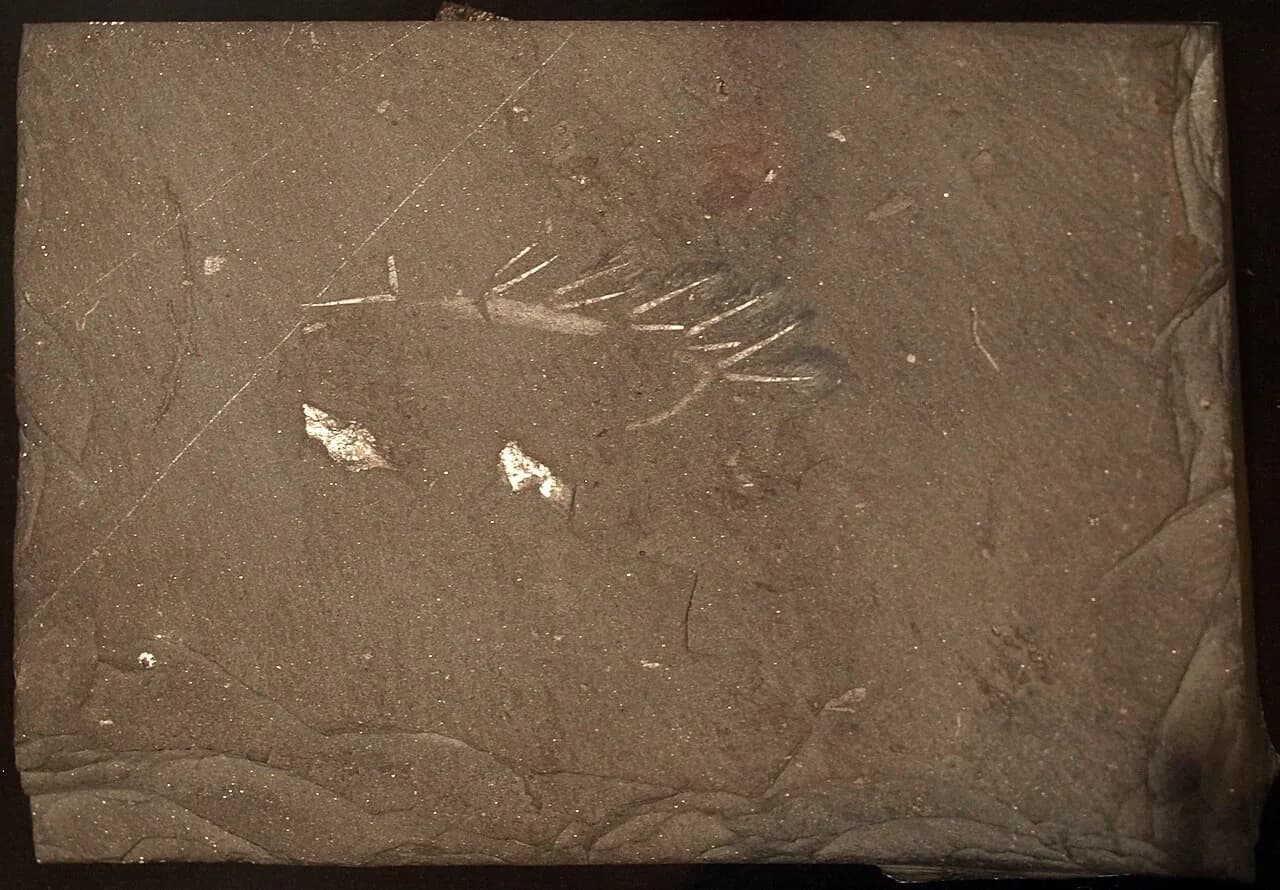
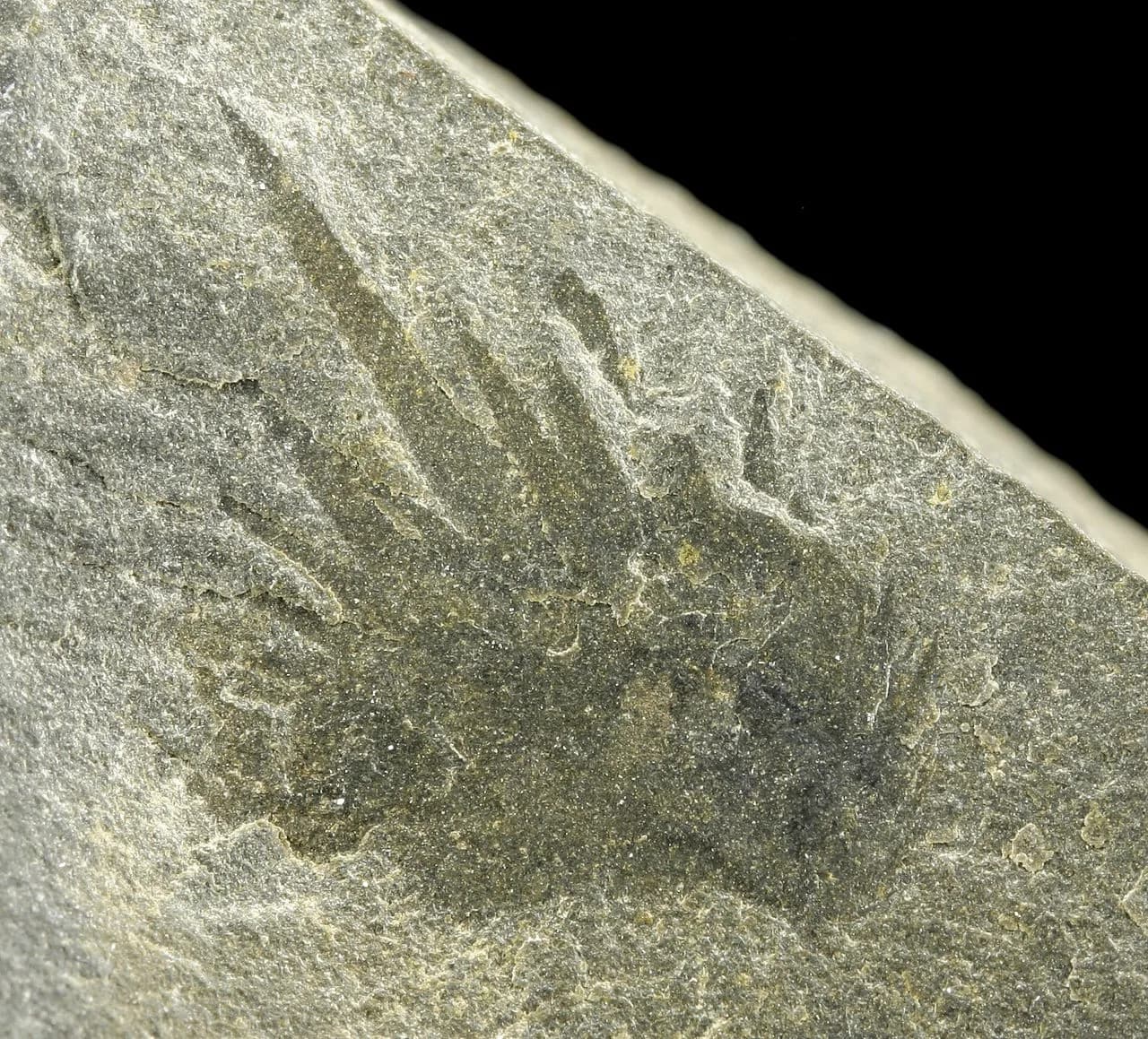
Wiwaxia corrugata fossil from the Burgess Shale, showing scales and spines
Wikipedia Commons
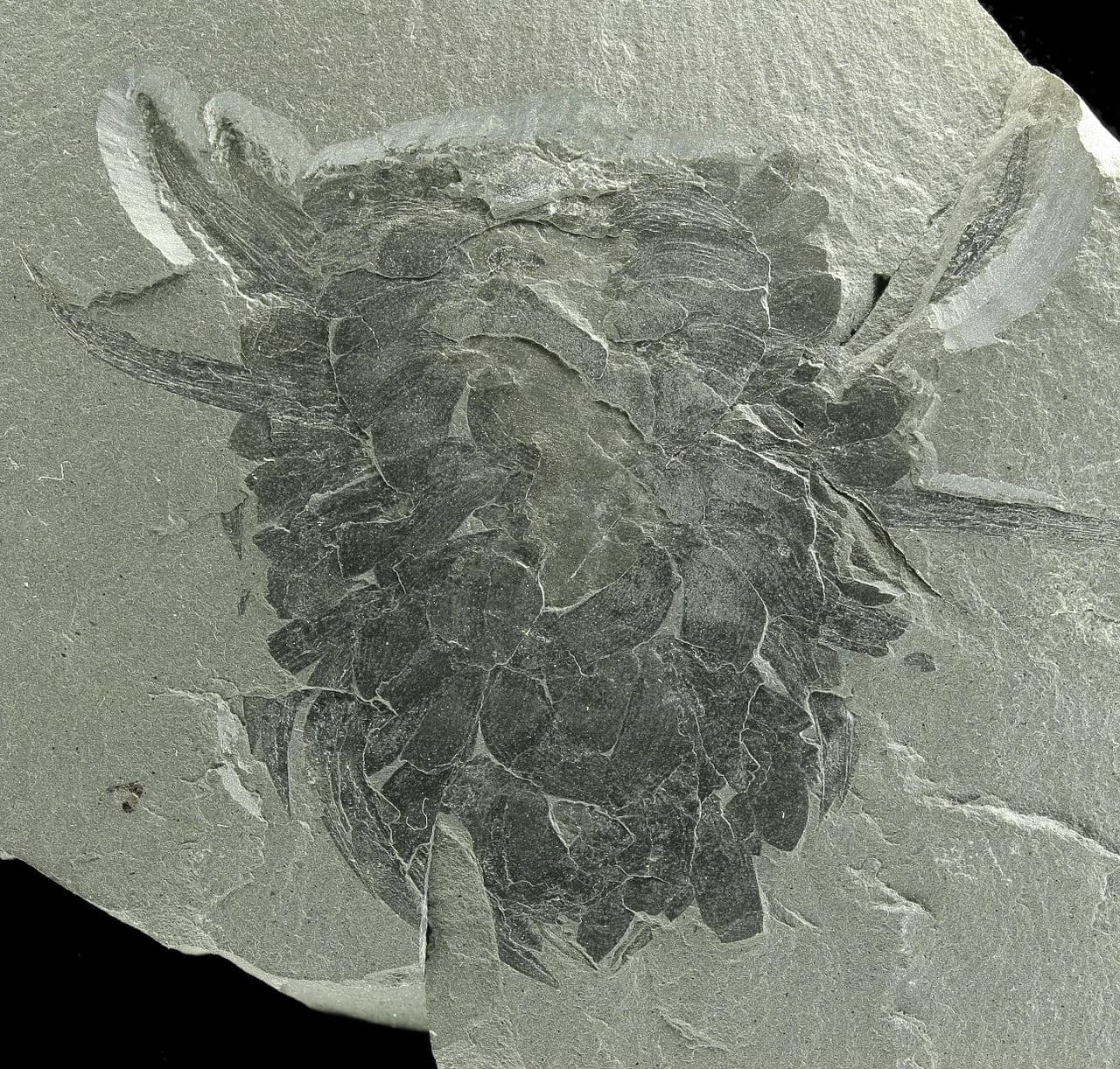
Wiwaxia corrugata reconstruction with its armor of scales and spines
Wikipedia Commons