Trilobite
Trilobites form the most diverse group of fossil arthropods ever recorded: over twenty thousand described species, from 1 centimetre to 72. Their eyes were built from crystals of pure calcite, mineral lenses with no equivalent in the animal kingdom. They lasted 270 million years, from 521 to 252, before vanishing at the Permian-Triassic extinction.
Trilobites first appeared in the Early Cambrian, approximately 521 million years ago, and survived until the great Permian-Triassic extinction 252 million years ago. This extraordinary longevity of nearly 270 million years makes them one of the most persistent animal groups in the history of life. They survived several mass extinctions, notably the Ordovician-Silurian event which decimated many families. Their peak diversity occurred during the Ordovician, with over 4,000 described species. They vanished entirely during the Permian extinction, the most devastating of all time.
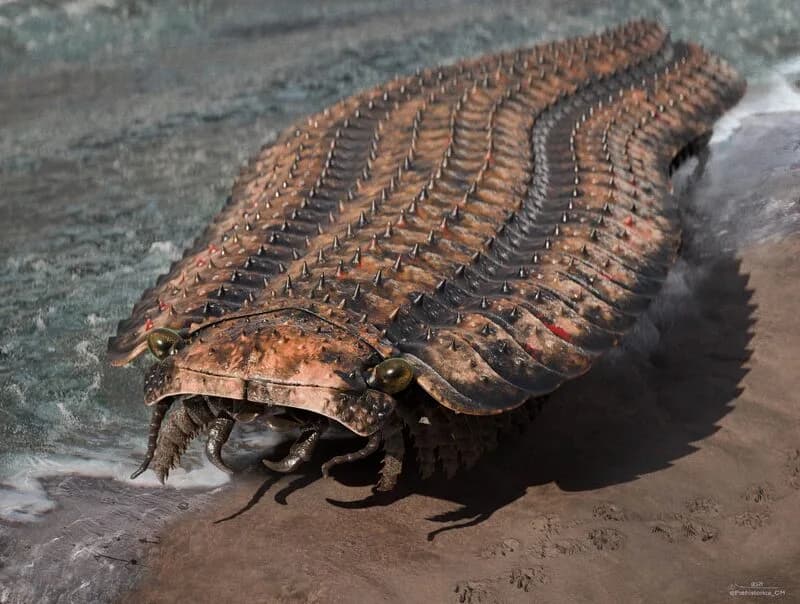
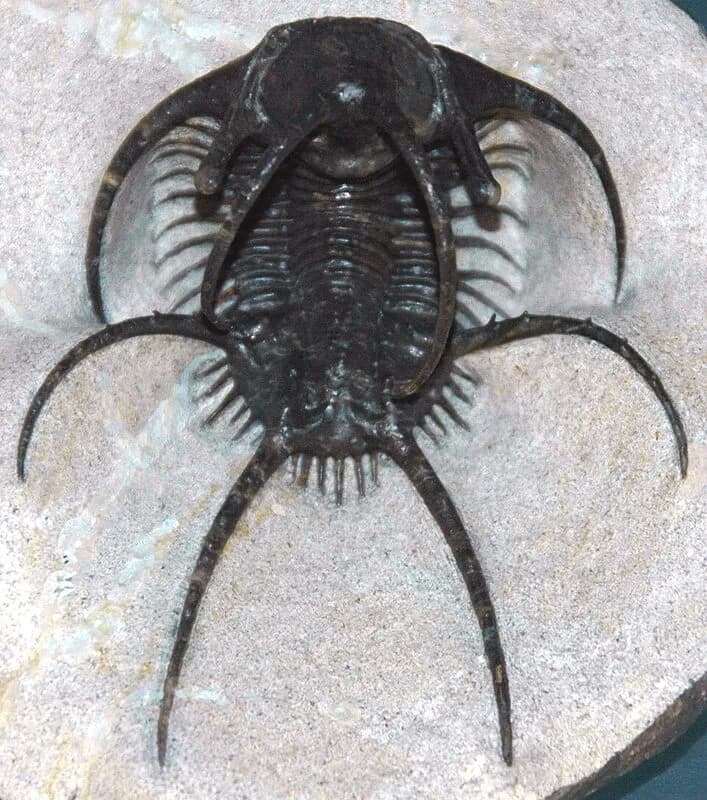
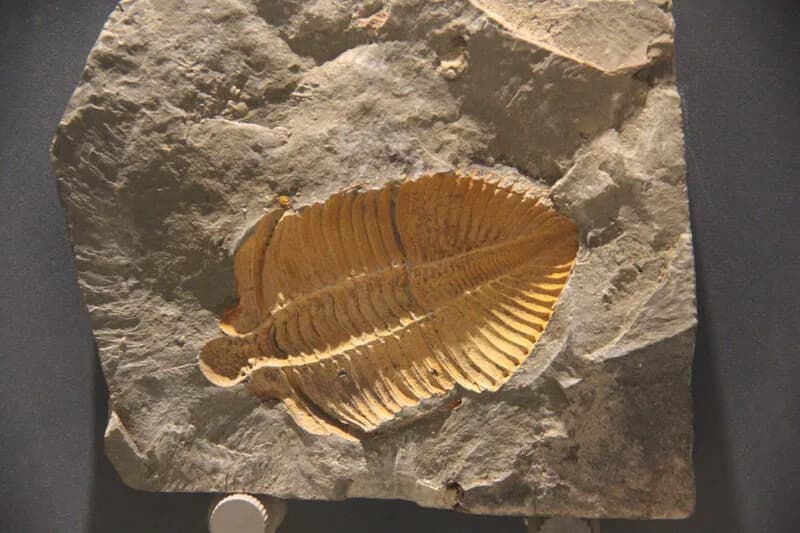
Trilobites exhibited a remarkable diversity of sizes, ranging from the tiny Acanthopleurella to the giant Isotelus rex. The smallest species measured barely one centimeter, while the largest reached 72 centimeters. The majority measured between 3 and 10 centimeters. Isotelus rex, discovered in the Ordovician of Manitoba (Canada), holds the record at 72 cm. The body was divided into three longitudinal lobes — hence the name 'trilobite' — and into three regions: the cephalon (head), the segmented thorax, and the pygidium (tail).
Trilobites occupied a wide variety of feeding niches depending on species and time period. Most were benthic detritivores, carefully sifting through marine sediments for decomposing organic matter on the ocean floor. Some species were specialized filter feeders, while others were active predators of small invertebrates including worms and other soft-bodied organisms. Pelagic trilobites filtered suspended plankton from the water column. Analysis of their mouthparts and trace fossils (Cruziana, Rusophycus) reveals highly diversified feeding adaptations across different lineages. A few species possessed modified appendages specifically designed for crushing shells, suggesting a specialized durophagous diet targeting hard-shelled prey items.
Trilobites inhabited exclusively marine environments, ranging from shallow coastal waters to abyssal depths far below the photic zone. They colonized every ocean of the Paleozoic era, achieving a truly worldwide distribution that spanned all continental shelves. Some species lived burrowed in soft sediments, others swam freely in open water or crawled methodically across reef structures. Ordovician and Silurian reef environments harbored exceptional trilobite diversity with dozens of coexisting species. Their remarkable geographic ubiquity and rapid evolutionary rates make them excellent stratigraphic index fossils, widely used by geologists to date and correlate Paleozoic sedimentary layers across the globe.
The trilobite body was covered by a chitinous exoskeleton mineralized with calcium carbonate, which explains their excellent fossilization potential throughout the geological record. The cephalon bore a pair of sensory antennae and remarkable compound eyes — among the first complex visual organs to appear in the animal kingdom. Holochroal eyes possessed crystalline calcite lenses, a unique optical material found nowhere else in the animal kingdom either past or present. The articulated thorax allowed many species to roll into a defensive ball (enrollment) to protect their soft and vulnerable ventral parts from predators. Each thoracic segment bore a pair of biramous limbs used for both locomotion and respiration.
Many trilobite species could roll into a tight defensive ball, a protective behavior called enrollment, comparable to that observed in modern woodlice and pill bugs. Remarkably preserved fossils show groups of trilobites enrolled together in clusters, strongly suggesting gregarious behavior when facing danger from predators. Some species migrated in precisely aligned rows along the seafloor, as evidenced by exceptional fossil trackways of Ampyx preserving chains of individuals connected by their long spines. Trilobites molted regularly throughout their growth cycle, periodically shedding their exoskeleton when it became too small. Most trilobite fossils are actually exuviae (shed molts) rather than dead individuals, highlighting the remarkable frequency of this important biological process.
Trilobites were among the first fossils scientifically described, by Johann Ernst Immanuel Walch in 1771, during the very early days of paleontology as a scientific discipline. Over 20,000 species have been formally described to date, classified across approximately 10 orders and more than 150 families, making them one of the most diverse arthropod groups ever documented. Their mineralized exoskeleton fossilizes exceptionally well in marine sediments, making them the most abundant and best-known fossil arthropods in the entire geological record. Exceptional deposits such as the Burgess Shale in Canada, Chengjiang in China, and the Dudley limestones in England have yielded extraordinarily well-preserved specimens. Trilobites remain the most collected and traded fossils in the world among both amateur and professional collectors.
| Period | Cambrien à Permien / Cambrian to Permian |
| Era | Paléozoïque / Paleozoic |
| Age | 521-252 Ma |
| Location | Mondiale / Worldwide |
| Length | 1 cm - 72 cm |
| Height | variable |
| Weight | variable |
| Diet | Filtreur |
| Discovery | 1771 |
Over 20,000 trilobite species (class Trilobita) have been described to date, distributed across approximately 10 orders and more than 150 families. These marine arthropods populated the oceans from the Cambrian to the Permian, a span of approximately 270 million years — from the early Cambrian (521 Ma) to the great Permian-Triassic extinction (252 Ma). Their peak diversity occurred during the Ordovician.
Trilobites possessed holochroal compound eyes with lenses made of pure crystalline calcite, unique in the entire animal kingdom — neither before nor after trilobites has any animal used such mineral lenses. These eyes are among the first complex visual organs to appear in animals. Some species like Dalmanitina had up to 15,000 lenses per eye.
Isotelus rex, discovered in the Ordovician of Manitoba (Canada), holds the size record at 72 centimeters in length. The majority of trilobite species measured between 3 and 10 centimeters, and the smallest species like Acanthopleurella reached only one centimeter. This size diversity reflects the incredible adaptive variety of these Paleozoic arthropods.
Elrathia kingii trilobite fossil from the Middle Cambrian
Wikimedia Commons
Enrolled trilobite fossil in defensive position
Wikimedia Commons