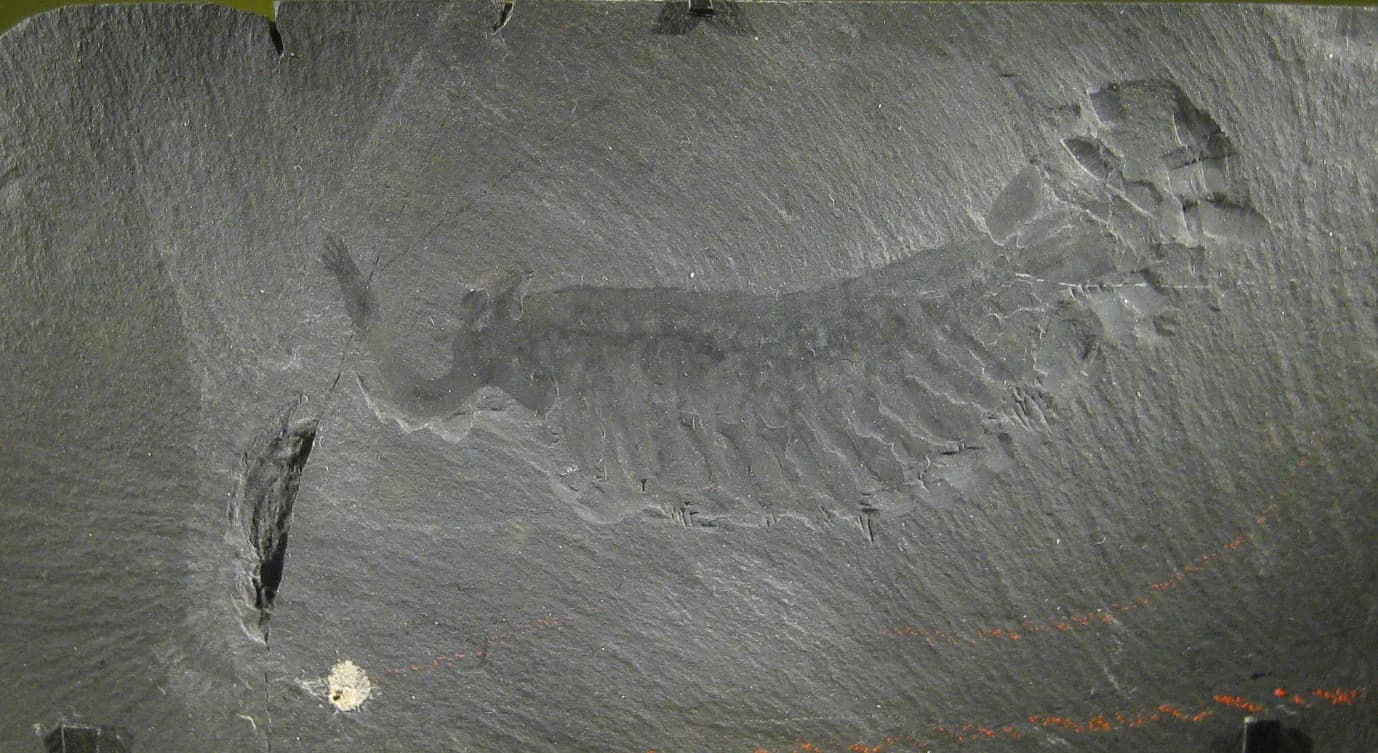
Opabinia
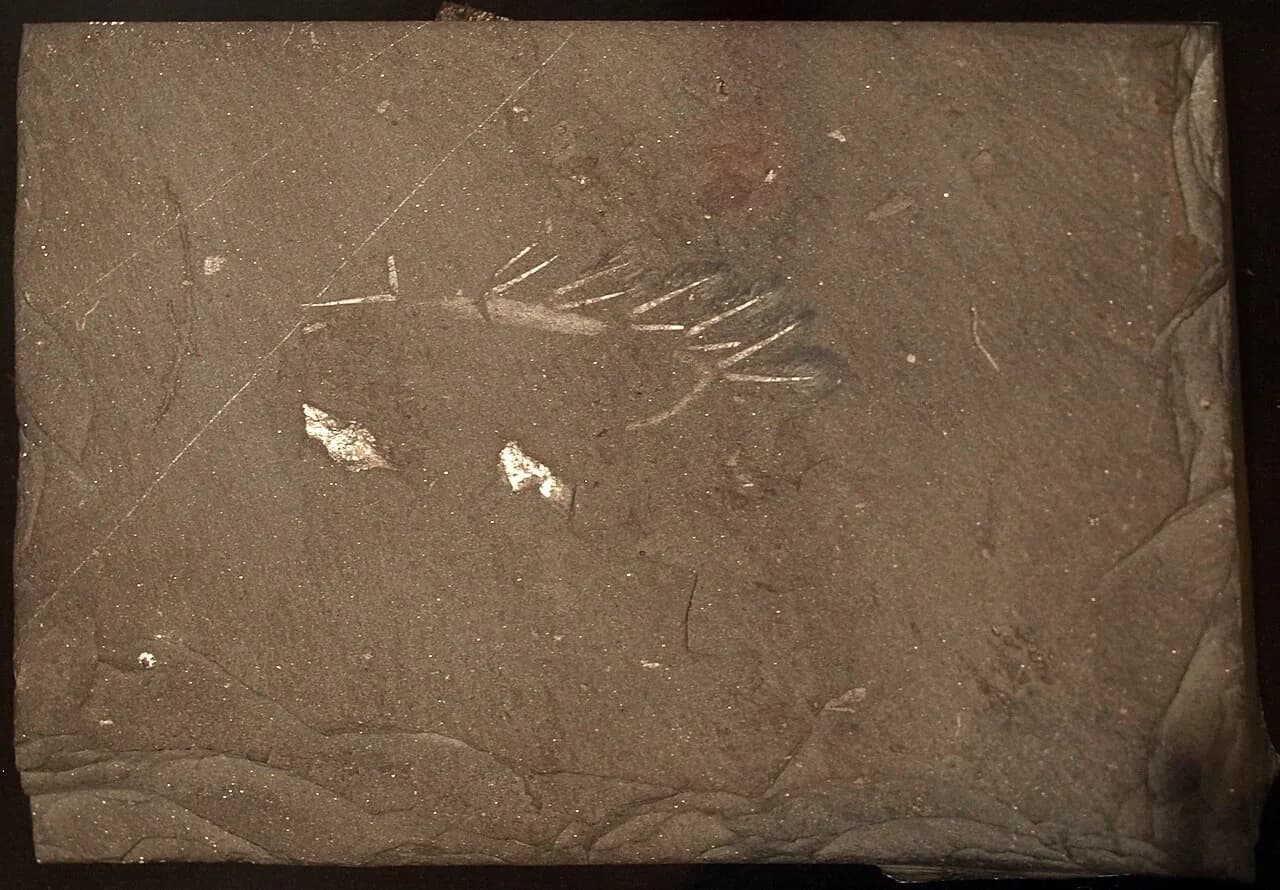
Opabinia regalis carried five stalked eyes on its head and a frontal proboscis tipped with a claw. When Harry Whittington presented the reconstruction in 1972, the room burst out laughing, so improbable did the animal look. Four to 7 centimetres long, it comes from the Burgess Shale in British Columbia and dates to 505 million years ago.
Opabinia lived during the Middle Cambrian, approximately 505 million years ago, in the warm, shallow seas that covered Laurentia (the ancient North American continent). Like Hallucigenia, it belongs to the extraordinary fauna of the Burgess Shale in British Columbia. The Cambrian Explosion was then in full swing, and the oceans teemed with experimental life forms, many of which have no modern equivalent. Opabinia became famous in paleontological history for causing an outburst of laughter at its presentation at a scientific congress in 1972 — so implausible was its appearance. It belongs to the radiodont group or their stem group, primitive arthropods close to Anomalocaris, the first great predators in the history of life.
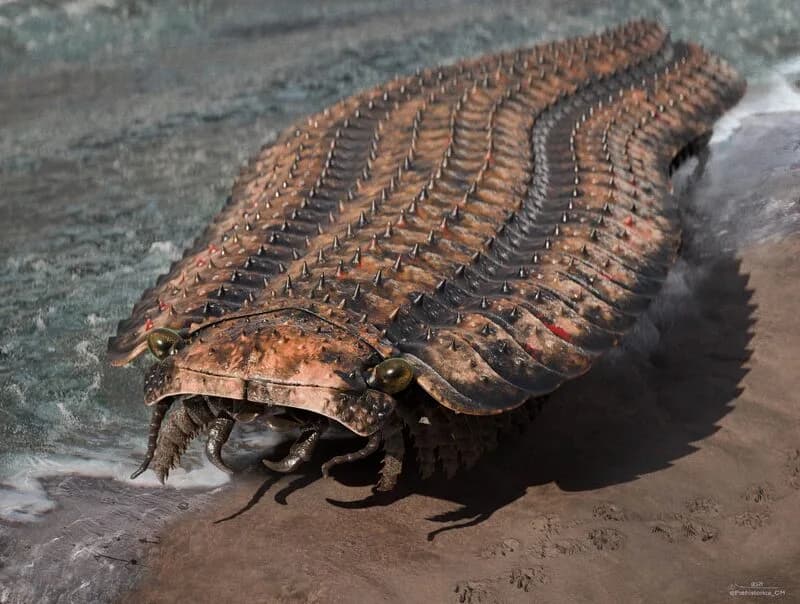
Opabinia measured about 4 to 7 centimeters in length, making it a modest-sized animal in Cambrian seas. Its segmented, laterally flattened body bore 15 pairs of lateral swimming lobes that allowed it to propel itself through the water. The most remarkable element of its anatomy was its flexible frontal proboscis, ending in a two-jawed claw, which extended forward about one-third of the total body length. Its fan-shaped tail, composed of three pairs of blades, resembles that of a shrimp. But it is obviously its five stalked eyes, arranged on top of the head, that earned it its celebrity.
Opabinia was probably an active predator or scavenger on the Cambrian seafloor. Its articulated proboscis, equipped with a terminal claw, was perfectly adapted for probing sediments and extracting small soft-bodied invertebrates from their burrows. The proboscis could curve backward to bring food to the mouth, located under the head (not at the tip of the proboscis). This unique feeding mechanism has no exact parallel in the modern animal world. Opabinia probably fed on small worms, larvae, and other soft-bodied benthic organisms, methodically probing the marine substrate with its prehensile proboscis.
Opabinia inhabited the shallow seafloors of tropical Cambrian seas, in the same environment as other Burgess Shale organisms. This setting corresponded to the foot of an underwater reef escarpment, in relatively deep waters (about 100 meters or more) but still within the photic zone. The bottom consisted of fine clay-silt sediments, regularly disturbed by underwater mud flows that buried and preserved benthic communities. Opabinia shared its habitat with a diverse fauna including Hallucigenia, Wiwaxia, Marrella, Pikaia, and the fearsome Anomalocaris, the apex super-predator of Cambrian seas.
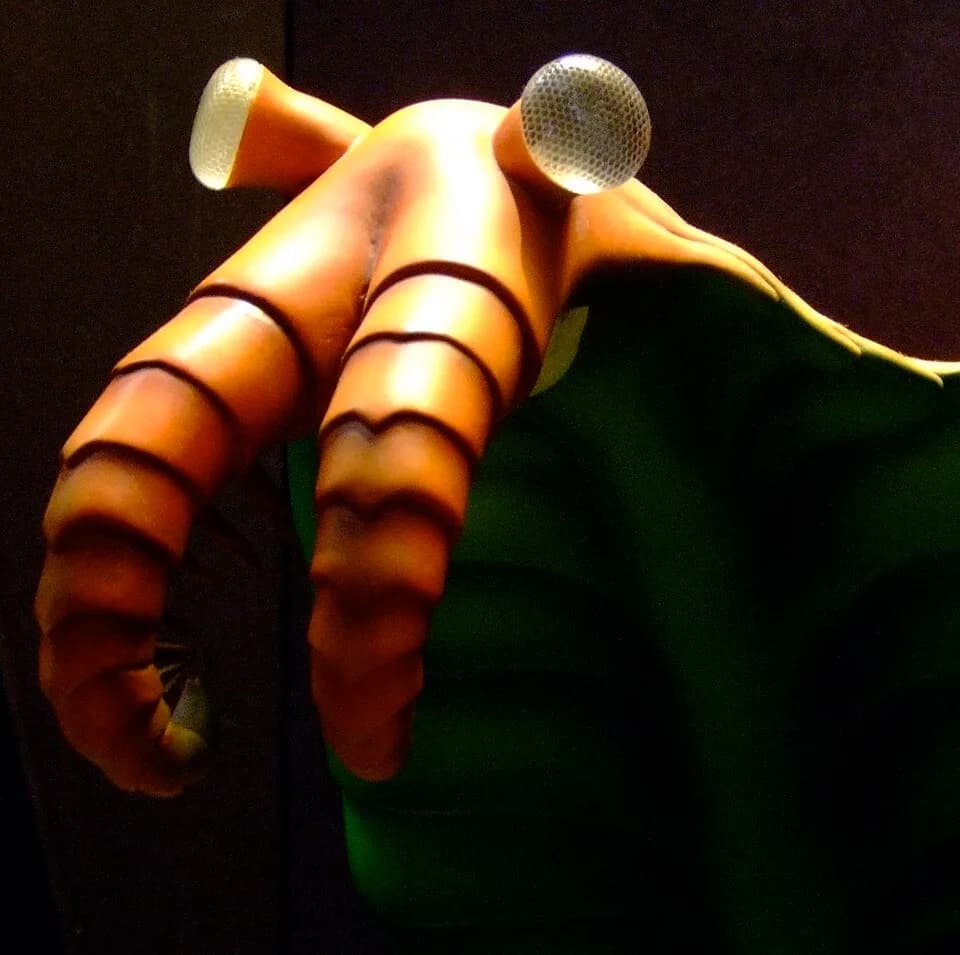
Opabinia's anatomy is one of the strangest ever observed in the animal kingdom. Its five stalked compound eyes, arranged in two lateral pairs and one median eye, constituted a visual system without known equivalent. The flexible frontal proboscis, ending in a bifid claw, was probably a modified prehensile appendage — homologous to the 'great appendages' of Anomalocaris and other radiodonts. The segmented body bore 15 pairs of lateral swimming lobes, each topped with gill-like lamellar structures. The mouth, curiously, opened backward under the head, which forced Opabinia to curve its proboscis to introduce food. The fan-shaped tail with three pairs of blades provided propulsion and directional control.
Opabinia was likely an active swimmer that moved above the seafloor through undulations of its 15 pairs of swimming lobes, similar to a modern cuttlefish. Its five eyes gave it an extensive field of vision, probably useful for detecting predators and locating prey in turbid Cambrian waters. Its prehensile proboscis probed the sediment to extract small organisms, which it then brought back to its ventral mouth. Opabinia could probably also swim in open water for short distances using its fan tail, which served as a rudder and supplementary propulsor. Against predators like Anomalocaris, its main defense was probably rapid flight.
Opabinia regalis was first described by Charles Doolittle Walcott in 1912, from specimens collected in the Burgess Shale of British Columbia. The genus name comes from Opabin Pass in the Canadian Rockies, near the discovery site. The species remained relatively obscure until Harry Whittington published a detailed redescription in 1975, revealing its extraordinary morphology with five eyes and a proboscis. During the presentation of these results at a paleontology congress in 1972, the audience burst out laughing upon seeing the reconstruction — so implausible did the animal seem. Only about twenty specimens are known, all from the Burgess Shale. Stephen Jay Gould popularized Opabinia in his book 'Wonderful Life' (1989), making it a symbol of Cambrian diversity.
| Period | Cambrien moyen / Middle Cambrian |
| Era | Paléozoïque / Paleozoic |
| Age | 505 Ma |
| Location | Schistes de Burgess, Colombie-Britannique, Canada / Burgess Shale, British Columbia, Canada |
| Length | 4-7 cm |
| Weight | < 5 g |
| Diet | Détritivore / Predator |
| Discovery | 1912 |
Yes, Opabinia regalis truly possessed five stalked compound eyes — arranged in two lateral pairs and one median eye — a configuration without equivalent in the known animal world. During Harry Whittington's presentation of results in 1972, the entire audience burst out laughing at the reconstruction. This Cambrian radiodont of 4 to 7 centimeters lived 505 million years ago in the Burgess Shale seas (British Columbia). Described by Walcott in 1912.
Opabinia regalis's frontal proboscis — flexible, ending in a bifid claw — probed Cambrian sediments to extract small soft-bodied invertebrates. Remarkable detail: the mouth opened backward under the head, which forced the proboscis to curve into a U-shape to deliver food. This unique feeding mechanism has no equivalent in modern fauna. Its 15 pairs of swimming lobes propelled the body above the seafloor.
Opabinia regalis belongs to the radiodonts or their stem group — primitive arthropods close to Anomalocaris, the first great predators in the history of life. Stephen Jay Gould popularized Opabinia in 'Wonderful Life' (1989) as a symbol of the evolutionary experiments of the Cambrian Explosion — life forms without modern descendants. Only about twenty specimens are known, all from the Burgess Shale. Its proboscis is homologous to the 'great appendages' of Anomalocaris.
Opabinia regalis model on display at the Smithsonian, showing its five eyes and proboscis
Wikipedia Commons
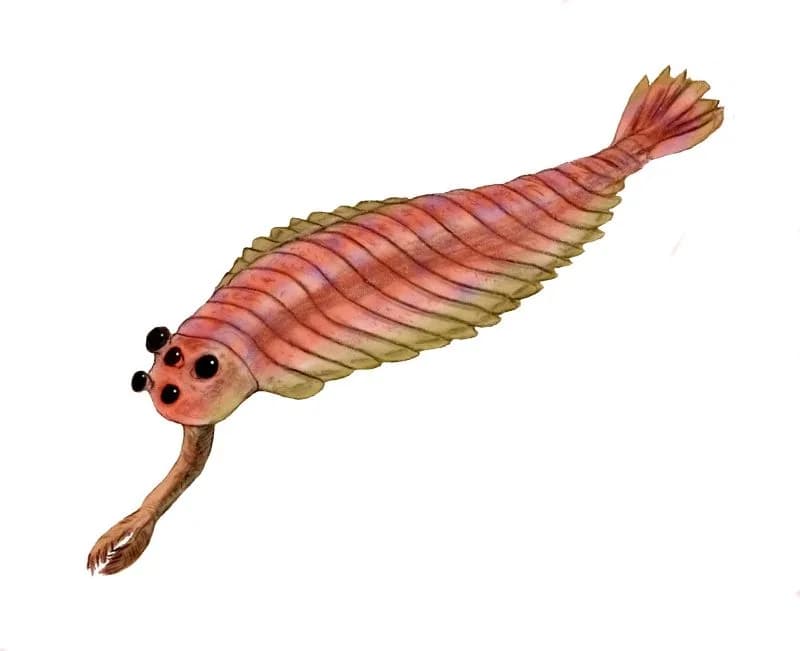
Artistic reconstruction of Opabinia regalis with its swimming lobes
Nobu Tamura, CC BY-SA 3.0