Dinosaure licorne
Tsintaosaurus spinorhinus was a herbivorous hadrosaur from China, described in 1958 from fossils in Shandong and dated to 72 to 66 million years ago. At 8 to 10 metres and 2.5 to 3 tonnes, it was nicknamed the unicorn dinosaur for its forward-pointing crest. A 2013 revision showed the crest was hollow and worked as a resonance chamber.
Tsintaosaurus lived during the Late Cretaceous, approximately 72 to 66 million years ago, during the Campanian and Maastrichtian stages. It inhabited what is now eastern China, in Shandong Province, a region then characterized by extensive fertile coastal plains. This period corresponds to the end of the age of dinosaurs, shortly before the Cretaceous-Paleogene mass extinction. The climate of eastern Asia was warm and humid, with seasonal monsoons favoring lush vegetation of conifers, ferns, and angiosperms that formed the dietary base of this hadrosaur.
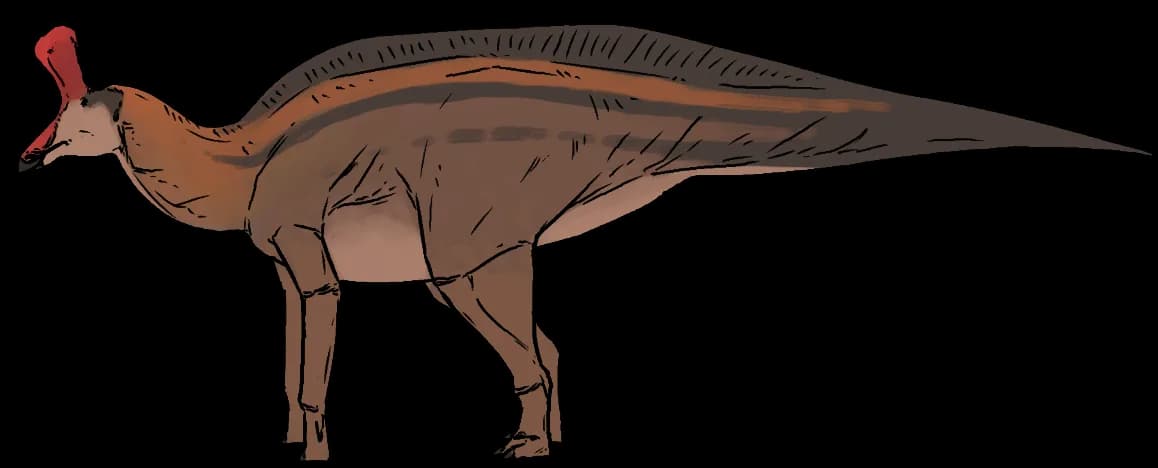
Tsintaosaurus was a respectably sized hadrosaur, measuring approximately 8 to 10 meters in length, 3.5 meters in height, and weighing an estimated 2.5 to 3 tonnes. Its build was comparable to a modern Asian elephant in overall mass and stature. Its most distinctive feature was its forward-pointing cranial crest, long interpreted as a unique bony spike resembling a unicorn horn. Recent studies have significantly revised this interpretation, suggesting a broader, hollow crest similar to those of other lambeosaurines, likely capable of producing resonating sounds for long-distance communication within herds.
A strict herbivore, Tsintaosaurus fed on low to mid-level vegetation: ferns, conifers, angiosperms, and aquatic plants from the wetlands it frequented along the coastal plains of Shandong. Like all hadrosaurs, it possessed sophisticated dental batteries composed of hundreds of teeth arranged in columns and continuously replaced, forming an extremely efficient grinding surface. Its broad, flattened beak allowed it to cut plant stems with precision, while the dental batteries ground even the toughest plants into digestible pulp. This continuous tooth replacement system ensured optimal chewing efficiency throughout the animal's entire lifespan.
Tsintaosaurus inhabited the coastal plains and wetlands of eastern China, in what is now Shandong Province, near the city of Qingdao (formerly Tsingtao). The Late Cretaceous Chinese environment was a mosaic of warm temperate forests, meandering rivers, and marshlands rich in diverse vegetation. The Wangshi Formation, where the fossils were discovered, represents an ancient fluvio-lacustrine environment ideally suited for hadrosaur life with abundant food resources. Seasonal monsoon rainfall sustained a dense hydrographic network that supported diverse herbivorous dinosaur communities alongside numerous predatory theropods, including tyrannosaurs that likely preyed upon Tsintaosaurus.
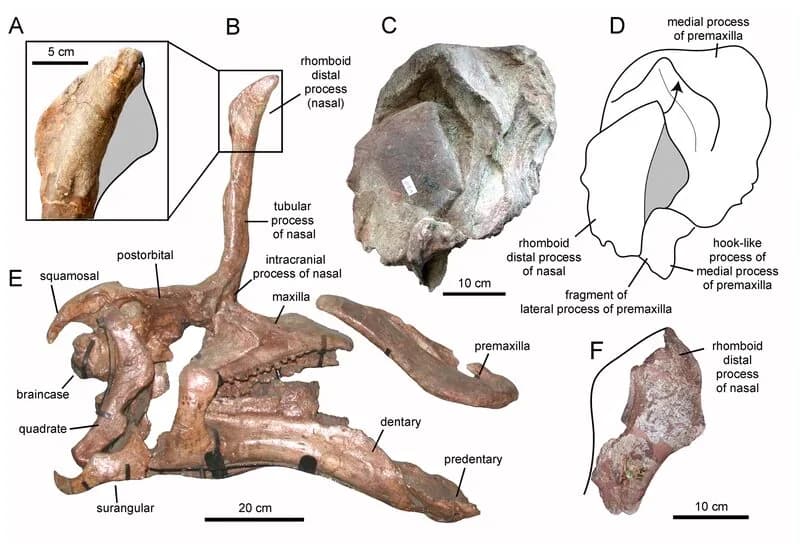
The anatomy of Tsintaosaurus is dominated by its unique cranial crest. Originally described as a bony spine pointing forward from the top of the skull — earning it the nickname 'unicorn dinosaur' — this structure was reassessed in 2013 by Albert Prieto-Márquez and Jonathan Wagner. Their study revealed the crest was actually broader and hollow, formed by the nasal and premaxillary bones, similar to the crests of other lambeosaurines like Parasaurolophus. This crest likely served as a resonating chamber to amplify vocalizations.
Tsintaosaurus likely lived in herds of varying sizes, like most known hadrosaurs, providing safety in numbers against large predators. Its hollow crest presumably served as a resonating chamber, enabling the production of deep, powerful sounds to communicate with herd members over long distances across the coastal plains. These vocalizations played a role in social cohesion, predator alarm, and courtship displays during the breeding season. As a facultative biped, it could alternate between quadrupedal walking for grazing and bipedal running to flee predators such as Asian tyrannosaurs that shared its Late Cretaceous habitat.
Tsintaosaurus spinorhinus was described in 1958 by the renowned Chinese paleontologist C.C. Young (Yang Zhongjian) from fossils discovered in the Wangshi Formation near Qingdao (Tsingtao), Shandong Province, China. The generic name references the city of Tsingtao and the specific epithet means 'spiny nose.' The holotype specimen included a partial skull with the famous crest. Additional discoveries in the same formation, including postcranial material from multiple individuals, have helped better understand this hadrosaur, leading to the major 2013 revision of its crest morphology by Prieto-Márquez and Wagner.
| Period | Crétacé supérieur / Late Cretaceous |
| Era | Mésozoïque / Mesozoic |
| Age | 72-66 Ma |
| Location | Chine (Shandong) / China (Shandong) |
| Length | 8-10 m |
| Height | 3.5 m |
| Weight | 2.5-3 tonnes |
| Diet | Herbivore |
| Discovery | 1958 |
Tsintaosaurus spinorhinus was nicknamed 'unicorn dinosaur' because its cranial crest, as originally described by C.C. Young in 1958, appeared to point forward like a single horn. In 2013, Prieto-Márquez and Wagner revised this interpretation: the crest was actually broader and hollow, formed by the nasal and premaxillary bones, similar to that of Parasaurolophus and likely serving as a resonating chamber.
Tsintaosaurus spinorhinus measured between 8 and 10 meters in length, reached 3.5 meters in height, and weighed between 2.5 and 3 tonnes — comparable to an Asian elephant. It lived 72 to 66 million years ago (Campanian–Maastrichtian) in Shandong Province, eastern China. Its holotype fossil was discovered near Qingdao, the city famous for its Tsingtao beer.
The hollow crest of Tsintaosaurus spinorhinus, formed by the nasal and premaxillary bones, likely served as a resonating chamber to amplify vocalizations. These deep, powerful sounds allowed communication with herd members over long distances across the coastal plains of Shandong, predator alerts, and participation in courtship displays, as in related lambeosaurines Parasaurolophus and Corythosaurus.
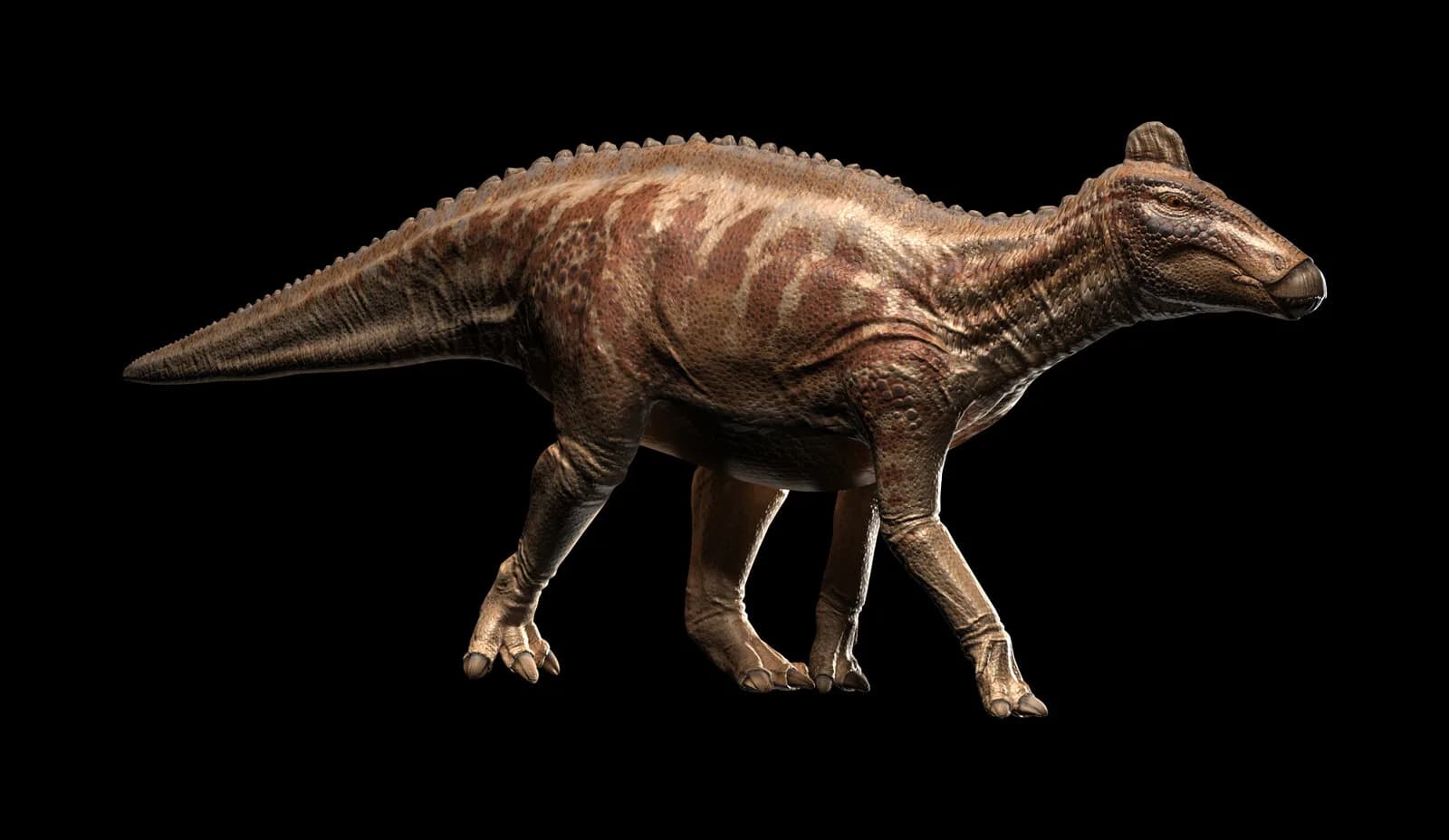
Tsintaosaurus spinorhinus life reconstruction
Wikimedia Commons, CC BY-SA
Prefrontal bone of Tsintaosaurus with crest
Wikimedia Commons, CC BY-SA