Lambéosaure
Lambeosaurus lambei was a herbivorous hadrosaur from North America, described in 1923 and dated to 76 to 75 million years ago. At 9 metres and 2.5 tonnes, it carried a hollow crest connected to its nasal passages, which let it produce low resonant calls to communicate within the herd. Its name honours Lawrence Lambe, a pioneering Canadian palaeontologist.
Playable in Path of Titans
See Lambeosaurus lambei's stats, abilities and role on our survival server.
Lambeosaurus lived during the Late Cretaceous period, approximately 76 to 75 million years ago, during the Campanian stage. This era was characterized by a warm and humid climate, with shallow epicontinental seas dividing North America into two large landmasses known as Laramidia and Appalachia. Lambeosaurus coexisted with many other iconic dinosaurs, including Corythosaurus, Parasaurolophus, primitive tyrannosaurids, and various ceratopsians. The fauna of this period was extraordinarily diverse, forming complex ecosystems in which hadrosaurs occupied a central role as dominant gregarious herbivores, shaping vegetation communities across vast floodplain environments through their browsing and grazing activities.
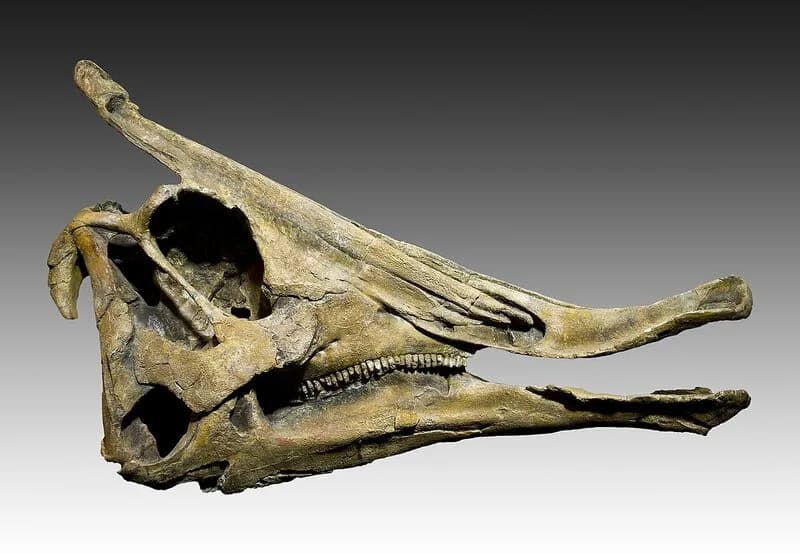
Lambeosaurus was one of the largest known hadrosaurs, reaching up to 9 meters in length and approximately 3.5 meters in height at the hips, with a body mass estimated around 2.5 tonnes for a healthy adult. The species showed notable sexual dimorphism, with males generally being larger and possessing more elaborately developed crests than females. Juvenile specimens discovered in the same formations demonstrate a progressive development of the characteristic cranial structures, suggesting that the crest continued growing throughout the animal's life, achieving its definitive hatchet-like form only in full adulthood. This ontogenetic progression has been well-documented through growth series recovered from Dinosaur Park Formation localities in Alberta.
Lambeosaurus was a strict herbivore that fed primarily on low-growing vegetation and shrub foliage available in its coastal and forested environment. Its dentition was remarkably adapted to its plant-based diet, featuring a dense dental battery composed of hundreds of tightly packed teeth forming a highly effective grinding surface capable of processing tough plant material. This dental structure allowed it to chew ferns, conifers, angiosperms, and other fibrous plants with exceptional efficiency. Paleobotanical studies of its discovery region indicate that it had access to a wide variety of plants, including palms and flowering plants that were beginning to diversify during this period, making the Late Cretaceous a time of abundant and varied food resources.
Lambeosaurus inhabited coastal plains and floodplain forests situated along the Western Interior Seaway, a vast epicontinental sea that bisected North America from north to south. These environments correspond to what is now the province of Alberta, Canada, where conditions were markedly warmer and more humid than today. The Dinosaur Park Formation, rich in Lambeosaurus fossils, records a landscape dominated by meandering rivers, swamps, and dense forests. This semi-aquatic and lush habitat provided an abundance of plant food resources as well as relative protection against terrestrial predators such as tyrannosaurids. Seasonal flooding likely drove the migrations of hadrosaur herds across the coastal lowlands in search of fresh feeding grounds and nesting sites.
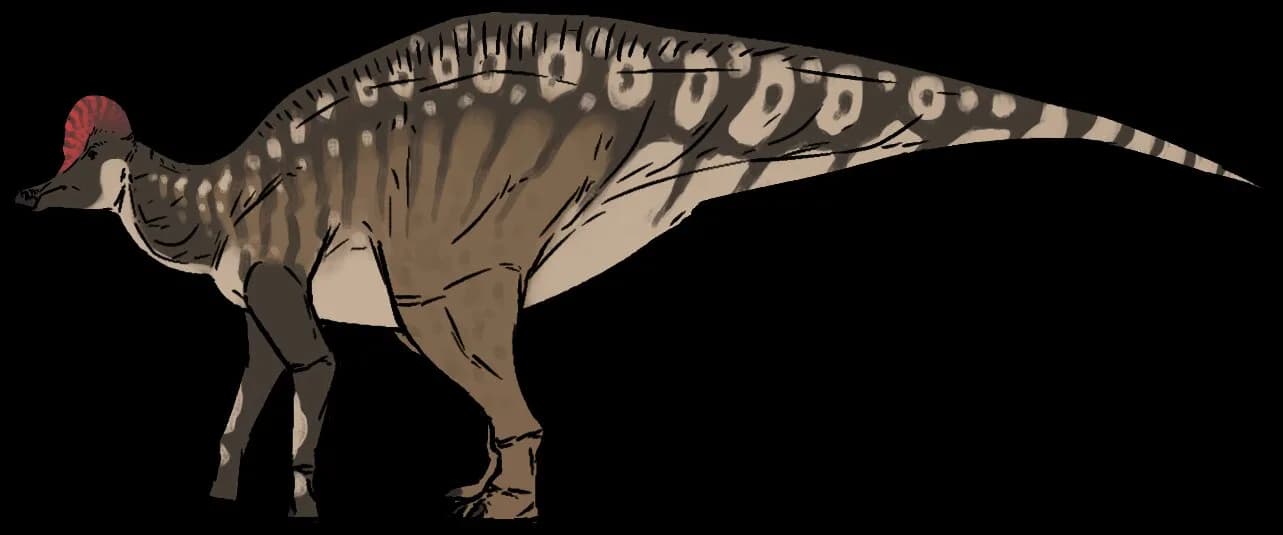
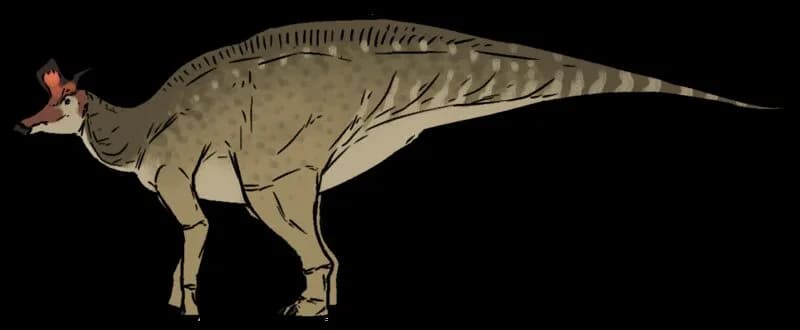
The anatomy of Lambeosaurus is dominated by its distinctive hollow cranial crest, most often described as hatchet-shaped. This spectacular crest was composed of strongly dilated nasal bones and upward-extended premaxillae. The nasal passages ran upward through the interior of the crest before looping back down toward the nostrils. In addition to its distinctive crest, Lambeosaurus possessed the typical attributes of crested hadrosaurs: a massive and robust body, strong hind limbs bearing most of the animal's weight, shorter forelimbs, a long tail serving as a counterbalance, and a horizontal vertebral column. Its hands likely bore webbed skin that facilitated locomotion in wetland environments. The crest varied considerably between species, sexes, and age classes.
Lambeosaurus was most likely a gregarious animal that lived in large mixed herds composed of individuals of all ages. Collective nesting sites of hadrosaurs discovered across North America suggest these dinosaurs practiced elaborate parental care, with adults guarding nests and attending to young. The hollow crest of Lambeosaurus almost certainly played a crucial role in intraspecific communication: by resonating air through the nasal passages inside the crest, the animal could produce deep, far-carrying sounds to signal its presence, reinforce social bonds, or warn the group of approaching predators. These acoustic signals were likely complemented by visual signals exploiting the shape and coloration of the crest for species and sex recognition within mixed hadrosaur communities.
Fossils of Lambeosaurus lambei have been discovered primarily in the Dinosaur Park Formation in Alberta, Canada. The species was formally described in 1923 by Canadian paleontologist William Parks, who named it in honor of his colleague Lawrence Lambe, celebrated for his pioneering work on Canadian dinosaurs. Numerous specimens have been unearthed in the Dinosaur Provincial Park region, a UNESCO World Heritage Site that has yielded an exceptional quantity of hadrosaur remains. Complete skulls, partial skeletons, and isolated bones now allow a detailed reconstruction of this animal's anatomy. Recent studies of bone microstructure have shed light on its growth rates and overall biology, confirming that Lambeosaurus grew relatively rapidly to reach its impressive adult size.
| Period | Crétacé supérieur / Late Cretaceous |
| Era | Mésozoïque / Mesozoic |
| Age | 76-75 Ma |
| Location | Amérique du Nord / North America |
| Length | 9 m |
| Height | 3.5 m |
| Weight | 2.5 tonnes |
| Diet | Herbivore |
| Discovery | 1923 |
Lambeosaurus lambei reached up to 9 metres in length, 3.5 metres at the hips, and an estimated weight of 2.5 tonnes. It was one of the largest known hadrosaurs. Males were generally larger than females, with a more developed cranial crest.
The hatchet-shaped hollow crest of Lambeosaurus lambei channelled air through internal nasal passages, producing deep, far-carrying sounds. These acoustic signals served for social communication within the herd, individual recognition, and predator warnings against Campanian tyrannosaurids.
Lambeosaurus lambei lived 76 to 75 million years ago (Campanian) along the Western Interior Seaway, in present-day Alberta, Canada, in the Dinosaur Park Formation. The species was described in 1923 by palaeontologist William Parks, in honour of his colleague Lawrence Lambe.
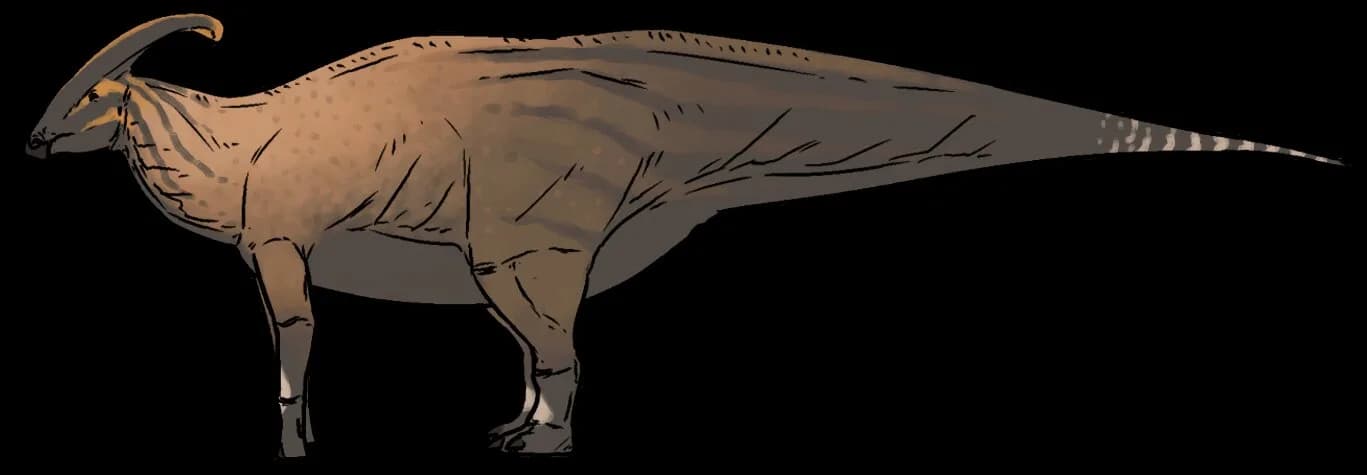
Life reconstruction of Lambeosaurus lambei
Wikimedia Commons, CC BY-SA
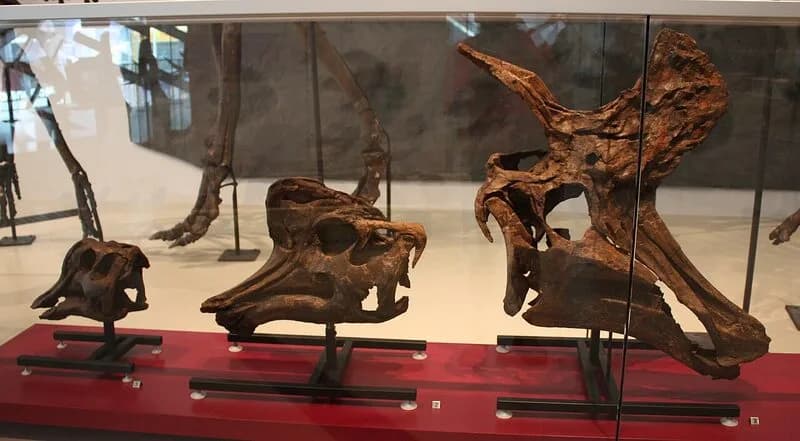
Lambeosaurus skull ontogeny
Wikimedia Commons, CC BY-SA