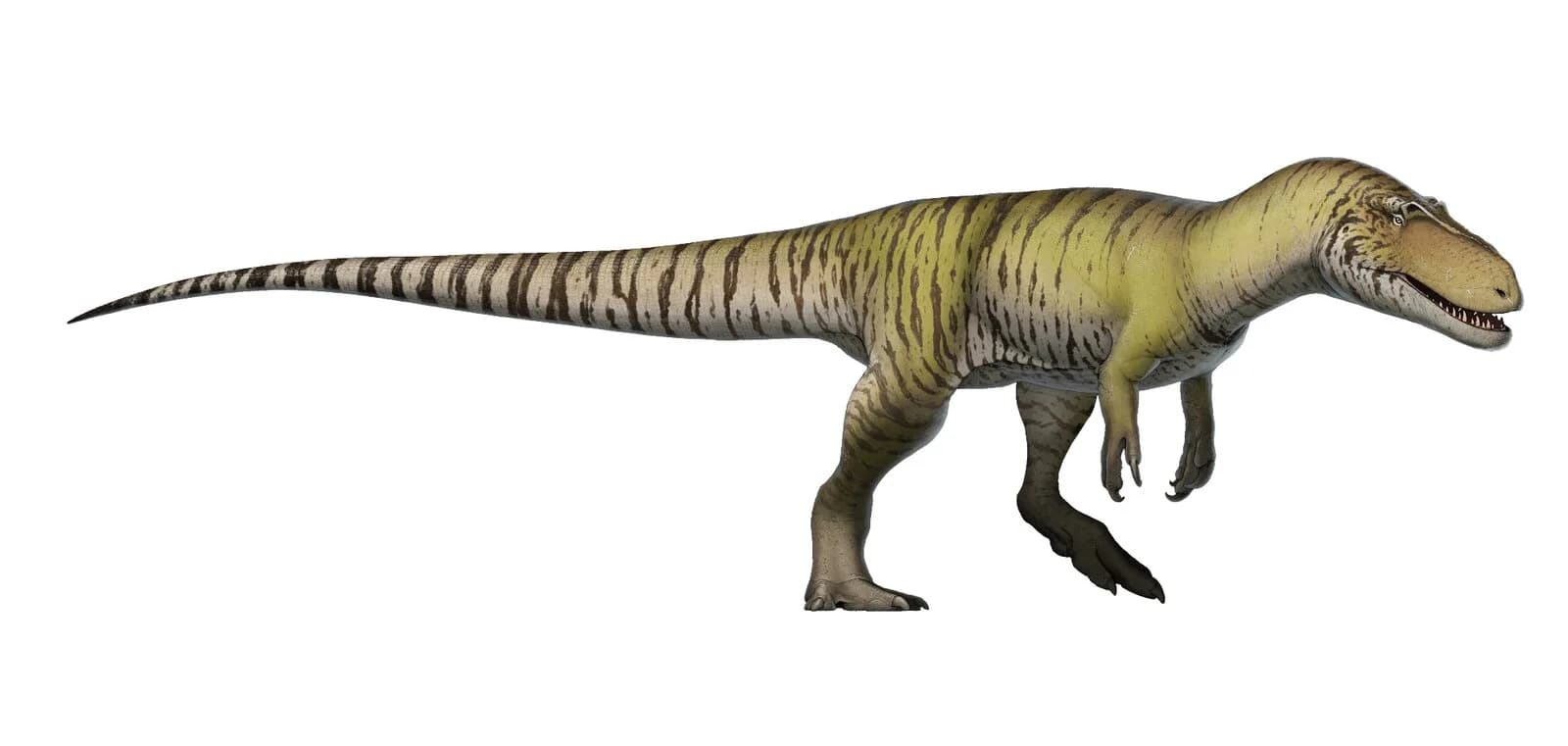
Torvosaure
Torvosaurus tanneri was the largest predator of the European Jurassic, at 10 to 11 metres and 2 to 4 tonnes. Its teeth reached 10 centimetres, among the largest of any Jurassic theropod. Its presence in Colorado, Utah and Portugal attests that those lands were still connected 153 to 148 million years ago.
Torvosaurus lived during the Late Jurassic period, approximately 153 to 148 million years ago, during the Kimmeridgian to Tithonian stages. It inhabited the Morrison Formation of North America and the Lourinhã Formation of Portugal, demonstrating a broad geographic range across the ancient supercontinent of Laurasia. This period was characterized by warm, semi-arid climates with seasonal rainfall patterns that supported vast ecosystems of diverse dinosaurs. Torvosaurus was one of the largest predators of its era, competing with Allosaurus and Ceratosaurus for prey resources. The presence of this genus on both sides of the proto-Atlantic Ocean provides important evidence about land connections during the Late Jurassic.
Torvosaurus was one of the largest theropods of the Jurassic period, measuring approximately 9 to 11 meters in length with an estimated weight of around 2 to 4 tons. The European species T. gurneyi may have been even larger, with skull fragments suggesting a head measuring over one meter in length. Its skull was massive and deep, equipped with large, blade-like teeth well-suited for slicing through flesh and hide. The forelimbs were notably short but powerfully built, bearing large curved claws capable of inflicting serious wounds. The overall build was robust and heavily muscled, making Torvosaurus a formidable predator capable of taking on the largest herbivores of its Jurassic ecosystem.
Torvosaurus was a top-tier carnivore that likely preyed upon large sauropods, stegosaurs, and other herbivorous dinosaurs of the Late Jurassic. Its massive, blade-like teeth were well-adapted for delivering deep, slashing bites that could cause catastrophic bleeding in prey animals. Unlike Allosaurus, which had a more lightly built skull adapted for hatchet-like biting, Torvosaurus possessed a more robust skull suggesting it could engage in more powerful, direct biting. Evidence of tooth marks on sauropod bones from the Morrison Formation may be attributable to Torvosaurus. As a megalosaurid, it represents an older lineage of large predators that competed directly with the more numerous allosaurids for ecological dominance.
Torvosaurus inhabited the semi-arid floodplains and river valleys of the Morrison Formation in western North America and the Lourinhã Formation in what is now Portugal. These environments featured seasonal rivers, scattered lakes, and patches of conifer forest interspersed with more open terrain. The climate was warm with pronounced dry and wet seasons, creating a landscape that fluctuated between lush riverside habitats and drier upland areas. The Morrison Formation supported one of the most diverse dinosaur communities ever documented, with numerous species of sauropods, ornithopods, and theropods sharing the landscape. Torvosaurus likely favored well-watered areas where large herbivores congregated, providing reliable hunting opportunities for this massive predator.
Torvosaurus possessed a typical megalosaur anatomy, but pushed to the extreme in terms of size and robustness. Its deep, massive skull bore teeth 10 to 12 centimeters long, with coarse serrations adapted for slicing flesh. Unlike Allosaurus with its relatively short arms, Torvosaurus had proportionally long and extremely powerful arms equipped with large curved claws — its name indeed means 'savage lizard.' Its hindlimbs were robust but less adapted for fast running, suggesting a hunting mode based on power rather than speed.
Torvosaurus was likely a solitary apex predator that relied on ambush tactics and powerful bite attacks to subdue large prey. Its robust build suggests it was not built for sustained pursuit, instead favoring short, explosive charges from concealment to surprise unsuspecting herbivores at water sources or along forest edges. The large claws on its hands may have been used to grip prey during attacks, supplementing the devastating bite force of its massive jaws. Territorial behavior is plausible given its large size and high metabolic demands. Torvosaurus likely defended prime hunting territories against rivals, including both conspecifics and competing large theropods like Allosaurus that shared its Late Jurassic ecosystem.
Torvosaurus was described in 1979 by Peter Galton and James Jensen from remains discovered in the Morrison Formation at Dry Mesa Quarry, Colorado. The holotype primarily comprised forelimb bones — remarkably robust humeri and forearms with large claws. The European species T. gurneyi was described in 2014 by Christophe Hendrickx and Octávio Mateus from fossils found in the Lourinhã Formation in Portugal, including a maxilla, teeth, and embryos. The discovery of Torvosaurus embryos in Portugal, some of the largest known theropod eggs, provided valuable information about the reproduction of these giants.
| Period | Jurassique supérieur / Late Jurassic (Kimméridgien–Tithonien) |
| Era | Mésozoïque / Mesozoic |
| Age | 153–148 Ma |
| Location | Amérique du Nord (Colorado, Utah) et Europe (Portugal) / North America (Colorado, Utah) and Europe (Portugal) |
| Length | 10–11 m |
| Height | ~3 m |
| Weight | 2 000–4 000 kg |
| Diet | Carnivore |
| Discovery | 1972 |
Torvosaurus tanneri measured between 9 and 11 meters in length with an estimated weight of 2,000 to 4,000 kilograms, directly rivaling Allosaurus fragilis. The European species T. gurneyi, described in 2014 from Portugal, had a skull estimated at over one meter, suggesting an even larger size. Torvosaurus differed from Allosaurus with a deeper skull and proportionally longer arms bearing large claws.
In 2014, Christophe Hendrickx and Octávio Mateus described the species T. gurneyi from fossils of the Lourinhã Formation in Portugal, including embryos and eggs. These rank among the largest known theropod eggs. Their presence demonstrates that Torvosaurus had a transatlantic distribution during the Late Jurassic, when North America and Europe were still connected by land bridges.
Torvosaurus tanneri was likely an ambush predator rather than a pursuit hunter. Its robust build and limbs less adapted for fast running suggest it waited for prey at water sources or in wooded areas. Its 10 to 12 centimeter teeth with coarse serrations, and its powerful arms with large claws, were used to capture and restrain sauropods and stegosaurs of the Morrison Formation.
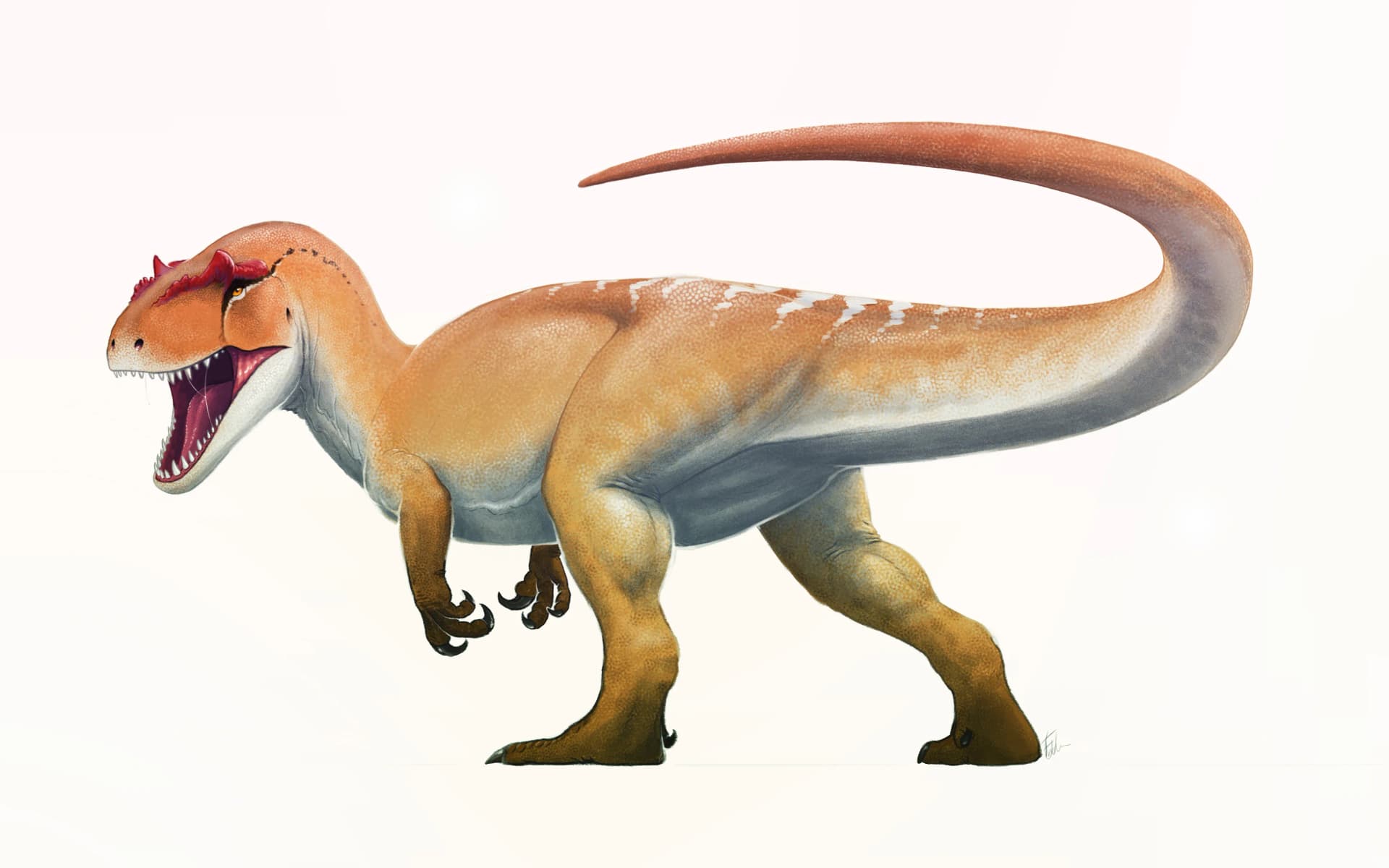
Life reconstruction of Torvosaurus tanneri
Fred Wierum, CC BY-SA 4.0, via Wikimedia Commons
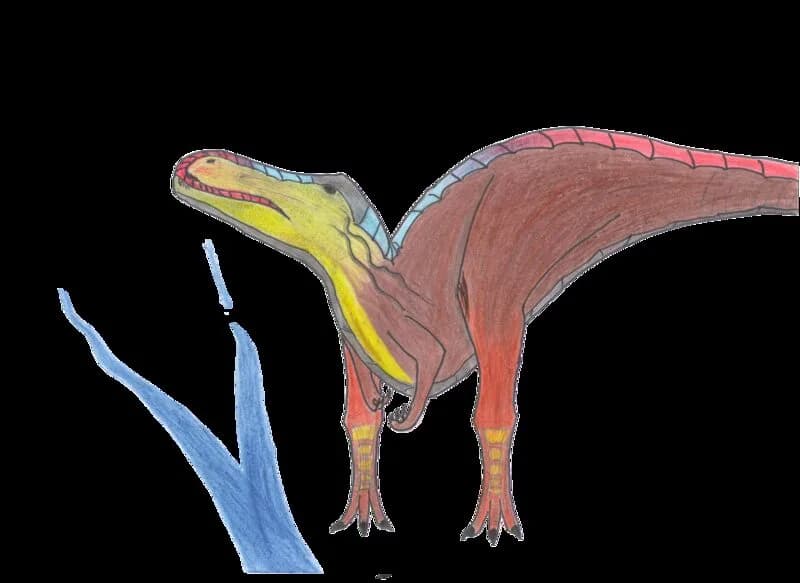
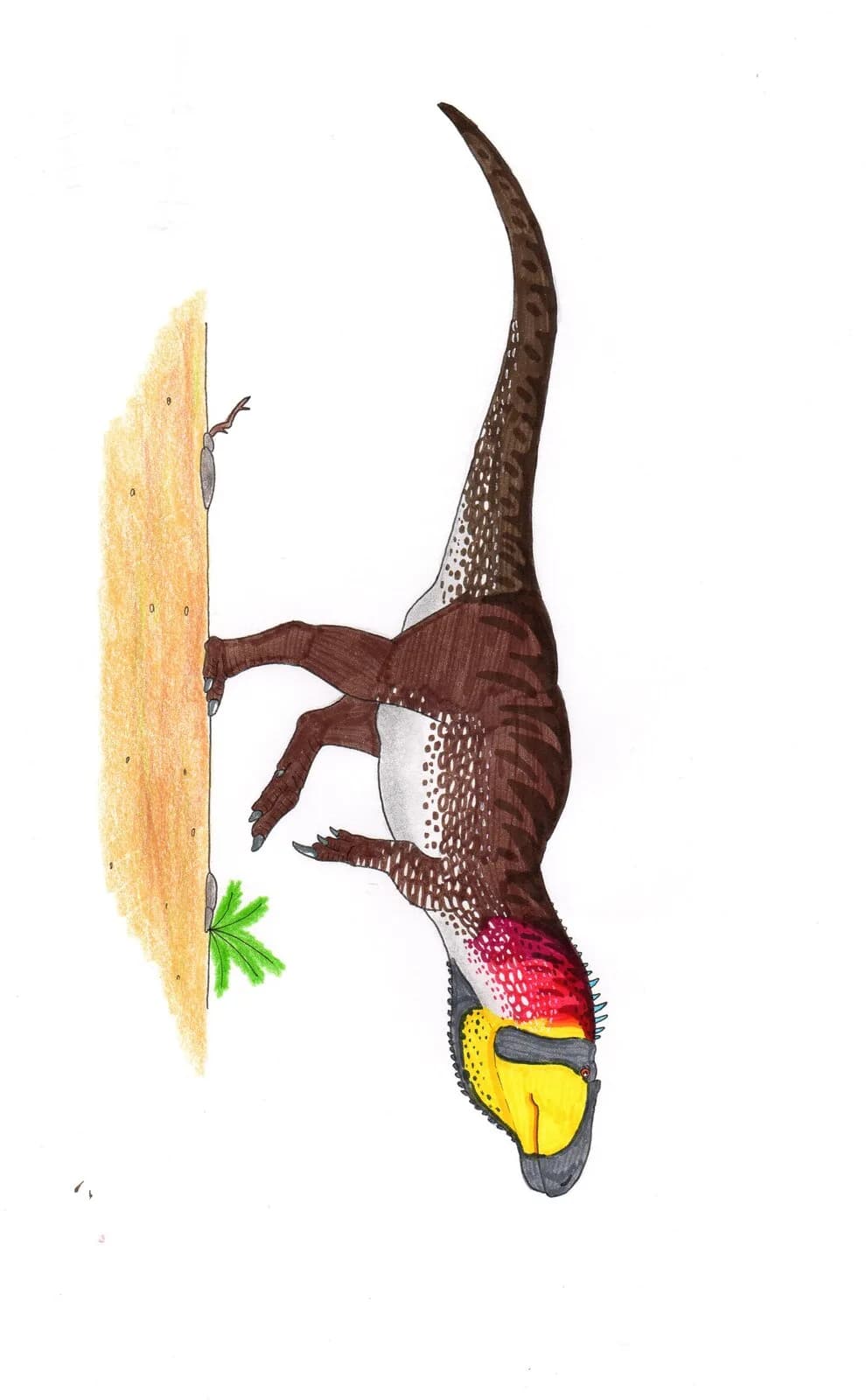
Torvosaurus tanneri reconstruction
Pitchablo, CC BY-SA 4.0