Torosaurus
Torosaurus latus carries one of the largest skulls of any land animal: up to 2.77 metres, a record contested with Pentaceratops. Eight metres long and 4 to 6 tonnes, described in 1891, it lived 68 to 66 million years ago. Some palaeontologists read it as a fully mature Triceratops rather than a separate genus, a debate still open.
Torosaurus lived at the very end of the Late Cretaceous period, approximately 68 to 66 million years ago, during the Maastrichtian stage. It was contemporary with the famous Triceratops, sharing the same environments across western North America. This period corresponds to the final millions of years before the massive Cretaceous-Paleogene extinction event, caused by the Chicxulub asteroid impact. Torosaurus belonged to the family Ceratopsidae, subfamily Chasmosaurinae, the same group as Triceratops. The climate of this era was warm and humid, with fertile coastal plains bordering the gradually retreating Western Interior Seaway. It ranks among the very last non-avian dinosaurs to have walked the Earth before the great extinction event.
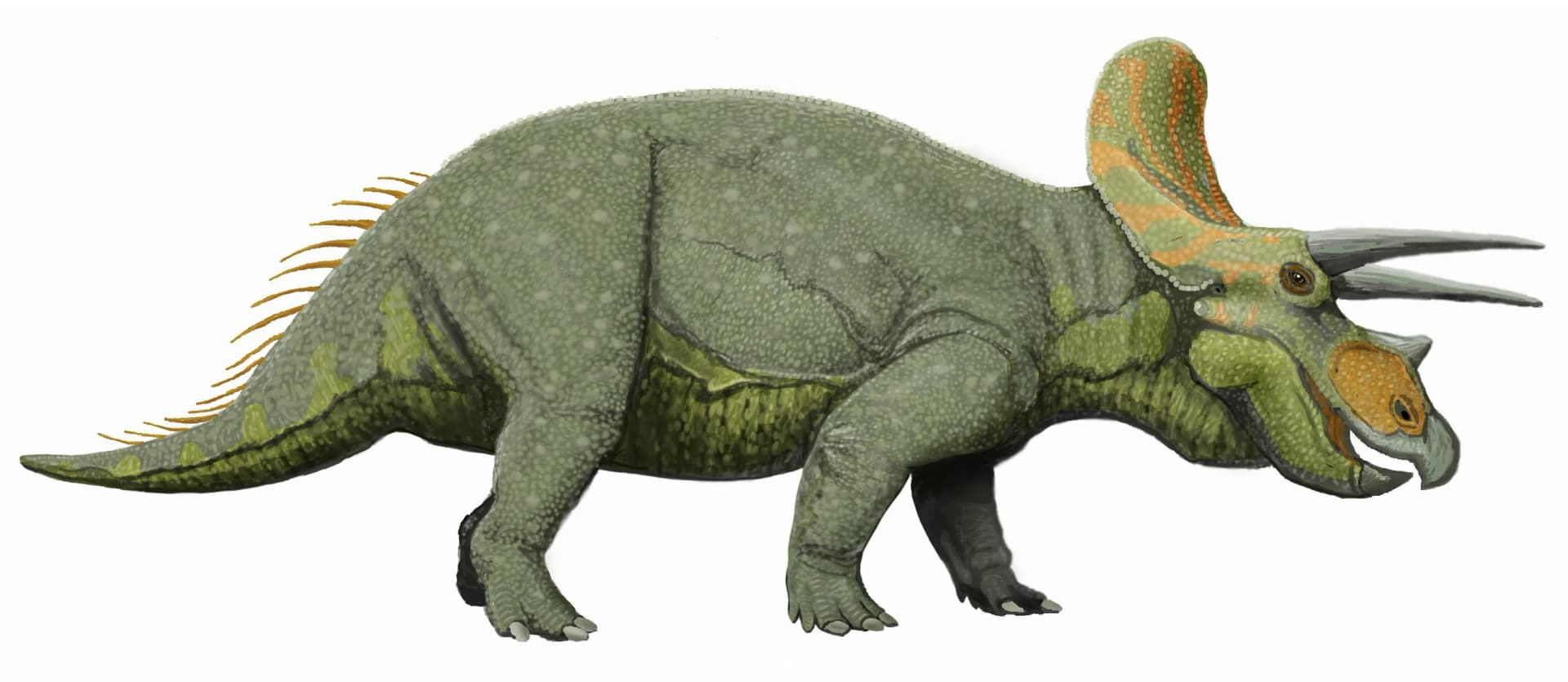
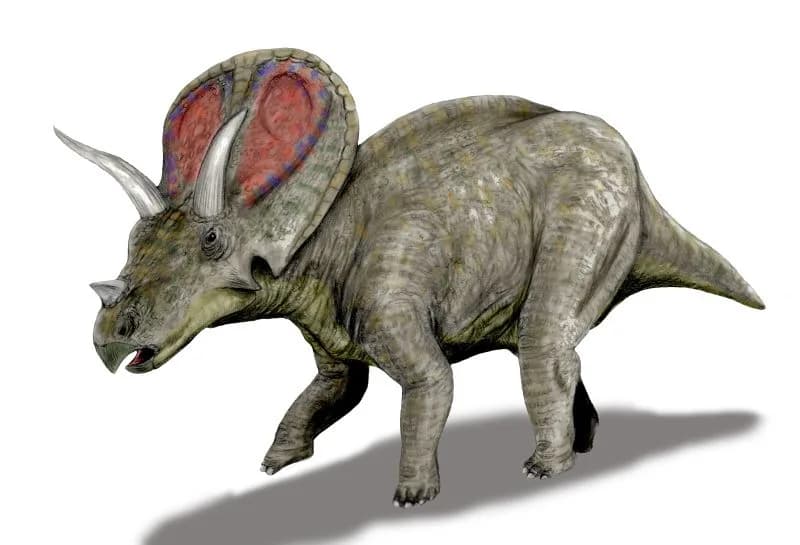
Torosaurus was among the largest ceratopsians that ever existed, reaching a total length of approximately 8 meters with an estimated weight between 4 and 6 tonnes. But it is primarily its skull that distinguishes it in spectacular fashion: with a length reaching up to 2.77 meters on certain specimens, it possesses one of the largest skulls of any land animal that ever lived. This exceptional size is mainly due to its elongated bony frill, far more extensive than that of Triceratops. The massive, stocky body rested on four robust legs, with the hind limbs being slightly longer than the forelimbs, giving the animal the slightly forward-tilted posture typical of large ceratopsids.
A strict herbivore, Torosaurus fed on the low-growing, tough vegetation available across the Late Cretaceous plains. Its powerful horny beak, located at the front of its jaw, allowed it to efficiently section stems, leaves, and branches from the most resistant plants, including cycads, ferns, low conifers, and early angiosperms. At the rear of the jaw, dental batteries composed of hundreds of teeth arranged in columns provided efficient grinding of fibrous plant material. This continuous tooth replacement system ensured the chewing surface remained always functional, essential for an herbivore of this size consuming tens of kilograms of vegetation daily.
Torosaurus inhabited the vast coastal plains of western North America, in regions corresponding today to Wyoming, Montana, and South Dakota. Its environment was that of the retreating Western Interior Seaway, giving way to fertile alluvial plains covered with conifer forests, tree ferns, and primitive flowering plants. It coexisted with numerous iconic dinosaurs of this period, notably Triceratops, Tyrannosaurus rex, Edmontosaurus, and Ankylosaurus. The Lance and Hell Creek geological formations, where its fossils have been discovered, attest to a rich and diverse ecosystem during the final millions of years of the Mesozoic era.
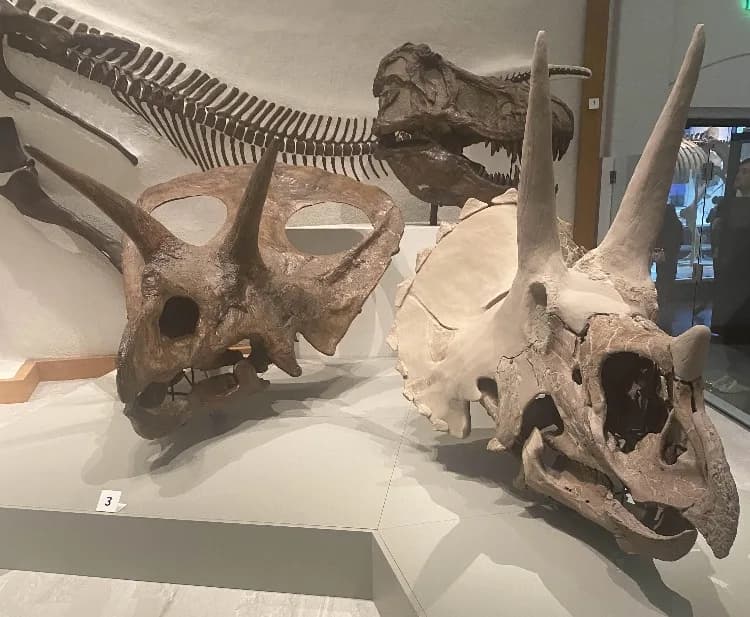
The anatomy of Torosaurus is dominated by its spectacular skull, particularly its parietal-squamosal bony frill of extraordinary length. Unlike the solid frill of Triceratops, the Torosaurus frill features two large characteristic fenestrae — oval openings in the parietal bone that considerably lightened the structure while allowing vascularization and muscle attachment. Two long brow horns surmounted the eye sockets, measuring over one meter in length, while a shorter, blunter nasal horn adorned the snout. The powerful horny beak at the front of the jaw was toothless, but the rear of the mouth housed complex dental batteries. The massive body displayed the typical morphology of large ceratopsids, with a broad ribcage and powerful limbs.
The social behavior of Torosaurus is debated among paleontologists, partly because its fossils are considerably rarer than those of Triceratops. The absence of dedicated Torosaurus bone beds suggests it was potentially less gregarious than some other ceratopsians, or simply far less abundant in its ecosystem. Its fenestrated frill, likely covered with vascularized and colored skin, very probably served as a display organ during courtship and intraspecific confrontations for dominance. The imposing brow horns could be used during ritualized combat between males, similar to confrontations observed in modern cervids. When facing predators such as Tyrannosaurus, Torosaurus could rely on its formidable horns and imposing mass to deter attacks.
Torosaurus was first named and described in 1891 by the famous paleontologist Othniel Charles Marsh, from specimens discovered in Wyoming. Its name means 'perforated lizard,' referring to the characteristic fenestrae in its bony frill. Torosaurus fossils remain relatively rare compared to those of Triceratops: only a few skulls and skeletal fragments are known, mainly from Wyoming, Montana, and South Dakota. In 2010, paleontologists John Scannella and Jack Horner proposed a controversial hypothesis suggesting that Torosaurus was actually the mature adult form of Triceratops, whose frill would become fenestrated and elongated with age. This theory was vigorously contested by numerous subsequent studies, notably those by Nick Longrich and Daniel Field in 2012, who maintained the validity of Torosaurus as a distinct genus.
| Period | Crétacé supérieur / Late Cretaceous |
| Era | Mésozoïque / Mesozoic |
| Age | 68-66 Ma |
| Location | Wyoming, Montana, Dakota du Sud / Wyoming, Montana, South Dakota |
| Length | 8 m |
| Weight | 4-6 tonnes |
| Diet | Herbivore |
| Discovery | 1891 |
In 2010, Scannella and Horner proposed that Torosaurus latus was simply an adult Triceratops whose frill becomes fenestrated and elongated with age. This hypothesis was strongly challenged: in 2012, Longrich and Field demonstrated that young Torosaurus and adult Triceratops coexist in the same geological formations, confirming the validity of Torosaurus as a distinct genus.
Some Torosaurus latus specimens display a skull reaching 2.77 meters in length, making it one of the largest skulls of any land animal that ever lived — a record shared with Pentaceratops. This exceptional size is due to the elongated, fenestrated parietal-squamosal frill, far more extensive than that of Triceratops. The animal itself measured about 8 meters and weighed 4 to 6 tonnes.
Torosaurus latus lived at the very end of the Late Cretaceous, 68 to 66 million years ago (Maastrichtian), in western North America. Its fossils have been found primarily in Wyoming, Montana, and South Dakota, in the Lance and Hell Creek Formations. It was contemporary with Triceratops, Tyrannosaurus rex, and Ankylosaurus in these ecosystems of the final millions of years of the Mesozoic.
Torosaurus latus illustration
Nobu Tamura, Wikimedia Commons
Torosaurus and Triceratops comparison
Wikimedia Commons