Chasmosaure
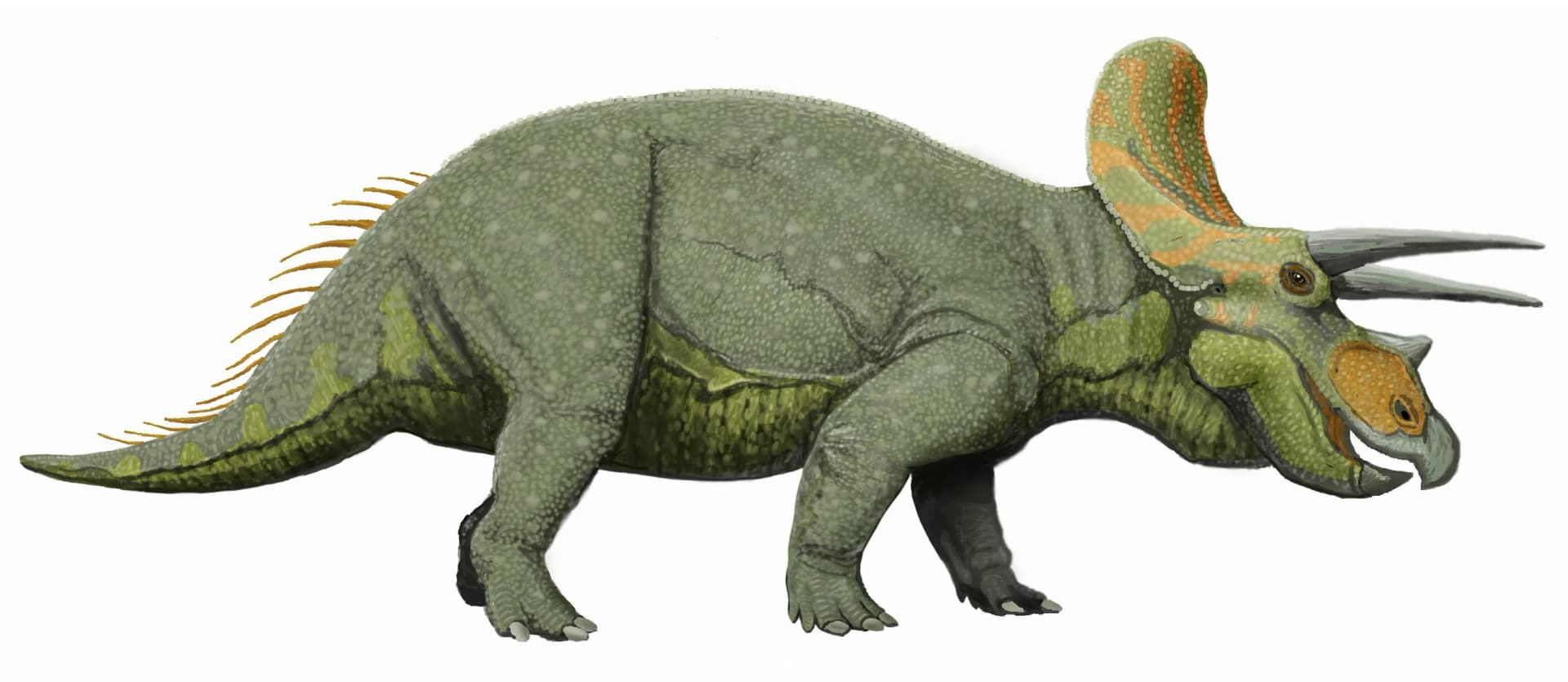
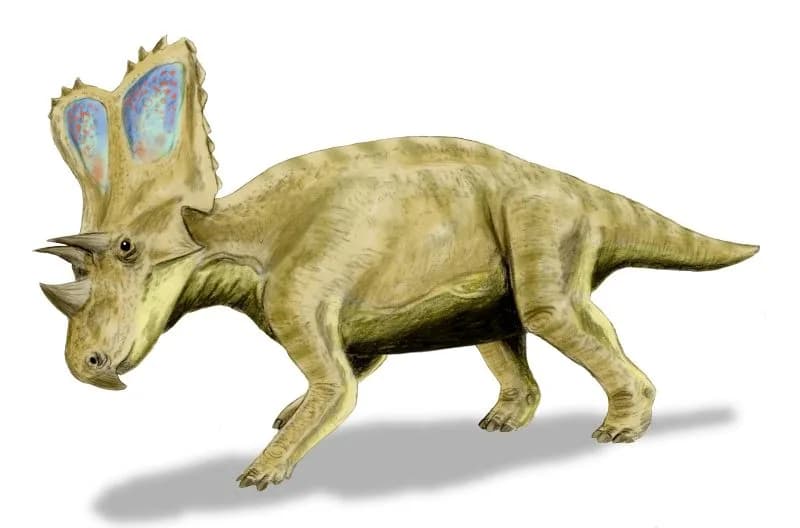
Chasmosaurus belli is a ceratopsian from Alberta, described in 1898 and dated to 77 to 75 million years ago. Its frill is the largest of any ceratopsian relative to body size: heart-shaped, it exceeded a metre across. Two wide openings lightened it, hence its name of « opening lizard ». It most likely served as a coloured display panel.
Chasmosaurus lived during the Late Cretaceous, approximately 77 to 75 million years ago (Campanian), in what is now Alberta, Canada. It belongs to the family Ceratopsidae and the subfamily Chasmosaurinae, of which it is the eponymous genus. This subfamily also includes the famous Triceratops, Torosaurus, and Pentaceratops. Chasmosaurus inhabited the lush alluvial plains of the Dinosaur Park Formation, a subtropical environment rich in waterways and dense vegetation. It coexisted with many other iconic Campanian North American dinosaurs, including the tyrannosaurid Gorgosaurus, the hadrosaur Corythosaurus, and the horned ceratopsian Styracosaurus. Two species are recognized as valid: C. belli and C. russelli, although the taxonomy of the genus has been considerably revised over the decades.
Chasmosaurus was a medium-sized ceratopsian, measuring approximately 4.8 to 5.2 meters in length with a height of about 2 meters at the hips and an estimated weight between 1.5 and 2 tonnes. Its skull, including the frill, could reach nearly 2 meters in total length, representing a remarkable proportion relative to the animal's body size. The bony frill alone constituted more than half the skull's length. The brow horns were relatively short compared to those of Triceratops, measuring between 30 and 50 centimeters depending on the specimen. The nasal horn was even more modest, forming a small squat appendage above the snout. The massive body rested on four sturdy and stocky limbs, with the hind limbs being slightly longer than the forelimbs.
An exclusive herbivore, Chasmosaurus fed on the low fibrous vegetation of the Late Cretaceous plains, including ferns, cycads, low conifers, and the earliest angiosperms that were beginning to diversify during this period. Its powerful horny beak, sharp and curved downward, was perfectly adapted for sectioning tough stems and fronds. The posterior dental batteries, composed of stacked columns of continuously replaced teeth, provided efficient grinding of the most resistant plant material through a vertical shearing motion. The low position of its head, combined with its short but muscular neck, predisposed it to grazing close to the ground. Its ecological niche was comparable to that of a modern rhinoceros, filling the role of a specialized browser of low vegetation.
Chasmosaurus inhabited the coastal plains and alluvial zones of western North America, primarily in the present-day Alberta region of Canada. Its fossils come almost exclusively from the Dinosaur Park Formation, in the famous Dinosaur Provincial Park, a UNESCO World Heritage Site. The Campanian environment in this region was a vast system of subtropical floodplains traversed by winding rivers emptying into the Western Interior Seaway, a shallow sea that divided the North American continent from north to south. The climate was warm and humid, with conifer forests, swamps, and fern meadows. Chasmosaurus shared this rich habitat with a diverse fauna including hadrosaurs, ankylosaurs, and several species of tyrannosaurs.
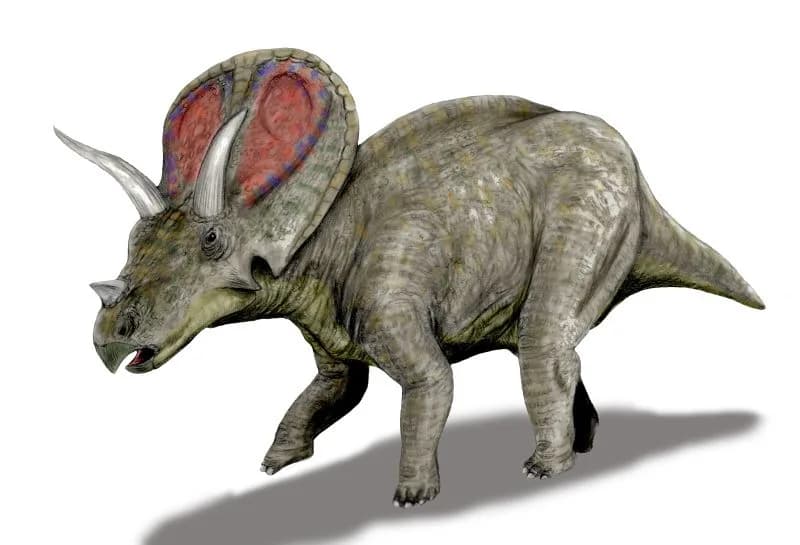
The anatomy of Chasmosaurus is dominated by its extraordinary heart-shaped frill, the largest relative to body size of any known ceratopsian. This parietal-squamosal frill featured two large windows (fenestrae) that considerably lightened it — hence the genus name, from the Greek 'chasma' meaning opening. Bordered by epoccipitals (small bony horns), the frill was covered in living, richly vascularized skin, suggesting it could change color during courtship displays or confrontations between rivals. The toothless horny beak at the front of the snout gave way to a row of shearing teeth typical of ceratopsids. The rest of the skeleton presents a massive quadrupedal construction, with ossified tendons reinforcing the vertebral column and a relatively short tail for a dinosaur.
Chasmosaurus was very likely a gregarious animal, moving in herds across the Late Cretaceous plains. The discovery in 2010 of an exceptional bone bed in the Dinosaur Park Formation containing the remains of at least three adults and three juveniles, apparently killed together during a sudden flood, provides the strongest evidence of this group behavior with protection of the young. Its spectacular bony frill played a central role in intraspecific visual communication: individual recognition, dominance display, and courtship during the breeding season. When facing predators like Gorgosaurus, Chasmosaurus likely adopted a frontal defensive posture, presenting its imposing frill and horns to appear larger and deter attack. Individual variations in frill shape and ornamentation also suggest a role in individual recognition.
Chasmosaurus was discovered in 1898 by Canadian paleontologist Lawrence Lambe along the Red Deer River in Alberta. Lambe initially described the specimen as Monoclonius belli in 1902, before Charles Sternberg created the genus Chasmosaurus in 1914 to accommodate this distinct species. The name refers to the large openings (fenestrae) in the frill. Since then, numerous specimens have been unearthed from the Dinosaur Park Formation, making Chasmosaurus one of the best-documented ceratopsians in the fossil record. One of the most remarkable specimens is a nearly complete juvenile discovered in 2013, preserving even skin impressions showing polygonal scales of different sizes. The taxonomy of the genus has been profoundly revised in recent decades, with several species formerly attributed to Chasmosaurus being reclassified into other genera such as Vagaceratops and Mercuriceratops.
| Period | Crétacé supérieur / Late Cretaceous |
| Era | Mésozoïque / Mesozoic |
| Age | 77-75 Ma |
| Location | Alberta, Canada / Alberta, Canada |
| Diet | Herbivore |
| Discovery | 1898 |
Chasmosaurus belli's parieto-squamosal frill, heart-shaped, constituted more than half the skull's length. Two large windows (fenestrae) considerably lightened it, hence its Greek name 'chasma' (opening). Covered in richly vascularized skin, it likely served as a colorful display for sexual selection and herd communication, 77 to 75 million years ago.
Lawrence Lambe discovered Chasmosaurus in 1898 along the Red Deer River, Alberta. He initially named it Monoclonius belli in 1902, before Charles Sternberg created the genus Chasmosaurus in 1914. Fossils from the Dinosaur Park Formation, a UNESCO site, make it one of the best-documented ceratopsians. A nearly complete juvenile discovered in 2013 even preserved skin impressions with polygonal scales.
An exceptional bone bed discovered in 2010 in the Dinosaur Park Formation contains remains of at least three adults and three Chasmosaurus juveniles, apparently killed together during a flood, proving gregarious behavior with protection of young. Facing the tyrannosaurid Gorgosaurus, Chasmosaurus likely adopted a frontal defensive posture, presenting its imposing frill and horns to appear more formidable.
Chasmosaurus belli life reconstruction showing its heart-shaped frill
Nobu Tamura, CC BY 3.0
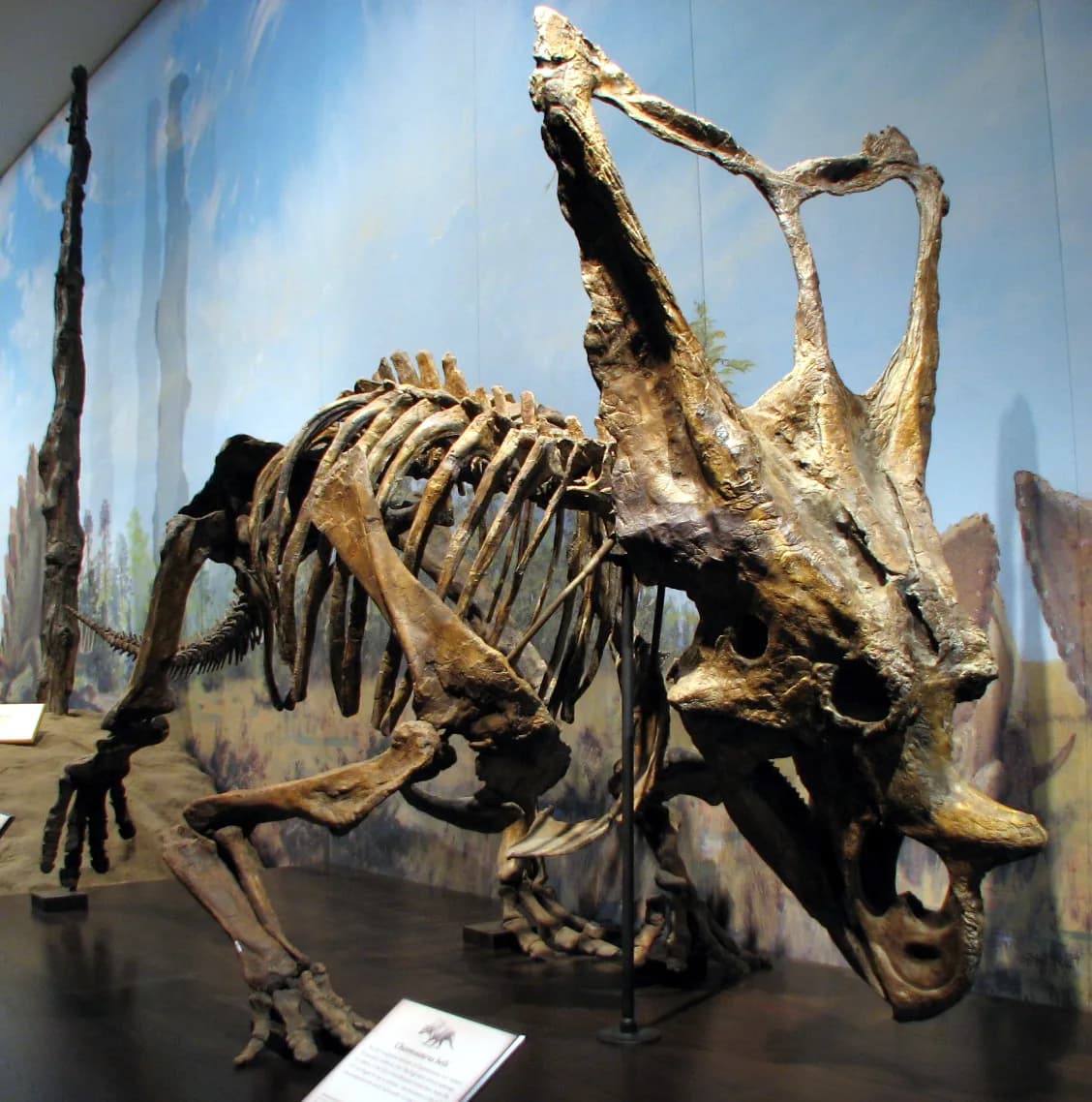
Fossil skull of Chasmosaurus at the Canadian Museum of Nature
Wikimedia Commons