Titanocératops
Titanoceratops ouranos was a ceratopsian from New Mexico dated to 74 million years ago. At 6.8 metres and 6 tonnes, it was taken for a large Pentaceratops for 70 years before receiving its own name in 2011. Its 2.65-metre skull rivals that of Triceratops, even though it lived 8 million years earlier.
Titanoceratops lived during the Late Cretaceous, approximately 74 million years ago, in what is now the southwestern United States. Originally described in 1941 as a specimen of Pentaceratops, it was reclassified in 2011 by Nicholas Longrich as a distinct genus belonging to the Chasmosaurinae subfamily. This reclassification remains controversial among paleontologists, with some considering it merely a large individual of Pentaceratops. Its name means 'titanic horned face,' referencing its exceptional size among ceratopsians. It predates its famous cousins Triceratops and Torosaurus by several million years, making it a key species for understanding ceratopsian evolution.
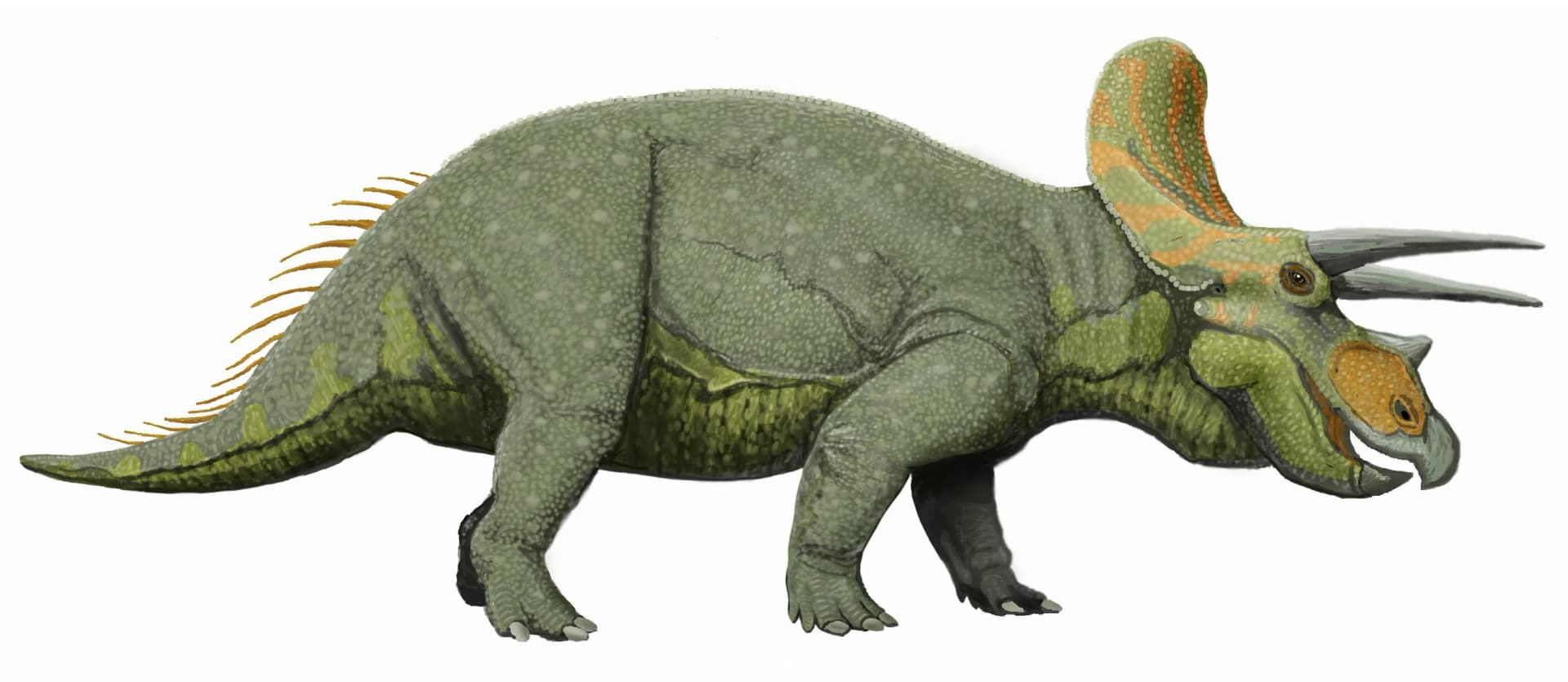
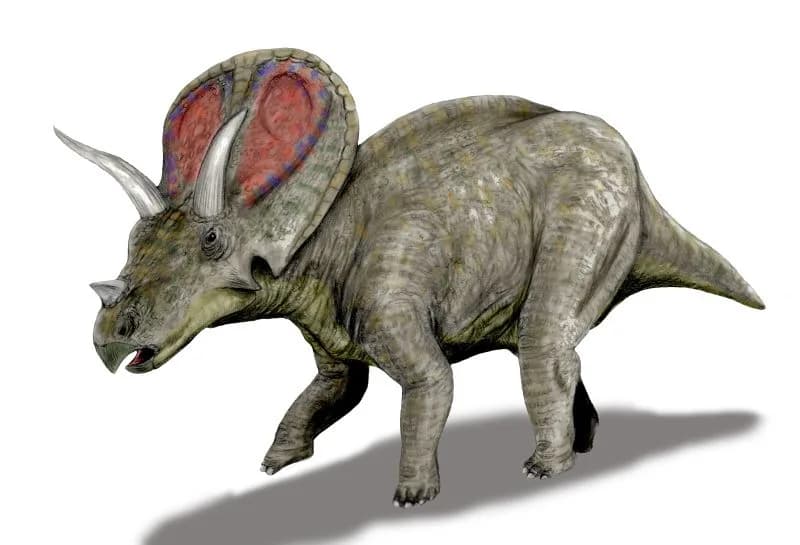
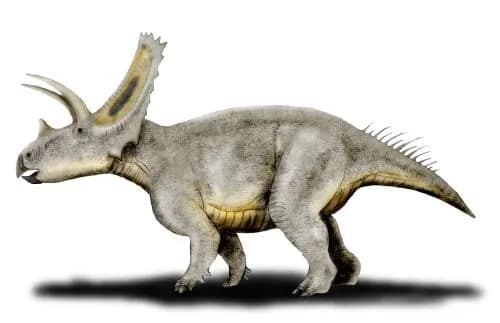
With an estimated length of 6.8 meters, a height of 2.5 meters at the shoulder, and a weight approaching 6 tonnes, Titanoceratops ranks among the largest ceratopsians known from its time period. Its massive skull measured approximately 2.65 meters in total length, including a spectacular bony frill adorned with prominent epioccipital horns along its margin. The two supraorbital horns were particularly long and robust, far exceeding those of most contemporary ceratopsids in both length and thickness. A more modest nasal horn completed an impressive defensive arsenal that rivaled that of the later Triceratops.
A strict herbivore, Titanoceratops fed primarily on the low, fibrous vegetation typical of the Late Cretaceous, including ferns, cycads, low-growing conifers, and primitive angiosperms that were rapidly diversifying during this geological period. Its powerful horny beak, characteristic of ceratopsians, allowed it to efficiently section tough stems and branches that other herbivores could not process. Complex dental batteries ensured effective vertical grinding of resistant plant materials. Its large body size gave it access to a wide range of food resources across the forested and coastal plain environments of New Mexico.
Titanoceratops inhabited the coastal plains and subtropical forests of southwestern North America, in what is now New Mexico. Its fossils come from the Fruitland Formation and Kirtland Formation, sedimentary deposits rich in Late Campanian remains. The environment of the time included meandering rivers, swamps, and dense forests dominated by conifers and angiosperms. The warm, humid climate fostered remarkable biodiversity, with numerous dinosaur species coexisting in this productive ecosystem alongside crocodilians, turtles, and early mammals that thrived in the understory vegetation.
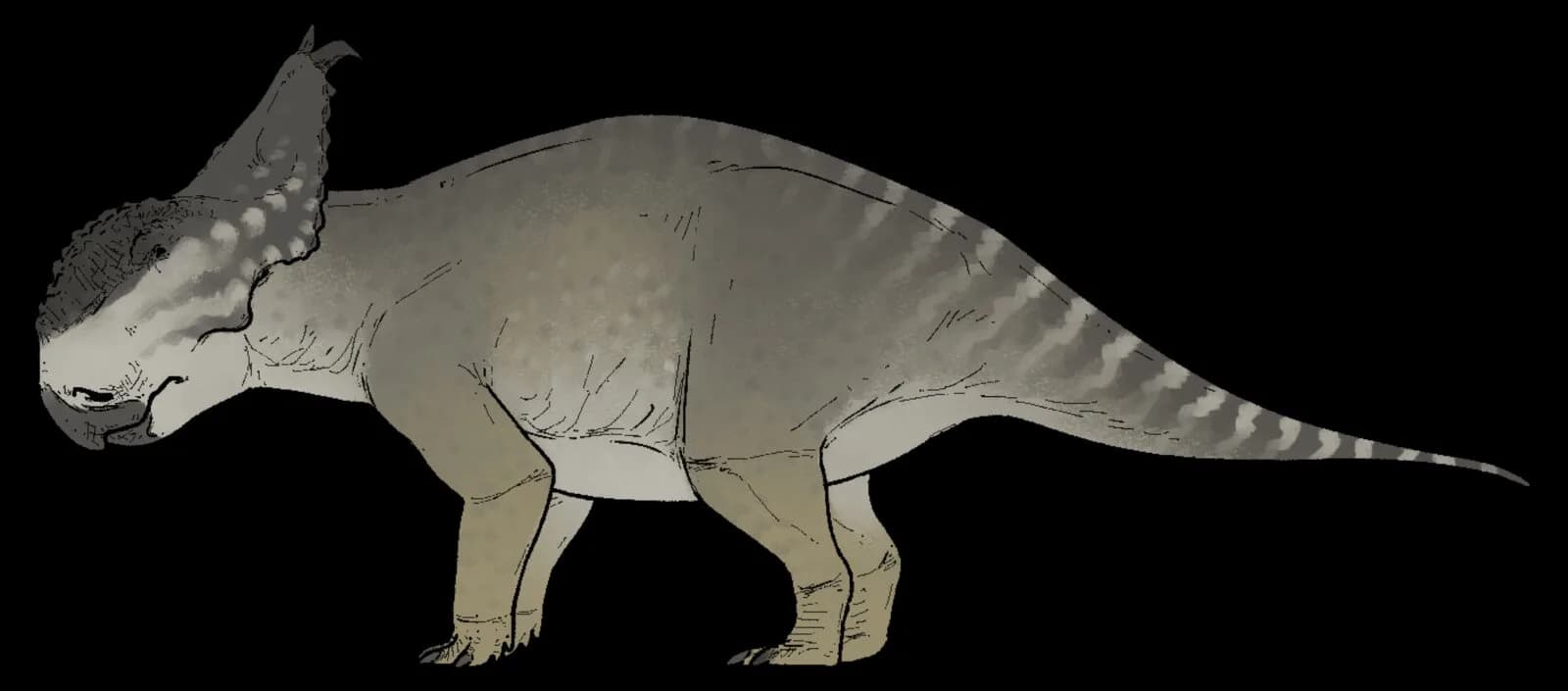
The anatomy of Titanoceratops is dominated by its colossal skull, one of the largest among all ceratopsians. The parietal-squamosal frill, likely fenestrated unlike that of Triceratops, extended broadly rearward and bore decorative bony spines along its margins. The supraorbital horns were long and curved forward, forming formidable weapons for both defense and intraspecific combat. The massive body rested on four robust limbs, with the forelimbs slightly shorter than the hindlimbs, creating a characteristic forward-leaning posture. The relatively short, thick tail served as a counterbalance to the monumental skull.
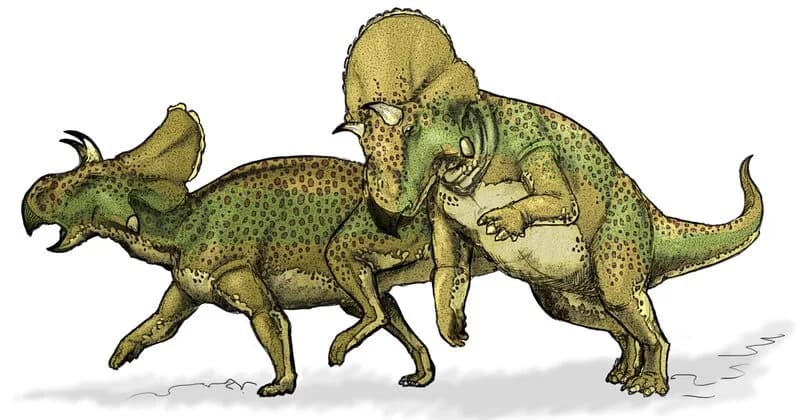
Titanoceratops likely exhibited social behavior similar to that of other large ceratopsians, living in small groups or loose herds for protection against predators such as tyrannosaurs. Its imposing horns and frill almost certainly served during ritualized combat between males competing for access to females, as evidenced by healed injuries observed on fossils of related ceratopsians. The richly vascularized frill could also serve as a visual signal for intraspecific recognition and thermoregulation. When confronted by predators, it could charge with considerable force using its massive horns.
The holotype of Titanoceratops (OMNH 10165) was collected in 1941 in San Juan County, New Mexico, from the Kirtland Formation. For nearly 70 years, this specimen was considered an exceptionally large example of Pentaceratops sternbergii. In 2011, paleontologist Nicholas Longrich of Yale University reexamined the skull and concluded it belonged to a distinct genus, which he named Titanoceratops ouranos. This reclassification sparked an animated debate within the scientific community, with some researchers contesting the validity of the genus. The specimen is housed at the Sam Noble Oklahoma Museum of Natural History.
| Period | Crétacé supérieur / Late Cretaceous |
| Era | Mésozoïque / Mesozoic |
| Age | 74 Ma |
| Location | Nouveau-Mexique, États-Unis / New Mexico, USA |
| Length | 6.8 m |
| Height | 2.5 m |
| Weight | 6 tonnes |
| Discovery | 1941 |
The skull of Titanoceratops ouranos measured approximately 2.65 meters in total length, including a spectacular bony frill adorned with prominent epioccipital horns. For an animal 6.8 meters long and weighing around 6 tonnes, this skull rivals Triceratops in dimensions, even though Titanoceratops predates it by 8 million years.
The question remains debated. Nicholas Longrich of Yale University reclassified the holotype specimen (OMNH 10165) in 2011 as a distinct genus, Titanoceratops ouranos. Some paleontologists contest this decision, arguing it represents a large individual of Pentaceratops sternbergii. The fossil, collected in 1941 in New Mexico, had been classified as Pentaceratops for 70 years.
Titanoceratops ouranos lived approximately 74 million years ago, during the Campanian stage of the Late Cretaceous, in what is now New Mexico. Its fossils come from the Fruitland and Kirtland Formations. This ceratopsian predates Triceratops by several million years and is considered a possible ancestor of the large chasmosaurine ceratopsids of the Maastrichtian.
Artistic reconstruction of Titanoceratops ouranos
Nobu Tamura, CC BY-SA 3.0
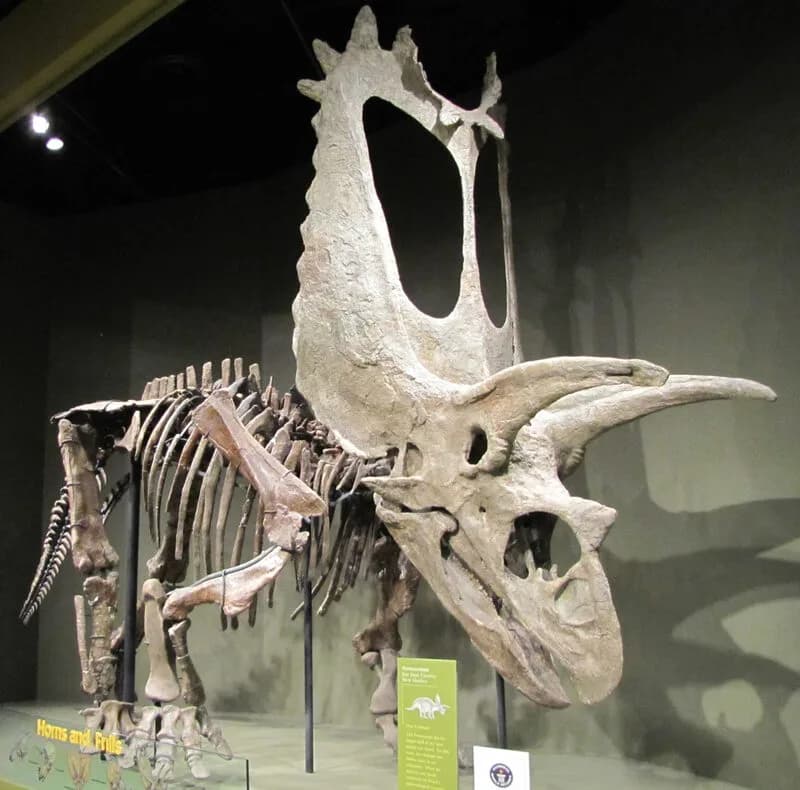
Titanoceratops reconstruction showing the massive frill
Wikimedia Commons, CC BY-SA