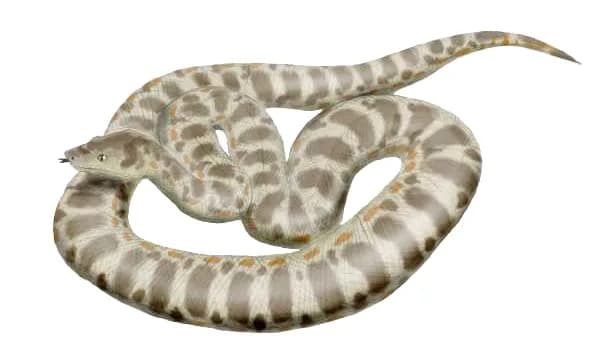
Titanoboa
Titanoboa cerrejonensis is the largest snake of all time: 12.8 to 14.3 metres and around 1,135 kilograms, twice the length and ten times the mass of the largest living anaconda. It was uncovered in the Cerrejón mine in Colombia and described in 2009. It moved 60 to 58 million years ago, five million years after the dinosaurs vanished.
Titanoboa lived during the Middle Paleocene, approximately 60 to 58 million years ago (Selandian-Thanetian). This colossal snake appeared only 5 million years after the Cretaceous-Paleogene (K-Pg) mass extinction that wiped out non-avian dinosaurs. At that time, Earth was experiencing a remarkable climatic optimum: average tropical temperatures reached 32 to 33 degrees Celsius, some 5 to 8 degrees higher than today. These extreme heat and humidity conditions in the tropical forests of northern South America allowed ectotherms (cold-blooded animals) to reach unprecedented dimensions. Titanoboa is the largest snake ever discovered, vastly surpassing the largest modern boas and anacondas. Its emergence so soon after the K-Pg boundary demonstrates how rapidly reptilian megafauna filled the ecological niches left vacant by the dinosaurs.
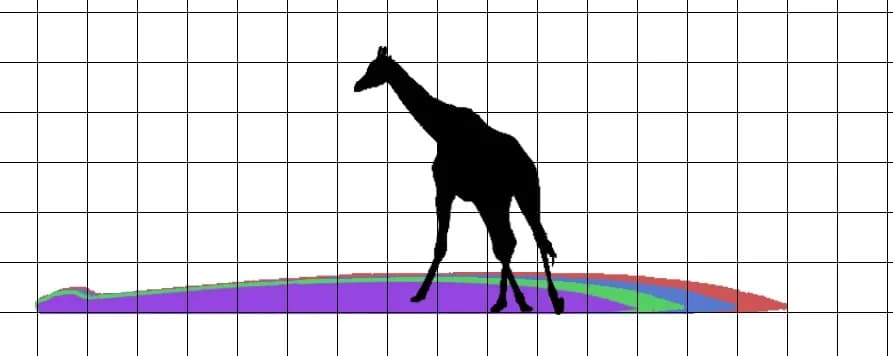
Titanoboa cerrejonensis is the largest snake that ever existed. The most reliable estimates, based on 28 fossil vertebrae from multiple individuals, indicate a total length of 12.8 to 14.3 meters and a body mass of approximately 1,135 kilograms. Its maximum body diameter reached nearly 1 meter at the widest section. For comparison, the largest living snake — the green anaconda (Eunectes murinus) — rarely exceeds 6 meters and 100 kg. Titanoboa was therefore more than twice as long and ten times heavier than the largest known anaconda. The estimation method relies on allometric regression between vertebral size and total length in extant Boidae, as applied by Head et al. (2009).
An apex semi-aquatic predator, Titanoboa hunted in the warm waters of Paleocene swamps and rivers in Colombia. Its primary prey included large freshwater fish — notably lungfish (Dipnoi) and perciform fish that could exceed 2 meters — as well as primitive crocodilians such as Cerrejonisuchus improcerus (1.8 m) and Acherontisuchus guajiraensis (4.5 m), which coexisted in the same Cerrejon ecosystem. Large freshwater turtles likely supplemented its diet. Like modern anacondas, Titanoboa most likely killed by constriction, coiling its massive loops around prey to suffocate it before swallowing it whole. Its slow ectothermic metabolism, typical of large reptiles, allowed it to survive for several weeks between substantial meals, making each hunt a high-stakes but infrequent event.
Titanoboa inhabited the humid tropical forests and vast Paleocene river systems in what is now northern Colombia. The Cerrejon ecosystem reconstructed by paleobotanists was a dense closed-canopy rainforest, traversed by broad meandering rivers and dotted with freshwater swamps and lakes. Average annual temperatures exceeded 30 degrees Celsius with abundant rainfall throughout the year. This warm, perpetually wet aquatic environment was ideal for a giant ectothermic snake requiring high ambient temperatures to maintain its metabolism and support its enormous body mass. The fossil site is located in the Cerrejon open-pit coal mine in the department of La Guajira. Paleobotanical evidence from the same formation reveals the earliest known neotropical rainforest, with flora including palms, legumes, and giant-leafed plants similar to modern tropical species.
Titanoboa's anatomy is known primarily from its thoracic vertebrae, which are remarkably large and robust. Each vertebra measures approximately 12 centimeters across — nearly double those of the largest anaconda. Vertebral morphology indicates a phylogenetic relationship with Boidae (the family including boas and anacondas) rather than with pythons or venomous snakes. Its body was cylindrical and massive, probably ventrally flattened to facilitate swimming in shallow waterways. Contrary to popular depictions, Titanoboa was not venomous: it was a pure constrictor. Its jaw could dislocate to swallow prey considerably wider than its head, thanks to the kinetic cranial bones typical of snakes.
Titanoboa most likely adopted a semi-aquatic lifestyle comparable to the modern green anaconda. It spent most of its time submerged in warm river and swamp waters, where its colossal mass was supported by buoyancy. On land, its movements would have been slow and laborious due to its enormous weight. An ambush predator, it likely hunted by lying in wait for fish, crocodilians, or turtles to come within striking range. Constriction was its primary weapon: its coils exerted an estimated pressure exceeding 400 pounds per square inch, sufficient to crush the ribs of any prey of its era. Like large modern snakes, it probably ate only once every few weeks.
Titanoboa was discovered in 2009 at the Cerrejon coal mine in the department of La Guajira in northern Colombia. Paleontologists Jonathan Bloch (University of Florida) and Jason Head (University of Nebraska) described the species Titanoboa cerrejonensis from 28 fossil vertebrae of several individuals, collected between 2004 and 2007 during joint expeditions with the Smithsonian Tropical Research Institute and the Colombian Institute of Geology (Ingeominas). The holotype (UF/IGM 1) includes anterior and mid-thoracic vertebrae. In total, remains of 30 distinct individuals have been identified from the Cerrejon Formation. The Smithsonian National Museum of Natural History presented a 14-meter life-size reconstruction in 2012 during the exhibition Titanoboa: Monster Snake. The documentary of the same name, produced by the Smithsonian Channel, popularized this discovery to the general public.
| Period | Paléocène moyen / Middle Paleocene |
| Era | Cénozoïque / Cenozoic |
| Age | 60-58 Ma |
| Location | Colombie (mine de Cerrejon) / Colombia (Cerrejon mine) |
| Length | 12.8-14.3 m |
| Height | ~1 m (diametre / diameter) |
| Weight | ~1,135 kg |
| Diet | Piscivore |
| Discovery | 2009 |
No, Titanoboa cerrejonensis was not venomous. It was a pure constrictor, related to modern boas and anacondas (family Boidae). It killed prey by coiling its loops around them and squeezing them to suffocation, exerting an estimated pressure exceeding 400 pounds per square inch. This predation mode is confirmed by the vertebral morphology of Titanoboa, described by Head et al. (2009) from 28 fossil vertebrae.
Titanoboa cerrejonensis measured 12.8 to 14.3 meters long and weighed approximately 1,135 kilograms, according to estimates by Head et al. (2009) based on 28 fossil vertebrae. The largest living snake — the green anaconda (Eunectes murinus) — rarely exceeds 6 meters and 100 kg. Titanoboa was therefore more than twice as long and ten times heavier, with a maximum body diameter approaching nearly one meter.
The extraordinary size of Titanoboa cerrejonensis is directly linked to the Paleocene tropical temperatures that reached 32 to 33 degrees Celsius in what is now northern Colombia — 5 to 8 degrees higher than today. As ectotherms, snakes have their metabolism and growth accelerated by heat. These extreme heat and humidity conditions, occurring 60 to 58 million years after the dinosaur extinction, allowed reptiles to reach unprecedented sizes.
Life-size Titanoboa reconstruction at the Smithsonian
Wikipedia Commons
Titanoboa fossil vertebra compared to a modern anaconda
Ray Carson / University of Florida, CC BY 3.0