SuperCroc
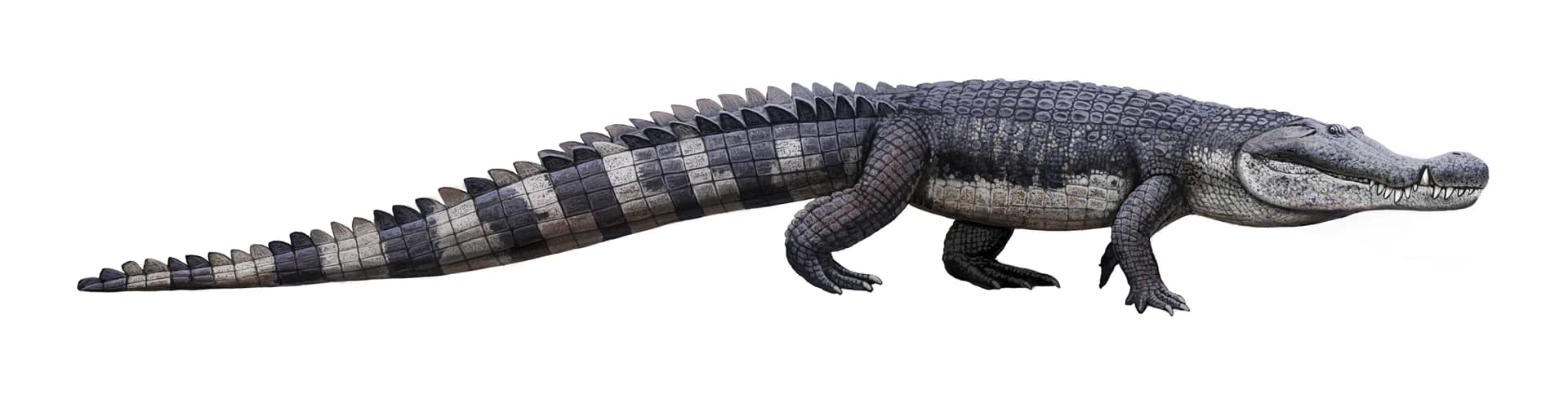
Sarcosuchus imperator was a pholidosaurid from Niger and Brazil, described in 1964 and dated to 113 to 110 million years ago. At 9 to 12 metres and 3.5 to 8 tonnes, it earned the nickname SuperCroc: twice the length of a living Nile crocodile. It was not a true crocodile though, but a distant relative predating modern crocodilians.
Playable in Path of Titans
See Sarcosuchus imperator's stats, abilities and role on our survival server.
Sarcosuchus lived during the Early Cretaceous, approximately 113 to 110 million years ago (Aptian-Albian), some 30 million years before the great tyrannosaurid dinosaurs. This giant crocodylomorph — to be formally distinguished from true crocodiles (Crocodylia), which would not appear until later — roamed the rivers and freshwater lakes of the Gondwana supercontinent. It inhabited what is now the Sahara Desert, in an Africa that was then lush and crisscrossed by vast river systems. Sarcosuchus belongs to the family Pholidosauridae, a group of basal neosuchians that went extinct well before the appearance of modern crocodilians. Its coexistence with Spinosaurus in the same geological formation (Elrhaz/Tegama) makes it a key player in the aquatic ecosystems of Cretaceous North Africa.
Sarcosuchus imperator ranked among the largest crocodyliforms that ever existed. Its total length is estimated between 9 and 12 meters, with a massive skull approximately 1.6 meters long — nearly the size of an adult human. Its body mass ranged between 3.5 and 8 tonnes depending on estimates, with the oldest individuals being the most imposing due to continuous lifelong growth (indeterminate growth). Unlike modern crocodilians that reach adult size in 10-15 years, growth ring analysis of its osteoderms reveals that Sarcosuchus took approximately 50 to 60 years to reach maximum size, an extraordinarily slow growth rate even for a reptile.
As the dominant semi-aquatic predator, Sarcosuchus fed primarily on large freshwater fish, notably coelacanths and lungfish (dipnoi) that abounded in Cretaceous African rivers. However, its colossal size and powerful jaws also allowed it to attack medium-sized dinosaurs venturing to the water's edge. Its conical, interlocking teeth, typical of piscivorous crocodylomorphs, were designed to seize and retain slippery prey rather than to tear flesh. The characteristic bulla (bony swelling) at the tip of its snout may have served as a sensory amplifier to detect prey vibrations in water, or as a vocal resonance organ.
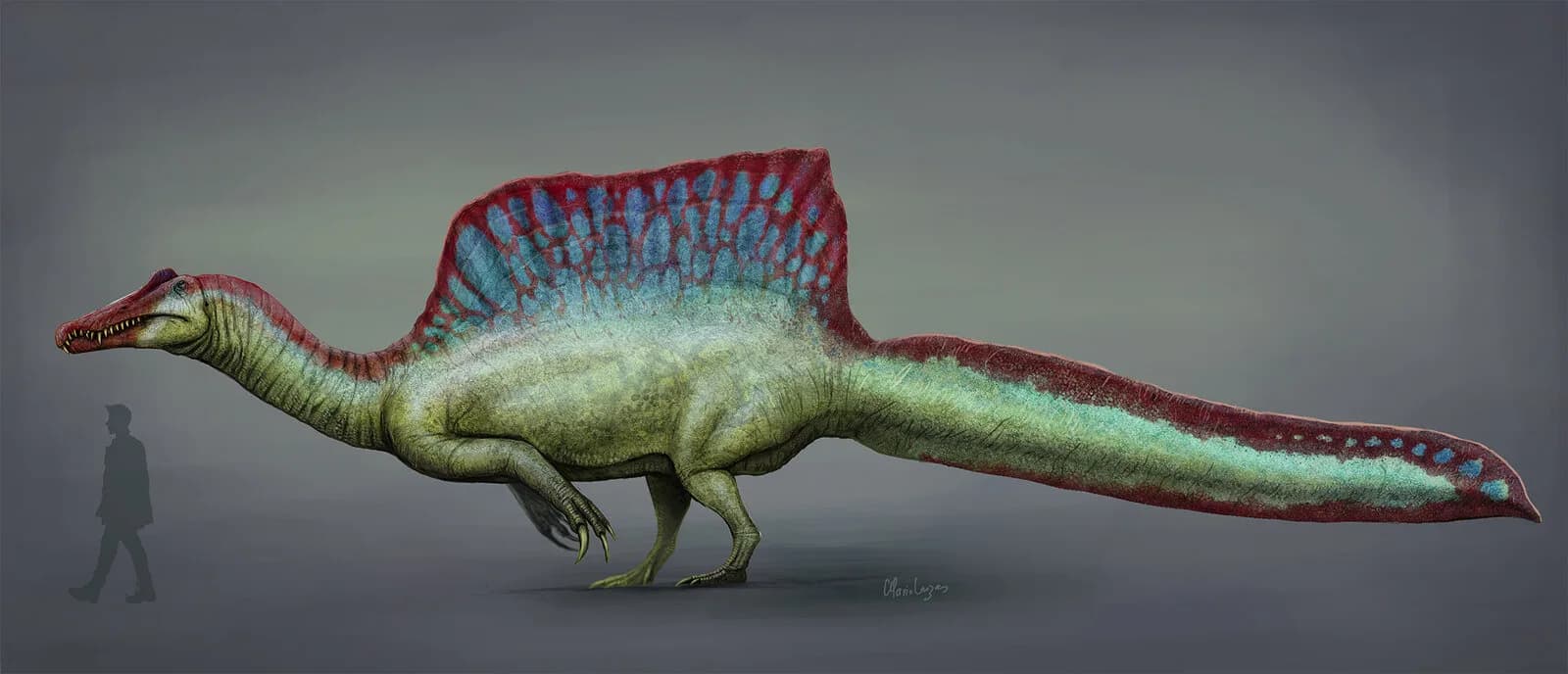
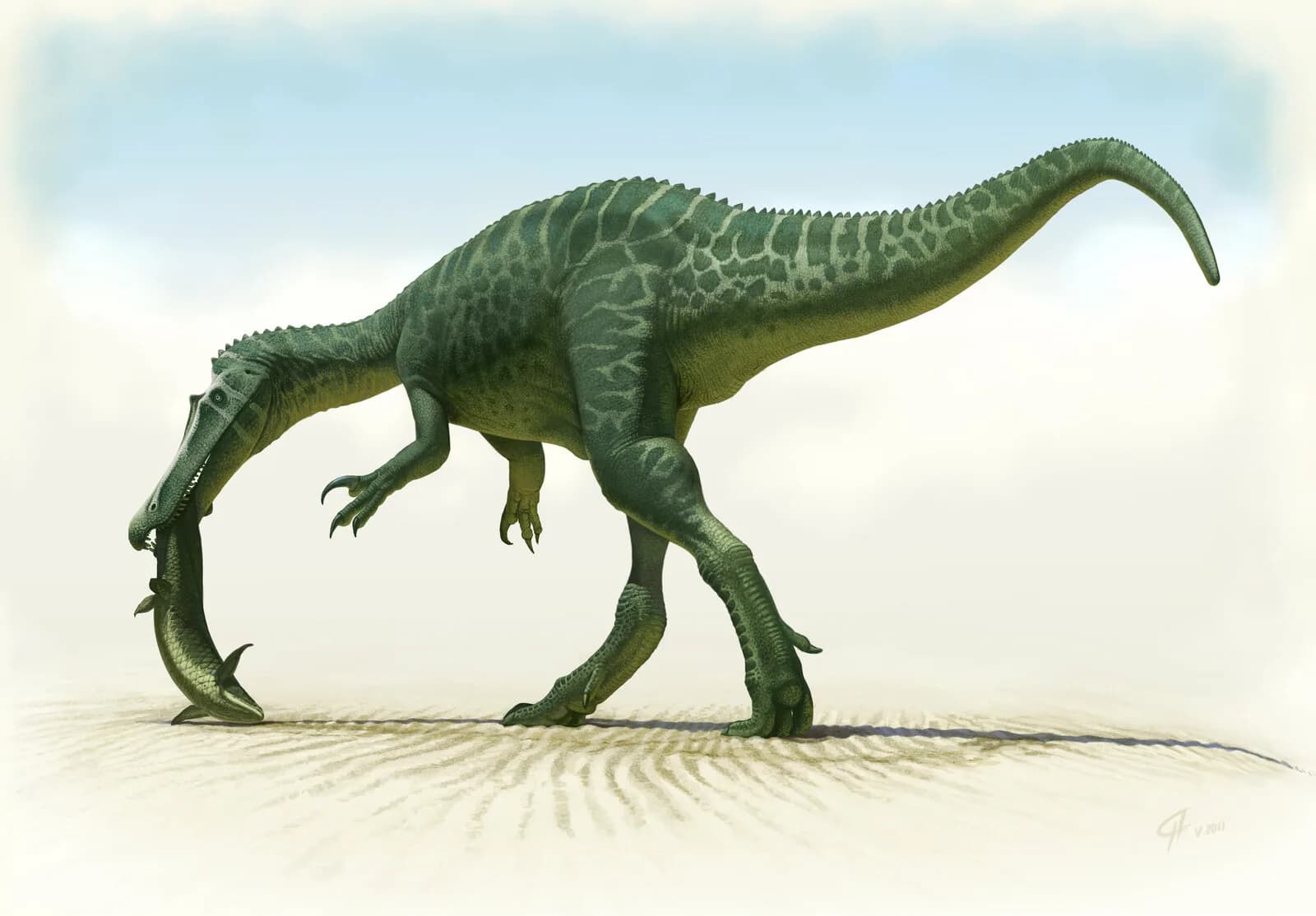
Sarcosuchus inhabited the vast riverine and lacustrine systems of what is now the Tenere Desert in Niger, as well as regions of northeastern Brazil. During the Early Cretaceous, the modern Sahara was a lush alluvial plain traversed by wide, deep rivers bordered by conifer forests and tree ferns. The Elrhaz Formation (Tegama Group) in Niger is the primary fossil site, with the Santana Formation in Brazil as a secondary locality. Both regions were part of western Gondwana before the complete separation of Africa and South America. The Elrhaz aquatic ecosystem also harbored Spinosaurus, Suchomimus, and giant fish — fierce competition for aquatic resources.
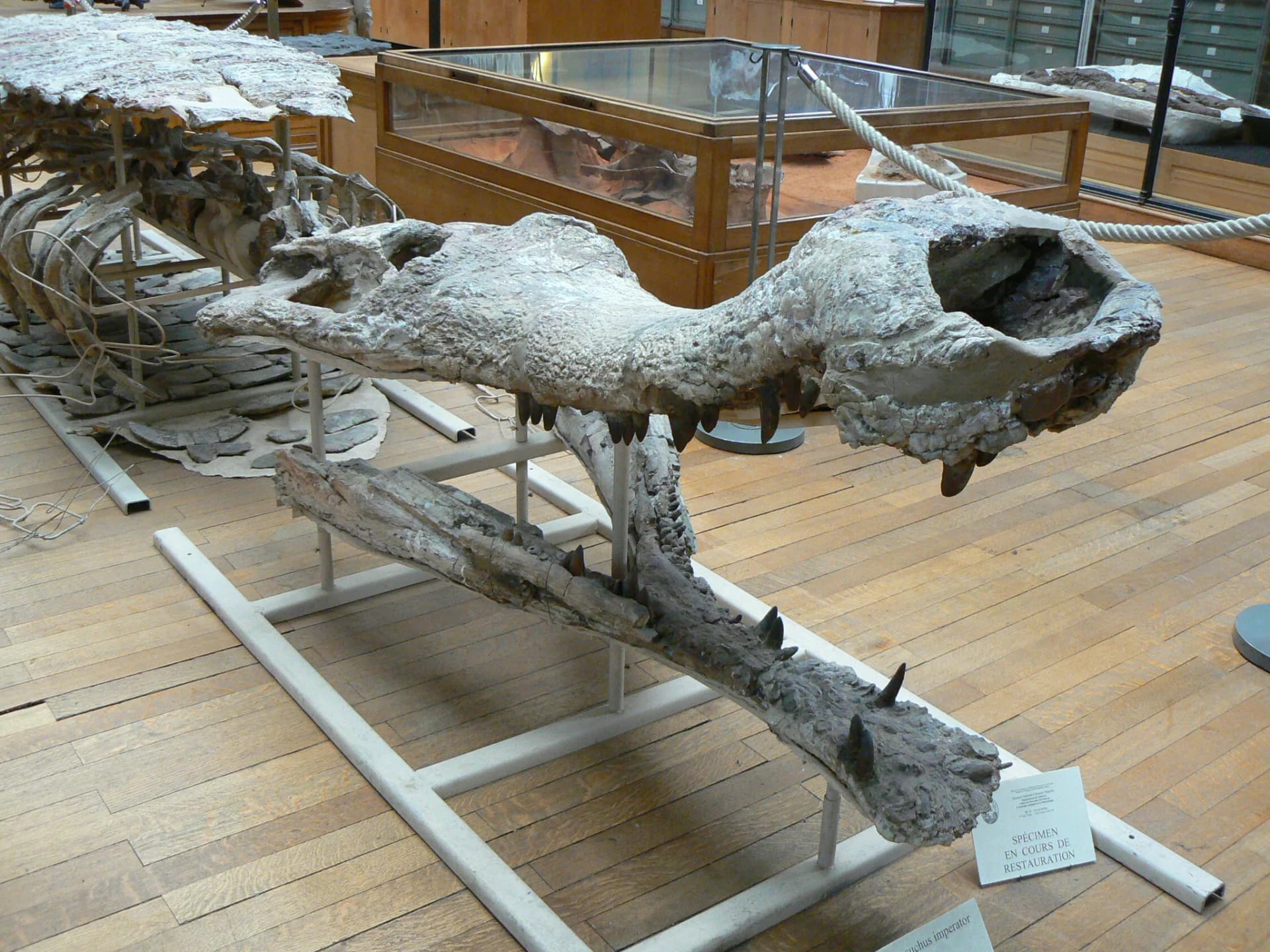
Sarcosuchus anatomy is remarkable for several distinctive characteristics. Its skull features an elongated, narrow snout (longirostrine), widened at the tip into a prominent bulla — a hollow bony swelling unique among crocodylomorphs, whose exact function remains debated (acoustic resonance, amplified olfaction, or sexual dimorphism). Its orbits are oriented slightly upward and forward, indicating partial binocular vision adapted to surface hunting. Its osteoderms (dorsal bony plates) are exceptionally developed, forming a rigid armor protecting the back and flanks. Histological analyses of these osteoderms revealed lines of arrested growth (LAGs) that allow estimating individual age, similar to tree rings.
Sarcosuchus was most likely a semi-aquatic ambush predator, spending most of its time submerged in rivers with only its eyes and nostrils breaking the surface — behavior identical to modern crocodilians. Its hunting technique consisted of patiently waiting for prey to approach the water's edge before lunging with explosive speed over a short distance. Unlike modern saltwater crocodiles, Sarcosuchus was strictly freshwater (dulcicolous). Its extremely slow growth suggests a low metabolism and exceptional longevity, possibly exceeding 60 years. The nasal bulla may have played a role in intraspecific communication, producing low-frequency vocalizations audible underwater for territory marking or mate attraction.
The first remains of Sarcosuchus were discovered in 1964 by French paleontologist Albert-Felix de Lapparent in the Gadoufaoua region, in the heart of the Tenere Desert, Niger. The initial formal description was made by France de Broin and Philippe Taquet in 1966, who established the genus and species Sarcosuchus imperator (from Greek sarx 'flesh' + suchos 'crocodile', and Latin imperator 'emperor'). However, it was the exhaustive redescription by Paul Sereno and colleagues in 2001, following new Niger expeditions that unearthed much more complete specimens, that propelled Sarcosuchus to paleontological celebrity status under the nickname 'SuperCroc.' The 2001 National Geographic documentary 'SuperCroc' contributed to its worldwide popularity. The principal specimens are housed at the National Museum of Niger (Niamey) and the University of Chicago.
| Period | Crétacé inférieur / Early Cretaceous |
| Era | Mésozoïque / Mesozoic |
| Age | 113-110 Ma |
| Location | Niger (Ténéré), Brésil / Niger (Ténéré Desert), Brazil |
| Length | 9-12 m |
| Height | 1.5-2 m |
| Weight | 3.5-8 tonnes |
| Diet | Piscivore |
| Discovery | 1964 |
No, Sarcosuchus imperator was not a true crocodile. It was a pholidosaurid — a basal crocodylomorph of the family Pholidosauridae, distinct from true crocodilians (Crocodylia) which would not appear until later in evolution. Sarcosuchus lived 113 to 110 million years ago during the Early Cretaceous, in rivers of Gondwana now corresponding to the Tenere Desert in Niger. It coexisted with Spinosaurus in the same geological formation.
Sarcosuchus imperator took approximately 50 to 60 years to reach its maximum size of 9 to 12 meters, according to analysis of lines of arrested growth (LAGs) in its osteoderms. This is three to four times slower than a modern Nile crocodile, which reaches adult size in 15 years. This indeterminate lifelong growth explains why the oldest specimens could weigh up to 8 tonnes.
The bulla — the characteristic hollow bony swelling at the tip of Sarcosuchus imperator's snout — remains one of the mysteries of this species. The main hypotheses are: a vocal resonance organ for underwater and territorial communication, a sensory amplifier to detect prey vibrations in the water, or a sexual dimorphism trait. None of these hypotheses has yet been definitively confirmed by available fossil data.
Sarcosuchus imperator fossil skull showing the characteristic nasal bulla
Wikipedia Commons
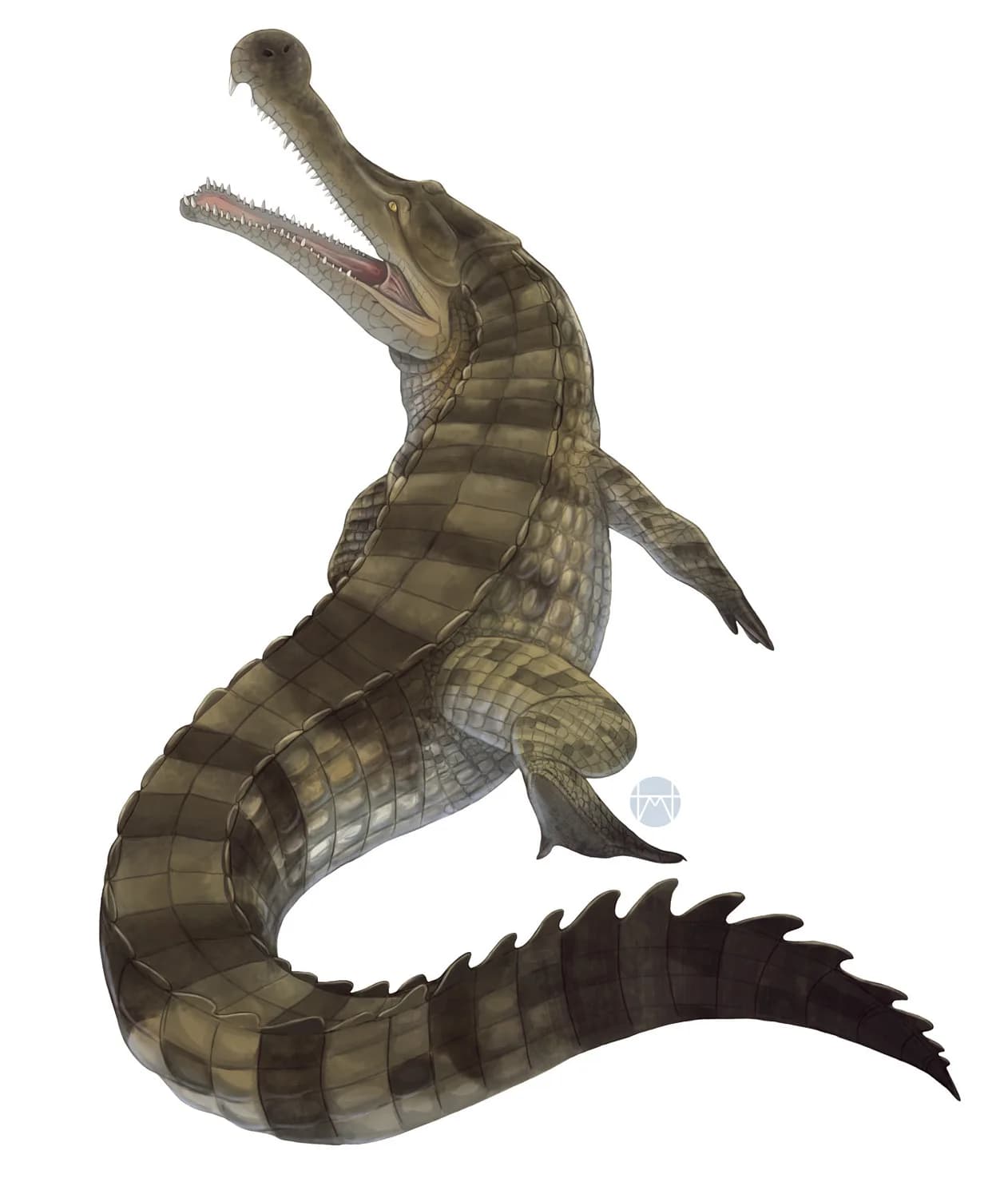
Sarcosuchus imperator life reconstruction in its Cretaceous riverine environment
Nobu Tamura, CC BY-SA 4.0