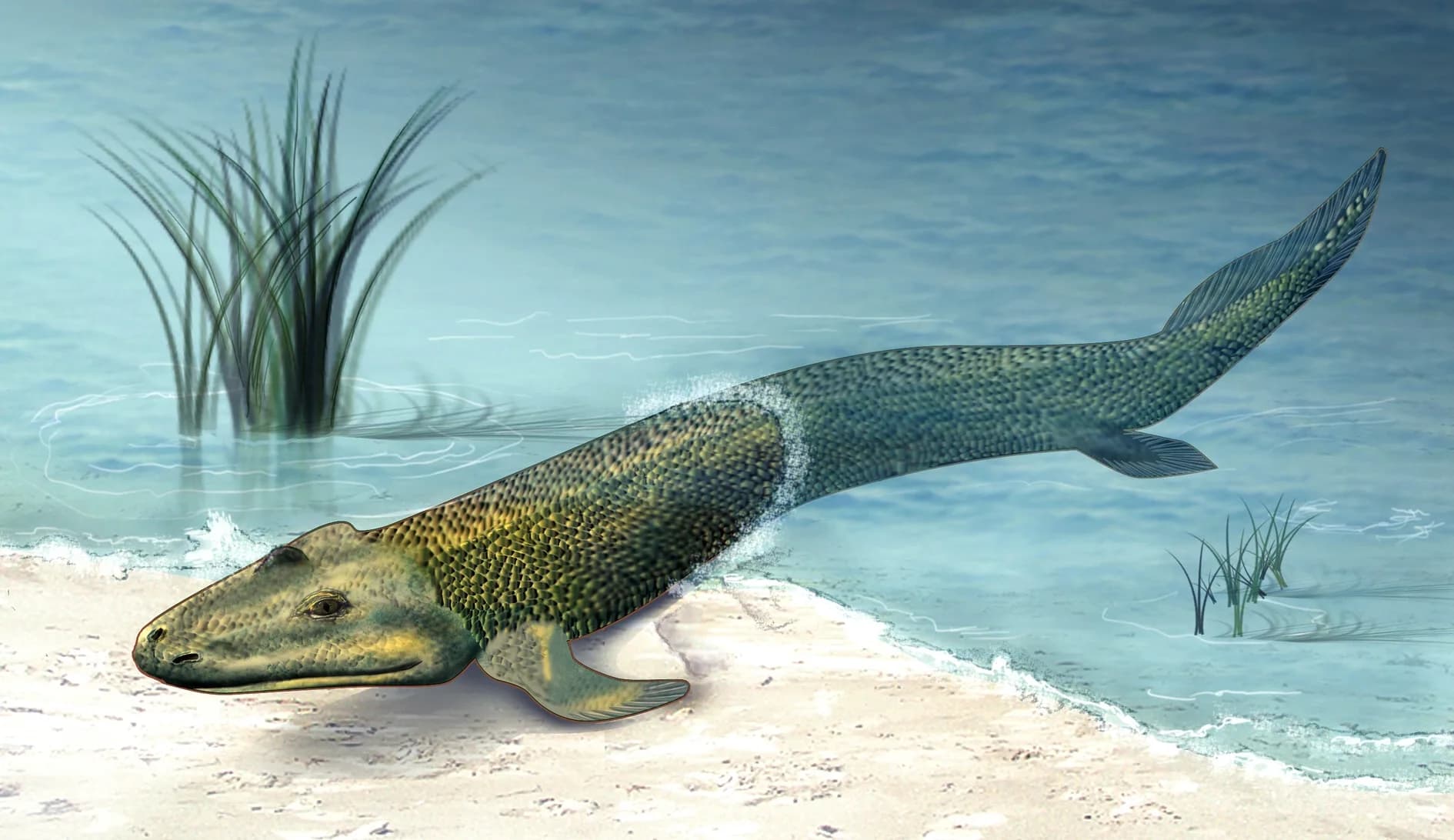
Tiktaalik
Tiktaalik roseae was not found by chance: Neil Shubin targeted Devonian rocks of a precise age and setting on geological maps, then dug where the fossil ought to be. About 2.7 metres long and 20 to 50 kilograms, unearthed on Ellesmere Island in 2004, it dates to some 375 million years ago. Its name means « large freshwater fish » in Inuktitut.
Tiktaalik roseae lived during the Late Devonian period, approximately 375 million years ago, at a pivotal moment in the history of life on Earth when the first vertebrates were beginning to colonize land. This lobe-finned fish belongs to the order Elpistostegalia, a group of sarcopterygians positioned at the precise boundary between fish and tetrapods. The Late Devonian was characterized by globally high temperatures, an oxygen-rich atmosphere, and vast tropical floodplains crisscrossed by shallow waterways — an ideal setting to drive the transition from aquatic to terrestrial life. Tiktaalik represents one of the most important links ever discovered in this fundamental transition that would eventually lead to all land-dwelling vertebrates, including humans.
Tiktaalik measured approximately 2.7 meters in length, making it one of the largest predators in its freshwater ecosystem. Its body was dorsoventrally flattened, with an estimated width of about 40 centimeters and a height of only around 30 centimeters — an ideal shape for navigating very shallow waters. Its triangular, flattened skull measured roughly 30 centimeters long, resembling a crocodile more than a typical fish. Its weight is estimated at 20 to 50 kilograms. Its robust pectoral fins, equipped with proto-joints corresponding to the wrist and elbow, could support a significant portion of its body weight — a capability unique among known fish.
Tiktaalik was a carnivorous ambush predator lurking in the shallow waters of Devonian streams. Its powerful jaws, lined with sharp, pointed teeth, allowed it to capture smaller fish, aquatic invertebrates, and likely primitive terrestrial arthropods that ventured near the water's edge. The dorsal position of its eyes, similar to modern crocodiles, suggests a sit-and-wait hunting strategy: Tiktaalik would remain motionless, partially submerged, watching for prey from the surface before striking with speed. Its robust fins also enabled it to propel itself through extremely shallow waters and even across temporarily exposed muddy surfaces, giving it access to hunting grounds inaccessible to conventional fish.
Tiktaalik inhabited shallow streams, deltas, and tropical floodplains of what is now Ellesmere Island in the Canadian Arctic. During the Late Devonian, this region lay near the equator and enjoyed a warm, humid subtropical climate, with meandering rivers flowing across vast alluvial plains. These warm, shallow freshwater environments, dotted with primitive aquatic vegetation, provided an ideal habitat for an animal capable of moving both in water and on exposed muddy surfaces. The sediments in which Tiktaalik was preserved — fine-grained fluvial sandstones — testify to these meandering river and floodplain environments where the boundary between aquatic and terrestrial realms was constantly shifting.
Tiktaalik's anatomy constitutes an extraordinary blend of fish and tetrapod characteristics, making it one of the most remarkable transitional fossils in the history of paleontology. On the fish side, it retained scales, fin rays, and functional gills. On the tetrapod side, it possessed a flattened skull with dorsally positioned eyes, a mobile neck — an absolute first among fish, which have their heads fused to their bodies — robust ribs capable of supporting its weight out of water, and most importantly, pectoral fins containing bones homologous to the humerus, radius, ulna, and proto-wrist elements. These fins functioned as primitive arms, allowing it to prop itself up and push forward on the substrate. This anatomical mosaic perfectly illustrates how evolution proceeds through gradual modifications rather than sudden leaps.
Tiktaalik likely behaved as a semi-aquatic predator, spending most of its time in shallow water but capable of brief excursions onto land. Its robust pectoral fins, equipped with proto-wrist joints, allowed it to haul itself out of the water and crawl across muddy banks — behavior comparable to the modern mudskipper, but on a much larger scale. Its ability to turn its head independently of its body, thanks to its mobile neck, gave it a considerable advantage in spotting prey and predators without moving its entire body. This primitive amphibious behavior represented a major evolutionary advantage: accessing new food sources on land while retaining the ability to retreat to the safety of water when threatened.
Tiktaalik was discovered in 2004 on Ellesmere Island in the Nunavut territory of Arctic Canada by a team led by paleontologists Neil Shubin, Edward Daeschler, and Farish Jenkins. This discovery was no accident: the team had specifically targeted Devonian rocks approximately 375 million years old, hoping to find a transitional fossil between fish and tetrapods. After five years of excavation in extreme Arctic conditions, their perseverance was rewarded with the unearthing of several remarkably well-preserved specimens. The name 'Tiktaalik' means 'large freshwater fish' in Inuktitut, the language of the Inuit people of Nunavut, chosen in consultation with local community elders. Neil Shubin published the 2008 bestseller Your Inner Fish, recounting the story of this discovery and explaining how Tiktaalik illuminates our own anatomy. This discovery now features in every evolution textbook as one of the most important transitional fossils ever found.
| Period | Dévonien supérieur / Late Devonian |
| Era | Paléozoïque / Paleozoic |
| Age | ~375 Ma |
| Location | Île d'Ellesmere, Arctique canadien / Ellesmere Island, Canadian Arctic |
| Length | ~2.7 m |
| Height | ~0.3 m |
| Weight | ~20–50 kg |
| Diet | Carnivore |
| Discovery | 2004 |
Tiktaalik roseae is a lobe-finned fish of the order Elpistostegalia, positioned exactly at the boundary between fish and tetrapods. It retained scales, fin rays, and gills (fish side), but possessed a mobile neck, flattened skull, weight-bearing ribs, and pectoral fins with homologs of the humerus, radius, ulna, and wrist bones (tetrapod side). This anatomical mosaic makes it one of the most important transitional fossils ever discovered.
Tiktaalik roseae was discovered in 2004 on Ellesmere Island (Nunavut, Canada) by a team led by Neil Shubin, Edward Daeschler, and Farish Jenkins. The discovery was no accident: after five years of excavations targeting Devonian rocks approximately 375 Ma old, the team was rewarded with several remarkably well-preserved specimens. The name 'Tiktaalik' means 'large freshwater fish' in Inuktitut, chosen in consultation with Nunavut Inuit elders.
Tiktaalik roseae had a mobile neck — an absolute first among fish, whose head is normally fused to the body. Its pectoral fins contained bones homologous to the humerus, radius, ulna, and proto-wrist elements of modern tetrapods, including humans. As Neil Shubin explains in Your Inner Fish (2008), the bones in your arm and hand are directly homologous to the fin structures of Tiktaalik, 375 million years old.
Life reconstruction of Tiktaalik roseae in its habitat
Zina Deretsky/NSF, Public domain, via Wikimedia Commons
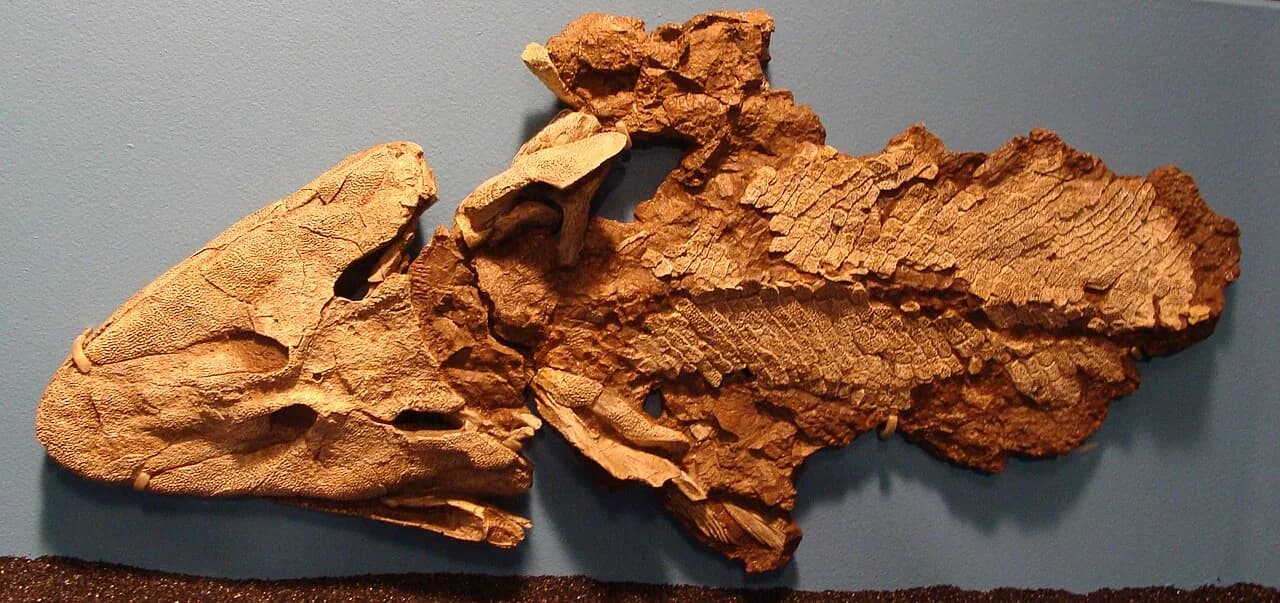
Reconstruction of Tiktaalik roseae
Nobu Tamura, CC BY-SA 3.0, via Wikimedia Commons