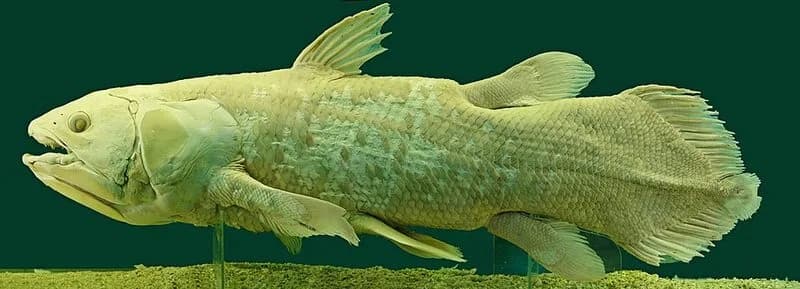
Cœlacanthe
Latimeria chalumnae, the coelacanth, was presumed gone for 66 million years until a living specimen was caught off South Africa in 1938. It measures 1.5 to 2 metres and 60 to 100 kilograms, and haunts the Indian Ocean and Indonesian waters. Its lobed fins move in alternation, like a walking horse's legs, foreshadowing tetrapod locomotion.
Coelacanths belong to the order Coelacanthiformes, which first appeared in the Middle Devonian approximately 410 million years ago. These lobe-finned fish thrived throughout the Paleozoic and Mesozoic eras, surviving at least four mass extinction events. They were believed extinct since the end of the Cretaceous, 66 million years ago, until the stunning discovery of a living specimen in 1938 off South Africa. This rediscovery sent shockwaves through the scientific world, comparable to finding a living dinosaur. The coelacanth has since become the iconic embodiment of the concept of a living fossil.
The modern coelacanth Latimeria chalumnae averages 1.5 meters in length, with the largest specimens reaching up to 2 meters. Its weight ranges between 60 and 100 kilograms, with females generally bulkier than males. Fossil species exhibited a wide variety of sizes, some measuring only 10 centimeters while others exceeded 3 meters. The second living species, Latimeria menadoensis, discovered in Indonesia in 1997, has similar dimensions. Compared to other deep-sea fish, the coelacanth is remarkably massive, with a robust body and thick armored scales giving it an imposing primitive silhouette.
The coelacanth is a nocturnal predator feeding primarily on deep-water fish and cephalopods. Its diet includes squid, cuttlefish, small sharks, eels, and various benthic fish found near the seafloor. Its hunting technique relies on slow, silent drifting facilitated by its articulated lobed fins, followed by rapid suction of prey using its unique intracranial joint. This hinge divides the skull into two sections, allowing the upper jaw to lift considerably and increasing oral volume to generate powerful suction. It hunts primarily at night in submarine caves and along volcanic slopes.
The coelacanth inhabits deep waters of the western Indian Ocean and Indonesian coasts, at depths between 150 and 700 meters. Latimeria chalumnae primarily dwells in the waters around the Comoros Islands, South Africa, Mozambique, Madagascar, and Tanzania. The Indonesian species Latimeria menadoensis inhabits deep waters off Sulawesi. During daylight, these fish shelter in submarine caves and volcanic cavities, sometimes forming small aggregations. At night, they descend along steep rocky slopes to hunt. Their deep, inaccessible habitat explains why they eluded detection for millions of years.
The coelacanth's anatomy is extraordinarily primitive and unique among living fish. Its paired lobed fins, supported by articulated bony structures resembling limbs, move in an alternating pattern similar to the gait of a tetrapod — fundamental to understanding the evolution of terrestrial vertebrates. Its skull features a unique intracranial joint allowing amplified mouth opening. It possesses an electrosensory rostral organ for detecting prey electrical fields. Its notochord, a cartilaginous tube filled with pressurized oil, replaces a fully ossified vertebral column. Its thick cosmoid scales closely resemble those of Devonian-era fish.
The coelacanth leads a slow, energy-efficient existence adapted to the oxygen-poor deep marine environment. During the day, it rests passively in submarine volcanic caves, often in small groups of three to fifteen individuals, drifting lazily with subtle fin movements. At night, it leaves shelter to hunt along rocky slopes. Its locomotion is remarkable: its paired fins move in a cross-pattern alternation anticipating the walking gait of tetrapods. The coelacanth is ovoviviparous — females carry young for approximately thirteen months, an exceptionally long gestation for a fish.
The first fossil coelacanth was described by Louis Agassiz in 1836, long before the discovery of a living specimen. Over 130 fossil species have been identified spanning 400 million years, from the Devonian through the Late Cretaceous. The living fossil was discovered on December 22, 1938, by Marjorie Courtenay-Latimer, curator of the East London Museum in South Africa, among a trawler's catch. Professor J.L.B. Smith identified it and named it Latimeria chalumnae in her honor. A second specimen was not found until 1952 in the Comoros. The 1997 discovery of a second living species in Indonesia again astonished the scientific community.
| Period | Dévonien à aujourd'hui / Devonian to present |
| Era | Paléozoïque-Actuel / Paleozoic-Present |
| Age | 410-0 Ma |
| Location | Océan Indien, Indonésie / Indian Ocean, Indonesia |
| Length | 1.5-2 m |
| Height | 0.4-0.5 m |
| Weight | 60-100 kg |
| Discovery | 1938 |
Latimeria chalumnae lives at depths of 150 to 700 meters in the western Indian Ocean and Indonesian coasts, sheltering by day in submarine volcanic caves. This deep, inaccessible habitat explains why it eluded detection until December 22, 1938, when Marjorie Courtenay-Latimer recognized it in the catch of a South African trawler, astounding the global scientific community.
The paired fins of Latimeria chalumnae move in alternating cross-pattern, anticipating the walking gait of tetrapods. Supported by articulated bony structures resembling limbs, they constitute living proof of the evolutionary link between lobe-finned fish (Sarcopterygii) and the first terrestrial amphibians. The order Coelacanthiformes has been known since the Middle Devonian, 410 million years ago.
Two coelacanth species are currently known: Latimeria chalumnae, in waters around the Comoros, South Africa, Mozambique, Madagascar, and Tanzania, and Latimeria menadoensis, discovered in 1997 in deep waters off Sulawesi, Indonesia. Both average 1.5 meters in length weighing 60 to 100 kg, leading nocturnal lives in the depths.
Coelacanth (Latimeria chalumnae) photographed in the deep waters of the Comoros
Wikimedia Commons
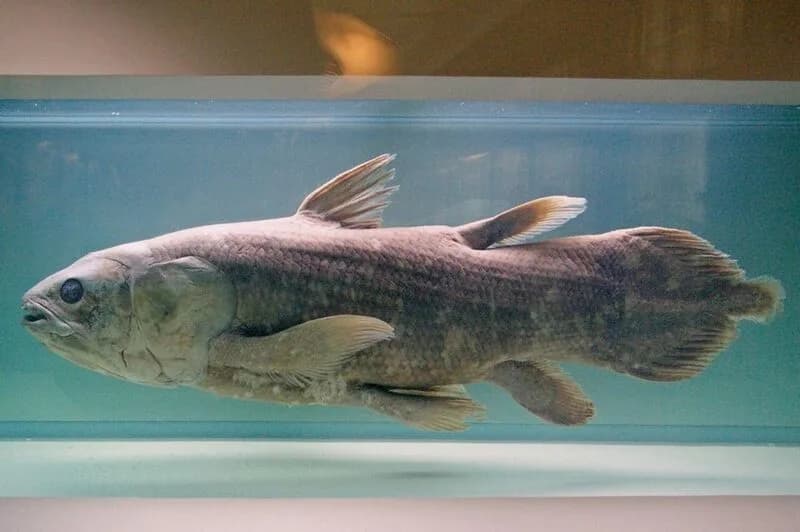
Preserved coelacanth specimen at the National Museum of Natural History
Wikimedia Commons