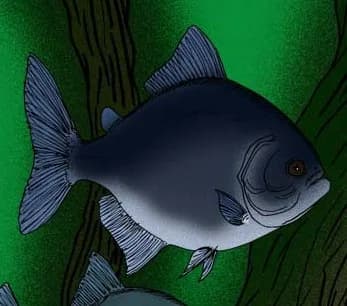
Mégapiranha
Megapiranha paranensis holds the record for bite force relative to body size among all known fishes, living or extinct. From 71 centimetres to a metre long and 10 to 15 kilograms, roughly four times a modern piranha, it was described in 2009 from the Paraná region of Argentina. It hunted 10 to 8 million years ago.
Megapiranha paranensis lived during the Middle to Late Miocene, approximately 10 to 8 million years ago, in the rivers and waterways of South America. This period of the Miocene was marked by exceptional aquatic biodiversity in South America, with tropical rivers teeming with life — fish, reptiles, and aquatic mammals coexisted in a rich and complex freshwater ecosystem. The Paraná Basin, in present-day Argentina, provided an ideal habitat for this giant predator, with its warm waters and abundant food resources. The South American Miocene was truly the golden age of characiform fish, the order to which modern piranhas and pacus belong.
Megapiranha paranensis was a massive freshwater fish, reaching an estimated length of 71 centimeters to over one meter — approximately four times the size of the largest modern piranhas. To put this size in perspective, the modern red-bellied piranha (Pygocentrus nattereri) rarely exceeds 35 centimeters. Megapiranha thus represents the largest piranha that ever lived, and one of the most imposing characiform fish ever known. Its robust and powerful body was adapted to freshwater river environments, with well-developed musculature allowing it to swim powerfully through the currents of Miocene Argentine rivers. Its estimated body mass suggests a stocky and formidably muscular animal.
Megapiranha was likely a carnivore-omnivore, similar to its modern descendants. Its extraordinarily powerful jaw allowed it to crush bones and shells with disconcerting ease, suggesting a highly diversified diet including fish, crustaceans, mollusks, and possibly small terrestrial vertebrates that ventured too close to the water's edge. The morphology of its teeth, intermediate between the cutting teeth of piranhas and the crushing teeth of pacus, indicates it could both slice flesh and crush hard materials. This dietary versatility gave it a considerable ecological advantage, allowing it to exploit a much wider range of food resources than any modern piranha or pacu species.
Megapiranha inhabited the rivers and fluvial systems of Miocene Argentina, primarily the Paraná Basin in the province of Entre Ríos. During this period, South America was an isolated continent whose freshwater aquatic ecosystems were remarkably diverse and harbored a unique endemic fauna. The tropical and subtropical rivers of the Miocene offered ideal conditions for large predatory fish, with warm temperatures, dense riparian vegetation, and an abundance of potential prey. The Paraná Basin, one of the largest river systems in South America, constituted a vast and interconnected hydrographic network that allowed large species to thrive and maintain viable populations.
The most remarkable anatomical feature of Megapiranha is its unique dentition, composed of massive teeth arranged in a distinctive zigzag pattern — a morphology intermediate between the sharp, cutting teeth of modern piranhas (Serrasalminae) and the flat, crushing teeth of pacus (Colossoma). This zigzag arrangement in a single row is considered an evolutionary transitional state between the single row of piranhas and the double row of pacus. Its masticatory muscles were extraordinarily developed, occupying an unusual proportion of the cranial volume. The bony structure of its jaw, reinforced and thickened, testifies to considerable bite forces well exceeding those of any modern freshwater fish of comparable size.
The bite force of Megapiranha is the most astonishing aspect of its predatory behavior. Biomechanical studies have estimated its bite force between 1,240 and 4,749 Newtons — an absolutely extraordinary figure relative to its body size. This bite-force-to-body-size ratio is the highest ever calculated for any fish, living or extinct, surpassing even the values obtained for the great white shark. For comparison, a modern red-bellied piranha generates approximately 72 Newtons of force with its jaws. This phenomenal bite power suggests that Megapiranha could attack armored prey, crush turtle shells, and shatter bones — predatory behavior without equivalent among modern freshwater fish.
Megapiranha paranensis is known primarily from fossil teeth discovered in Miocene fluvial deposits of the Ituzaingó Formation, in the province of Entre Ríos, Argentina. The species was formally described in 2009 by paleontologists Alberto Cione and colleagues, based on exceptionally well-preserved dental fragments that revealed the characteristic zigzag arrangement. These teeth represent a crucial transitional fossil, demonstrating the evolutionary link between piranhas and pacus — two groups of characiform fish that were previously considered more distantly related. The rarity of complete fossils is explained by the fragility of freshwater fish skeletons, which rarely preserve well in fluvial sediments.
| Period | Miocène / Miocene |
| Era | Cénozoïque / Cenozoic |
| Age | 10-8 Ma |
| Location | Paraná, Argentine / Paraná, Argentina |
| Length | 71 cm - 1 m |
| Height | ~20-30 cm |
| Weight | ~10-15 kg |
| Discovery | 2009 |
Megapiranha paranensis was a freshwater fish, not a dinosaur. Belonging to the family Serrasalmidae (the family of modern piranhas and pacus), this giant characiform lived in the Paraná Basin (present-day Argentina) during the Middle to Late Miocene, approximately 10 to 8 million years ago. It measured 71 centimeters to over one meter, roughly four times the size of the largest modern piranhas.
Biomechanical studies estimated Megapiranha paranensis bite force between 1,240 and 4,749 Newtons. This bite-force-to-body-size ratio is the highest ever calculated for any fish, living or extinct, surpassing even the great white shark. For comparison, a modern red-bellied piranha (Pygocentrus nattereri) generates approximately 72 Newtons. This jaw allowed it to crush bones and turtle shells.
Megapiranha paranensis is known primarily from fossil teeth in the Ituzaingó Formation (Entre Ríos, Argentina). Their zigzag arrangement in a single row represents an intermediate state between the single-row cutting teeth of piranhas and the double-row crushing teeth of pacus. This transitional fossil confirms the kinship between the two Serrasalmidae groups and illuminates dental evolution in characiform fish.
Megapiranha paranensis reconstruction
Wikimedia Commons
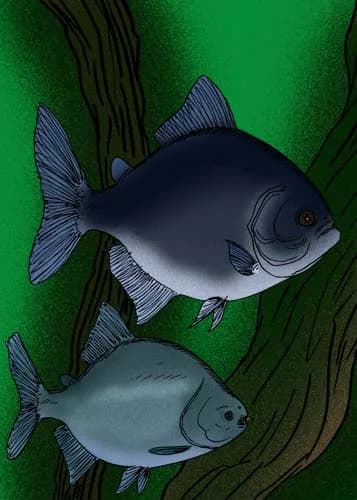
Megapiranha and Colossoma comparison
Wikimedia Commons