Thalassodromeus
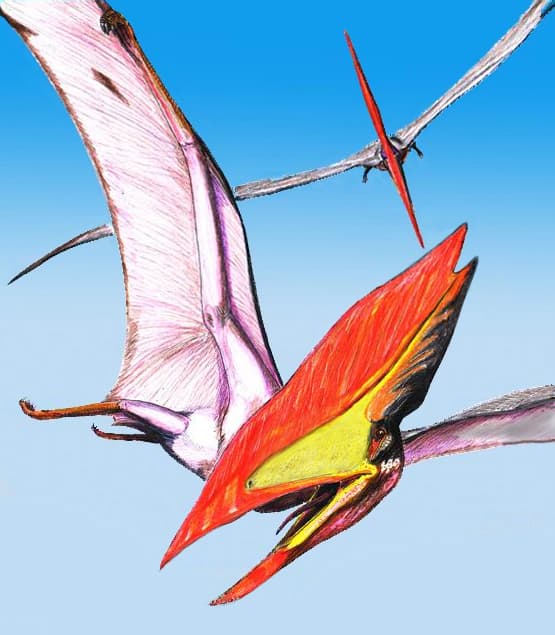
Thalassodromeus sethi carries one of the largest skulls of any vertebrate: 1.42 metres, most of it taken up by a crest. Its name means « sea runner », after the since-abandoned hypothesis that it fished by skimming the water with its beak open. The epithet sethi refers to the Egyptian god Seth. It flew over Brazil 110 to 100 million years ago.
Playable in Path of Titans
See Thalassodromeus sethi's stats, abilities and role on our survival server.
Thalassodromeus lived during the Early Cretaceous, toward the end of the Albian, about 100 to 110 million years ago. Its fossils come from the Romualdo Formation in the Araripe Basin of north-eastern Brazil — one of the most famous pterosaur deposits in the world. At that time, the region was a warm coastal area of lagoons and shallow bodies of water, rich in fish and other pterosaurs. It was in this tropical Gondwanan setting that this large, huge-crested pterosaur lived, at a time when these flying reptiles ruled the skies. The Araripe deposits, formed under particular lagoonal conditions, are renowned for preserving fossils in remarkable condition, sometimes in three dimensions, making them a privileged window onto Cretaceous Brazilian life.
Thalassodromeus was described in 2002 by Brazilian palaeontologists Alexander Kellner and Diogenes de Almeida Campos. The type species, T. sethi, owes its epithet to the Egyptian god Seth, whose crown recalled the shape of the animal's crest. The genus name means "sea runner", a reference to the originally proposed idea that it fished by skimming the water surface — an idea since widely challenged. Only the skull is well known, but its size and spectacular crest immediately made Thalassodromeus one of the most recognisable pterosaurs.
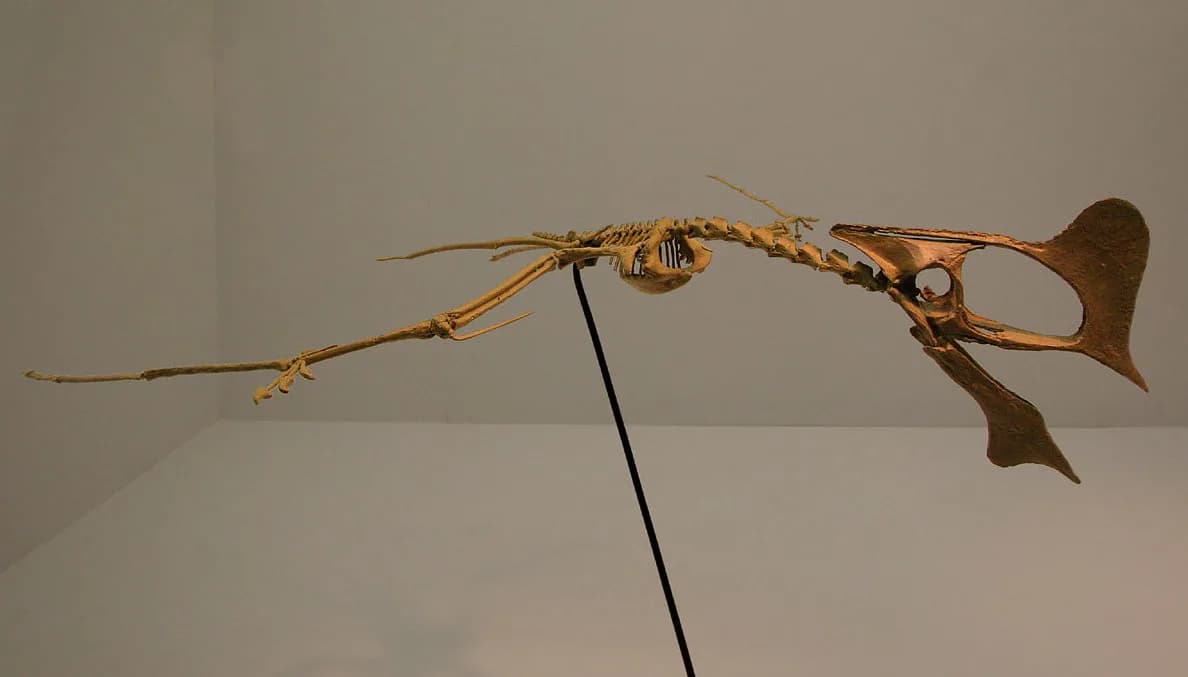
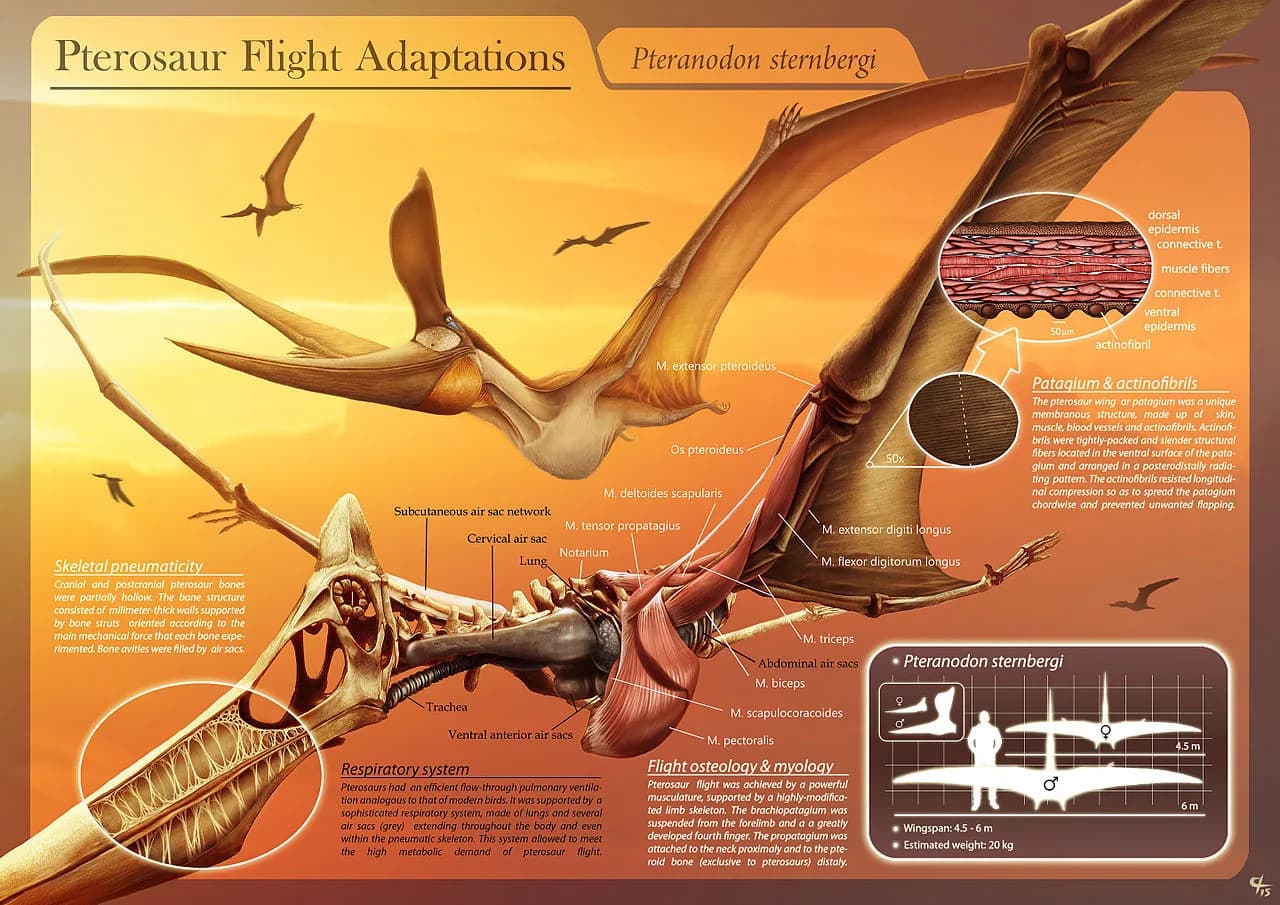
Thalassodromeus had one of the largest known skulls among pterosaurs, about 1.42 metres long. Its crest, proportionally among the largest of any vertebrate, alone took up a huge part of the head. Since only the skull is well documented, the total wingspan remains estimated, but it must have been considerable, placing Thalassodromeus among the large pterosaurs of its time. Despite these imposing dimensions, the animal stayed light: like all pterosaurs, its bones were hollow and air-filled, a condition essential to flight for a creature of this size. For comparison, its skull alone exceeded the body length of many playable dinosaurs: that shows just how oversized this animal's head was relative to the rest. This apparent imbalance was made possible by the extreme lightness of the crest and bones.
Thalassodromeus's diet has been the subject of lively debate. It was first imagined to fish by skimming the water surface, but study of its jaws showed this technique was unlikely. The hypothesis now favoured makes it a more generalist predator, on the ground as in flight, working somewhat like a modern stork, hornbill or raven. Its toothless jaws, with scissor-sharp edges, would have let it seize and slice all sorts of small prey — fish, but also small land animals. Its large size and powerful beak made it a versatile hunter. Analysis of its jaw mechanics notably showed that skim-feeding, which places very particular stresses on the beak, was not compatible with its structure. This example became a textbook case of how biomechanics can test, and sometimes refute, appealing hypotheses about the lifestyle of extinct animals.
The Araripe Basin, in the Cretaceous, was a tropical coastal region of Gondwana, of lagoons, marshes and bodies of water alternating with dry land. This environment yielded an exceptional fauna of pterosaurs, fish and other reptiles, preserved in rare detail. Thalassodromeus shared the sky with other pterosaurs, including crested forms like Tapejara and Tupandactylus. This diversity of pterosaurs in one environment suggests resource partitioning: different species exploited distinct prey and hunting techniques, reducing direct competition among these large fliers.
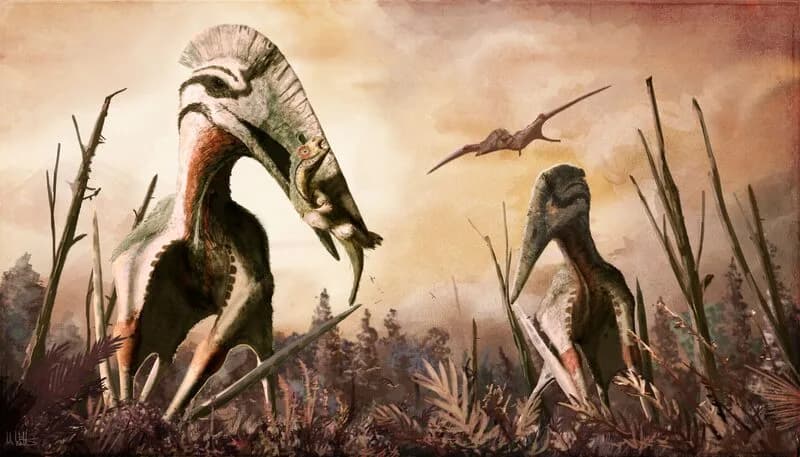
Thalassodromeus's dominant feature is its huge cranial crest, lightly built and supported by a thin bony framework, running from the tip of the snout to beyond the back of the skull, ending in a characteristic V-shaped notch. Its toothless jaws had sharp upper and lower edges, and its blade-like lower jaw may have turned slightly upward. Its skull bore a large nasoantorbital opening, typical of its group. Like all pterosaurs, its wings were formed by a membrane stretched over an extraordinarily elongated fourth finger. Together, these features outline an animal with an oversized head, built both for hunting and, no doubt, for display. A more recent revision of the genus clarified certain details of its skull and crest, confirming its originality among crested pterosaurs. The exact shape and extent of the crest make it one of the most spectacular display structures known in a flying vertebrate.
Thalassodromeus was an accomplished flier, able to cover great distances gliding over lagoons and coastal land. The function of its enormous crest remains debated: a visual signal for individual recognition and courtship, perhaps a role in temperature regulation, or both. On the hunting ground, its anatomy suggests an active, opportunistic predator able to feed on the ground as in flight. As for most pterosaurs, many aspects of its behaviour remain reconstructed from anatomy for lack of direct observation, but the picture that emerges is of a versatile, mobile hunter. In pterosaurs, flight was real and powerful: far from passive gliders, these animals actively flapped their wings and could take off from the ground. Thalassodromeus, with its large size, must have combined flapping flight and long gliding phases to save energy above the lagoons.
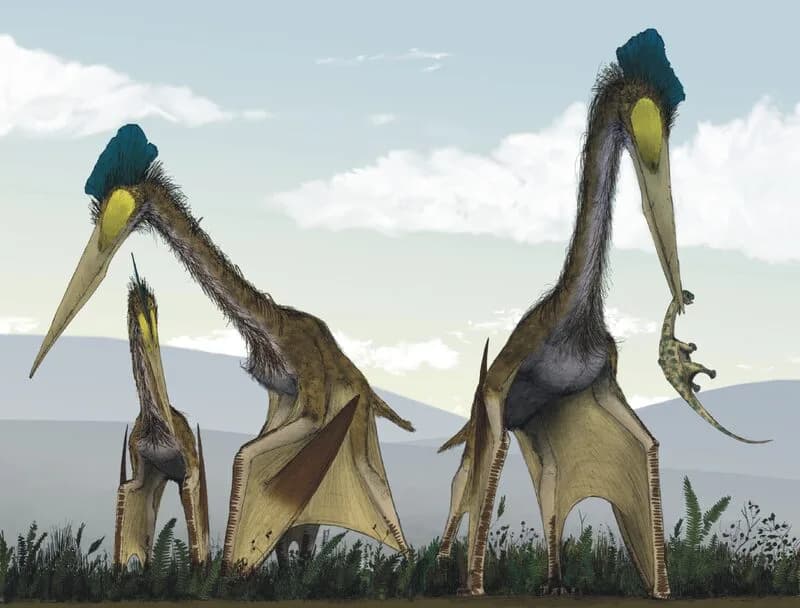
Thalassodromeus belongs to the clade Azhdarchoidea, a large group of Cretaceous pterosaurs that also includes giant azhdarchids like Quetzalcoatlus and Hatzegopteryx. More precisely, it belongs to the thalassodromids, a group of large-crested South American pterosaurs close to the tapejarids. This position makes Thalassodromeus a notable representative of the diversity of crested Gondwanan pterosaurs. Study of its exact relationships within the azhdarchoids has helped clarify how these flying reptiles evolved toward ever larger and more specialised forms through the Cretaceous. The debate over the group's exact name — thalassodromids, thalassodromines or tapejarids depending on the authors — shows how pterosaur classification remains a living field, where each new analysis can redraw the boundaries between families.
Compared with other crested pterosaurs of the Araripe, such as Tapejara or Tupandactylus, Thalassodromeus stands out for the enormous size of its head and crest, and for its sharp beak suited to a carnivorous diet. Where some close tapejarids seem to have eaten fruit, Thalassodromeus leaned clearly toward predation. On a larger scale, it foreshadows the giant azhdarchids that would dominate the sky at the end of the Cretaceous. This comparison illustrates the extraordinary variety of pterosaurs, able, within one large group, to produce forms with very different diets and silhouettes. It also shares with giant azhdarchids a trend toward tooth loss and head enlargement, traits that would culminate in colossi like Quetzalcoatlus and Hatzegopteryx, among the largest flying animals of all time.
Thalassodromeus is known mainly from its skull, remarkably preserved, which allowed detailed appreciation of its crest and jaw structure. This quality of preservation is typical of the Araripe deposits, where pterosaur fossils sometimes preserve soft tissues. The rest of the skeleton, however, remains poorly documented, leaving several aspects of its anatomy and proportions open to interpretation. Each new find attributable to the genus, or to its close relatives, can therefore refine the reconstruction of this animal and pin down its place among the crested pterosaurs of the South American Cretaceous. The Araripe Basin, moreover, keeps yielding new pterosaurs, raising hope that a more complete skeleton of Thalassodromeus, or a close relative, may one day fill the current gaps in our knowledge of this spectacular group.
Thanks to its spectacular crest, Thalassodromeus has become one of the most recognisable pterosaurs among enthusiasts, and a favourite of museums and reconstructions. It has also gained visibility through video games: it features among the playable creatures of Path of Titans, where it is showcased as a maneuverable flier and a versatile hunter. One important distinction should be recalled, though: Thalassodromeus was not a dinosaur, but a pterosaur, a flying reptile of a separate lineage. Its digital popularity has the merit of drawing attention to these masters of the Mesozoic sky, too often wrongly reduced to mere background figures beside the dinosaurs.
| Period | Crétacé inférieur / Early Cretaceous (Albien) |
| Era | Mésozoïque / Mesozoic |
| Age | ~100–110 Ma |
| Location | Brésil / Brazil (Formation de Romualdo, bassin de l'Araripe) |
| Length | crâne ~1.42 m / skull ~1.42 m |
| Height | — |
| Weight | — |
| Diet | Carnivore |
| Discovery | 2002 |
No. Thalassodromeus sethi was a pterosaur belonging to the clade Azhdarchoidea — a flying reptile from the Early Cretaceous (100-110 Ma), not directly related to dinosaurs. Pterosaurs form a distinct lineage within the archosaurs. Thalassodromeus coexisted with dinosaurs in the Araripe Basin of Brazil but constitutes an independent evolutionary group, described in 2002 by Kellner and Campos.
The name 'sea runner' (Thalassodromeus sethi) evoked the original idea that it fished by skimming the water surface. Biomechanical analyses showed that its jaw structure could not withstand the forces involved in skim-feeding — a technique imposing specific stresses on the beak. The currently favored hypothesis makes it a generalist predator, hunting on the ground and in flight like a modern stork or hornbill.
The skull of Thalassodromeus sethi measured approximately 1.42 meters in length, one of the largest known among pterosaurs. Its cranial crest, supported by a thin lightweight bony framework and ending in a characteristic V-shaped notch, was proportionally one of the largest ever documented in a flying vertebrate. Despite these dimensions, the animal remained light thanks to its hollow bones (pneumatization), essential for flight.
Information on this page is based on peer-reviewed scientific publications.
Life reconstruction of Thalassodromeus sethi, a huge-crested pterosaur from the Cretaceous of Brazil.
Dmitry Bogdanov, domaine public, via Wikimedia Commons
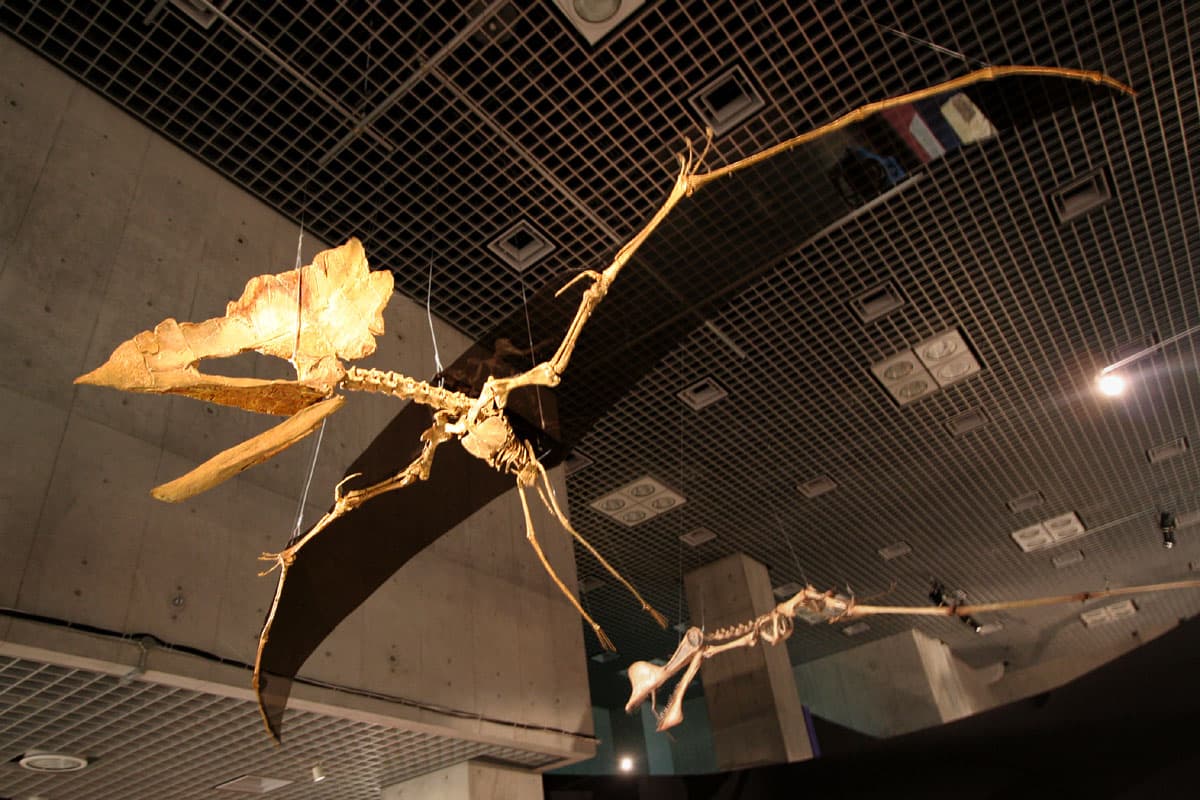
Model of Thalassodromeus on display in Japan, showing the characteristic cranial crest.
Kabacchi, CC BY 2.0, via Wikimedia Commons