Quetzalcoatlus
Quetzalcoatlus northropi is the largest flying animal that ever lived: a wingspan of 10 to 11 metres and 200 to 250 kilograms. Described in 1971 from fossils at Big Bend in Texas, it lived 68 to 66 million years ago. Standing on the ground it reached the height of a giraffe, around 5 metres, with a 2.5-metre skull.
Quetzalcoatlus lived at the very end of the Late Cretaceous, approximately 68 to 66 million years ago (Maastrichtian), within the last Mesozoic ecosystems before the K-Pg mass extinction. This giant azhdarchid pterosaur roamed the coastal and alluvial plains of what is now western Texas, in a semi-arid environment dotted with seasonal waterways. It coexisted with iconic dinosaurs such as Tyrannosaurus rex, Alamosaurus, and Torosaurus. Quetzalcoatlus is one of the last known pterosaurs, demonstrating the persistence of this group right up until the Chicxulub asteroid impact that ended the Mesozoic. Its name pays tribute to Quetzalcoatl, the Aztec feathered serpent god, owing to its colossal dimensions and silhouette evoking a divine winged reptile.
Quetzalcoatlus northropi holds the title of the largest flying animal that ever lived. Its wingspan reached 10 to 11 meters — comparable to a small touring aircraft. Standing on the ground, it measured approximately 4.5 to 5 meters tall, rivaling an adult giraffe. Despite these extraordinary dimensions, its body mass remained relatively modest: between 200 and 250 kg thanks to extremely pneumatized (hollow and air-filled) bones. Its elongated skull, topped by a low sagittal crest, could measure up to 2.5 meters from beak tip to crest rear. A smaller unnamed species had a wingspan of approximately 5.5 meters.
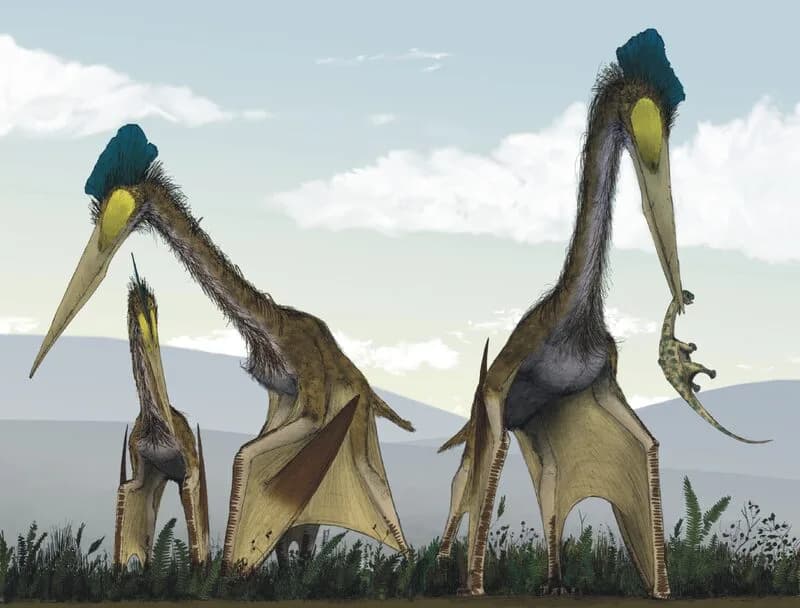
Unlike most piscivorous pterosaurs, Quetzalcoatlus was most likely a terrestrial predator, stalking its prey on foot across inland alluvial plains. Its long toothless beak, lacking the hooked tip of raptors, functioned as a precision clamp for seizing small dinosaurs, lizards, primitive mammals, amphibians, and freshwater fish. The absence of fossils in marine settings and the anatomy of its rigid neck (allowing rapid dorsoventral movements but not lateral flexion) support a feeding mode comparable to modern storks and marabous: methodically traversing open terrain while snatching prey from the ground. This 'terrestrial stalker' strategy proposed by Witton and Naish (2008) revolutionized our understanding of azhdarchids.
Quetzalcoatlus inhabited the inland alluvial plains of the Javelina Formation in Big Bend National Park, Texas. This Maastrichtian environment consisted of wooded floodplains, river meanders, and seasonal marshlands, far from marine coastlines. The climate was warm and subtropical, with distinct dry and wet seasons that influenced the distribution of prey and available water resources. The majority of large-species Q. northropi fossils come from fluvial sediments, confirming a continental rather than maritime lifestyle. Specimens of the smaller unnamed species, found in groups, suggest gathering areas near inland water sources where food was plentiful and abundant.
Quetzalcoatlus anatomy is a marvel of biological engineering adapted to large-scale flight. Its bones were extraordinarily pneumatized: long bone walls measured only a few millimeters thick, with internal trabeculae arranged in structural beam networks similar to modern aeronautical construction techniques. Its neck, composed of elongated tubular cervical vertebrae, was rigid and permitted only dorsoventral movements — ideal for darting toward the ground while walking. Its massive forelimbs, with a robust humerus and disproportionately elongated fourth finger supporting the wing membrane, also served as powerful pillars during quadrupedal ground locomotion. Its hindlimbs, long and adapted for walking, confirm it spent a significant portion of its time on the ground.
Quetzalcoatlus most likely took off via an explosive quadrupedal leap — launching its body into the air using the power of its forelimbs before unfurling its wings, similar to modern bats. Once airborne, it exploited thermal updrafts to soar over very long distances with minimal energy expenditure. Aerodynamic analyses (Habib, 2008) suggest it could travel 15,000 to 20,000 km in continuous flight, potentially crossing oceans. On the ground, it walked with a slow, methodical gait, like a giant heron, scanning the terrain for small prey. The discovery of multiple individuals of the smaller species at the same site suggests gregarious behavior, at least during foraging.
Quetzalcoatlus was discovered in 1971 by Douglas A. Lawson, then a geology student at the University of Texas at Austin, in the Javelina Formation of Big Bend National Park, Texas. The holotype (TMM 41450-3) consists of a partial left humerus of staggering size. Lawson published the preliminary description in 1975 in the journal Science, naming the animal after the Aztec god Quetzalcoatl, with the epithet 'northropi' honoring John Knudsen Northrop, aviation pioneer and designer of the YB-49 flying wing. Despite its fame, the complete formal description was not published until 2021 by Andres and Langston, after decades of work. The Texas Memorial Museum and the Royal Tyrrell Museum house the principal specimens.
| Period | Crétacé supérieur / Late Cretaceous |
| Era | Mésozoïque / Mesozoic |
| Age | 68-66 Ma |
| Location | Texas (Big Bend), Amérique du Nord / North America |
| Length | 2.5 m (crâne / skull) |
| Height | 4.5-5 m (au sol / standing) |
| Weight | 200-250 kg |
| Diet | Piscivore |
| Discovery | 1971 |
Yes, despite a wingspan of 10 to 11 meters and a mass of 200 to 250 kg, Quetzalcoatlus northropi was capable of flight. It launched with an explosive quadrupedal leap using both legs and arms, then exploited thermal updrafts to soar. Aerodynamic analyses by Habib (2008) suggest it could travel 15,000 to 20,000 km in continuous flight. Its wing loading of 8.64 kg/m² remained below the critical threshold for avian flight.
Unlike most piscivorous pterosaurs, Quetzalcoatlus northropi was most likely a terrestrial predator. Its long, toothless beak without a hooked tip functioned as a clamp for seizing small dinosaurs, lizards, primitive mammals, and freshwater fish across the inland alluvial plains of Texas. This 'terrestrial stalker' strategy proposed by Witton and Naish (2008) is supported by the absence of fossils in marine settings.
Quetzalcoatlus northropi was discovered in 1971 by Douglas A. Lawson, a geology student at the University of Texas, in the Javelina Formation of Big Bend National Park, Texas. The holotype (TMM 41450-3) is a partial left humerus of staggering size. Lawson described the animal in 1975 in the journal Science, naming it after the Aztec god Quetzalcoatl. The complete formal description was not published until 2021 by Andres and Langston.
Information on this page is based on peer-reviewed scientific publications.
Quetzalcoatlus northropi ground reconstruction, quadrupedal posture
Wikipedia Commons
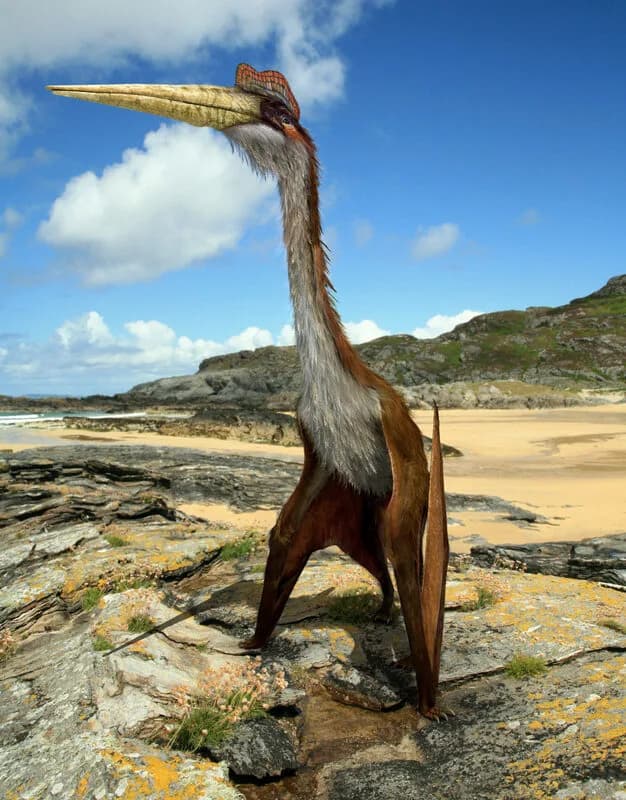
Quetzalcoatlus in flight compared to a human and a Pteranodon
Matt Martyniuk, CC BY-SA 4.0