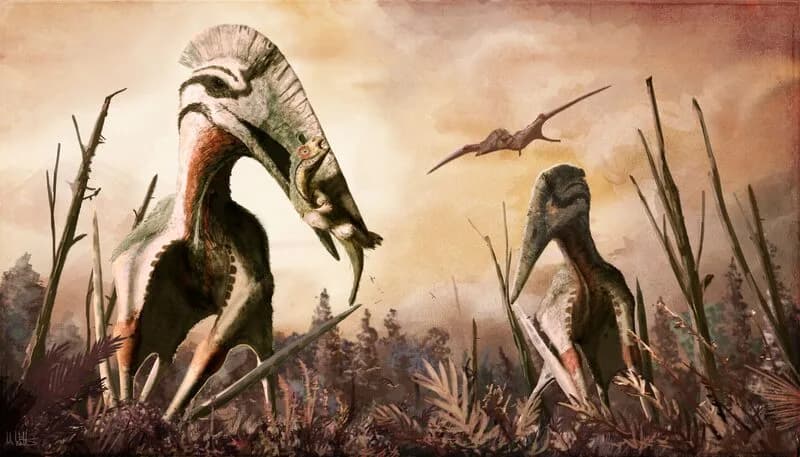
Hatzegopteryx
Hatzegopteryx thambema sat at the top of the food chain on Hațeg Island, in Transylvania: with no large carnivorous dinosaurs on that island territory, this 200-to-250-kilogram pterosaur filled the role. Its skull reached 3 metres, lightened by spongy bone comparable to expanded polystyrene. It lived around 66 million years ago.
Playable in Path of Titans
See Hatzegopteryx thambema's stats, abilities and role on our survival server.
Hatzegopteryx lived at the very end of the Late Cretaceous, approximately 66 million years ago, during the Maastrichtian stage, just before the K-Pg mass extinction that ended the Mesozoic era. This giant azhdarchid pterosaur inhabited Hațeg Island, a unique insular environment located in what is now Transylvania, Romania. At that time, Europe was an archipelago of islands fragmented by the Tethys Sea, and Hațeg Island harbored a remarkable endemic fauna characterized by insular dwarfism in many dinosaur species. Hatzegopteryx is one of the last known pterosaurs, demonstrating the persistent diversity of these flying reptiles right up until the Chicxulub asteroid catastrophe. Its name, derived from the Hațeg Basin and the Greek 'pteryx' (wing), directly evokes its Transylvanian geographic origin.
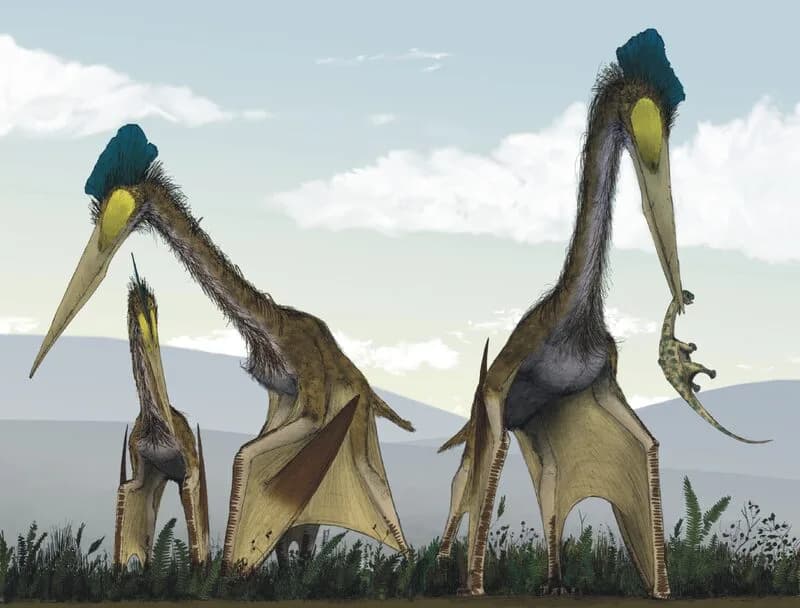
Hatzegopteryx thambema ranked among the largest flying animals that ever existed. Its wingspan is estimated at 10 to 12 meters, rivaling that of its cousin Quetzalcoatlus. Standing on the ground, it probably reached 5 meters in height, comparable to an adult giraffe. Its massive skull, including the beak, measured approximately 3 meters in length — an exceptional dimension even for a giant azhdarchid. The species name 'thambema' means 'monster' in Greek, a reference to its staggering size. Despite these colossal proportions, its body mass remained moderate thanks to a highly pneumatized bone structure, with an estimated weight between 200 and 250 kilograms. Sexual dimorphism remains unknown due to limited fossil material.
Unlike most pterosaurs, Hatzegopteryx was most likely a dominant terrestrial predator, sitting at the top of the food chain on Hațeg Island. In the absence of large carnivorous theropods on this island — a phenomenon unique in Cretaceous ecosystems — this giant pterosaur filled the ecological role normally occupied by predatory dinosaurs. It likely hunted the island's endemic dwarf dinosaurs, notably Magyarosaurus (a horse-sized dwarf sauropod), Zalmoxes (a rhabdodontid iguanodontian), and Telmatosaurus (a primitive hadrosaur). Its massive and robust beak, much wider than that of other azhdarchids, functioned as a formidable capture weapon, capable of seizing and swallowing considerable-sized prey whole, similar to modern marabou storks.
Hatzegopteryx inhabited Hațeg Island, a subtropical insular environment of the Maastrichtian located in present-day Transylvania, in west-central Romania. This island, with an estimated area between 70,000 and 80,000 square kilometers, was part of the European archipelago fragmented by the Tethys Sea during the terminal Cretaceous. The climate was warm and humid, with lush vegetation of conifers, tree ferns, and primitive flowering plants. The environment included alluvial plains, seasonal waterways, and marshy areas. The island's geographic isolation had produced a remarkable phenomenon of insular dwarfism in dinosaurs, while Hatzegopteryx conversely represented a case of gigantism, becoming the apex predator of this unique ecosystem where large terrestrial carnivores were absent.
Hatzegopteryx anatomy is distinguished from other giant azhdarchids by several unique characteristics. Its skull was remarkably wide and robust, with a massive mandible measuring approximately 50 centimeters in width — much wider than that of Quetzalcoatlus or Arambourgiania. The cranial bones exhibited an exceptional internal spongy structure, composed of bony trabeculae forming an alveolar network similar to expanded polystyrene. This unique architecture combined lightness with mechanical resistance, enabling it to withstand the considerable forces generated during the capture of large prey. Its neck was proportionally shorter and more robust than that of other giant azhdarchids, with stocky, reinforced cervical vertebrae adapted to withstand the mechanical stresses of terrestrial predation rather than optimized for long-distance soaring. The discovered fossil humerus is massive and demonstrates powerful forelimbs.
Hatzegopteryx most likely behaved as a methodical terrestrial predator, patrolling the plains and wooded areas of Hațeg Island in search of prey. This 'terrestrial stalker' behavior, proposed by Witton and Naish (2008, 2017) for azhdarchids in general, is particularly compelling for Hatzegopteryx due to its robust cranial anatomy and short, powerful neck. It probably walked in a quadrupedal posture, scanning the ground with its large lateral eyes, then struck at prey with rapid head and neck movements. Takeoff was likely achieved through an explosive quadrupedal leap, similar to that described for Quetzalcoatlus. Once airborne, it exploited thermal currents to soar above the island. As an insular apex predator, it probably exerted significant predation pressure on dwarf dinosaur populations, thereby regulating the Hațeg Island ecosystem in a manner comparable to large terrestrial carnivores on continents.
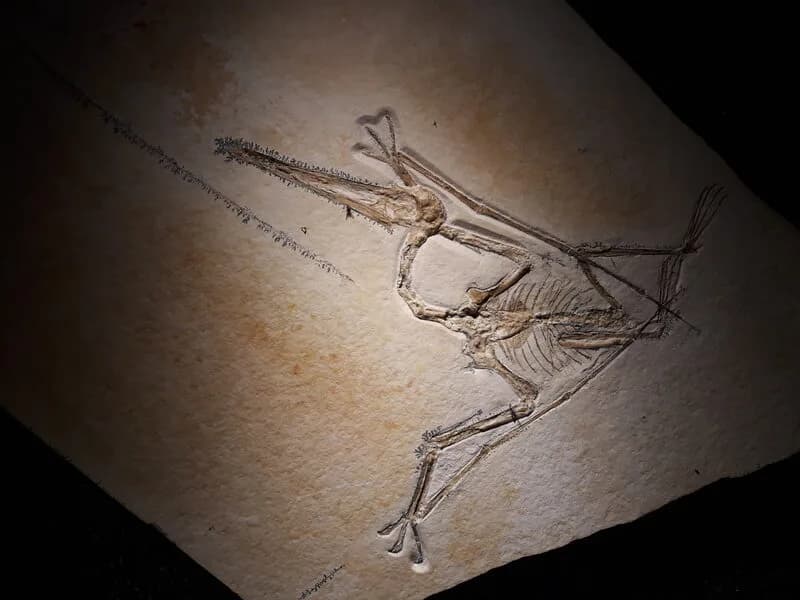
Hatzegopteryx thambema was described in 2002 by Eric Buffetaut, Dan Grigorescu, and Zoltan Csiki, from fossils discovered in the Densus-Ciula Formation in the Hațeg Basin of Transylvania, Romania. The holotype (FGGUB R1083) includes skull fragments, a partial left humerus, and cervical vertebra fragments. The cranial material is particularly significant, revealing the characteristic internal spongy structure of the species. Additional elements, described by Witton and Naish in 2017 in the journal PeerJ, include a mandible fragment and additional cervical vertebrae that provided better understanding of this pterosaur's unique proportions. The species epithet 'thambema' comes from ancient Greek meaning 'monster,' referencing the animal's extraordinary size. The fossils are housed at the University of Bucharest (FGGUB) and the Deva Museum in Romania. Despite the fragmentary material, Hatzegopteryx has become an emblematic case of island biogeography and ecological replacement, demonstrating how a giant pterosaur could occupy the apex predator niche in the absence of large theropods.
| Period | Crétacé supérieur / Late Cretaceous |
| Era | Mésozoïque / Mesozoic |
| Age | ~66 Ma (Maastrichtien / Maastrichtian) |
| Location | Île de Hațeg, Transylvanie, Roumanie / Hațeg Island, Transylvania, Romania |
| Length | ~3 m (crâne / skull) |
| Height | ~5 m (au sol / standing) |
| Weight | 200-250 kg |
| Diet | Carnivore |
| Discovery | 2002 |
Hatzegopteryx thambema had an estimated wingspan of 10 to 12 meters and stood about 5 meters tall, comparable to a giraffe. Its skull including the beak reached 3 meters in length. It rivals Quetzalcoatlus as one of the largest flying animals of all time. Despite these dimensions, its weight was moderate — 200 to 250 kilograms — thanks to a highly pneumatized bone structure.
Hațeg Island in Transylvania (Romania) was during the Maastrichtian an isolated insular environment separated from the Tethys Sea with no large carnivorous theropods. Hatzegopteryx thambema filled this vacant niche, hunting endemic dwarf dinosaurs like Magyarosaurus (a horse-sized sauropod) and Zalmoxes. Its massive, robust beak, wider than in other azhdarchids, functioned as a capture weapon capable of swallowing prey whole.
The skull of Hatzegopteryx thambema is distinguished by its mandible of approximately 50 centimeters in width — far wider than Quetzalcoatlus's. The cranial bones showed an exceptional internal spongy structure composed of bony trabeculae forming an alveolar network similar to expanded polystyrene, combining lightness with mechanical resistance. Its neck, shorter and more robust than in other giant azhdarchids, was adapted for active terrestrial predation. Described in 2002 by Buffetaut, Grigorescu, and Csiki.
Hatzegopteryx hunting the dwarf dinosaur Zalmoxes on Hațeg Island
Mark Witton, CC BY-SA 4.0
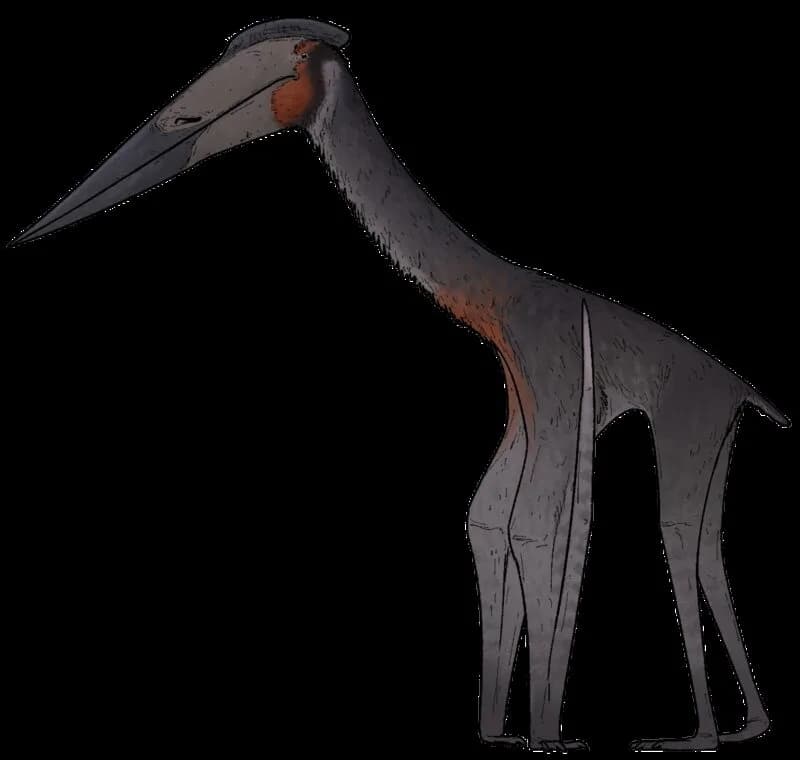
Hatzegopteryx thambema life reconstruction in standing posture
Connor Ashbridge, CC BY 4.0