Tapejara
Tapejara wellnhoferi carried a toothless beak, short and hooked like a parrot's, making it one of the few pterosaurs that may have eaten fruit. Its head crest extended into a soft-tissue sail that doubled the apparent height of its head. Its wingspan reached 3.5 metres for 10 to 20 kilograms, 112 to 108 million years ago in Brazil.
Tapejara wellnhoferi lived during the Early Cretaceous, approximately 112 to 108 million years ago, during the Albian age. This Brazilian pterosaur is one of the most emblematic representatives of the tapejarids, a family of pterodactyloids characterized by spectacular cranial crests and short, deep beaks. Tapejara was discovered in the Santana Formation of the Araripe Basin in northeastern Brazil, one of the world's richest fossiliferous deposits for Cretaceous pterosaurs. During this period, Brazil and Africa had only recently separated through the opening of the South Atlantic, and the Araripe region was bordered by shallow seas in a warm tropical climate. Tapejara coexisted with a remarkable diversity of other pterosaurs (Anhanguera, Tropeognathus), theropod dinosaurs, crocodilians, and a rich fish fauna in the lagoons and shallow seas of Cretaceous Brazil.
Tapejara was a medium-sized pterosaur, with an estimated wingspan of approximately 3.5 meters, though some more conservative estimates place it around 2.5 meters. The body was relatively compact compared to long-beaked piscivorous pterosaurs like Anhanguera. Its estimated weight ranged between 5 and 10 kg. Tapejara's most distinctive feature was its cranial crest composed of three elements: a bony blade on the snout, a bony crest at the back of the skull, and between them, a semicircular soft-tissue sail (preserved in some fossils) that considerably enlarged the crest's surface area. The beak was short, deep, and strongly curved downward, toothless, resembling that of a modern parrot. Sexual dimorphism is suggested by variations in crest size and shape among known specimens.
Tapejara's diet is one of the most debated among pterosaurs. Unlike classic piscivorous pterosaurs with long, toothed beaks, Tapejara possessed a short, deep, toothless, strongly curved beak that does not match the typical fish-hunter profile. Several hypotheses have been proposed. The most popular suggests a frugivorous or omnivorous diet, with the parrot-like beak being ideal for picking and crushing fruits, seeds, and tough vegetation. This hypothesis is supported by comparison with modern birds possessing similar beaks (parrots, toucans, hornbills). Other researchers suggest a diet including mollusks, crustaceans, or other hard-shelled invertebrates, the powerful beak being able to crush shells. A mixed diet combining fruits, seeds, and small animals is probably the most realistic, making Tapejara one of the rare potentially omnivorous pterosaurs.
Tapejara lived in the tropical environments of northeastern Brazil during the Early Cretaceous, in the Araripe Basin region situated today between the states of Ceará, Pernambuco, and Piauí. During the Albian, this region bordered the warm waters of the nascent South Atlantic, with a landscape of coastal plains, lagoons, mangroves, and tropical forests. The Santana Formation, source of the fossils, was deposited under lagoonal and shallow marine conditions characterized by rapid sedimentation that favored exceptional fossilization. The climate was warm and probably semi-arid with wet seasons, as evidenced by the diversity of fossil flora and fauna. If Tapejara was indeed frugivorous, it frequented coastal woodlands and gallery forests along waterways rather than open marine environments. The Araripe Basin pterosaurs show remarkable ecological diversity with varied feeding niches.
Tapejara's anatomy was distinguished by several remarkable derived characters among pterosaurs. The skull was short and deep, with a powerful beak strongly curved downward, evoking that of a macaw parrot. The cranial crest was its most spectacular feature: composed of a bony base on the premaxilla (snout) and an occipital bony blade (back of skull), it was amplified by a fibrous soft tissue extension forming a large semicircular sail visible in the best-preserved fossils. This crest could nearly double the apparent head height. The neck was relatively short and robust. The wings followed the standard pterosaurian plan with the hyper-elongated fourth finger supporting the membrane, but their proportions indicate more maneuverable than soaring flight. The hindlimbs were well-developed for walking. The pneumatized skeleton (hollow bones filled with air) reduced weight for flight while maintaining structural rigidity.
Tapejara's behavior is closely linked to the interpretation of its spectacular cranial crest and unique beak. The crest most likely served as a visual signal for intraspecific recognition, sexual selection, and rival intimidation. Aerodynamic studies have shown the crest could also influence flight by acting as a sail or rudder, though this secondary role remains controversial. Some researchers have proposed that the membranous crest could change color or pattern, like the colored throat fans of certain lizards, increasing its effectiveness as a social signal. If Tapejara was frugivorous, it probably fed in trees, using its claws and feet to grip branches while picking fruits and seeds with its powerful beak. Its maneuverable flight allowed it to navigate forest canopies. Nesting probably occurred in colonies, as with most pterosaurs, possibly on coastal cliffs or in large tropical forest trees.
Tapejara was first described in 1989 by Brazilian paleontologist Alexander Kellner from fossils of the Santana Formation in the Araripe Basin, northeastern Brazil. The name Tapejara comes from Old Tupi meaning 'the old being' or 'lord of ancient paths' (tapé 'path' + jara 'lord'), a tribute to Brazilian indigenous culture. The type species, T. wellnhoferi, honors Peter Wellnhofer, the eminent German pterosaur specialist. The Araripe Basin is world-famous for the exceptional quality of its Cretaceous fossils, preserved in limestone nodules that protected specimens from deformation. Tapejara played a central role in the taxonomic revision of tapejarids, a family that formerly included Tupandactylus and Tupuxuara before their reclassification. Specimens showing preserved membranous crests are among the most valuable, as they demonstrate that pterosaur crests were far larger than their bony portions alone suggest.
| Period | Crétacé inférieur / Early Cretaceous |
| Era | Mésozoïque / Mesozoic |
| Age | 112 - 108 Ma |
| Location | Amérique du Sud (Brésil, bassin d'Araripe) / South America (Brazil, Araripe Basin) |
| Length | Envergure / Wingspan: 3.5 m |
| Height | ~0.8 m |
| Weight | 10-20 kg |
| Diet | Omnivore |
| Discovery | 1989 |
No. Tapejara wellnhoferi was a pterosaur of the family Tapejaridae — a flying reptile from the Early Cretaceous (112-108 Ma), not directly related to dinosaurs. Pterosaurs form a distinct lineage within the archosaurs. Tapejara lived in the Araripe Basin of present-day Brazil and was first described in 1989 by paleontologist Alexander Kellner.
Unlike long-beaked toothed piscivorous pterosaurs, Tapejara wellnhoferi had a short, toothless, strongly downcurved beak — a morphology comparable to modern parrots, toucans, and hornbills, all frugivorous or omnivorous. The most widespread hypothesis proposes a diet including fruits, seeds, and small animals, making Tapejara one of the rare potentially frugivorous pterosaurs.
Tapejara wellnhoferi's cranial crest consisted of a bony base on the premaxilla and a semicircular soft-tissue sail (preserved in some Araripe Basin fossils) that nearly doubled the apparent head height. Its main function was likely visual signaling for individual recognition and courtship display. Aerodynamic studies also suggest a possible secondary role as a rudder in flight.
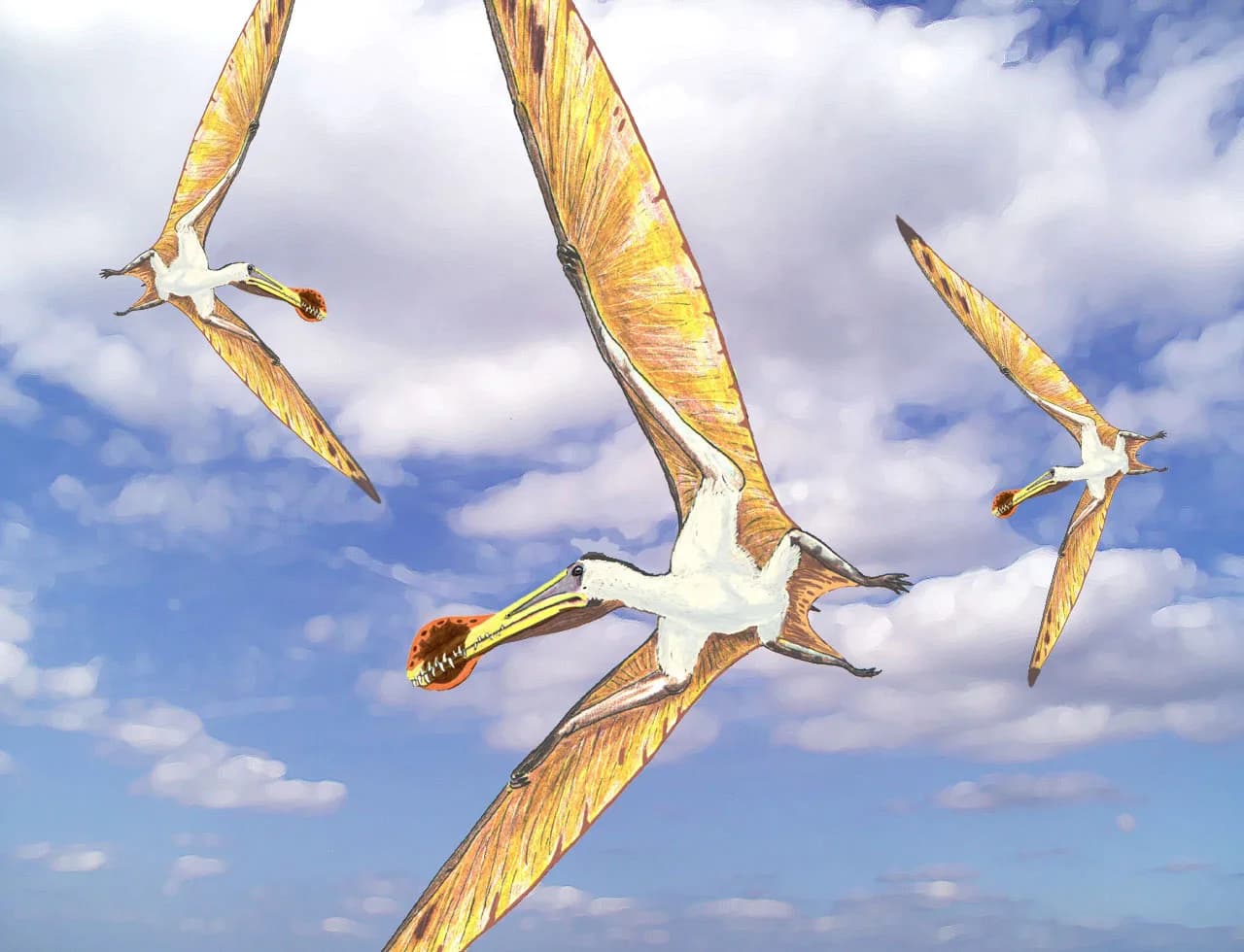
Artistic reconstruction of Tapejara wellnhoferi by Nobu Tamura
Nobu Tamura / Wikimedia Commons
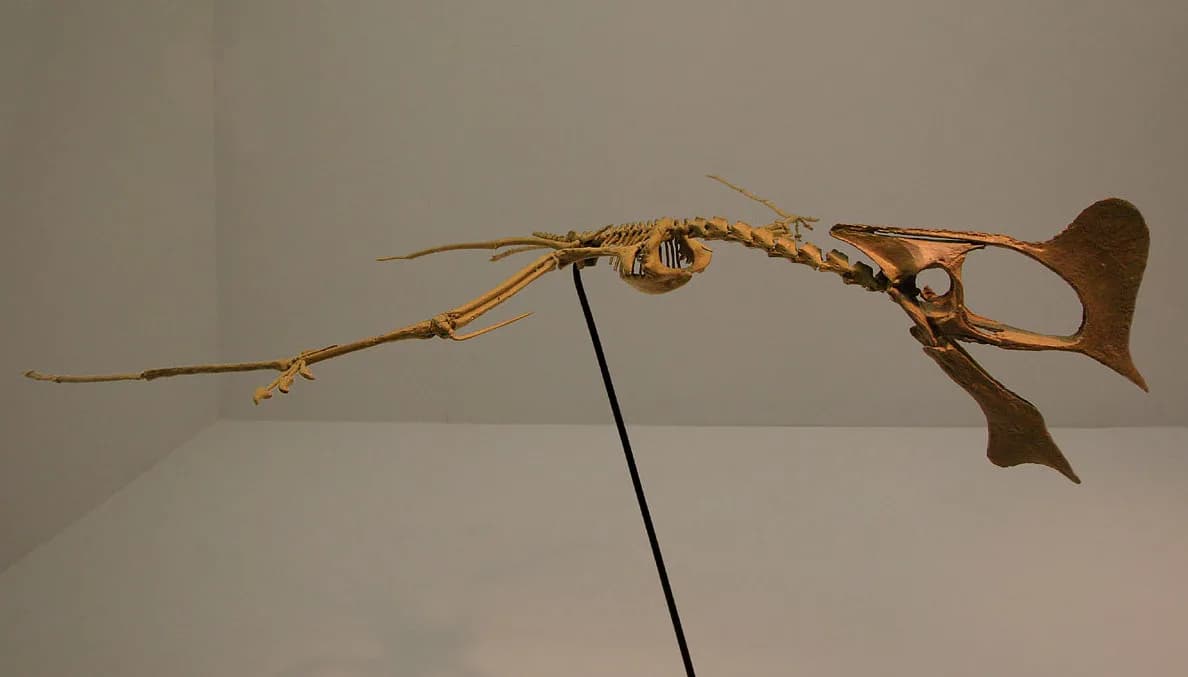
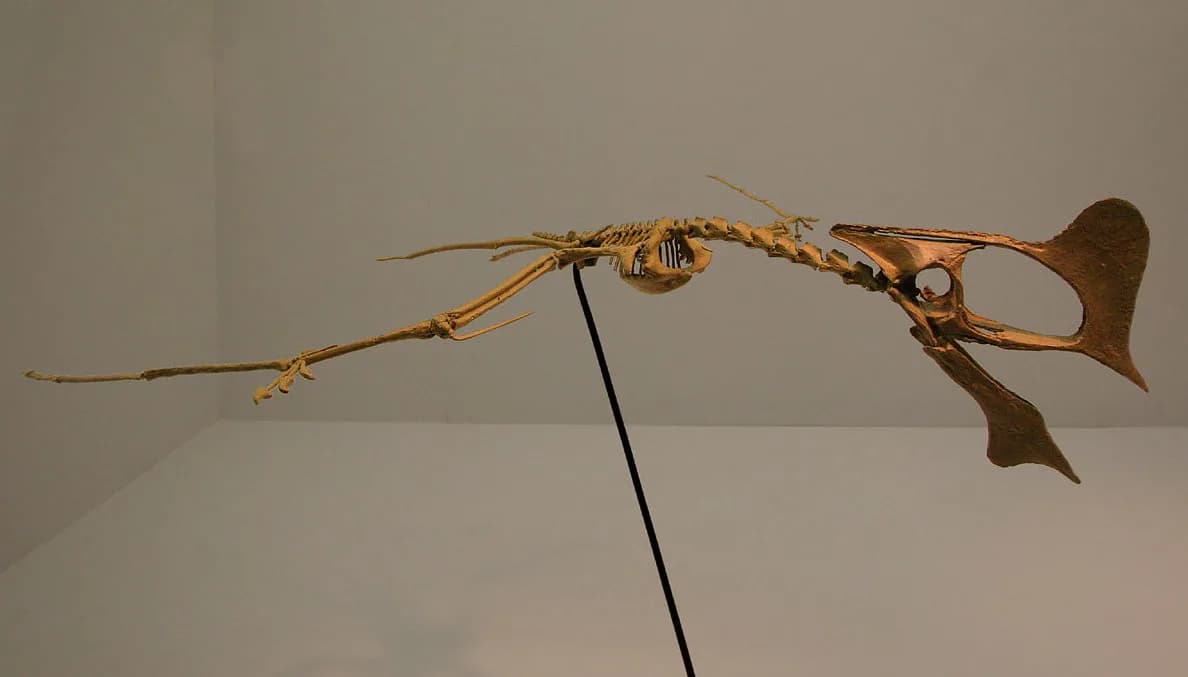
Fossil skeleton of Tapejara
Wikimedia Commons