Tarbosaure
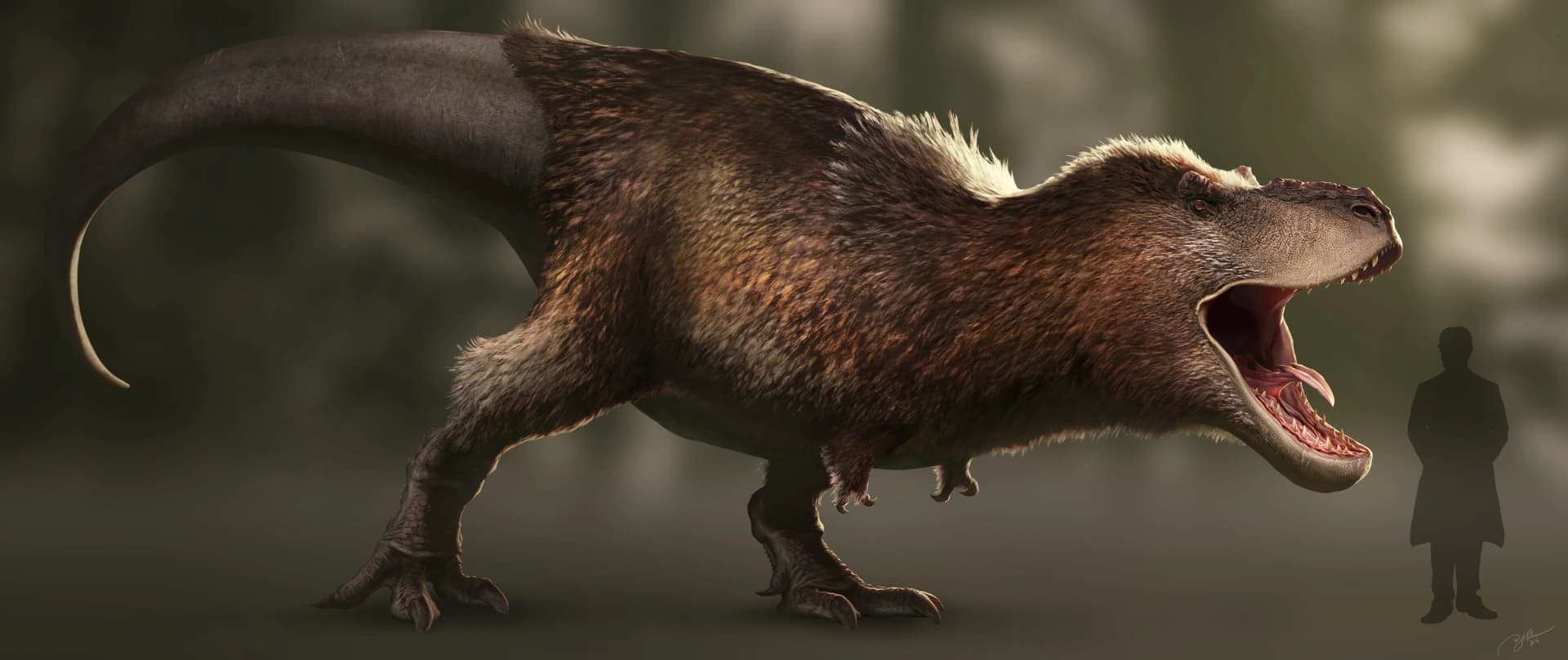
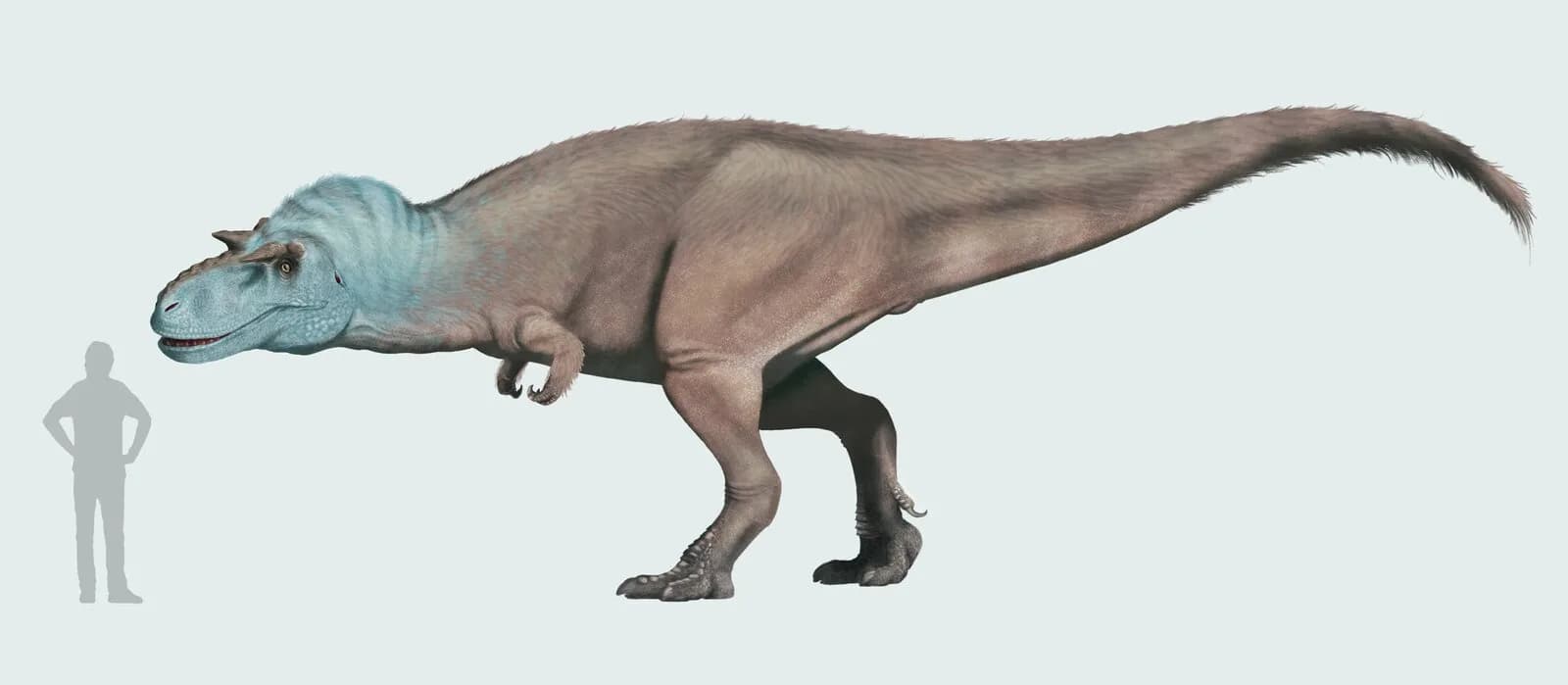
Tarbosaurus bataar is Asia's large tyrannosaurid: 10 to 12 metres and 4 to 5 tonnes, 70 million years ago in Mongolia and China. Its name means « alarming lizard ». Its arms are proportionally the shortest of any known tyrannosaurid, more reduced still than those of Tyrannosaurus rex, its closest relative.
Tarbosaurus bataar lived during the Late Cretaceous period, approximately 70 million years ago, during the Maastrichtian age. It inhabited the vast alluvial plains of what is now Mongolia and China, in a semi-arid environment characterized by seasonal rivers and scattered forests. This era corresponds to the final millions of years of the age of dinosaurs, before the great Cretaceous-Paleogene extinction event. Tarbosaurus was the dominant apex predator of the Asian Late Cretaceous ecosystem, occupying an ecological niche similar to that of Tyrannosaurus in North America. The Nemegt and Naran Bulag geological formations, where its fossils have been found, reveal a subtropical climate with alternating wet and dry seasons.
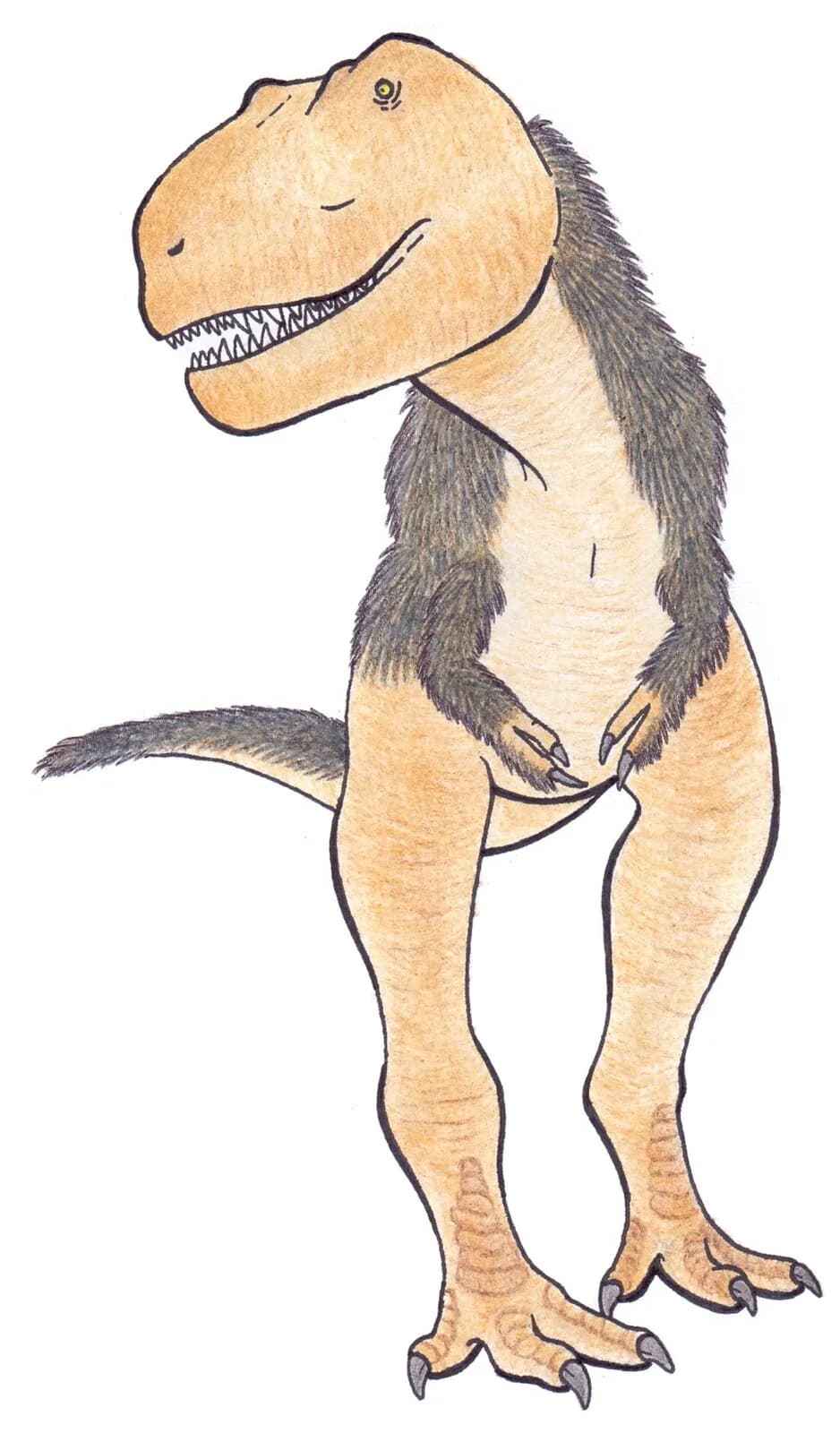
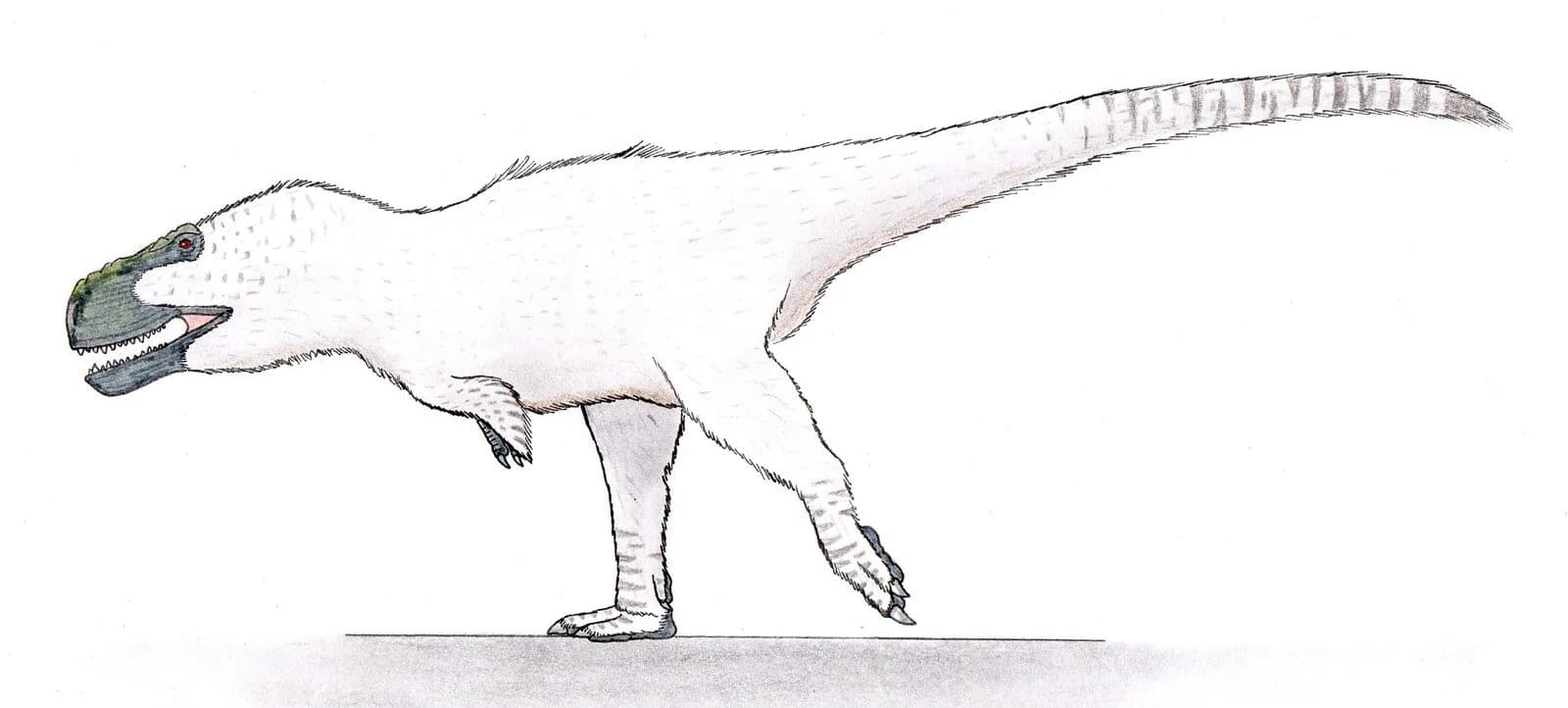
Tarbosaurus bataar ranked among the largest carnivorous theropods ever to have lived, reaching a length of 10 to 12 meters and an estimated weight of 4 to 5 tonnes. Its massive skull measured approximately 1.3 meters long, slightly smaller than that of Tyrannosaurus but equally formidable. It stood roughly 3.5 meters tall at the hips. Proportionally, Tarbosaurus possessed the shortest arms of any known tyrannosaurid: its forelimbs were even more reduced than those of T. rex, bearing only two tiny functional digits. Its long, muscular tail served as a counterbalance to its massive skull during bipedal locomotion.
An absolute carnivore and unchallenged apex predator of its ecosystem, Tarbosaurus bataar possessed jaws lined with 60 to 64 massive, thick, and slightly curved teeth designed to crush bone and tear flesh from its prey. Its bite force, although inferior to that of T. rex, remained among the most powerful in the animal kingdom, estimated at over 30,000 Newtons. Its likely prey included large hadrosaurs such as Saurolophus angustirostris, titanosaur sauropods like Nemegtosaurus, and other herbivores of the Nemegt Formation. Bite marks attributed to Tarbosaurus have been found on Saurolophus bones, directly confirming its predatory feeding habits. It probably also engaged in opportunistic scavenging.
Tarbosaurus bataar lived in the alluvial plains and fluvial environments of what is now the Gobi Desert in Mongolia and northern China. The Nemegt Formation, the primary fossil-bearing site for Tarbosaurus, represents an ancient system of rivers and floodplains surrounded by semi-arid zones. The climate was subtropical with marked seasons, alternating between wet periods that supported lush vegetation and drier arid seasons. The Nemegt ecosystem was extraordinarily diverse: it harbored hadrosaurs, ankylosaurs, giant therizinosaurs like Therizinosaurus, ornithomimosaurs like Gallimimus, and the mysterious Deinocheirus. Tarbosaurus reigned at the top of this complex food chain.
The anatomy of Tarbosaurus bataar reveals a highly specialized predator, very close to Tyrannosaurus but with distinctive characteristics. Its skull, though massive, was narrower and more elongated than that of T. rex, with a slimmer snout. The temporal fenestrae were proportionally smaller, and the lower jaw featured a unique locking mechanism among tyrannosaurids: a ridge on the dentary bone interlocked with a groove on the surangular, stiffening the mandible. Forward-facing eye sockets gave it good binocular vision, although the stereoscopic field of view was slightly more restricted than in T. rex due to the narrower skull. Its hind limbs were powerful and adapted for running, while its tiny two-fingered arms remain an evolutionary enigma.
The behavior of Tarbosaurus bataar is inferred from the study of its fossils and paleoecological environment. Several skeletons found in close proximity to one another in the Nemegt Formation suggest possible gregarious behavior, at least among juveniles, although adults may have been more solitary and territorial. Bite marks on Tarbosaurus bones, inflicted by other individuals of the same species, attest to violent intraspecific combat, likely related to competition for territory or mates. Biomechanical studies estimate its maximum speed at 25 to 40 km/h for an adult. The discovery of juvenile specimens with more gracile proportions suggests an ontogenetic niche shift: young individuals likely hunted smaller, faster prey, while adults targeted large herbivores.
Tarbosaurus bataar was discovered in 1946 during a Soviet-Mongolian paleontological expedition led by Ivan Efremov in the Gobi Desert. The holotype, a massive skull accompanied by postcranial fragments, was described and named by Soviet paleontologist Evgeny Maleev in 1955. Since that initial discovery, dozens of specimens have been unearthed, making Tarbosaurus one of the best-represented tyrannosaurids in the world. Among the most remarkable finds is a nearly complete juvenile skeleton, which has enabled the study of ontogenetic growth in the species. In 2012, an illegally exported Tarbosaurus skeleton from Mongolia was seized in the United States and returned to the Mongolian government, a case that drew international attention to fossil trafficking. The main discovery sites are located in the Nemegt, Naran Bulag, and Nogon Tsav formations in Mongolia.
| Period | Crétacé supérieur / Late Cretaceous |
| Era | Mésozoïque / Mesozoic |
| Age | 70 Ma / 70 Mya |
| Location | Mongolie, Chine / Mongolia, China |
| Length | 10–12 m / 33–39 ft |
| Height | 3,5 m (hanches) / 3.5 m (hips) |
| Weight | 4–5 tonnes / 4.4–5.5 short tons |
| Diet | Carnivore |
| Discovery | 1946 |
Tarbosaurus bataar (Mongolia/China, 70 Ma) and Tyrannosaurus rex (North America, 66-68 Ma) are two closely related but distinct tyrannosaurids. Tarbosaurus's skull is narrower and more elongated than T. rex's, with a unique jaw-locking mechanism. Its forelimbs were proportionally even shorter — the smallest of any known tyrannosaurid — bearing only two functional digits.
Tarbosaurus bataar was the apex predator of the Nemegt Formation (Gobi Desert, 70 Ma). Its likely prey included the hadrosaur Saurolophus angustirostris and titanosaur sauropods like Nemegtosaurus. Tarbosaurus bite marks were found directly on Saurolophus bones — direct fossil confirmation. The Nemegt ecosystem also included the mysterious Deinocheirus and the giant therizinosaur Therizinosaurus.
Tarbosaurus bataar was discovered in 1946 during a Soviet-Mongolian expedition led by Ivan Efremov in the Gobi Desert. Soviet paleontologist Evgeny Maleev described and named the species in 1955 from a massive skull and postcranial fragments. Dozens of specimens have since been unearthed, including a nearly complete juvenile skeleton — making it one of the best-represented tyrannosaurids in the world.
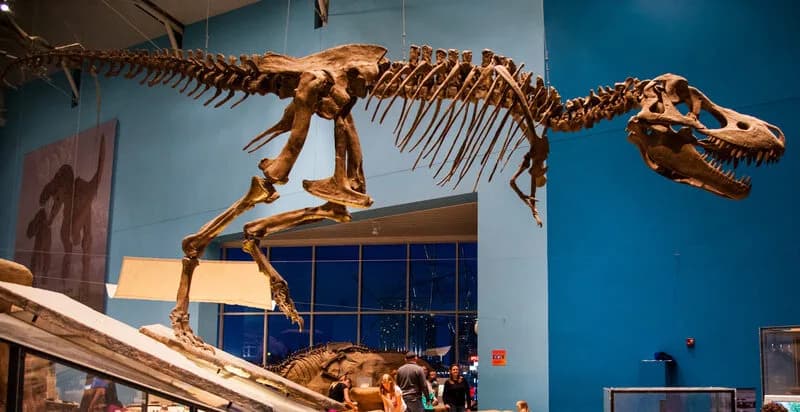
Mounted skeleton of Tarbosaurus bataar in the Dinosaur Mysteries exhibit
Lwilcoxson / Wikimedia Commons (CC BY-SA 4.0)
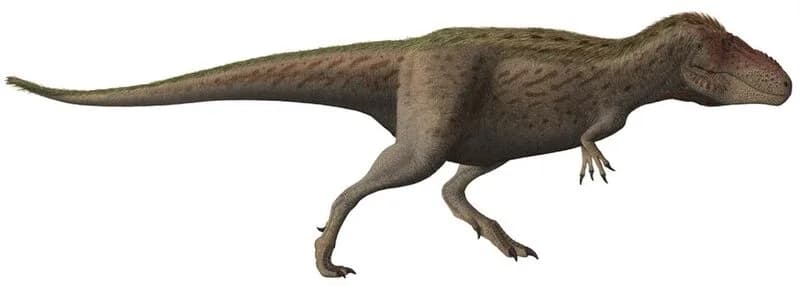
Life-sized reconstruction of two Tarbosaurus bataar (adult and subadult) with human scale
Steveoc 86 / Wikimedia Commons (CC BY 2.5)