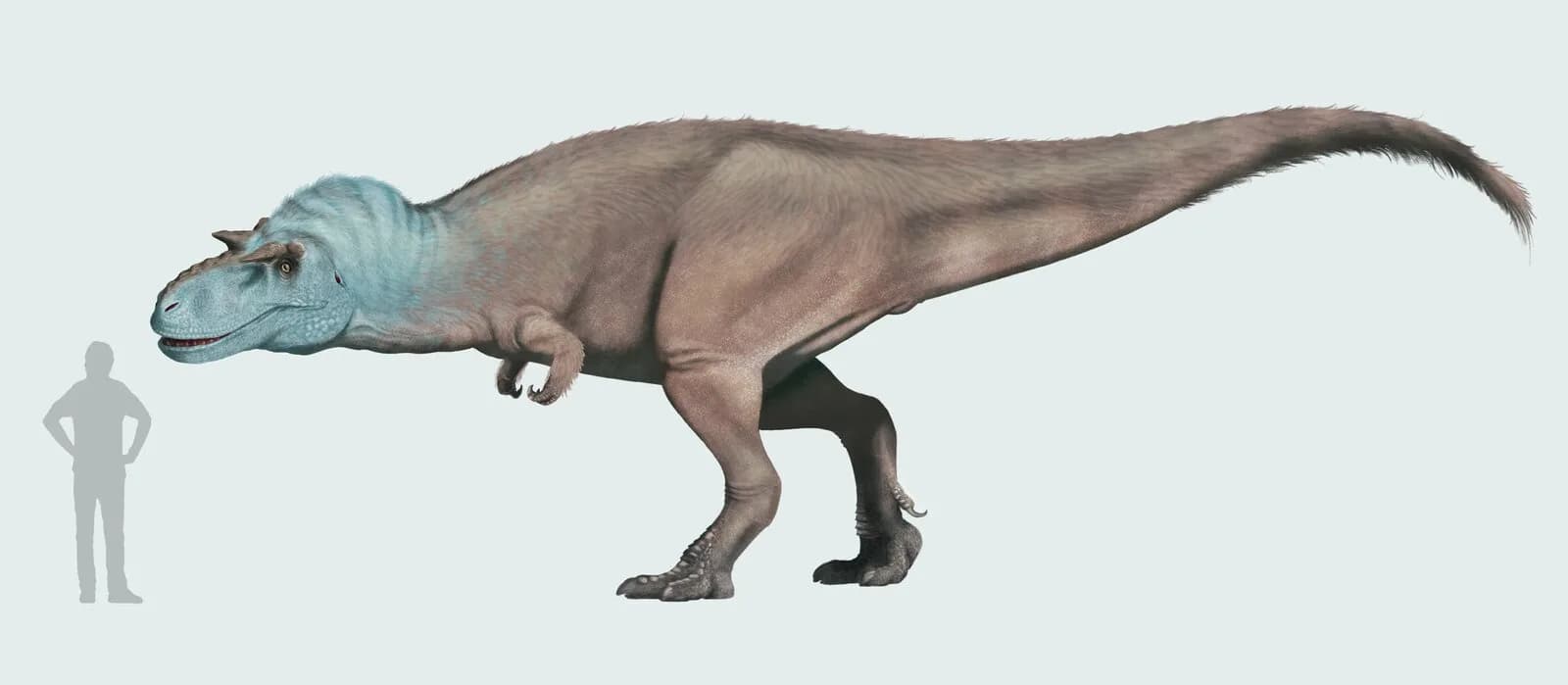
Gorgosaure
Gorgosaurus libratus is a tyrannosaurid 8 to 9 metres long and 1 to 2.5 tonnes, described in 1914 in Alberta and also found in Montana. It lived 76.6 to 75.1 million years ago. Its resemblance to Albertosaurus has fuelled a decades-long debate over whether the two are distinct. One juvenile carries a healed bone tumour on the jaw, among the few documented dinosaur cancers.
Gorgosaurus lived during the Late Cretaceous period, approximately 76.6 to 75.1 million years ago, during the Campanian stage, in what is now Alberta, Canada. It inhabited the Dinosaur Park Formation, one of the richest dinosaur fossil sites in the world, preserving a diverse coastal lowland ecosystem adjacent to the Western Interior Seaway. Gorgosaurus was the apex predator of its environment, slightly predating its close relative Albertosaurus in the geological record. The Campanian stage in western North America was a time of remarkable dinosaur diversity, with numerous species of ceratopsians, hadrosaurs, and ankylosaurs providing abundant prey for large tyrannosaurs like Gorgosaurus.
Gorgosaurus measured between 8 and 9 meters long with an estimated weight of 2 to 2.5 tonnes. Its skull measured about 1 meter long, armed with robust, serrated teeth typical of tyrannosaurs. Although smaller than Tyrannosaurus rex, it was one of the largest predators of its time in North America. Its build was more gracile than later tyrannosaurs, with proportionally longer legs, likely making it one of the fastest large theropods in its ecosystem, with estimated speeds of 30 to 40 km/h.
Gorgosaurus was an apex carnivore that preyed on the abundant herbivorous dinosaurs of its ecosystem, particularly ceratopsians like Centrosaurus and hadrosaurs like Corythosaurus and Lambeosaurus. Its powerful jaws and robust teeth could generate tremendous bite forces, allowing it to crush bone and process large quantities of meat efficiently. Evidence from bite marks on prey bones confirms its role as an active predator rather than a pure scavenger. Juveniles had more gracile skulls and longer legs proportionally, suggesting they may have targeted different, smaller prey than adults, thereby reducing intraspecific competition for food resources within the same population and ecosystem.
Gorgosaurus inhabited the lush coastal lowlands of the Dinosaur Park Formation in what is now Alberta, Canada. During the Late Cretaceous, this region was a subtropical coastal plain adjacent to the Western Interior Seaway, featuring meandering rivers, swamps, and dense forests of conifers and angiosperms. The warm, humid climate supported rich vegetation and an extraordinarily diverse community of dinosaurs. This productive ecosystem provided abundant prey for Gorgosaurus in the form of large herds of ceratopsians and hadrosaurs that migrated across the coastal plains. The proximity to the inland sea created a mosaic of habitats from riverine forests to more open floodplains, offering diverse hunting opportunities for this apex predator.
Gorgosaurus possessed the characteristic tyrannosaur body plan: a massive skull with powerful jaws, tiny two-fingered forelimbs, and strong, muscular hind legs built for bipedal locomotion. Its skull was somewhat more lightly built than that of Tyrannosaurus rex, with a more elongated snout and proportionally larger eye openings. The teeth were thick and conical, designed for gripping and crushing rather than slicing. What set Gorgosaurus apart from other tyrannosaurs was its more gracile overall build, with proportionally longer legs suggesting greater running speed. The tail was long and heavy, serving as a counterbalance during locomotion. Growth studies based on bone histology reveal that Gorgosaurus underwent rapid growth during adolescence, reaching near-adult size by approximately age ten.
Gorgosaurus was probably an active hunter combining pursuit and ambush depending on prey type. The discovery of a juvenile specimen with preserved stomach contents (two small Citipes-type dinosaurs) revealed that young tyrannosaurs had a different diet from adults. This ontogenetic dietary shift is comparable to that observed in modern crocodilians. Bone pathologies found on multiple specimens, including healed fractures and infections, attest to a violent life. The coexistence with Daspletosaurus in the same habitat raises questions about niche partitioning between these two large predators.
Gorgosaurus was discovered in 1913 by Charles H. Sternberg in the Dinosaur Park Formation along the Red Deer River in Alberta. Lawrence Lambe described it in 1914 as Gorgosaurus libratus, meaning 'well-balanced fierce lizard.' Over 20 specimens are now known, making Gorgosaurus one of the best-represented tyrannosaurs. The most notable recent specimen is a 6-year-old juvenile described in 2023, whose preserved stomach contents revealed for the first time the diet of a young tyrannosaur, confirming that juveniles exploited different prey than adults.
| Period | Crétacé supérieur / Late Cretaceous (Campanien) |
| Era | Mésozoïque / Mesozoic |
| Age | 76.6–75.1 Ma |
| Location | Amérique du Nord / North America (Alberta, Canada ; Montana, USA) |
| Length | 8–9 m |
| Height | ~2.5 m |
| Weight | 1 000–2 500 kg |
| Diet | Carnivore |
| Discovery | 1914 |
Gorgosaurus libratus measured 8 to 9 meters long, weighing 1,000 to 2,500 kilograms — considerably less than Tyrannosaurus rex (12 m, 8–14 tonnes). Its more gracile build and proportionally longer legs likely gave it greater speed, estimated at 30-40 km/h. It lived during the Campanian, 76.6 to 75.1 million years ago, in Alberta, Canada.
In 2023, a juvenile Gorgosaurus libratus specimen discovered in Alberta revealed two small Citipes-type dinosaurs in its fossilized stomach — proving for the first time that young tyrannosaurs targeted smaller, more agile prey than adults. This age-based dietary partitioning reduced intraspecific competition, a mechanism similar to that observed in modern crocodilians.
Gorgosaurus libratus lived on the coastal plains of the Dinosaur Park Formation in Alberta, Canada, near the Western Interior Seaway. It primarily hunted hadrosaurs (Corythosaurus, Lambeosaurus) and ceratopsians (Centrosaurus, Styracosaurus). It shared its habitat with another large tyrannosaur, Daspletosaurus — a rare case of two related apex predators coexisting in the same ecosystem.
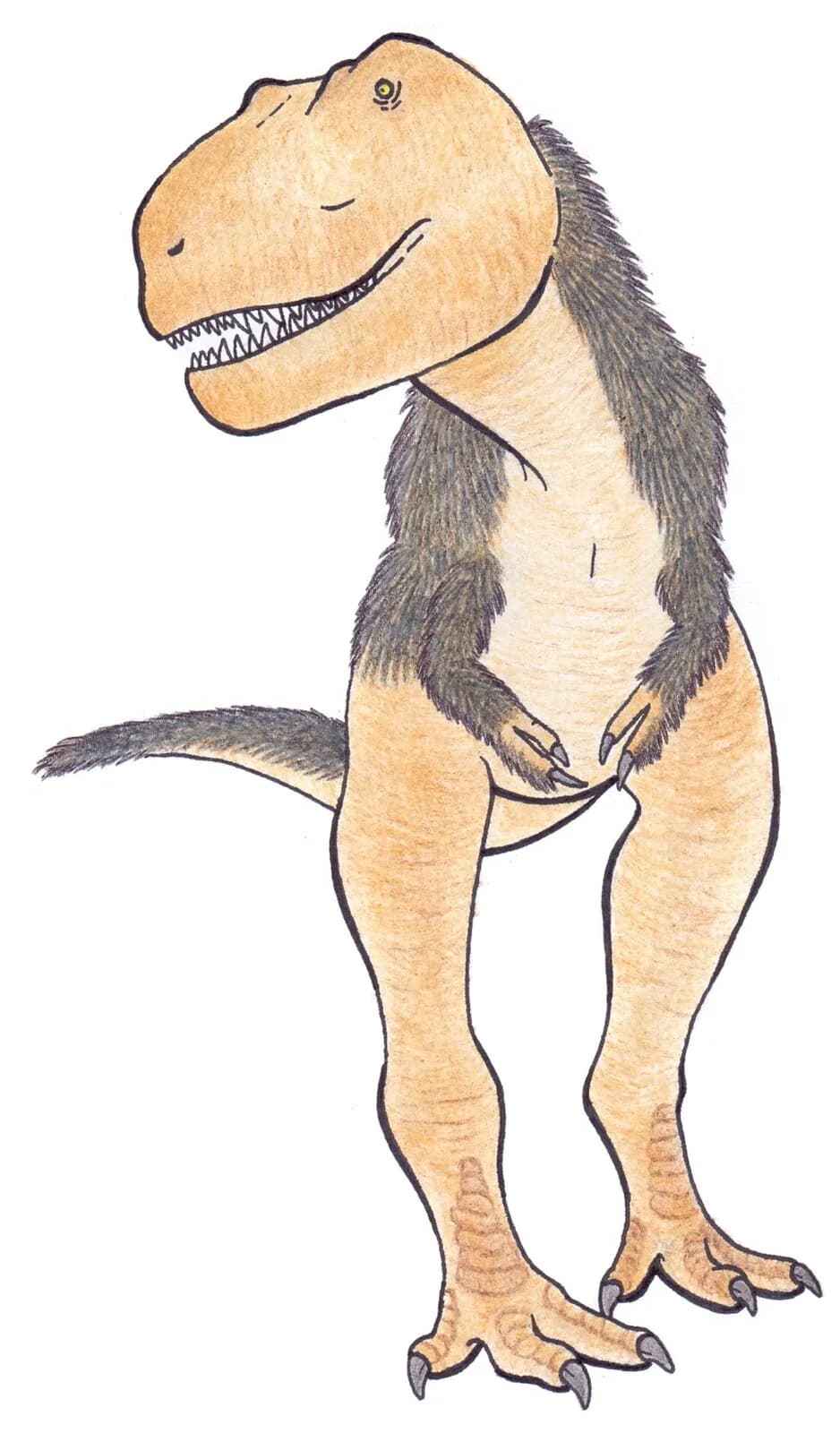
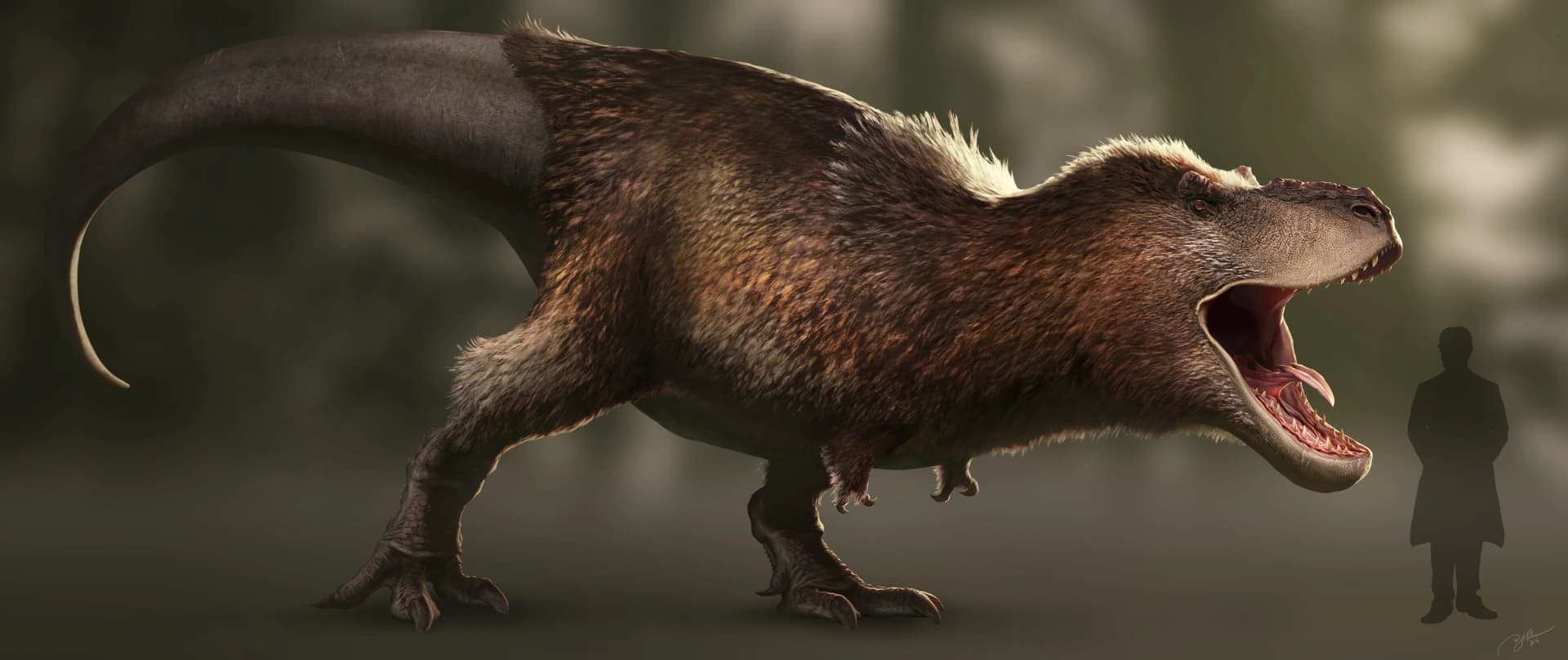
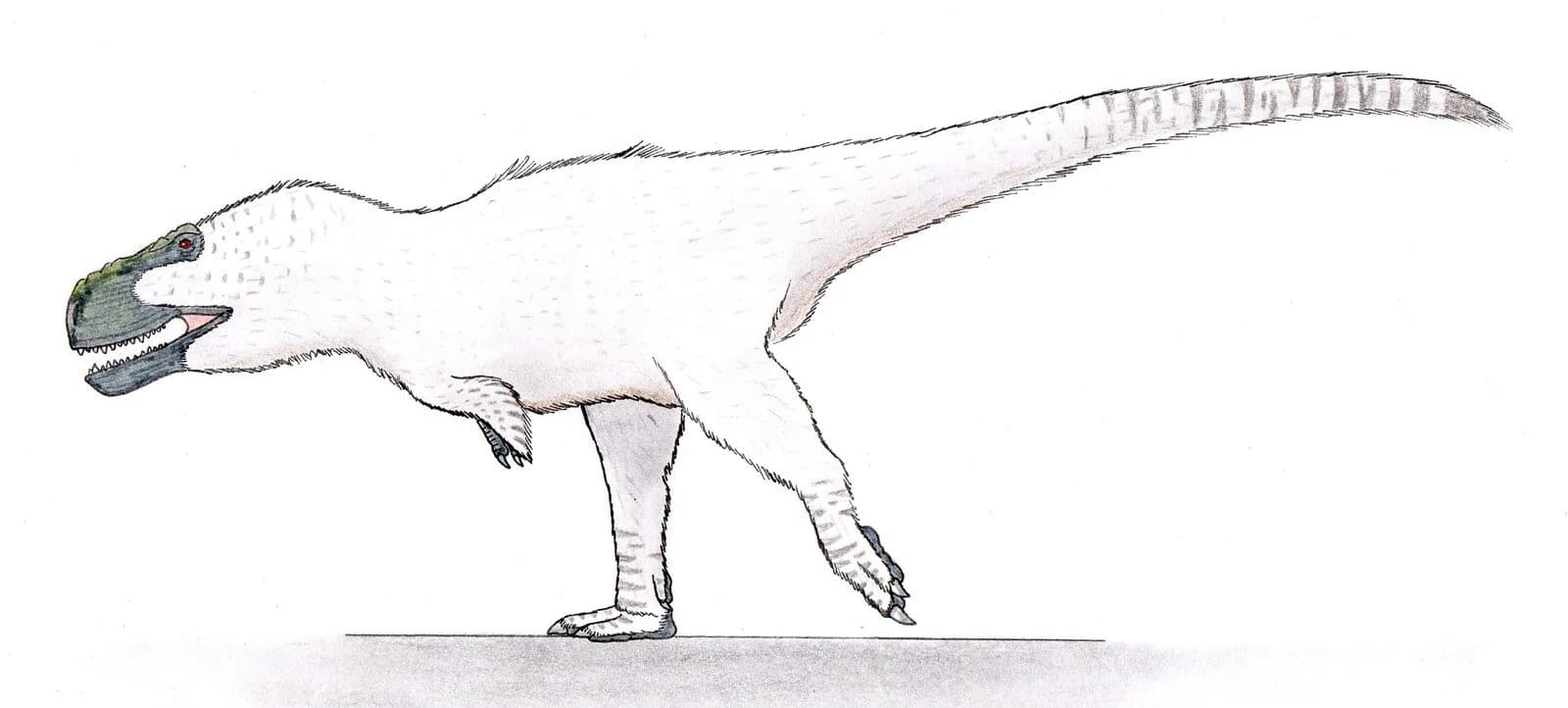
Life reconstruction of Gorgosaurus libratus
Leoomas, CC BY-SA 4.0, via Wikimedia Commons
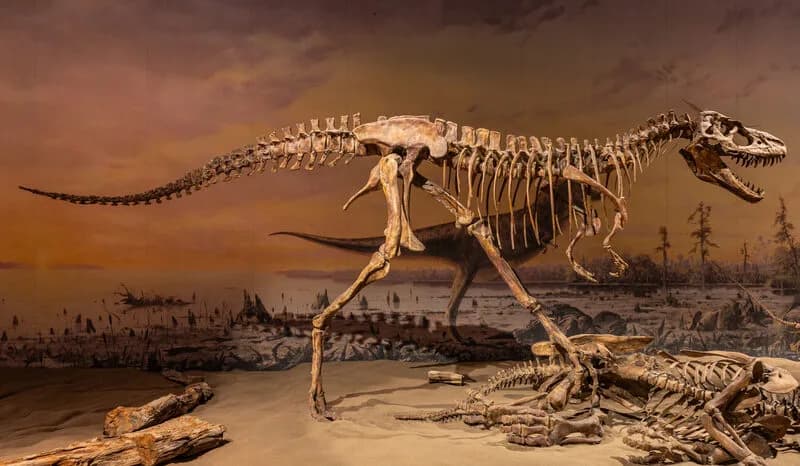
Mounted Gorgosaurus libratus skeleton, Royal Tyrrell Museum
Chris Woodrich, CC BY-SA 4.0