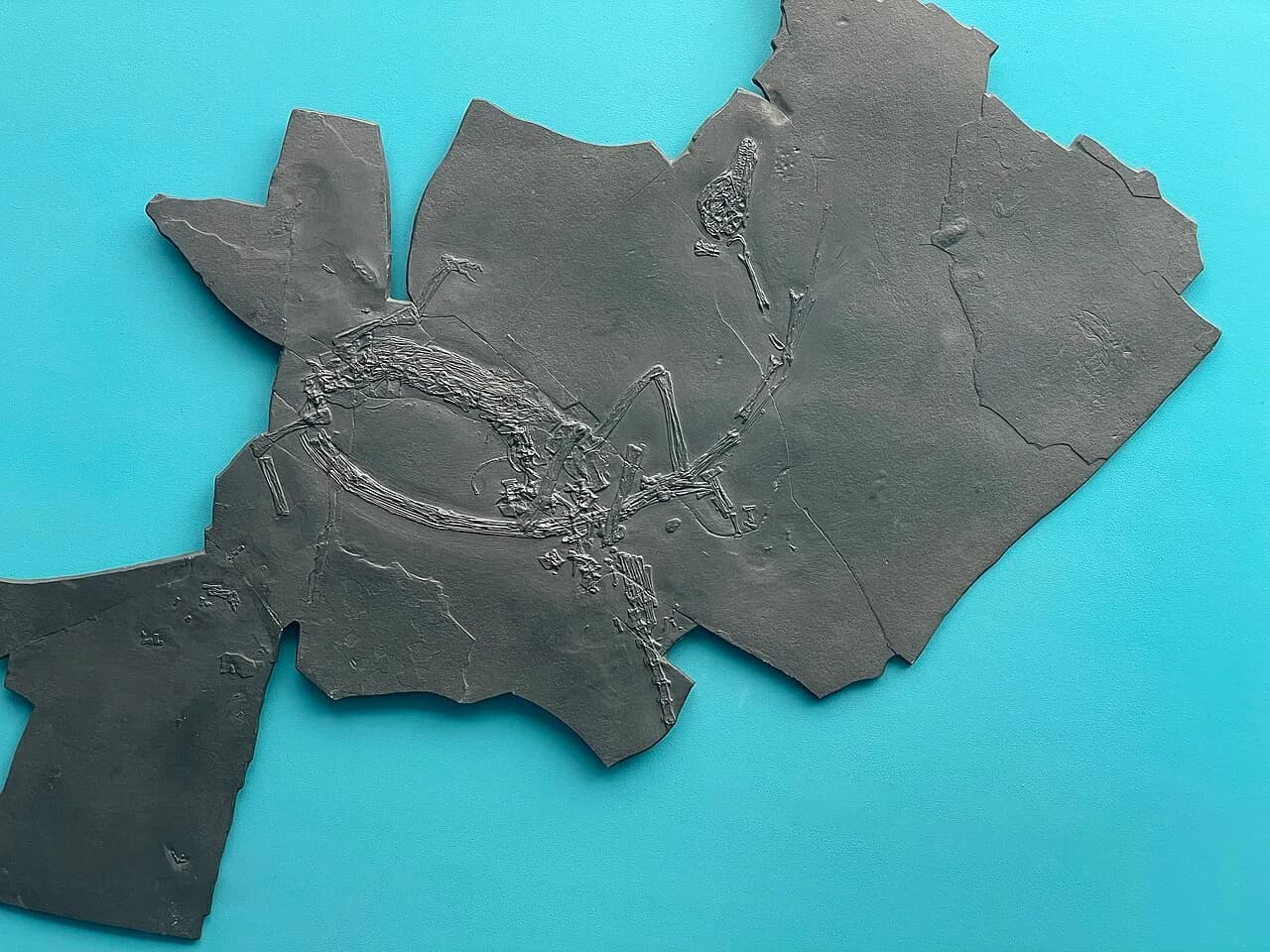
Tanystropheus
Tanystropheus longobardicus carried a 3-metre neck on a 6-metre body, half its total length, a proportion with no equivalent among reptiles. That neck nonetheless held only thirteen vertebrae, each hugely elongated, rather than a great many short ones. It weighed 100 to 150 kilograms and lived 242 to 228 million years ago.
Tanystropheus lived during the Middle Triassic, approximately 242 to 228 million years ago, spanning the Anisian to Norian stages. This period corresponds to a pivotal era in the history of life on Earth, as marine and coastal ecosystems were slowly recovering from the devastating end-Permian mass extinction, the deadliest of all time, which had wiped out approximately 96 percent of all marine species. The supercontinent Pangaea still dominated global geography, and the Tethys Ocean, bordering its southern shores, offered warm, shallow coastal waters rich in fish and invertebrates. Tanystropheus shared its environment with the earliest nothosaurs, placodonts, and primitive ichthyosaurs, in a world where reptiles were only just beginning to reconquer the seas following the great extinction event that had devastated marine ecosystems.
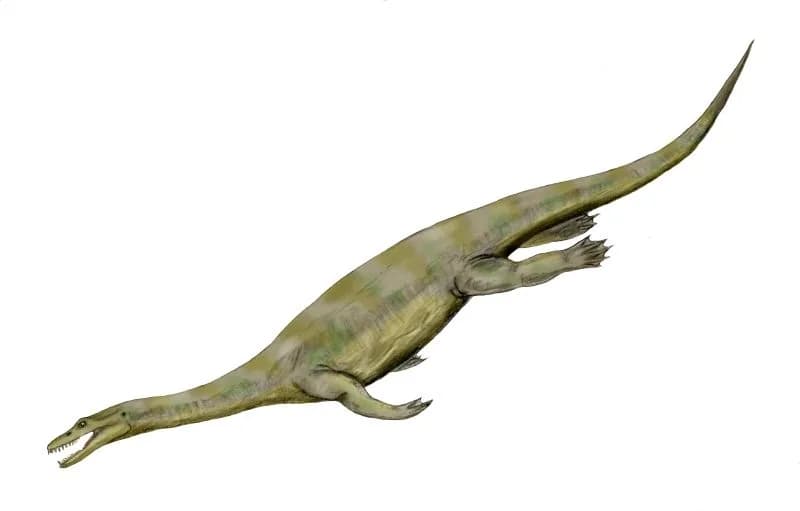
Tanystropheus longobardicus reached a total length of approximately 6 meters, making it an imposing animal for its time. The most astonishing feature of this creature is undeniably its neck, which measured approximately 3 meters on its own — more than half the total body length. This extraordinarily elongated neck was wildly disproportionate to the rest of the body: the torso was relatively compact and the tail was of moderate length. Its weight is estimated between 100 and 150 kilograms. The skull, small and triangular, appeared almost ridiculously tiny at the end of this seemingly endless neck. This unique morphology makes Tanystropheus one of the most recognizable and bizarre reptiles of the entire Mesozoic era, challenging the imagination of even the most experienced paleontologists and delighting enthusiasts of prehistoric life around the world.
Tanystropheus was a specialized piscivore that fed primarily on fish and cephalopods captured in the shallow coastal waters of the Tethys Ocean. Its conical and pointed teeth, set in a narrow, elongated snout, were perfectly adapted for grasping slippery prey such as fish and small squid. The most likely hunting strategy involved an ambush technique: Tanystropheus remained motionless on the shoreline or in very shallow waters, then rapidly projected its long neck to surprise fish passing nearby, somewhat like modern herons stalking their prey from the water's edge. Recent isotopic analyses have confirmed that large adult specimens had a primarily aquatic diet consisting mainly of marine organisms, while juveniles may have had a more varied diet that included insects and terrestrial invertebrates, suggesting an ontogenetic shift in feeding ecology.
Tanystropheus inhabited the coastal shores of the Tethys Ocean, a vast tropical to subtropical body of water that separated the continental masses of Laurasia to the north and Gondwana to the south during the Triassic period. Its fossils have been discovered primarily in the limestone formations of Monte San Giorgio, on the Italian-Swiss border, a site designated as a UNESCO World Heritage Site for the exceptional richness of its Middle Triassic fossil fauna. Additional specimens have been found in Israel, Germany, and other regions bordering the ancient Tethys. The preferred habitat appears to have been coastal lagoons, sheltered bays, and shallow littoral zones — environments offering both access to abundant marine prey and terrestrial resting areas. The debate persists as to whether Tanystropheus was a semi-aquatic animal splitting its time between land and sea, or a primarily aquatic creature returning to land only to reproduce and bask.
The anatomy of Tanystropheus is dominated by its absurdly elongated neck, one of the most extraordinary structures in the entire animal kingdom across all geological periods. This neck contained only 13 cervical vertebrae — a surprisingly low number — but each one was extremely elongated, with some individual vertebrae measuring over 20 centimeters in length. Thin, elongated cervical ribs ran alongside the neck, partially stiffening it and suggesting that the neck was not as flexible as one might intuitively imagine from its serpentine appearance. The skull was small, flattened, and equipped with nostrils positioned on top, facilitating surface breathing while the body remained submerged. The teeth were conical, pointed, and slightly recurved, ideal for capturing slippery fish and cephalopod prey. The torso was relatively short and robust, with powerful hind limbs and more gracile forelimbs. The tail was long and may have served as a rudder during swimming or as a counterbalance during terrestrial locomotion.
The behavior of Tanystropheus has been the subject of passionate scientific debate for decades, with researchers fiercely divided on fundamental aspects of its ecology and lifestyle. The central question is whether this animal was primarily aquatic, semi-aquatic, or essentially terrestrial and hunting from the shoreline. A landmark study published in 2020 using high-resolution computed tomography scanned the skull of Tanystropheus and revealed that its nostrils were positioned on the top of the skull, a classic adaptation typical of aquatic or semi-aquatic animals that need to breathe while keeping most of their body submerged. Furthermore, oxygen isotope analysis of the bones showed values consistent with a primarily aquatic lifestyle. The most widely accepted hypothesis today is that Tanystropheus was a semi-aquatic ambush predator, remaining motionless in shallow waters or on coastal rocks, then suddenly projecting its stiffened neck toward passing fish — a technique comparable to that of the modern grey heron.
The first fossils of Tanystropheus were described in 1886 by Italian paleontologist Francesco Bassani, initially from isolated cervical vertebrae found in the Middle Triassic limestones of Besano, in northern Italy. These extraordinarily elongated vertebrae were first mistaken for the wing bones of a giant pterosaur, an understandable error given their unusual shape and proportions. The name Tanystropheus was established by Francesco Bassani, derived from the Greek tanys meaning long and strophe meaning vertebra. It was at Monte San Giorgio, the famous Italian-Swiss fossil site classified by UNESCO, that the most complete specimens were unearthed throughout the twentieth century, finally allowing scientists to reconstruct the incredible morphology of this animal in full. In 2020, Tanystropheus went viral on social media when a major study by Stephan Spiekman and colleagues, using high-resolution CT scans, revealed new anatomical details and confirmed its aquatic lifestyle. The absurd proportions of the animal — a neck comprising more than half the total length — made it an Internet sensation and a favorite subject of paleontological memes shared millions of times worldwide.
| Period | Trias moyen / Middle Triassic |
| Era | Mésozoïque / Mesozoic |
| Age | 242-228 Ma |
| Location | Suisse, Italie, Israël / Switzerland, Italy, Israel |
| Length | 6 m |
| Height | ~0.5 m |
| Weight | 100-150 kg |
| Diet | Piscivore |
| Discovery | 1886 |
No. Tanystropheus longobardicus was an archosauromorph of the family Tanystropheidae, a Middle Triassic reptile (242-228 Ma) unrelated to dinosaurs. It lived before the first dinosaurs and belongs to a separate lineage that never evolved into dinosaurians. Its fossils were discovered mainly at Monte San Giorgio (Italy/Switzerland, UNESCO site) and Israel.
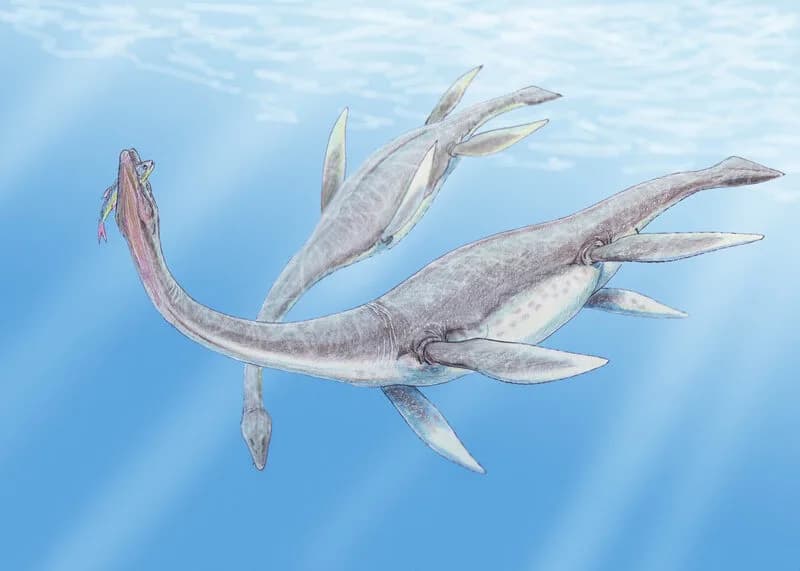
Tanystropheus longobardicus had only 13 cervical vertebrae for a 3-meter neck — over half its total 6-meter length. Each vertebra was individually extremely elongated (some exceeding 20 cm), with stiffening cervical ribs, making the neck partially rigid rather than undulating. This system is radically different from plesiosaurs, which had dozens of short vertebrae.
A landmark 2020 study by Stephan Spiekman et al. used high-resolution CT scans of the Tanystropheus longobardicus skull and revealed its nostrils were positioned on top of the snout — a typical adaptation in semi-aquatic vertebrates. Bone oxygen isotope analysis confirmed a primarily aquatic lifestyle, with adults feeding on fish and cephalopods in the coastal waters of the Tethys Ocean.
Tanystropheus longobardicus with its disproportionately long neck
Wikimedia Commons
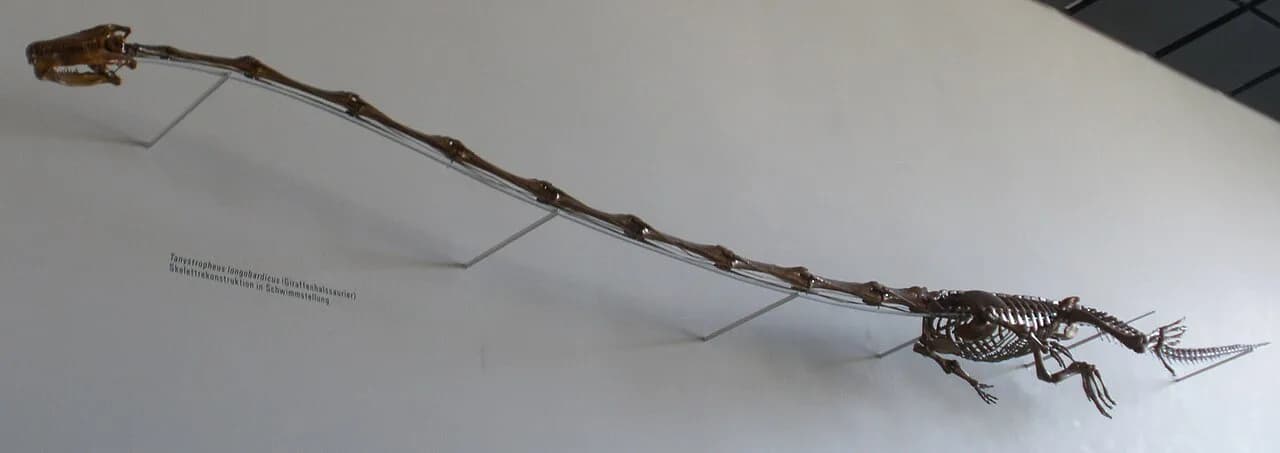
Tanystropheus longobardicus, a reptile with a neck longer than its body
Wikimedia Commons