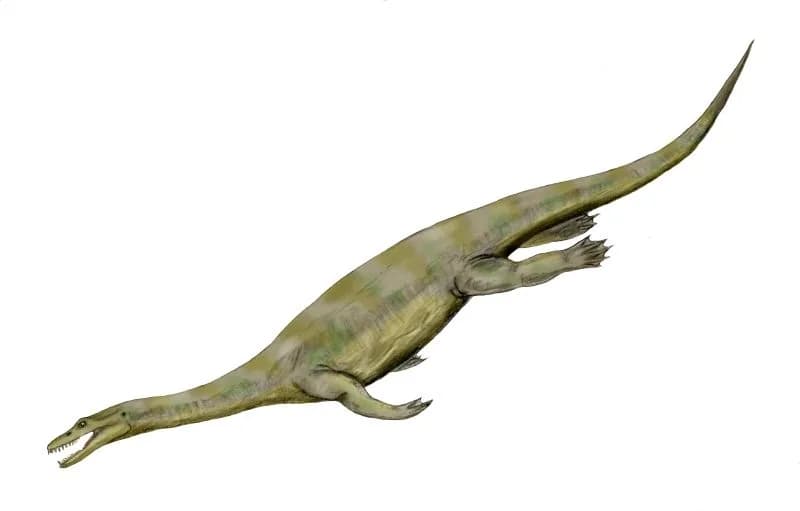
Nothosaure
Nothosaurus mirabilis led a semi-aquatic life close to that of today's seals: it hunted at sea and rested on rocky shores. Its long needle-like teeth interlocked as the jaws closed, forming a trap no fish could back out of. Four to 7 metres long and 80 to 150 kilograms, it lived 245 to 228 million years ago.
Nothosaurus lived during the Middle to Late Triassic, approximately 245 to 228 million years ago, spanning the Anisian to Norian stages. This period represents a pivotal era in marine life history, shortly after the Great Permian-Triassic extinction that had wiped out nearly 96% of all marine species in the most devastating mass extinction in Earth's history. The Triassic saw the emergence of the first great marine reptiles, and Nothosaurus was among the pioneers of this oceanic reconquest. It shared the seas with early ichthyosaurs and placodonts, those shell-crushing marine reptiles. The supercontinent Pangaea still dominated world geography, and the Tethys Ocean where Nothosaurus lived separated the northern landmass of Laurasia from the southern Gondwana. The climate was generally warm and arid on the continents, but the Tethys coastlines offered a rich and productive marine environment.
Nothosaurus typically measured about 4 meters in length, though some species like N. giganteus and N. zhangi reached impressive sizes of 5 to 7 meters, making them among the largest marine predators of the Middle Triassic. Its weight is estimated between 80 and 150 kilograms for average-sized specimens. Its body was elongated and streamlined, adapted for swimming, with a low profile of about 50 centimeters in height. The neck was relatively long and flexible, making up a notable proportion of the total length, and supported an elongated skull armed with needle-like teeth. The long, muscular tail served as the primary propulsion organ in water. Compared to the marine reptiles that would follow in the Jurassic and Cretaceous, Nothosaurus was modestly sized, but it nevertheless ranked among the largest marine predators of the Middle Triassic world.
Nothosaurus was a carnivorous piscivore that primarily fed on fish, which it captured using its remarkably adapted long needle-like teeth. These teeth interlocked perfectly when the jaws closed, creating an inescapable trap for slippery prey — a mechanism also found in some fish-eating pterosaurs that evolved millions of years later. Fossil evidence shows its diet was not limited to fish: remains of juvenile placodonts have been found in the stomachs of related nothosaurs, indicating opportunistic predatory behavior extending to other marine reptiles. It likely also hunted squid, crustaceans, and other small marine organisms. Its hunting strategy probably resembled that of modern seals, diving from the coast to pursue schools of fish in shallow coastal waters before surfacing to breathe.
Nothosaurus lived in the shallow coastal waters of the Tethys Ocean, which stretched between the landmasses of Laurasia to the north and Gondwana to the south during the Triassic period. It was a semi-aquatic animal that divided its time between sea and land, much like modern seals and sea lions — earning it the nickname 'seal of the Triassic.' It frequented rocky shores, beaches, and estuaries where it could rest, bask in the sun, and possibly reproduce. Its fossils have been found in coastal marine sediments across Europe (Germany, Netherlands, Spain, France, Switzerland, Italy), the Middle East (Israel), China (Guizhou Province), and North Africa, attesting to a remarkably wide geographic distribution along the Tethys coastlines throughout the Middle and Late Triassic.
The anatomy of Nothosaurus perfectly reflects its unique semi-aquatic lifestyle, bridging the gap between fully terrestrial and fully marine reptiles. Its skull was broad and flattened, with an elongated snout bearing nostrils positioned on top, allowing it to breathe easily by only surfacing the top of its head above water. Its long, conical, needle-shaped teeth interlocked like the teeth of a trap when it closed its jaws, forming a perfect cage for catching fish. Its four limbs were webbed, with long toes connected by membranes, facilitating propulsion and maneuverability in water while still retaining some terrestrial capability. The tail was long and potentially equipped with a caudal fin for additional thrust. Unlike the plesiosaurs that would follow, Nothosaurus retained relatively functional limbs on land, with joints still permitting terrestrial locomotion, albeit probably clumsy and slow.
The behavior of Nothosaurus is often compared to that of modern seals, earning it the popular nickname 'seal of the Triassic.' It was an active predator that hunted in shallow coastal waters, probably making dives from the shore to pursue schools of fish in the nutrient-rich Tethys waters. It had to return regularly to the surface to breathe, being an air-breathing reptile that had not fully committed to a pelagic lifestyle. On land, it rested on coastal rocks and beaches, where it could also bask in the sun to regulate its body temperature, an essential behavior for an ectothermic animal. The question of its reproduction remains actively debated: some researchers suggest it laid eggs on land like sea turtles, while others believe it practiced viviparity, as evidence of live birth has been found in related nothosaur species from Triassic deposits.
The first fossils of Nothosaurus were discovered in 1834 by paleontologist Georg zu Münster in the Muschelkalk limestone formation in Germany, making it one of the earliest marine reptiles to be scientifically described. Since this initial discovery, over 15 species have been described, making Nothosaurus the most diverse genus in the entire nothosaur order and one of the best-known Triassic marine reptiles. Remarkably complete specimens, including fully articulated skeletons sometimes preserving fine anatomical details, have been unearthed in Germany, the Netherlands, Spain, France, Switzerland, Italy, Israel, and China. Chinese discoveries in Guizhou Province, including N. youngi, N. yangjuanensis, and N. zhangi, have considerably expanded the known geographic distribution of the genus across the Tethys realm. N. zhangi is one of the largest known species, reaching nearly 7 meters in length. Nothosaurus is widely considered a probable ancestor of the plesiosaurs that would dominate the oceans of the Jurassic and Cretaceous periods for over 135 million years.
| Period | Trias moyen à supérieur / Middle to Late Triassic |
| Era | Mésozoïque / Mesozoic |
| Age | 245-228 Ma |
| Location | Europe (Allemagne, Pays-Bas, Espagne, Italie), Chine, Israël / Europe (Germany, Netherlands, Spain, Italy), China, Israel |
| Length | 4-7 m |
| Height | ~0.5 m |
| Weight | 80-150 kg |
| Diet | Piscivore |
| Discovery | 1834 |
No, Nothosaurus mirabilis was not a dinosaur but a semi-aquatic marine reptile of the order Nothosauridae (Sauropterygia). It lived 245 to 228 million years ago during the Triassic — before the appearance of dinosaurs. Nicknamed the 'seal of the Triassic,' it divided its time between sea and rocky shores of the Tethys Ocean, like modern sea lions. First described by Georg zu Münster in 1834 from the German Muschelkalk.
Nothosaurus typically measured about 4 meters, but some species like N. giganteus and N. zhangi (Guizhou, China) reached 5 to 7 meters. Over 15 species are described, making Nothosaurus the most diverse nothosaur genus of the Triassic, with fossils from Europe (Germany, Spain, Italy), the Middle East (Israel), and China. Weight was estimated between 80 and 150 kilograms for average-sized specimens.
Nothosaurus is considered a probable ancestor of plesiosaurs — the long-necked marine reptiles that would dominate the oceans for over 135 million years. Nothosaurus represents an intermediate stage: its webbed limbs still permitted terrestrial locomotion, unlike plesiosaurs which had transformed these limbs into flippers. Nothosaurs went extinct at the end of the Triassic, their plesiosaur successors appearing at the start of the Jurassic.
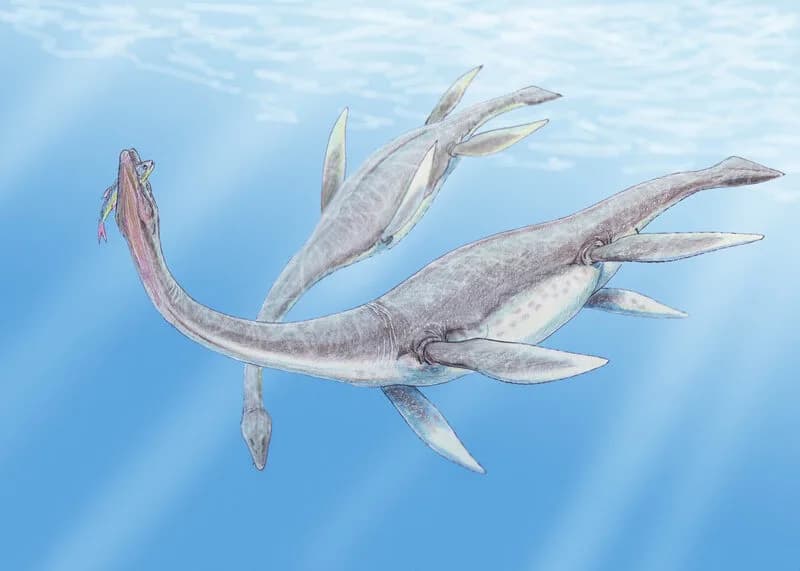
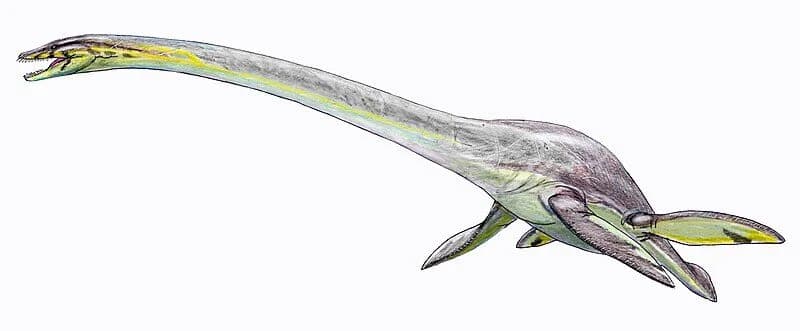
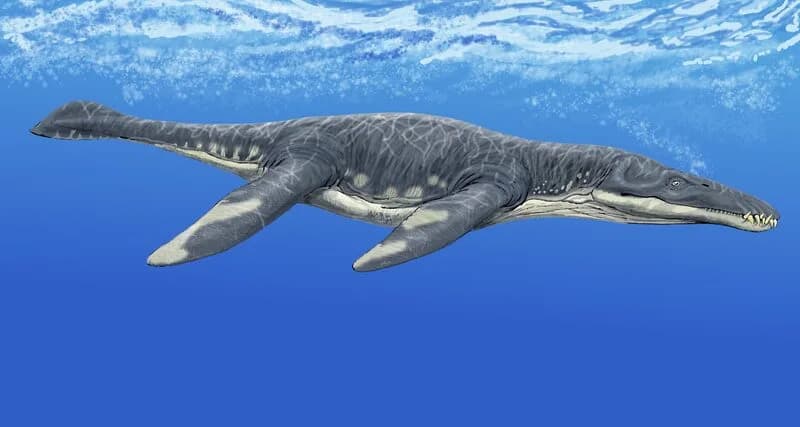
Life reconstruction of Nothosaurus, the 'seal of the Triassic'
Nobu Tamura / Wikimedia Commons
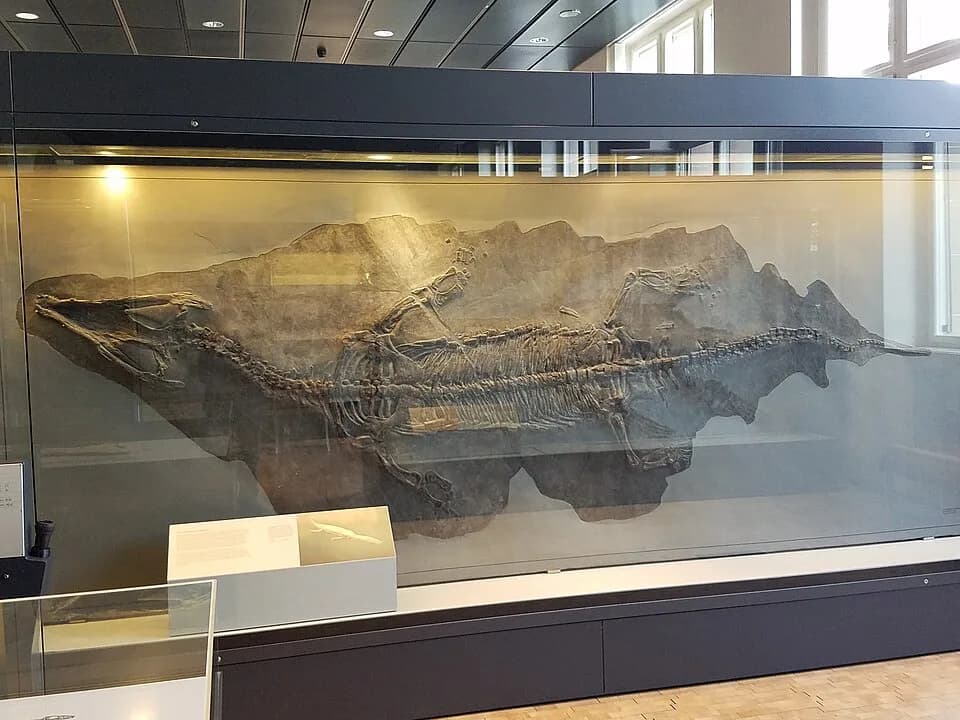
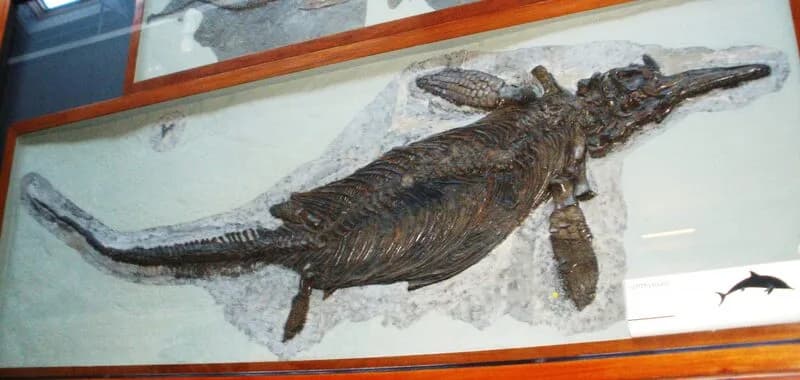
Complete skeleton of Nothosaurus giganteus
Wikimedia Commons
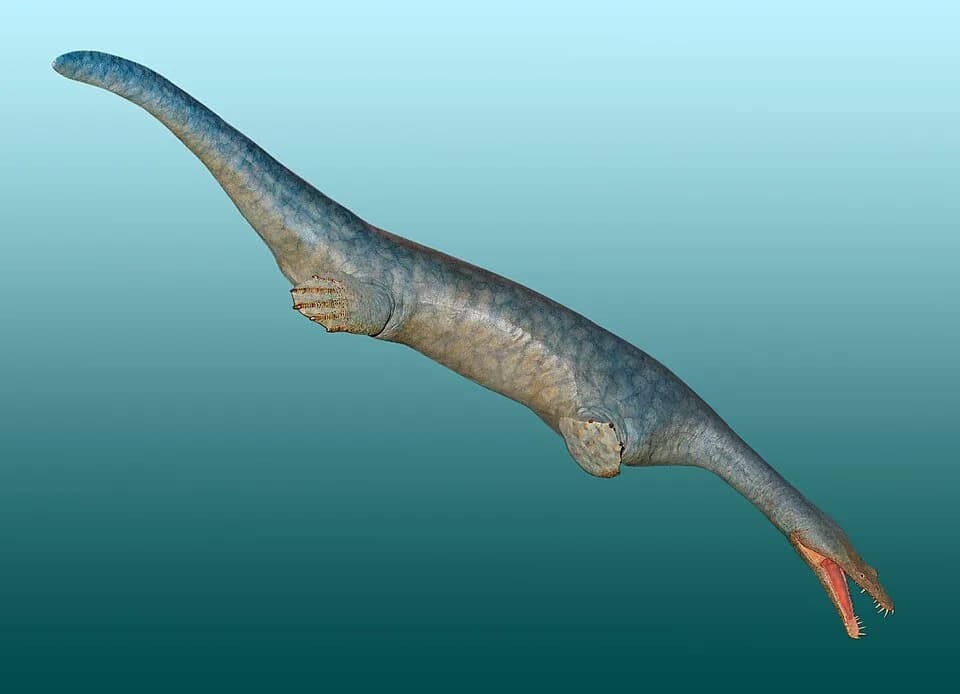
Fossil skull of Nothosaurus mirabilis
Wikimedia Commons