Stéthacanthus
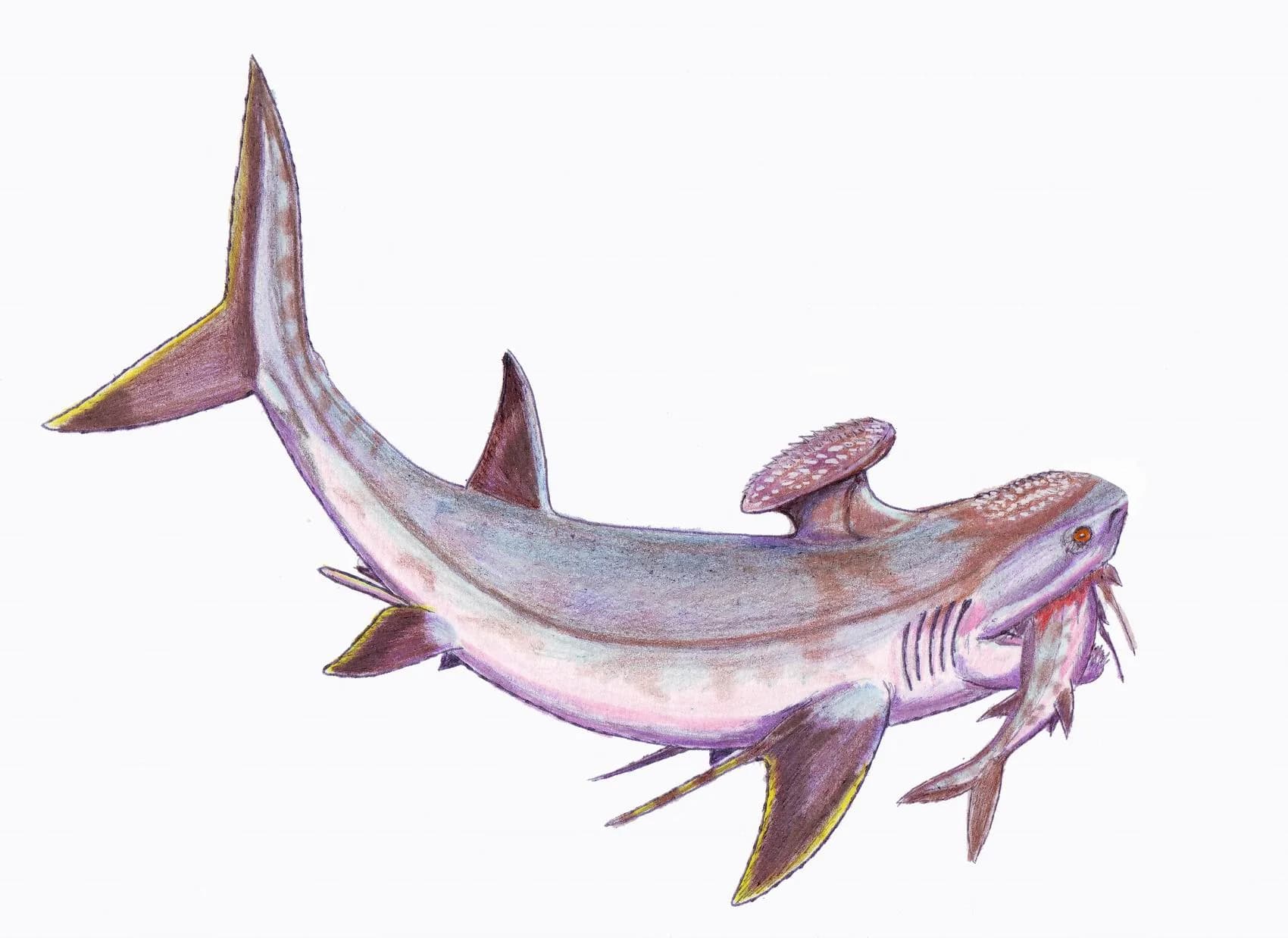
Stethacanthus altonensis was an early shark described in 1889, found in Montana and Scotland between 382 and 323 million years ago. At 0.7 to 2 metres and 10 to 30 kilograms, it carried an anvil-shaped dorsal fin found nowhere else in the animal kingdom. Covered in denticles, from below it resembled a gaping mouth.
Stethacanthus lived during the Late Devonian and Early Carboniferous, approximately 382 to 323 million years ago. This primitive shark belongs to the order Symmoriiformes, an archaic group of chondrichthyans (cartilaginous fish) now entirely extinct. It evolved during the 'Age of Fishes,' a period of explosive vertebrate diversification that saw the emergence of the first modern sharks. Its extinction coincides with ecological upheavals at the end of the Carboniferous, when marine faunas underwent significant restructuring linked to climate changes and sea level variations.
Stethacanthus was a modestly-sized shark by modern standards, measuring between 70 centimeters and 2 meters in total length depending on species. Its weight is estimated at approximately 10 to 30 kilograms. Despite its relatively small size, its most striking feature was a unique dorsal outgrowth shaped like an anvil or ironing board — a flattened bony structure atop an enlarged dorsal spine, covered with small upward-pointing dermal denticles. The top of its head also bore a patch of similar denticles, creating a striking visual ensemble.
Stethacanthus was probably a small to medium-sized active predator, feeding on fish, primitive cephalopods, crustaceans, and other marine invertebrates. Its dentition, composed of small multicuspid teeth, was adapted for catching slippery prey rather than tearing large prey apart. Its relatively small mouth and fine teeth suggest a primarily piscivorous diet, targeting prey proportional to its own size. It likely hunted in shallow coastal waters and estuaries where prey was abundant and diverse, using quick bursts of speed to ambush small fish and invertebrates hiding among the reef structures and lagoon sediments.
Stethacanthus inhabited the warm, shallow seas of the Late Devonian and Early Carboniferous, primarily in what is now North America and Europe. Its fossils are particularly abundant in the Bear Gulch Limestone of Montana in the United States, an exceptional lagerstätte conservation deposit that has preserved remarkably complete specimens with extraordinary anatomical detail. Other significant remains have been discovered in Scotland and various other North American formations. These depositional environments represent tropical lagoons and shallow epicontinental seas characterized by warm, well-oxygenated waters teeming with diverse marine life including fish, cephalopods, and crustaceans.
The anatomy of Stethacanthus is dominated by its unique dorsal structure: an enlarged dorsal spine topped by a flattened platform covered with upward-pointing dermal denticles. This dorsal 'brush,' called the spine-brush complex, has no equivalent among modern sharks. The top of the skull bore a symmetrical patch of similar denticles, creating a 'phantom jaw' effect when viewed from below. Its body was fusiform, typical of sharks, with a heterocercal tail fin (longer upper lobe). Its pectoral fins were well-developed, and it possessed claspers indicating sexual dimorphism — the anvil-shaped dorsal structure may have been present only in males.
Stethacanthus behavior remains largely speculative, but its unique dorsal structure has inspired several compelling hypotheses. The most widespread suggests the denticle-covered platform served as a defensive decoy: viewed from below by a larger predator, it mimicked an open mouth filled with teeth, deterring attacks. Other researchers propose a role in courtship display and sexual selection — if the structure was limited to males, it could have served as a visual signal to attract females. A third hypothesis suggests it served as a suction cup for attaching to larger animals, though this idea has less support.
Stethacanthus was first described by American paleontologist John Strong Newberry in 1889. The generic name means 'chest spine' (from Greek stethos 'chest' + akantha 'spine'), referring to its characteristic dorsal structure. The best-preserved specimens come from the Bear Gulch Limestone in Montana, dating to the Early Carboniferous (Mississippian), where exceptional preservation conditions allowed fine anatomical details to be preserved, including the complete spine-brush complex structure. Several species are recognized: S. altonensis (type), S. productus, and S. praecox. Fragmentary fossils have also been found in Scotland.
| Period | Dévonien sup. – Carbonifère inf. / Late Devonian – Early Carboniferous |
| Era | Paléozoïque / Paleozoic |
| Age | 382-323 Ma |
| Location | Amérique du Nord (Montana), Écosse / North America (Montana), Scotland |
| Length | 0.7-2 m |
| Weight | 10-30 kg |
| Discovery | 1889 |
No. Stethacanthus altonensis was a primitive shark belonging to the order Symmoriiformes, an entirely extinct group of chondrichthyans (cartilaginous fish). It lived 382 to 323 million years ago, long before the first dinosaurs appeared (around 230 Ma). It is a cartilaginous fish with no relation to dinosaurian reptiles.
The function of Stethacanthus altonensis's spine-brush complex remains debated. The leading hypothesis proposes a defensive decoy: viewed from below, the denticle-covered platform mimicked a gaping tooth-filled mouth to deter predators. Other researchers suggest a courtship role, as the structure may have been limited to males (sexual dimorphism). No equivalent exists among modern sharks.
The best-preserved Stethacanthus specimens come from the Bear Gulch Limestone of Montana (USA), an Early Carboniferous (Mississippian) Lagerstätte dated to about 323 million years ago. Fragmentary fossils have also been discovered in Scotland. The Montana deposit is exceptional for preserving fine anatomical details, including the complete spine-brush complex unique to this shark.
Stethacanthus reconstruction showing its anvil-shaped dorsal fin
Dmitry Bogdanov, CC BY 3.0
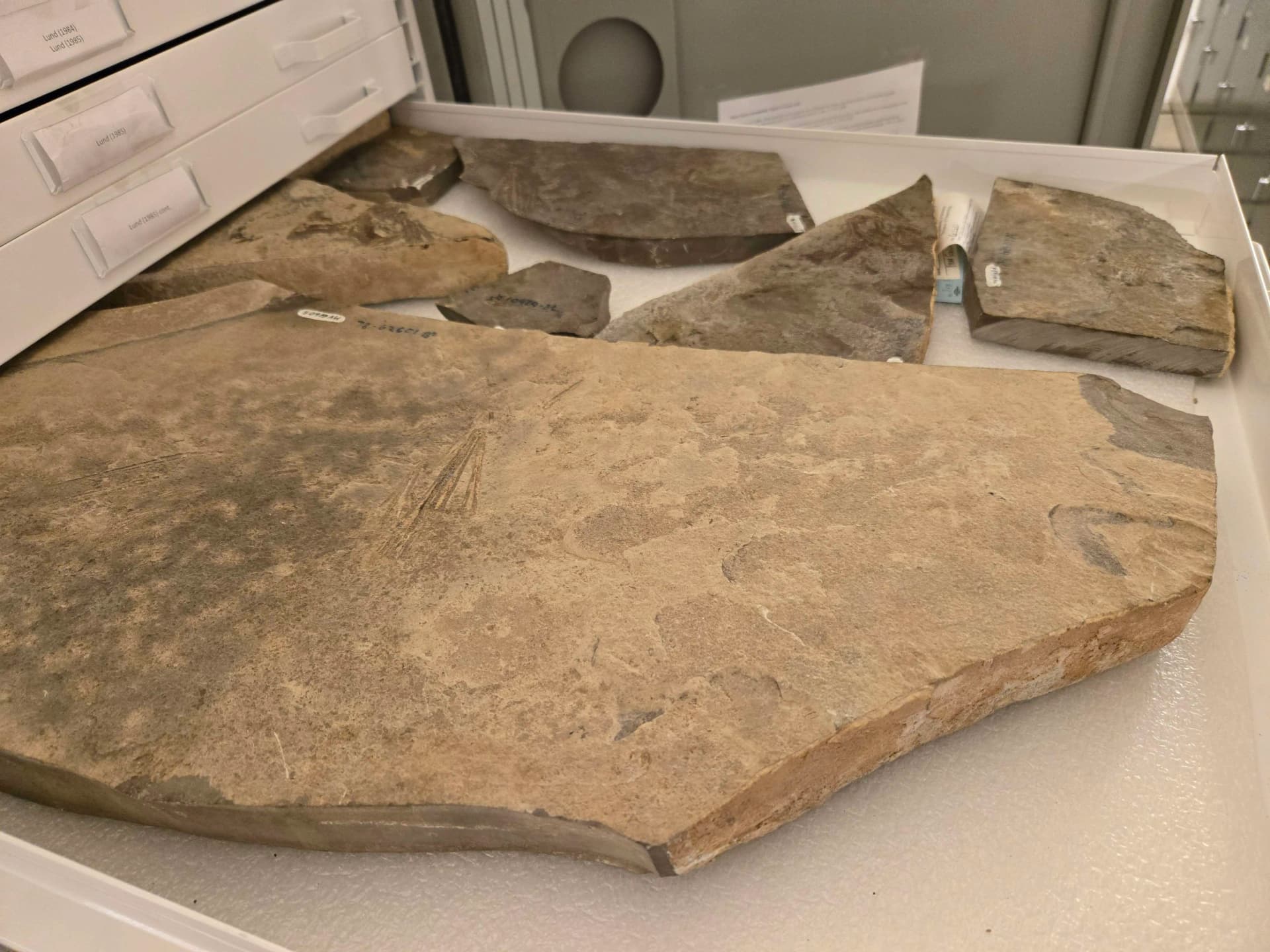
Stethacanthus productus fossil from Bear Gulch Limestone
Wikipedia Commons