Lézard-oiseau chinois
Sinornithosaurus millenii is among the very first non-avian dinosaurs whose feathers were observed directly on the fossil, in 1999 in Liaoning. Analysis of its melanosomes even allowed its colours to be restored. A metre long and 2 to 3 kilograms, it lived 124 to 122 million years ago. A 2009 study called it venomous, a claim since disputed.
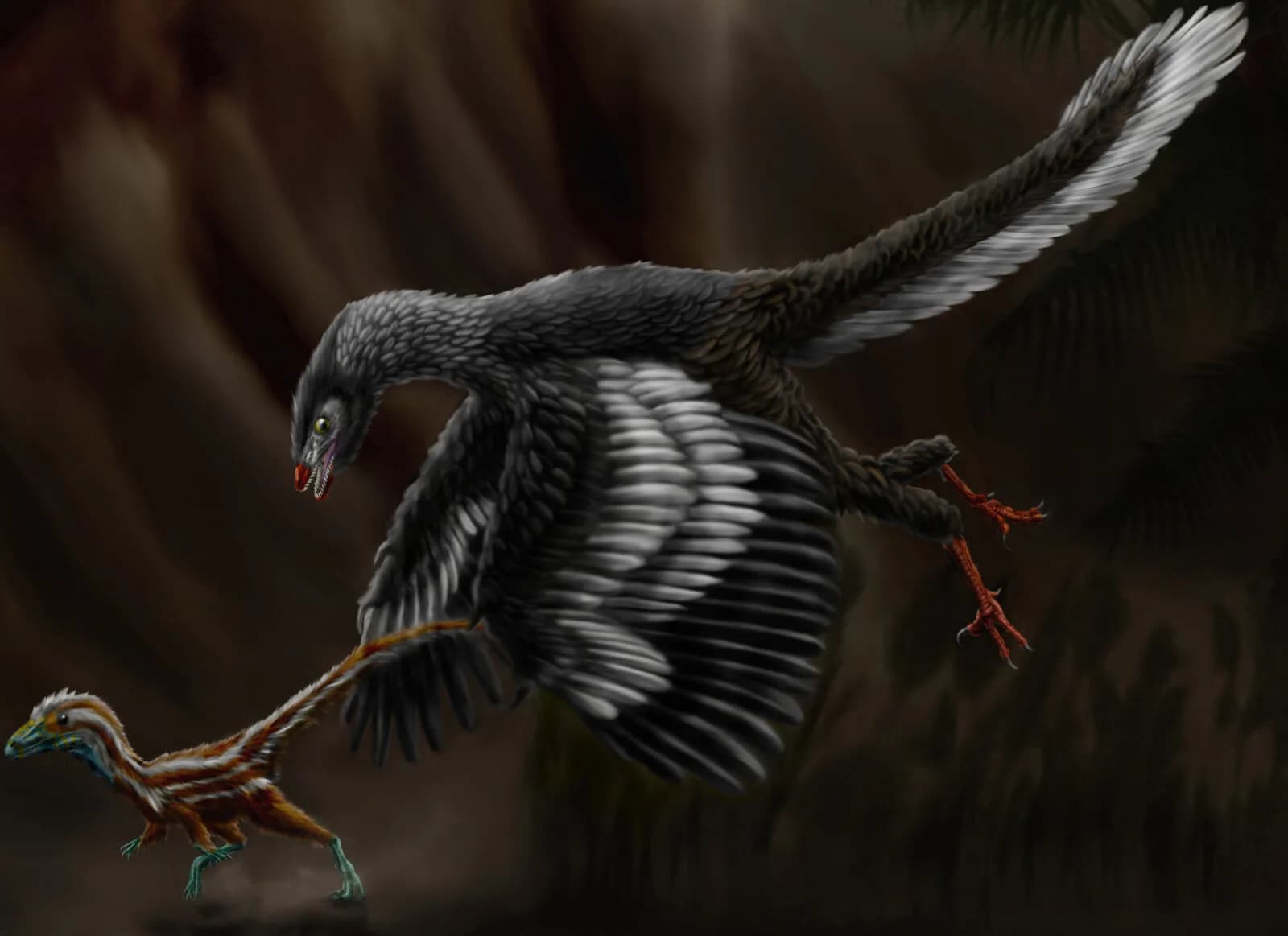
Sinornithosaurus lived during the Early Cretaceous, approximately 124 to 122 million years ago, during the Aptian stage. It inhabited Liaoning Province in China, a region then covered by temperate forests and volcanic lakes. This area, known as the Jehol biota, has yielded some of the most extraordinary fossils in the world thanks to exceptional preservation conditions. Sinornithosaurus coexisted with other feathered dinosaurs such as Microraptor and Sinosauropteryx. The climate at the time was temperate with distinct seasons, comparable to the forests of present-day southern Japan.
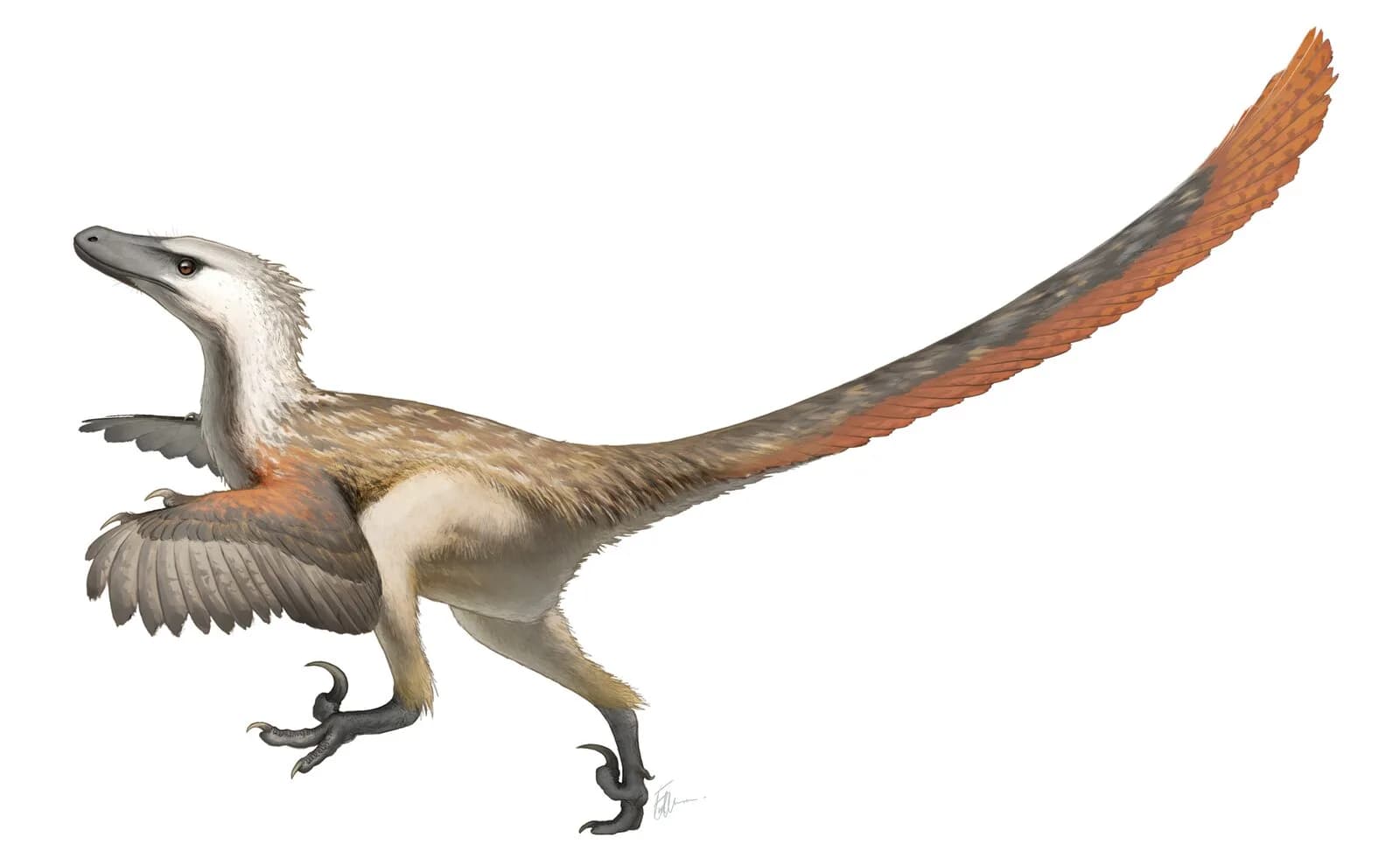
Sinornithosaurus was a small dromaeosaurid measuring approximately 1 meter in length, 30 centimeters tall at the hips, and weighing an estimated 2 to 3 kilograms. Its modest size placed it among the smallest known raptors. The entire body was covered in filamentous and pennaceous feathers, some of which showed asymmetric structures similar to those of modern flying birds. Its forelimbs were elongated and equipped with sharp claws. Despite its small size, its concentrated musculature and hollow bones gave it surprising power relative to its weight.
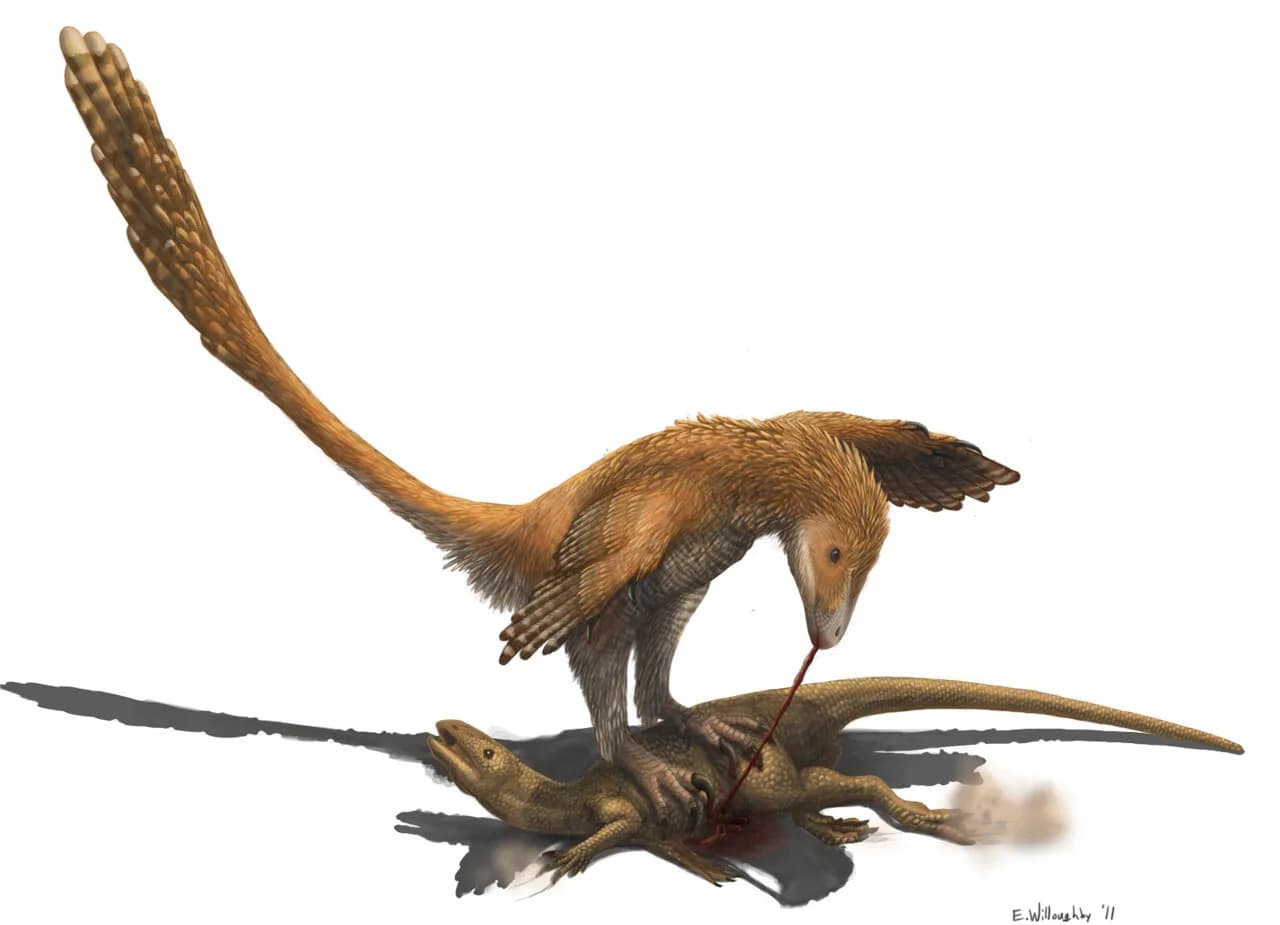
An agile carnivore, Sinornithosaurus likely hunted small vertebrates, lizards, primitive mammals, and insects both in the canopy and on the ground. In 2009, a controversial study suggested that its long, grooved teeth in the upper jaw may have been used to inject venom, similar to some modern snakes. This 'venomous raptor' hypothesis was contested by other paleontologists who attributed the tooth length to post-mortem displacement of skull bones. Nevertheless, the debate stimulated research into the feeding strategies of small arboreal dromaeosaurids.
Sinornithosaurus lived in the lacustrine forests of Liaoning, in what is now northeastern China. The Jehol biota ecosystem was a temperate volcanic environment, dotted with lakes and rivers lined with conifers, tree ferns, and ginkgos. Periodic volcanic eruptions buried animals under layers of fine ash, creating exceptional fossilization conditions that preserved feathers and soft tissues. This environment also harbored primitive angiosperms, among the earliest known flowering plants, which were beginning to diversify the local flora. The dense forest canopy provided ideal hunting grounds for small arboreal predators like Sinornithosaurus.
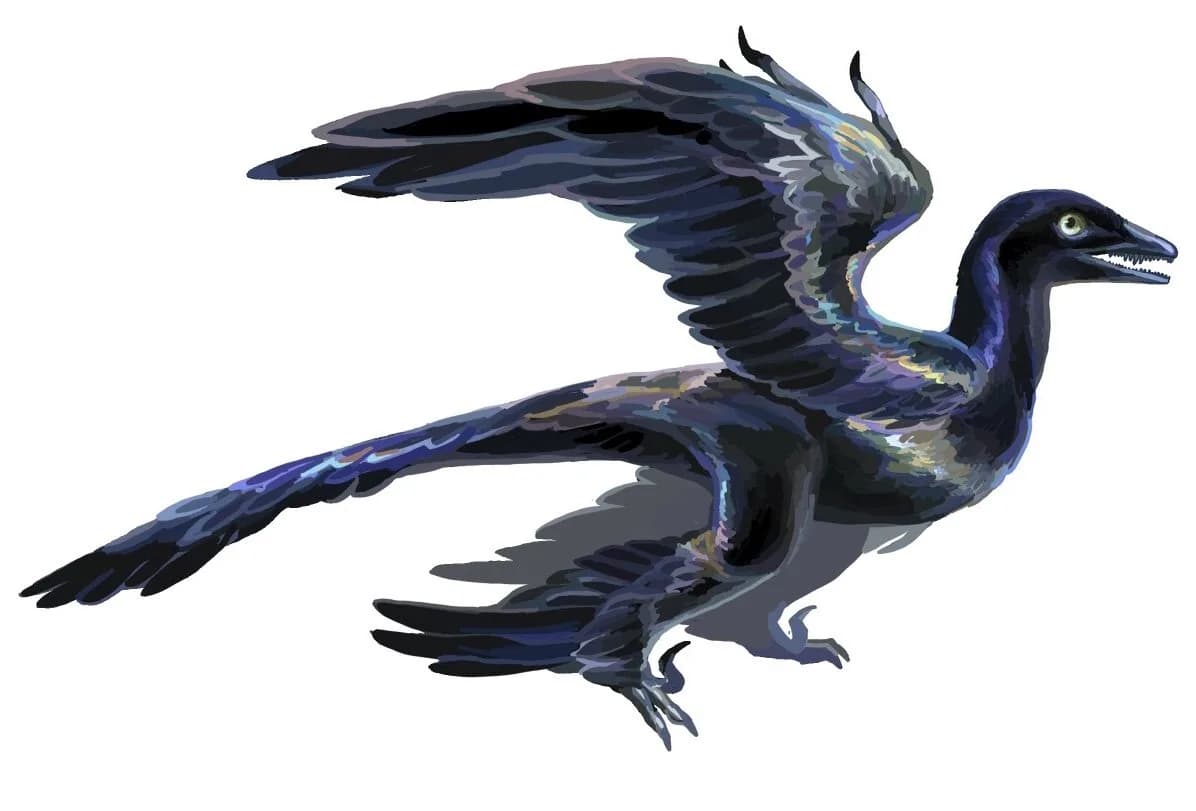
The anatomy of Sinornithosaurus reveals an animal perfectly adapted for arboreal life and agile hunting. Its elongated skull bore closely packed, pointed teeth, some unusually long in the maxilla. The body was entirely covered in feathers: simple filaments on the trunk and more complex pennaceous feathers on the arms and tail. The feet possessed the retractable sickle claw characteristic of dromaeosaurids, though smaller than in its larger cousins. The shoulder joint allowed an extended range of motion, facilitating climbing and the capture of arboreal prey.
Sinornithosaurus was likely both an arboreal and terrestrial predator, capable of climbing trees thanks to its curved claws and elongated forelimbs. Its dense plumage suggests at least partial endothermy, allowing it to remain active in cooler conditions. Analysis of its fossilized feathers revealed melanosomes of different shapes, indicating a multicolored plumage mixing shades of reddish-brown, black, and possibly gray, perhaps used for camouflage or display. Its ability to exploit both the ground and the canopy gave it a considerable ecological advantage over strictly terrestrial predators.
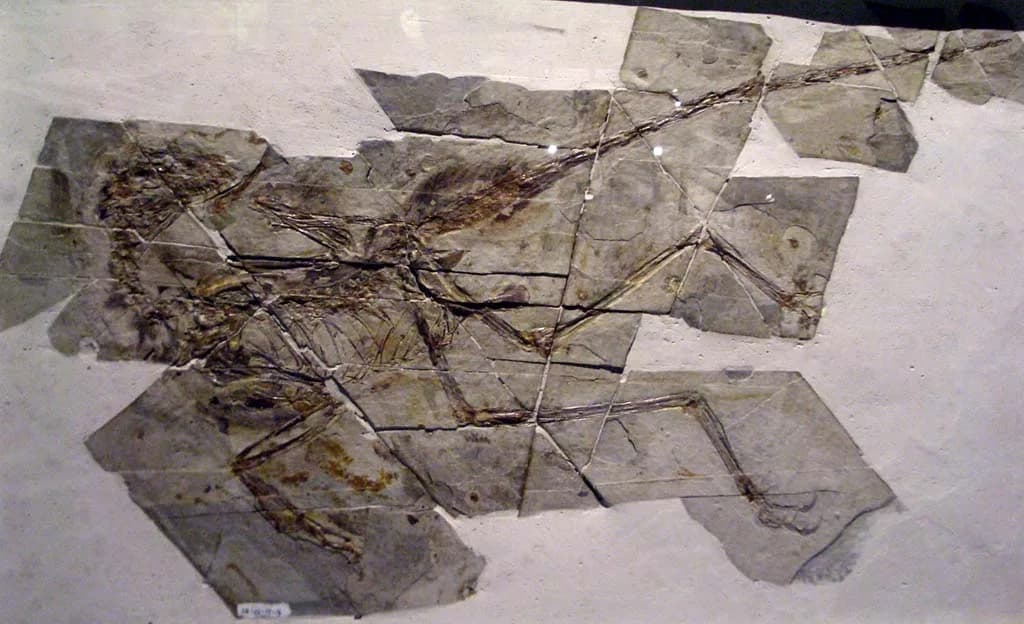
Sinornithosaurus was described in 1999 by Xu Xing, Wang Xiaolin, and Wu Xiaochun from a remarkably complete specimen discovered in the Yixian Formation in Liaoning, China. It was one of the very first non-avian dinosaurs whose feathers were directly observed on the fossil, confirming the evolutionary link between dinosaurs and birds. Several additional specimens have been discovered since, some with feather impressions so detailed that the original coloration could be deduced through melanosome analysis. The holotype specimen, catalogued as IVPP V12811, remains one of the most significant feathered dinosaur fossils ever recovered.
| Period | Crétacé inférieur / Early Cretaceous |
| Era | Mésozoïque / Mesozoic |
| Age | 124-122 Ma |
| Location | Chine (Liaoning) / China (Liaoning) |
| Length | 1 m |
| Height | 0.3 m |
| Weight | 2-3 kg |
| Diet | Insectivore |
| Discovery | 1999 |
Described in 1999 by Xu Xing from a specimen in the Yixian Formation (Liaoning, China), Sinornithosaurus millenii was one of the very first non-avian dinosaurs whose feathers were directly observed on the fossil, confirming the evolutionary link between theropod dinosaurs and birds. Its complete plumage — filaments on the trunk and pennaceous feathers on the limbs — illustrates a key step in the transition toward modern birds.
Sinornithosaurus millenii measured approximately 1 meter in length, 30 centimeters at the hips, and weighed 2 to 3 kilograms — lighter than a house cat. This small dromaeosaurid hunted lizards, small primitive mammals, and insects in the Jehol biota forests 124 to 122 million years ago. In 2009, a controversial study suggested it was venomous, a hypothesis widely contested by specialists.
Analysis of melanosomes — pigment organelles — preserved in the fossilized feathers of Sinornithosaurus millenii revealed different shapes associated with specific colors. This data indicates a multicolored plumage mixing shades of reddish-brown, black, and possibly gray, comparable to many modern birds. This is one of the first times the color of a non-avian dinosaur was directly deduced from fossil analysis.
Sinornithosaurus fossil (NGMC 91)
Wikimedia Commons, CC BY-SA
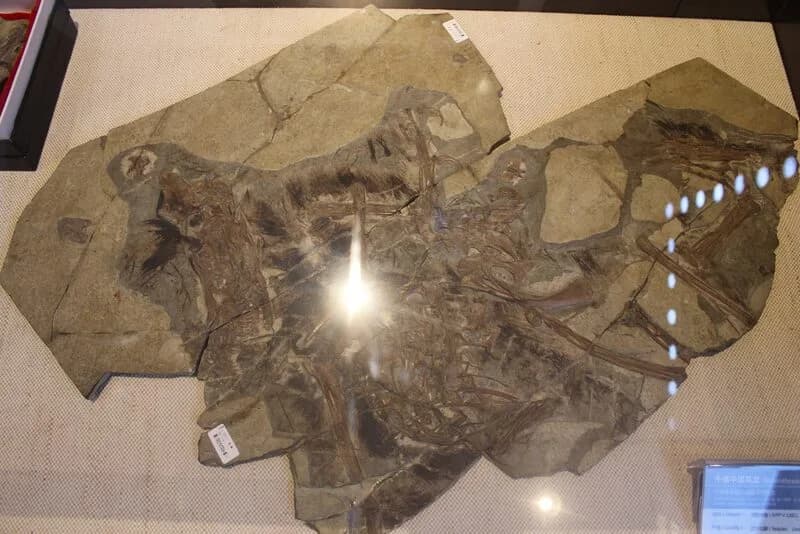
'Dave' specimen at Geological Museum of China
Wikimedia Commons, CC BY-SA