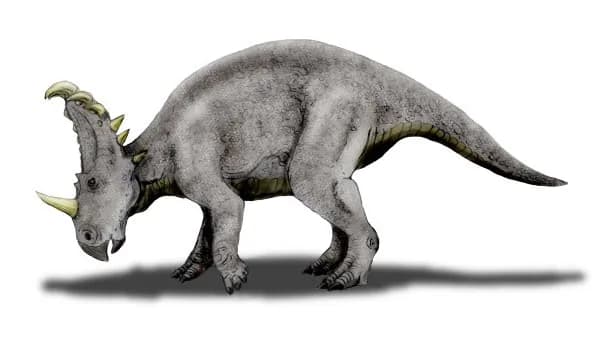
Sinoceratops
Sinoceratops zhuchengensis is the first ceratopsid ever found in China, described in 2010 from fossils in Shandong and dated to 73 to 66 million years ago. At 6 metres and around 2 tonnes, it ended the idea that these large horned dinosaurs existed only in North America. It appears in Jurassic World: Fallen Kingdom.
Sinoceratops lived during the Late Cretaceous period, approximately 73 to 66 million years ago, spanning the Campanian and Maastrichtian stages. This large ceratopsian inhabited what is now Shandong Province in eastern China. It shared its environment with other remarkable dinosaurs, including the gigantic tyrannosaurid Zhuchengtyrannus and the hadrosaur Shantungosaurus, the largest known hadrosaurid. Sinoceratops is particularly significant paleontologically because it represents the first and, to date, the only confirmed ceratopsid ever discovered in China, shattering the long-held assumption that large horned ceratopsians were exclusively North American. Its discovery profoundly altered our understanding of ceratopsid biogeography during the Late Cretaceous, suggesting land connections between Asia and North America during this period.
Sinoceratops was a sizeable ceratopsian, measuring approximately 6 meters in total length with an estimated weight of about 2 tonnes. Its massive skull reached approximately 1.8 meters in length, dominated by an ornate bony frill and a prominent nasal horn. Compared to its North American cousin Triceratops, it was considerably smaller, the latter reaching up to 9 meters and 10 tonnes. However, for an Asian ceratopsid, Sinoceratops was remarkably large, far surpassing the smaller protoceratopsids and leptoceratopsids that typically dominated Asian ceratopsian fauna. Its robust build, with powerful limbs and a stocky body, reflects a massive herbivore perfectly adapted for quadrupedal locomotion across the coastal plains of Cretaceous China. Its proportions were broadly comparable to a modern large rhinoceros, combining bulk with surprising agility for an animal of its size.
Sinoceratops was a strict herbivore, feeding on the abundant vegetation of the Late Cretaceous coastal plains of China. Equipped with a powerful horny beak at the front of its mouth, it could efficiently shear through the toughest stems and branches of ferns, cycads, low conifers, and primitive angiosperms that made up the flora of its time. Behind its beak, densely stacked dental batteries ensured effective grinding of even the most fibrous plant material. Like other ceratopsids, Sinoceratops likely occupied the ecological niche of a low to mid-level browser, with its head naturally held less than two meters above the ground. This complementary feeding strategy to that of giant hadrosaurs like Shantungosaurus allowed coexistence without excessive direct competition for plant resources in their shared ecosystem.
Sinoceratops lived on the coastal plains of what is now eastern China, specifically in the Zhucheng area of Shandong Province, a region recognized as one of the richest dinosaur fossil sites in East Asia. During the Late Cretaceous, this region was characterized by a warm and humid climate, with fertile alluvial plains fed by numerous waterways flowing into shallow inland seas. The lush vegetation included conifer forests, cycad groves, and dense understories of tree ferns. Sinoceratops shared this rich ecosystem with a diverse fauna including the tyrannosaurid Zhuchengtyrannus, the enormous hadrosaur Shantungosaurus, the ankylosaur Zhuchengosaurus, and various small theropods. The exceptional density of fossils at Zhucheng suggests an extremely productive environment capable of supporting large populations of giant herbivores.
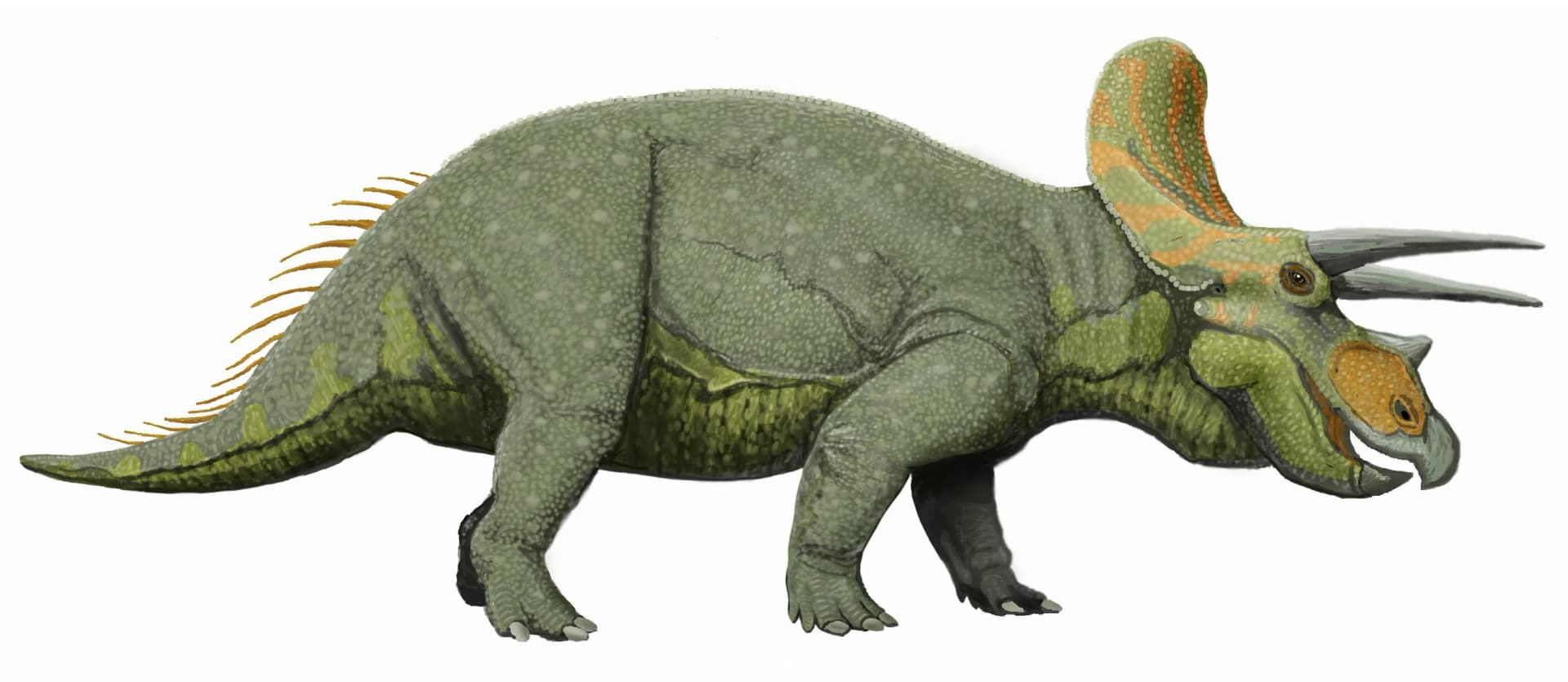
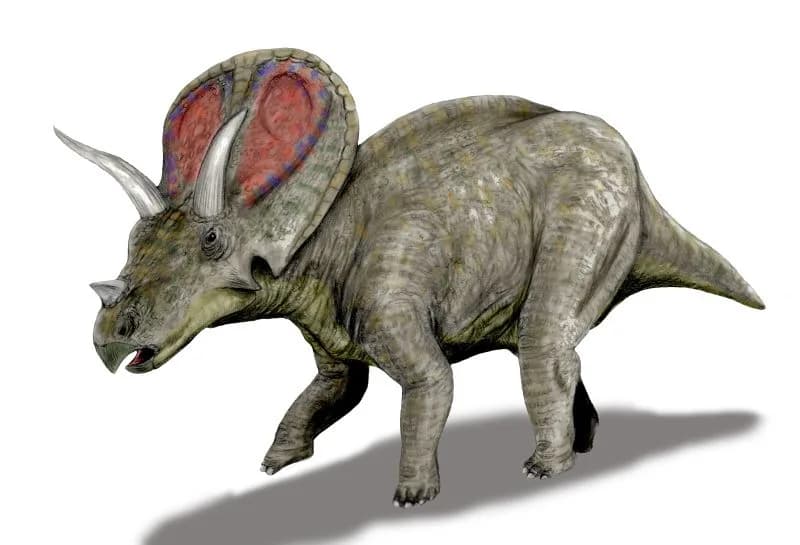
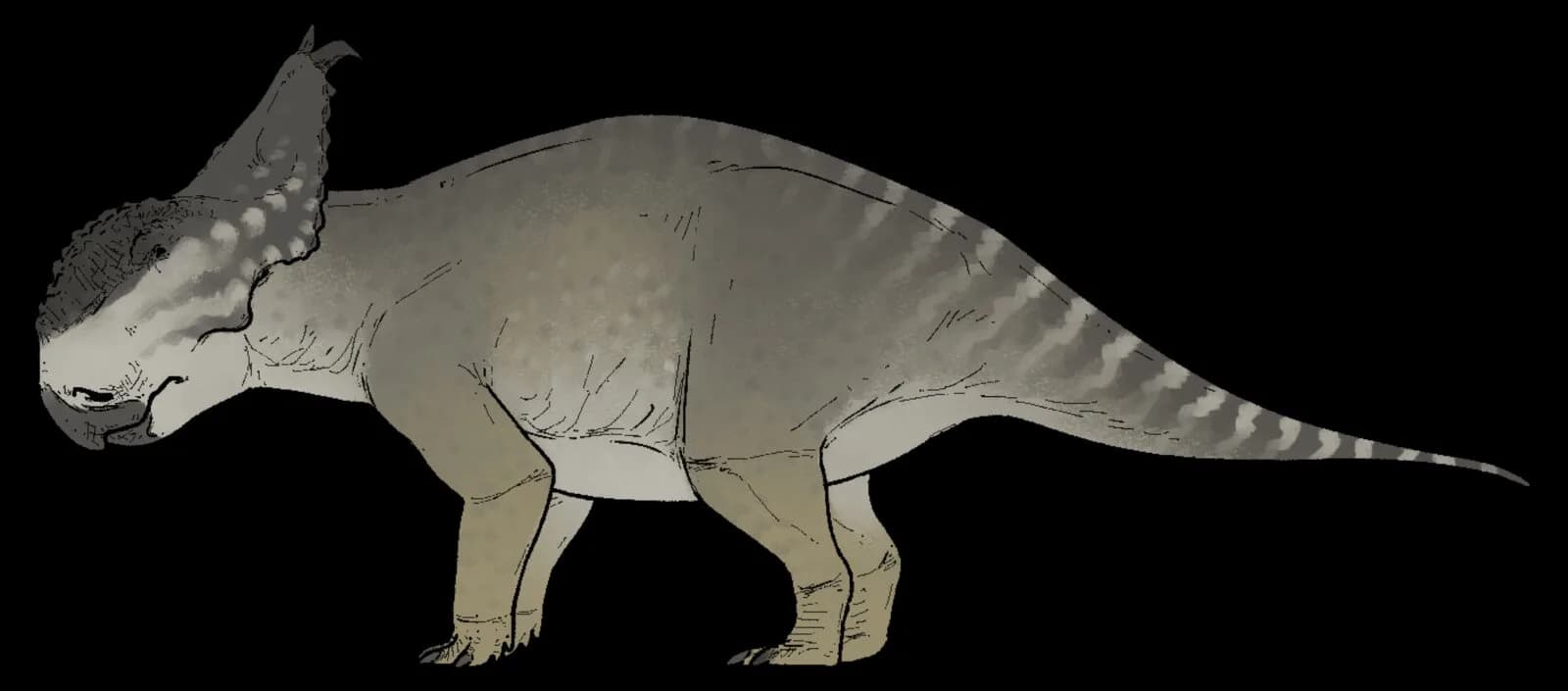
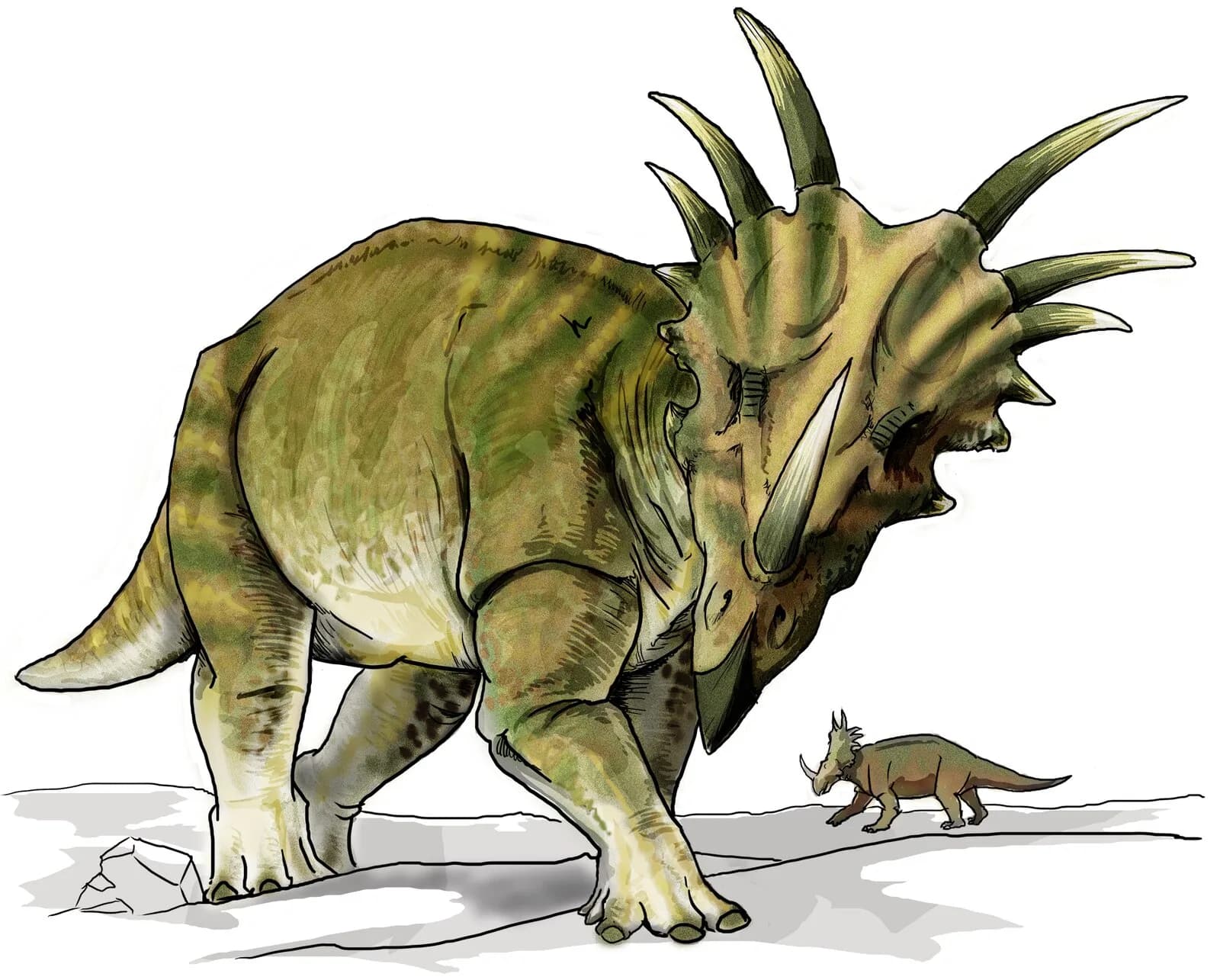
The anatomy of Sinoceratops is distinguished by several unique features among ceratopsids. Its most remarkable trait is its bony frill adorned with small forward-curving hornlets, an unusual arrangement that clearly differentiates it from North American ceratopsians whose ornamentations are generally directed backward or laterally. It possessed a single large prominent nasal horn but lacked brow horns entirely, unlike Triceratops which bears two imposing supraorbital horns. The frill featured partial fenestrae, reducing its weight while maintaining an impressive display surface. The massive skull was supported by a powerfully muscled neck, with pronounced muscle attachment sites on the cervical vertebrae. Its dentition comprised the characteristic ceratopsid dental batteries, with stacked tooth columns that were continuously replaced as they wore down from grinding resistant vegetation.
Sinoceratops behavior was likely similar to that of other large ceratopsids, involving a herding lifestyle with groups of varying size. While direct evidence of gregariousness is limited for this specific species, the discovery of multiple skeletal remains in the same geological formation at Zhucheng suggests the coexistence of several individuals within the same habitat. The nasal horn and ornate frill likely served both as defense against predators like Zhuchengtyrannus and as visual communication tools among conspecifics during courtship displays and dominance confrontations. Like Triceratops in North America, Sinoceratops could likely charge a threatening predator, using its horn and body mass as deterrent weapons. Juveniles were probably protected at the center of the herd, with adults forming a defensive bulwark against threats, a behavior analogous to that observed in large modern ungulates.
Sinoceratops was scientifically described in 2010 by Chinese paleontologist Xu Xing and colleagues, based on fossils discovered in the Wangshi Formation near the city of Zhucheng in Shandong Province, eastern China. The generic name means 'Chinese horned face' (from Chinese 'Sino' meaning China, and Greek 'ceratops' meaning horned face), while the specific name 'zhuchengensis' refers to the discovery locality. The holotype comprises a remarkably well-preserved partial skull that enabled detailed anatomical description. This discovery was a paleontological sensation because it represented the very first ceratopsid — a member of the family of large horned ceratopsians — ever identified outside North America, challenging decades of biogeographic assumptions. Sinoceratops gained additional worldwide fame in 2018 when it appeared in the film Jurassic World: Fallen Kingdom, becoming the first Chinese dinosaur to feature in the Jurassic Park franchise.
| Period | Crétacé supérieur / Late Cretaceous |
| Era | Mésozoïque / Mesozoic |
| Age | 73-66 Ma |
| Location | Zhucheng, Shandong, Chine / Zhucheng, Shandong, China |
| Length | 6 m |
| Weight | ~2 tonnes |
| Diet | Herbivore |
| Discovery | 2010 |
Described in 2010 by Xu Xing, Sinoceratops zhuchengensis is the first — and to date the only — confirmed ceratopsid discovered in China. The large horned ceratopsians, the Triceratops family, had previously been considered exclusively North American. Its presence in Asia suggests land connections between the two continents 73 to 66 million years ago via a Bering land bridge.
The bony frill of Sinoceratops zhuchengensis bears small forward-curving hornlets, an unusual arrangement: in all other known ceratopsids, the frill ornaments point backward or laterally. Additionally, Sinoceratops possessed only a single prominent nasal horn and no brow horns, unlike Triceratops with its two massive frontal horns and single nasal prominence.
Sinoceratops zhuchengensis measured approximately 6 meters long with an estimated weight of 2 tonnes, with a skull reaching about 1.8 meters. It lived at Zhucheng, Shandong Province, China (73–66 Ma), alongside the giant tyrannosaurid Zhuchengtyrannus, the record hadrosaur Shantungosaurus giganteus (16 m, 13–16 t), and the ankylosaur Zhuchengosaurus — one of Asia's richest Cretaceous ecosystems.
Sinoceratops zhuchengensis illustration
Nobu Tamura, Wikimedia Commons
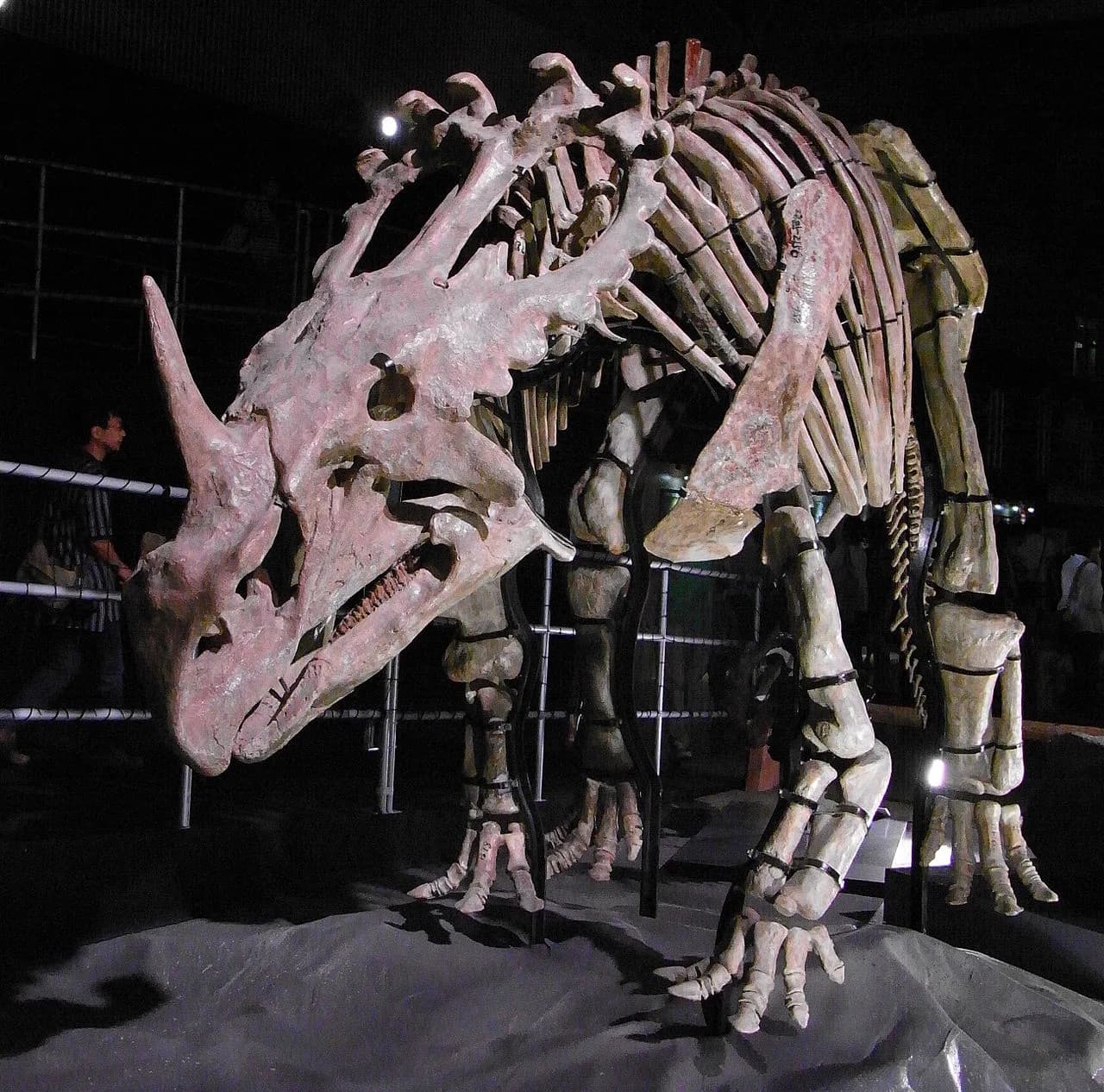
Sinoceratops skeleton
Wikimedia Commons