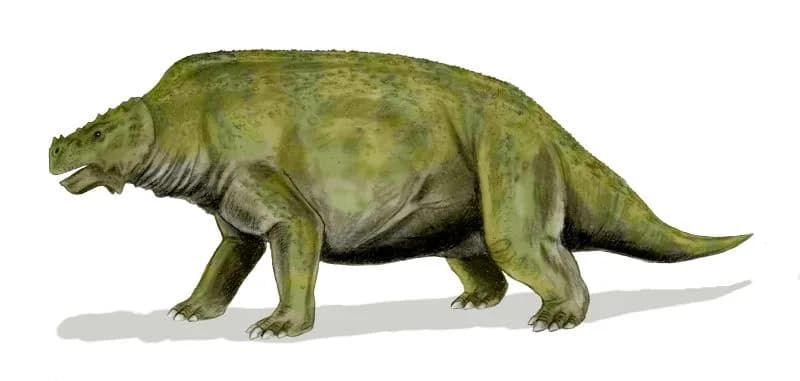
Scutosaure
Scutosaurus karpinskii was a herbivorous pareiasaur from Russia, described in 1930 and dated to 260 to 252 million years ago. At 2.5 to 3 metres and 400 to 500 kilograms, it was armoured with osteoderms from head to tail, belly included. It was the main prey of Inostrancevia: both species turn up in the same Dvina Basin deposits.
Scutosaurus lived during the Late Permian (Wuchiapingian-Changhsingian), approximately 260 to 252 million years ago, in what is now northern Russia. It was one of the largest pareiasaurs — a group of massive herbivorous reptiles that were among the first large terrestrial vertebrates. Pareiasaurs were the 'rhinoceroses' of the Permian: armored, stocky herbivores that dominated plant-eating communities. Scutosaurus coexisted with the super-predator Inostrancevia in the Northern Dvina Basin, where it constituted the primary prey of this giant gorgonopsian. It perished during the devastating Permian-Triassic mass extinction event.
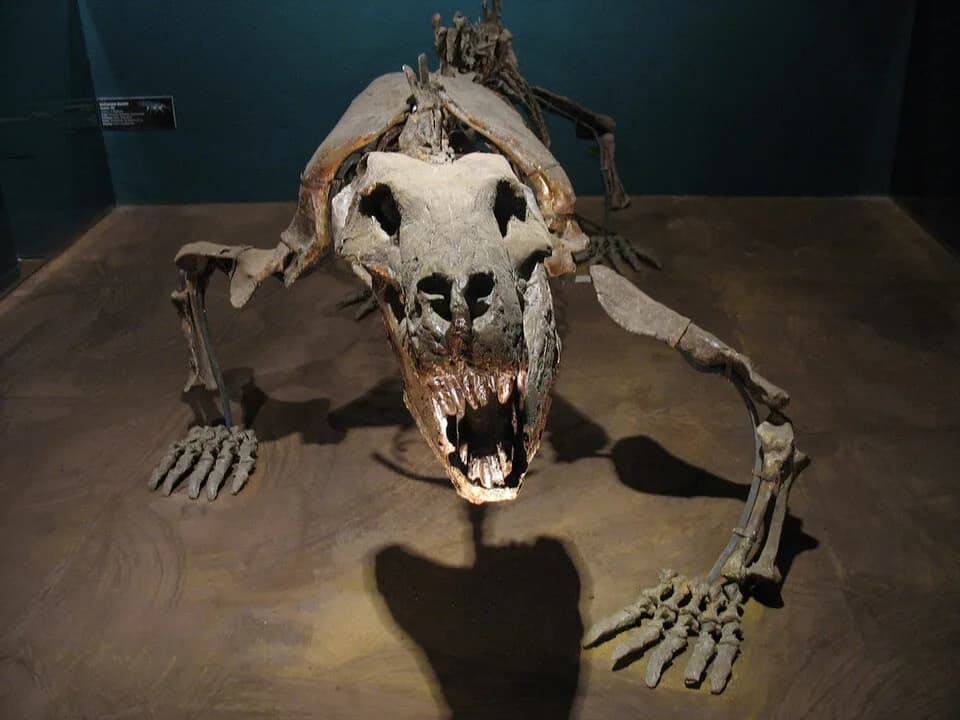
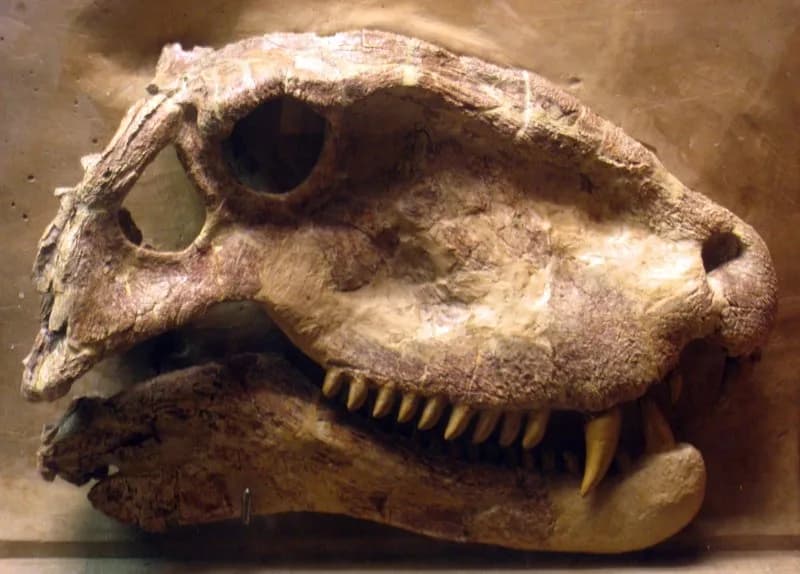
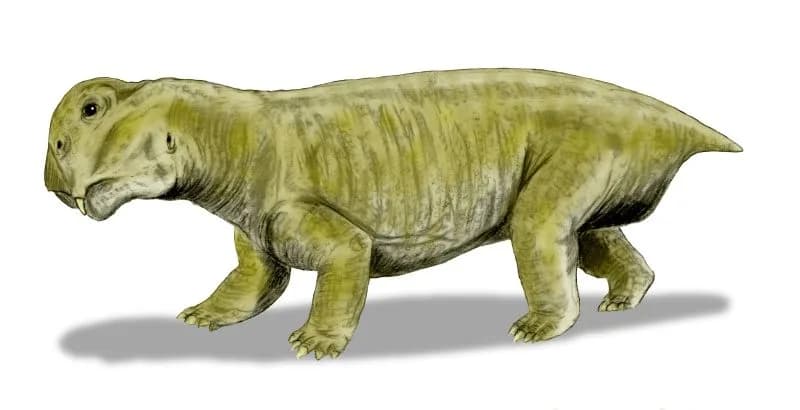
Scutosaurus was a massive animal, measuring approximately 2.5 to 3 meters in length with a weight reaching 400 to 500 kilograms. Its body was stocky and broad, covered in osteoderms (dermal bone plates) that formed natural armor across its back, flanks, and even its belly. Its wide, flat skull, about 50 centimeters long, bore bony protuberances and ornamentations giving it a rugged, armored appearance. Its legs were short but massive, supporting its considerable weight in a relatively sprawling posture. Its tail was short and thick, completing its tank-like silhouette.
Scutosaurus was a strict herbivore, feeding on the low vegetation of Late Permian environments. Its leaf-shaped teeth, with broad and crenulated crowns, were well adapted for grinding the tough, fibrous plants of the Permian — ferns, horsetails, primitive conifers, and lycopsids. Its jaw allowed a lateral shearing movement to shred vegetation before swallowing. Like modern large herbivores, Scutosaurus likely spent the majority of its time feeding to maintain its metabolism and substantial body mass. Its digestive system was probably voluminous to process large quantities of low-nutrient plant material.
Scutosaurus lived in the floodplains and riverbanks of the Northern Dvina Basin, in the northeast of Pangaea (modern-day Russia). The Late Permian climate in this region was temperate to warm with distinct seasons. Vegetation included primitive conifer forests, tree ferns, and diverse low-growing flora. Scutosaurus shared its habitat with Inostrancevia (its main predator), other pareiasaurs, various therapsids, and amphibians. The Northern Dvina Basin ecosystem is one of the best-documented of the Late Permian thanks to intensive excavations conducted since the nineteenth century.
Scutosaurus' anatomy was optimized for survival as a large herbivore in a world of saber-toothed predators. Its dermal armor, composed of dozens of osteoderms embedded in the skin, provided significant protection against attacks. Its massive skull was reinforced by bony protuberances and crests, particularly developed on the cheeks and temples, which could serve as both protection and visual signals. Its leaf-shaped teeth were well adapted for grinding plant material. Its short, sprawling limbs supported a broad, low-slung body — a stable but not particularly fast posture, compensated by its impressive defensive armor.
Scutosaurus was probably a gregarious herbivore living in loose herds, much like modern large herbivores. Its primary defense against predators like Inostrancevia was its osteoderm armor and imposing body mass. The cranial protuberances may have played a role in intraspecific combat between males over territories or mates, similar to modern iguanas and crocodilians. Its locomotion was slow and steady, adapted for continuous browsing rather than rapid flight. The large number of specimens found together in Russian deposits strongly suggests a well-developed social behavior among these ancient armored reptiles.
Scutosaurus karpinskii was described in 1930 by the eminent Russian paleontologist Pyotr Amalitsky (posthumous publication), based on complete skeletons discovered in the Permian sediments of the Northern Dvina Basin. The name means 'shield lizard' (Latin: scutum 'shield' + Greek: sauros 'lizard'). Amalitsky's excavations in the late nineteenth century produced dozens of articulated Scutosaurus skeletons, often found in association with its predator Inostrancevia — providing an extraordinary glimpse into Late Permian ecology. These remarkable fossils are now displayed at the Paleontological Museum in Moscow.
| Period | Permien supérieur / Late Permian |
| Era | Paléozoïque / Paleozoic |
| Age | 260-252 Ma |
| Location | Bassin de la Dvina du Nord, Russie / Northern Dvina Basin, Russia |
| Length | 2.5-3 m |
| Height | 1 m |
| Weight | 400-500 kg |
| Diet | Herbivore |
| Discovery | 1930 |
No. Scutosaurus karpinskii was a pareiasaur, a reptile of the Parareptilia group, living during the Late Permian (260–252 Ma) — roughly 10 to 20 million years before the first dinosaurs appeared in the Triassic. It is related neither to dinosaurs nor to mammals, but to a lineage of primitive reptiles now entirely extinct, distinct from the lineages leading to modern reptiles.
Scutosaurus karpinskii measured 2.5 to 3 meters long with a weight of 400 to 500 kg. Its body was covered in osteoderms (dermal bone plates) across its back, flanks, and even its belly, providing protection on all sides. The skull bore additional bony protuberances on the cheeks and temples. This complete armor provided passive defense against its main predator, Inostrancevia.
In the Permian sediments of the Northern Dvina Basin, Russia, Scutosaurus karpinskii skeletons are frequently associated with those of Inostrancevia, a saber-toothed gorgonopsian. This co-occurrence reflects a direct predator-prey relationship: Inostrancevia was Scutosaurus's main predator. Amalitsky's excavations in the late 19th century produced dozens of articulated specimens of both species, now housed at the Paleontological Museum in Moscow.
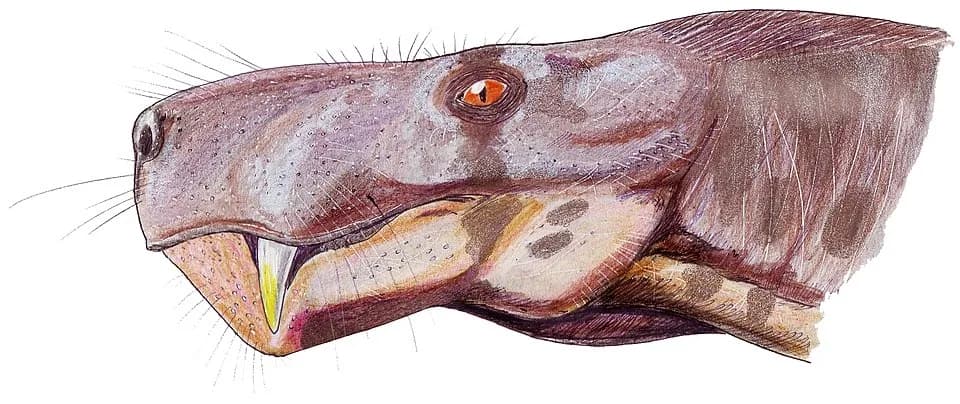
Scutosaurus karpinskii reconstruction, armored Permian pareiasaur
Nobu Tamura, CC BY-SA 3.0
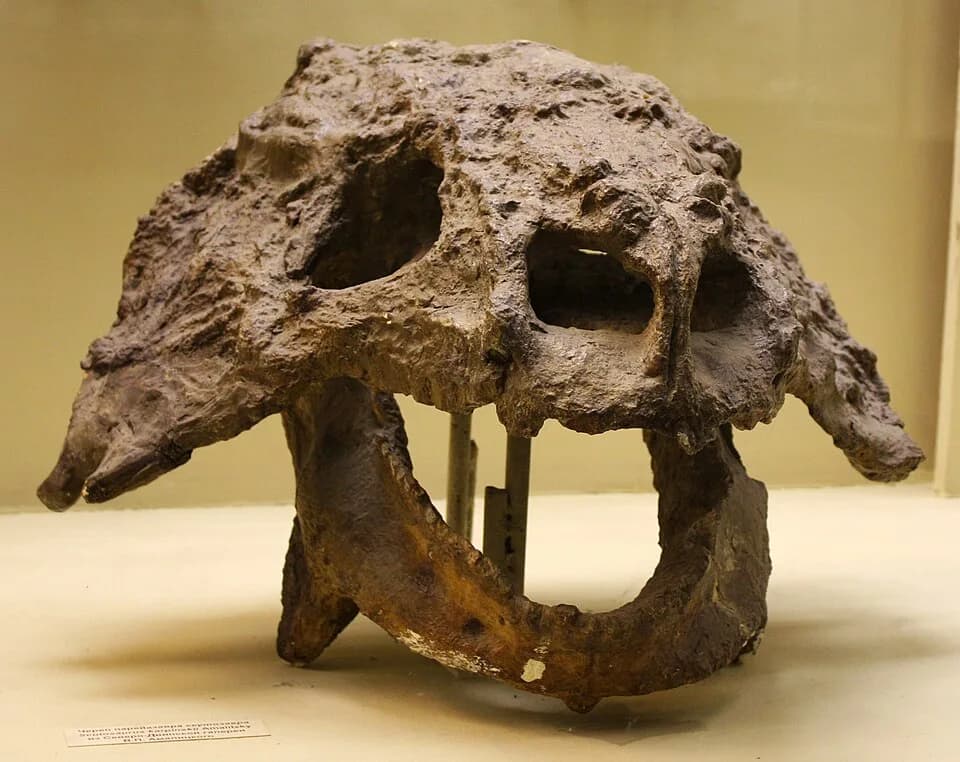
Mounted Scutosaurus karpinskii skeleton with visible osteoderm armor
Wikipedia Commons