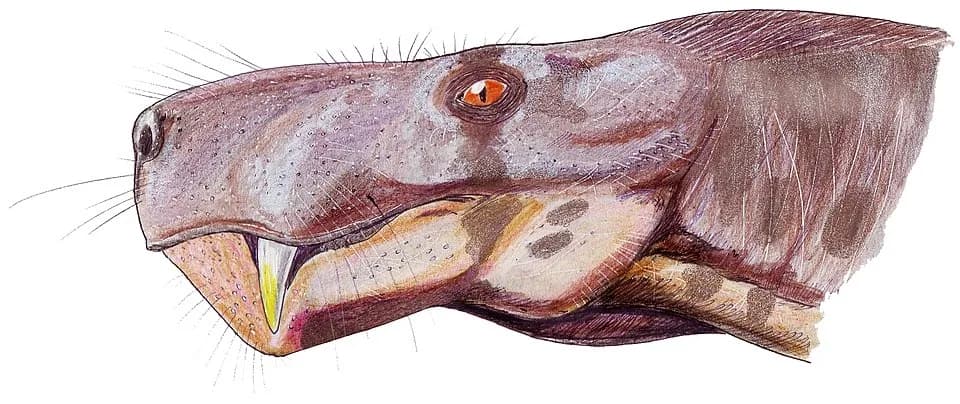
Gorgonops
Gorgonops torvus was a carnivorous therapsid of the Late Permian, described in 1876 from fossils in South Africa's Karoo Basin. Between 1.2 and 2 metres long and around 98 kilograms, it held the apex predator niche 260 million years before the big cats. As a therapsid, it is more closely related to human beings than to any reptile.
Gorgonops lived during the Late Permian (Wuchiapingian to Changhsingian), approximately 260 to 254 million years ago, in what is now South Africa. This formidable apex predator belonged to the order Therapsida, suborder Gorgonopsia, making it a synapsid — more closely related to mammals than to any reptile. Its name, meaning 'Gorgon face' in Greek, evokes the mythological monsters with snakes for hair, a reference to its terrifying skull armed with oversized canines. The entire Gorgonopsian lineage was wiped out during the Great Permian-Triassic Extinction, the most devastating mass extinction in Earth's history.
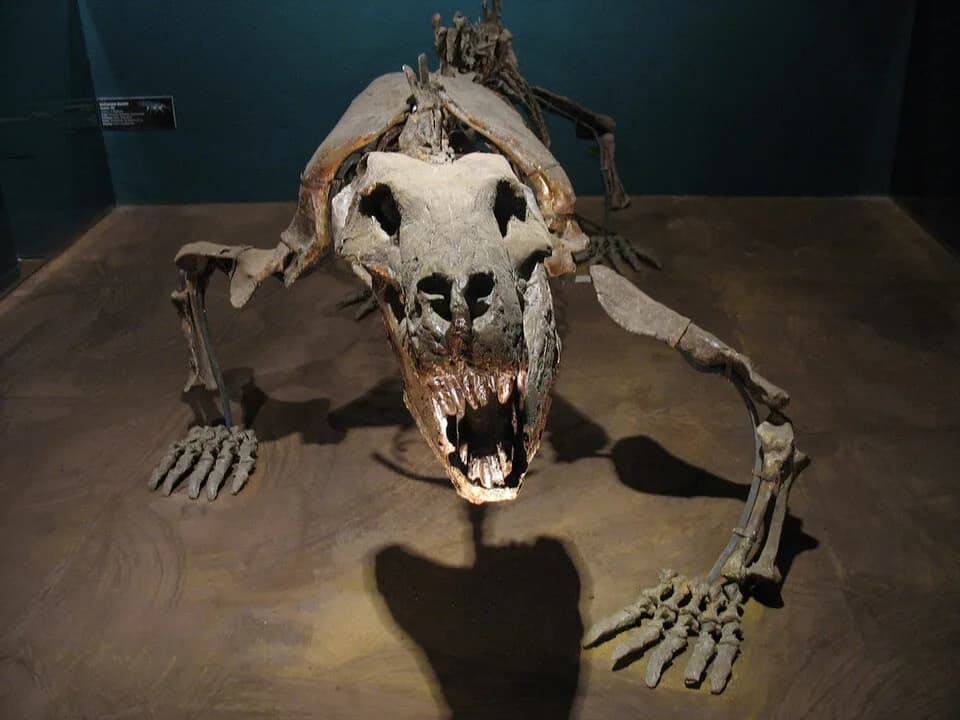
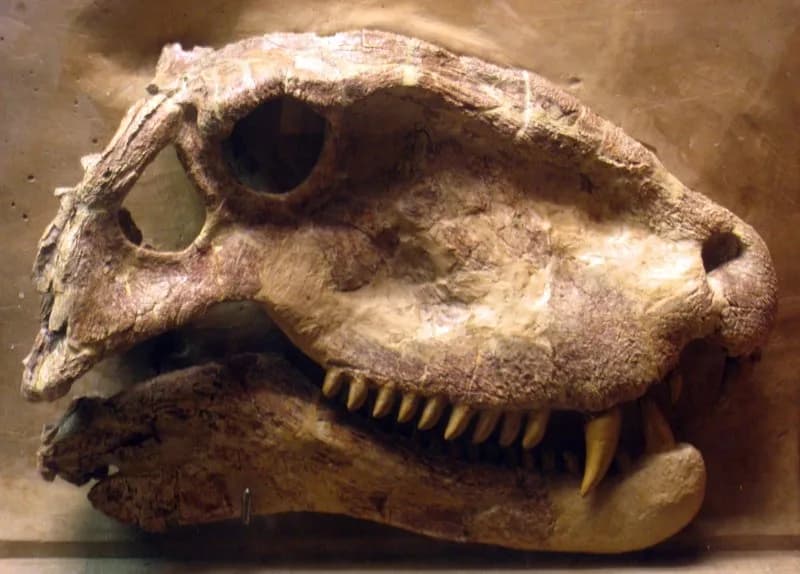
Gorgonops measured between 1.2 and 2 meters in total length from snout to tail tip, making it one of the largest terrestrial predators of its time during the Late Permian. Its massive skull reached 22 to 35 centimeters in length depending on the species, armed with spectacular upper canines that could measure up to 12 centimeters long — true biological sabers comparable in size to those of Smilodon, though they appeared 200 million years earlier. Its body mass is estimated at approximately 98 kilograms based on the detailed 2023 PeerJ study of the near-complete specimen SAM-PK-K10591, comparable to the weight of a modern African lioness. Its shoulder height probably reached 60 to 70 centimeters.
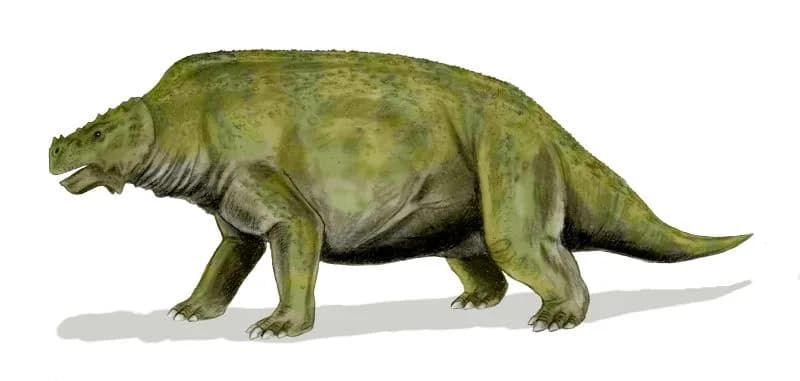
Gorgonops was the apex super-predator of its Permian ecosystem, the ecological equivalent of the modern lion. An ambush hunter rather than a pursuit predator, it used its robust forelimbs to immobilize prey before delivering a killing bite with its saber canines driven into vital areas (neck, throat). Its primary prey included herbivorous dicynodonts, smaller therapsids, and armored pareiasaurs like Scutosaurus. Its lower jaw, thicker at the front, served as protection for the upper canines — an adaptation analogous to the 'flanges' of saber-toothed cats.
Gorgonops inhabited the semi-arid plains and fluvial environments of the Karoo Basin in present-day South Africa, primarily in the Eastern Cape and Western Cape provinces. This exceptional sedimentary basin, one of the world's richest and best-preserved fossil deposits for Late Permian fauna, has yielded virtually all known gorgonopsian specimens. Some fossils have also been discovered in Malawi, slightly extending the known range. The environment of this period consisted of vast river plains crossed by seasonal watercourses, bordered by semi-desert areas dotted with low vegetation adapted to the arid conditions of the supercontinent Pangaea.
The Gorgonops skull was deep with a triangular profile viewed from above, relatively narrow and elongated. Its lateral eye sockets recall those of reptiles, while its greatly enlarged dual temporal fenestrae housed powerful jaw muscles. A partial secondary palate — a proto-mammalian trait — allowed it to breathe while holding prey. Its posture was 'hybrid': the hind limbs already nearly upright beneath the body (quasi-parasagittal, like mammals), while the forelimbs remained more laterally spread (like reptiles). It is a living snapshot of the evolution of mammalian locomotion frozen in time.
Gorgonops was most likely a solitary, territorial predator that ambushed prey across the semi-arid plains and along the watercourses of the Karoo Basin. Its robust, short forelimbs served to seize and firmly immobilize captured prey, while its longer, more gracile hind limbs enabled short but effective bursts of speed to lunge at a target. Its hunting strategy relied on patient ambush followed by a lethal bite with its saber canines rather than sustained endurance pursuit over long distances. Its metabolism was probably intermediate — inertial homeothermy, not yet fully endothermic like modern mammals — nevertheless giving it a distinct advantage over the ectothermic reptiles of its time.
Gorgonops was first described in 1876 by Richard Owen — the same scientist who coined the term 'Dinosauria' in 1842 — from an incomplete and flattened skull found on Mildenhall's farm near Fort Beaufort in the Eastern Cape of South Africa. In 1890, Richard Lydekker founded the family Gorgonopsidae based on the genus. In 1998, the first discovery of a complete skeleton by the University of Washington transformed understanding of gorgonopsian posture and locomotion. In 2023, a study published in PeerJ established the mass at approximately 98 kg and confirmed the ambush predator behavior.
| Period | Permien supérieur / Late Permian (Wuchiapingien-Changhsingien) |
| Era | Paléozoïque / Paleozoic |
| Age | 260-254 Ma |
| Location | Afrique du Sud (bassin du Karoo), Malawi / South Africa (Karoo Basin), Malawi |
| Length | 1.2-2 m |
| Height | 60-70 cm |
| Weight | ~98 kg |
| Diet | Carnivore |
| Discovery | 1876 |
Gorgonops torvus measured between 1.2 and 2 meters long, weighing approximately 98 kilograms according to a 2023 PeerJ study on specimen SAM-PK-K10591. Its canines reached 12 centimeters, comparable in size to Smilodon's — yet Gorgonops lived 200 million years earlier, in the Late Permian. Both predators represent an independent evolutionary convergence of saber teeth.
Gorgonops was neither. It was a gorgonopsian, belonging to the order Therapsida (advanced synapsids), suborder Gorgonopsia. Synapsids form the lineage that eventually produced mammals — Gorgonops is therefore more closely related to humans than to any dinosaur. It lived in the Late Permian, 260 to 254 million years ago, in the Karoo Basin of South Africa.
Gorgonops torvus was an ambush predator rather than a pursuit hunter. It used its robust forelimbs to immobilize prey — mainly herbivorous dicynodonts and pareiasaurs like Scutosaurus — before delivering a killing bite to vital areas with its 12-centimeter canines. Its partial secondary palate allowed it to breathe while maintaining a grip on prey, a proto-mammalian trait.
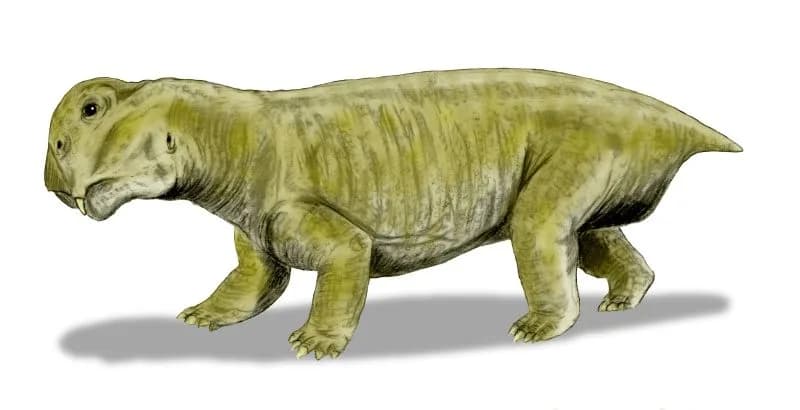
Life reconstruction of Gorgonops torvus
Nobu Tamura, CC BY-SA 3.0
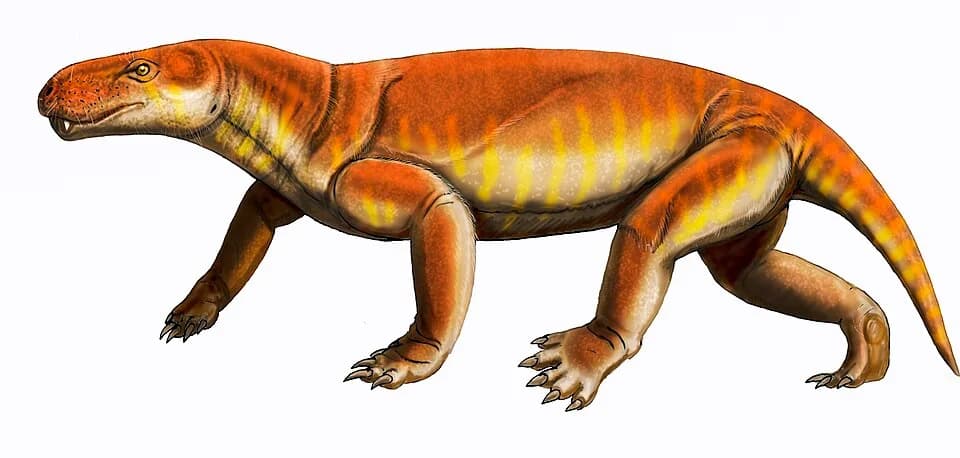
High-resolution reconstruction of Gorgonops torvus
Wikimedia Commons, CC BY-SA
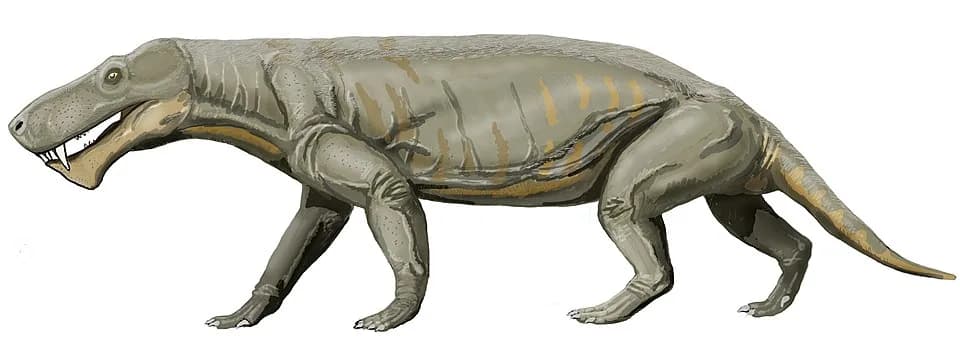
Reconstruction of Gorgonops whaitsii
Wikimedia Commons, CC BY-SA