Saurolophus
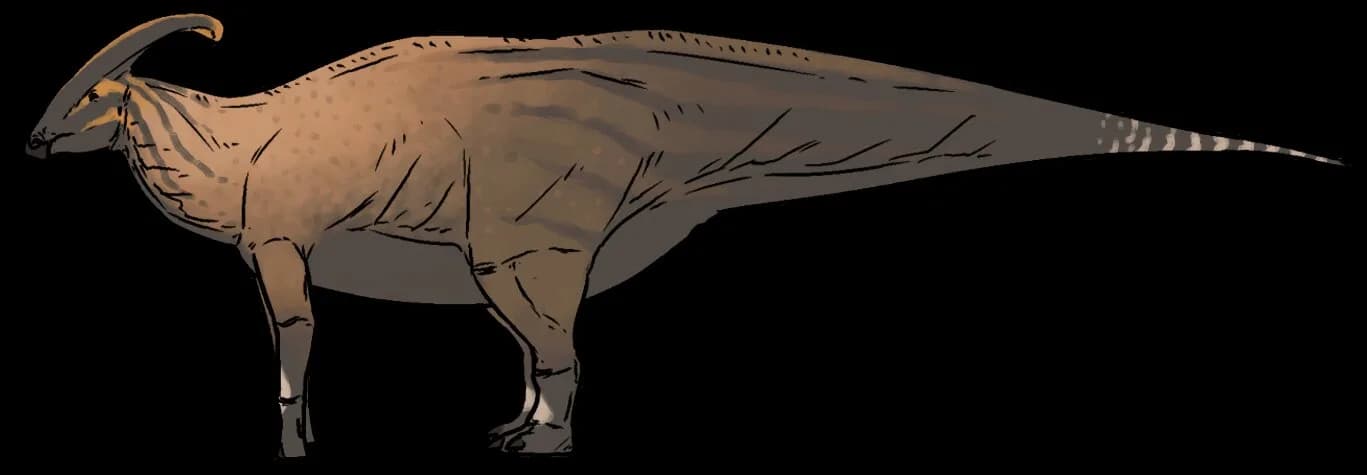
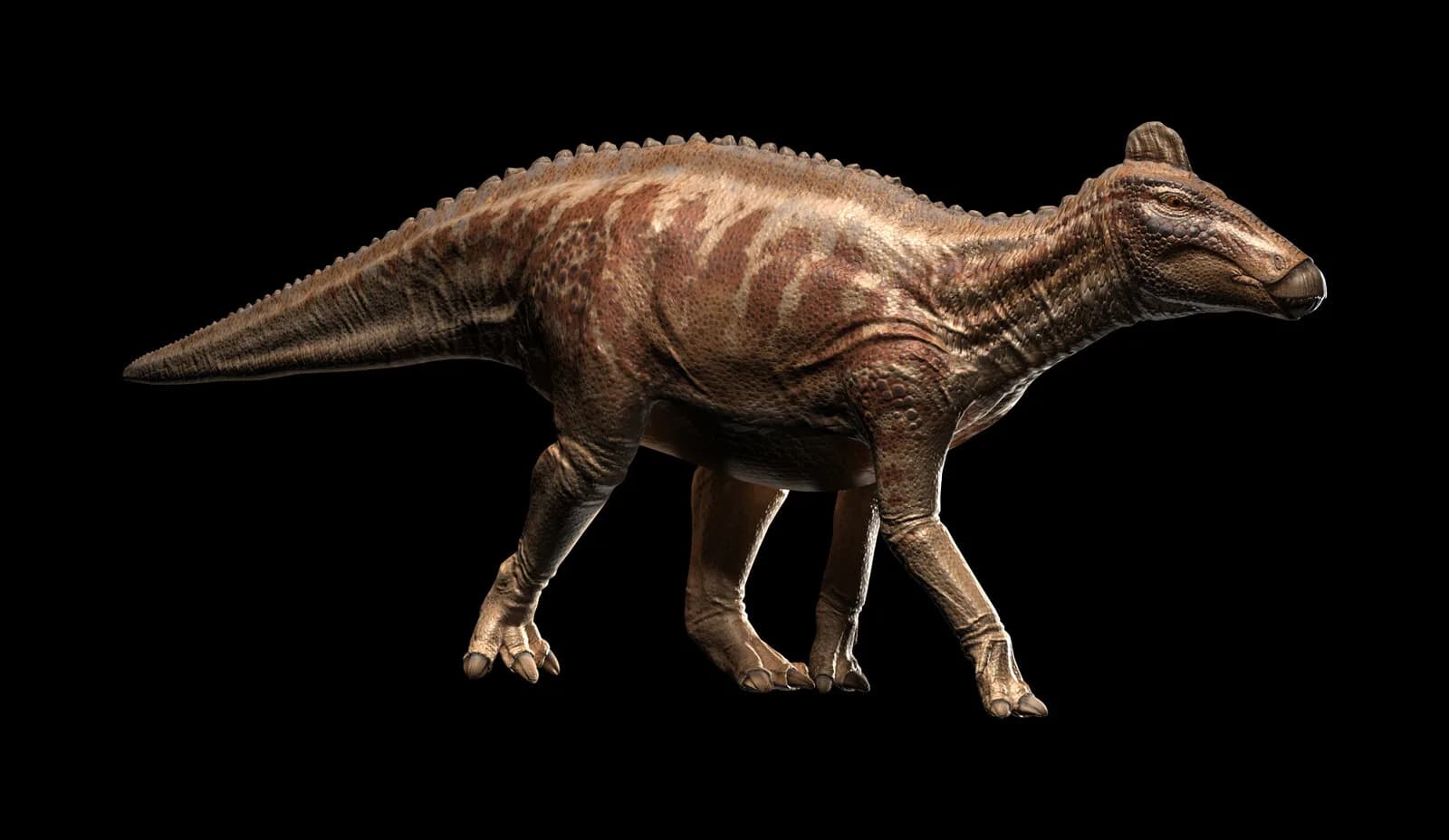
Saurolophus angustirostris belongs to the small set of dinosaurs found on two continents: North America and Asia. That dual presence suggests a crossing via the Bering land bridge around 70 million years ago. Nine to 12 metres long and 2 to 4 tonnes, it carried a solid bony crest, not a hollow one like Parasaurolophus.
Saurolophus lived during the Late Cretaceous period, approximately 70 to 66 million years ago, a time that represented the apex of hadrosaur diversity and abundance. This epoch coincided with the final millions of years before the mass extinction event that would end the reign of non-avian dinosaurs. Saurolophus shared its environment with some of the most formidable predators of all time, including Tyrannosaurus rex in North America and related tyrannosaurids in Asia, making vigilance and collective defense strategies essential for the survival of this species and the herds it formed across two continents.
Saurolophus was a large herbivore, reaching between 9 and 12 meters in length with a hip height of approximately 3 meters. Its estimated weight ranged from 2 to 4 metric tonnes depending on the individual and species. The Asian species Saurolophus angustirostris was generally larger than its North American counterpart Saurolophus osborni, with some Mongolian specimens exceeding 12 meters in total length. This geographic size variation between populations on two separate continents represents one of the few well-documented examples of geographic variation documented among Cretaceous hadrosaurids, and has been the subject of considerable scientific discussion.
Saurolophus was a strict herbivore that fed primarily on low-growing vegetation and foliage from trees and shrubs. Its powerful jaw, lined with hundreds of teeth arranged in dental batteries, allowed it to efficiently grind the toughest plant material, including conifers, cycads, ferns, and the flowering angiosperms that proliferated during the Late Cretaceous. Its robust forelimbs and the toothless beak at the front of its jaw allowed it to easily strip leaves and twigs from branches, while the dental batteries ground the plant matter before ingestion. Saurolophus could process enormous quantities of vegetation daily to sustain its large body mass.
Saurolophus inhabited diverse environments spread across two distinct continents, demonstrating remarkable ecological adaptability. In North America, it populated the vast coastal plains and riparian forests of what is now Alberta, Canada, an environment characterized by lush subtropical vegetation and numerous river systems. In central Asia, particularly in present-day Mongolia, it roamed more semi-arid environments including alluvial plains, sparse woodlands, and seasonal wetlands. Both habitats provided the abundant vegetation and water sources essential to sustaining large herds of megaherbivores that formed the bulk of the megafauna in these Late Cretaceous ecosystems across two separate continental landmasses.
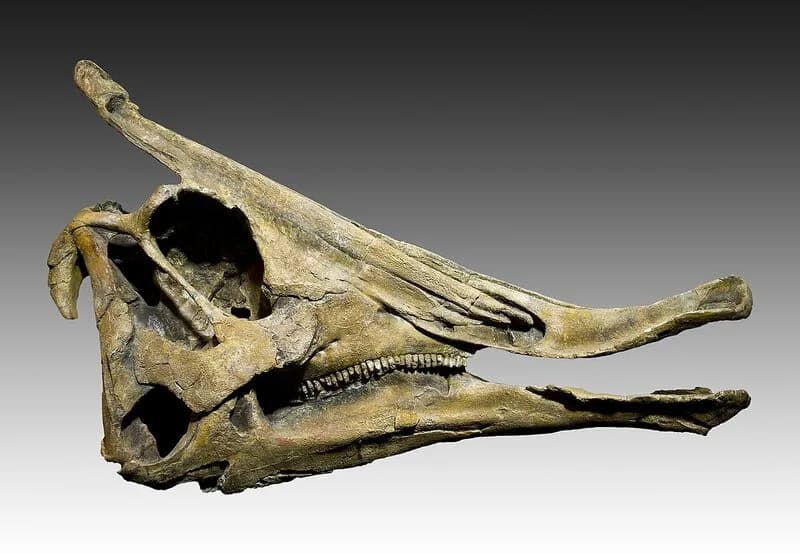
The anatomy of Saurolophus is dominated by its distinctive solid cephalic crest, formed by a bony extension of the premaxillary and nasal bones that projects backward from the skull as a compact spike. Unlike the hollow, tubular crests of Parasaurolophus and Lambeosaurus, the crest of Saurolophus is solid and lacks internal cavities communicating with the respiratory system. Its massive body rested on powerful hind limbs, while its shorter forelimbs allowed it to move quadrupedally during grazing or bipedally during rapid locomotion. Its thick, muscular tail served as a counterbalance during upright walking and bipedal running, a common feature among advanced hadrosaurids.
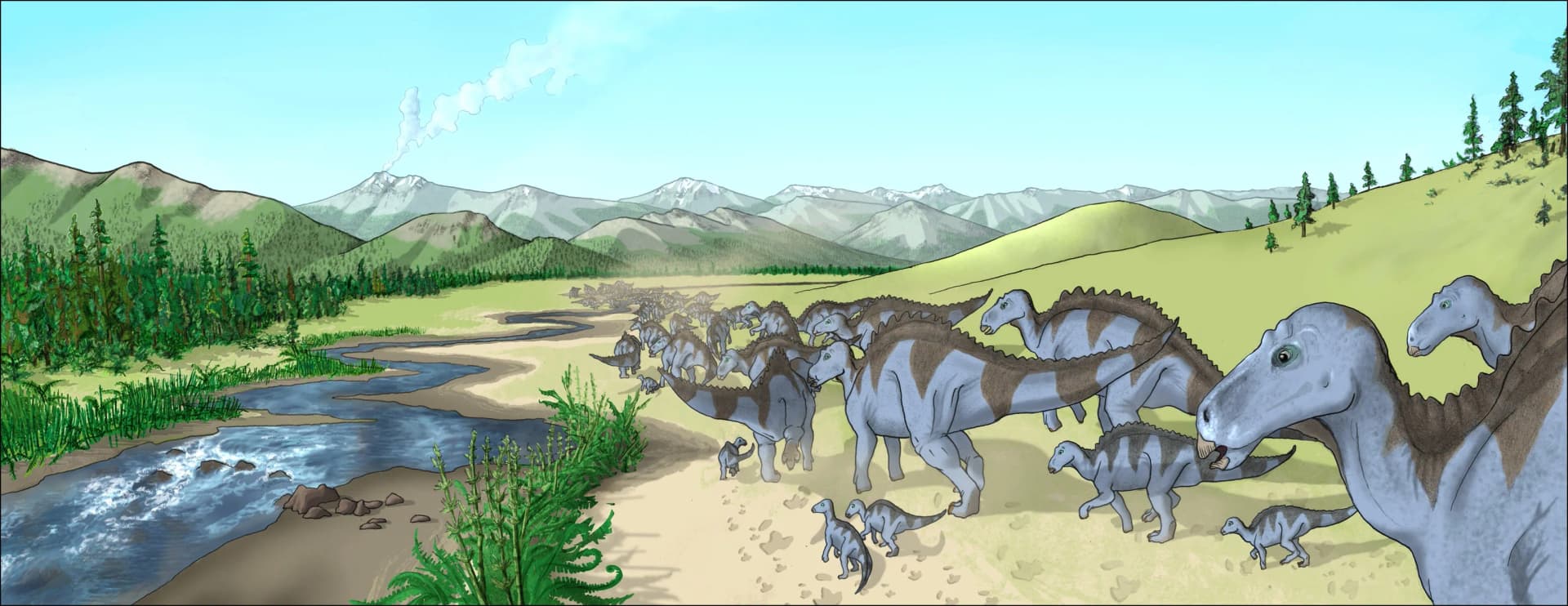
Saurolophus was likely a gregarious animal that lived in herds, a collective defense strategy essential against the numerous predators of its time. Although its bony crest is solid and could not serve as a resonating chamber like those of other hadrosaurs, paleontologists have hypothesized that an extensible nasal skin pouch covering the crest could have amplified vocalizations during social interactions, courtship displays, or danger alerts. Saurolophus could move bipedally or quadrupedally depending on circumstances, likely adopting four-legged locomotion during feeding phases and bipedalism when fleeing from predators, a behavioral flexibility shared by many advanced ornithopod dinosaurs of the Late Cretaceous.
Fossil remains of Saurolophus have been discovered on two continents, making it one of the rare dinosaur genera known to have inhabited both North America and Asia. The first described species, Saurolophus osborni, was unearthed in Alberta, Canada in 1911 and formally described by Barnum Brown in 1912. The Asian species Saurolophus angustirostris was discovered in the Nemegt Formation in Mongolia and is represented by numerous well-preserved specimens. These fossils include nearly complete skulls, partial skeletons, and skin impressions that have allowed researchers to reconstruct the external appearance of this animal with remarkable precision, including the texture and scale patterns of its integument.
| Period | Crétacé supérieur / Late Cretaceous |
| Era | Mésozoïque / Mesozoic |
| Age | 70-66 Ma |
| Location | Amérique du Nord, Asie / North America, Asia |
| Length | 9-12 m |
| Height | 3 m |
| Weight | 2-4 tonnes |
| Diet | Herbivore |
| Discovery | 1912 |
North American Saurolophus osborni measured about 9 meters; the Asian species Saurolophus angustirostris reached up to 12 meters, making it one of the largest known hadrosaur species. Their estimated weight ranged from 2 to 4 tonnes depending on the individual. This geographic size difference between the two populations is one of the few well-documented examples of geographic variation among Late Cretaceous hadrosaurs.
No. The crest of Saurolophus is solid, without internal cavities communicating with the airways, unlike the hollow tubular crests of Parasaurolophus and Lambeosaurus which functioned as resonating chambers. Paleontologists have hypothesized, however, that an extensible nasal skin pouch covering the crest may have amplified vocalizations during social interactions or danger alerts.
The presence of Saurolophus on both continents — Saurolophus osborni in Alberta, Canada, and Saurolophus angustirostris in Mongolia's Nemegt Formation — suggests populations crossed the Bering land bridge approximately 70 million years ago. This genus is one of the few dinosaurs known to have populated both North America and Asia, and its fossils were first described by Barnum Brown in 1912.
Saurolophus fossil skull
Wikimedia Commons, CC BY-SA
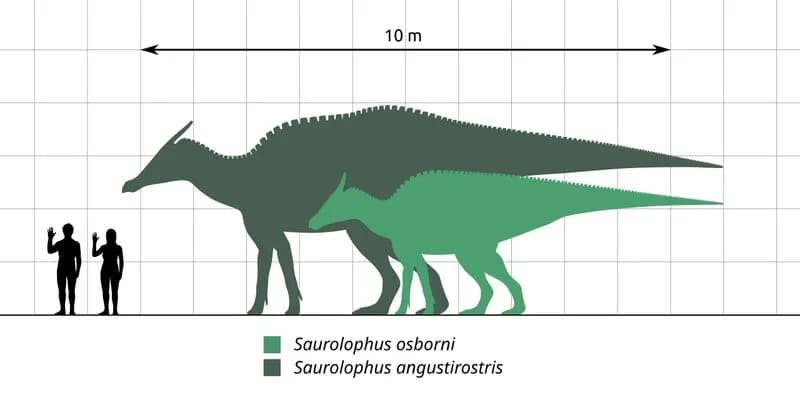
Saurolophus size comparison
Wikimedia Commons, CC BY-SA