Dent de chair
Sarkastodon mongoliensis was a creodont from Mongolia, described in 1938 and dated to 38 to 33 million years ago. At 2.5 to 3 metres and 400 to 800 kilograms, it weighed as much as a Kodiak bear without being related to one: creodonts are a now-extinct group of predators. Its 53-centimetre skull is among the largest known for a predatory mammal.
Sarkastodon lived during the late Eocene, approximately 38 to 33 million years ago, in what is now Mongolia. This giant carnivorous mammal belonged to the extinct order Creodonta, a group of predators that dominated terrestrial ecosystems before the rise of modern carnivores (order Carnivora). Sarkastodon was one of the largest creodonts that ever existed, reigning at the top of the food chain in the forests and savannas of Central Asia at a time when the continent was still covered in lush vegetation. Its reign coincided with the end of a warm tropical world that would soon give way to the global cooling of the Oligocene.
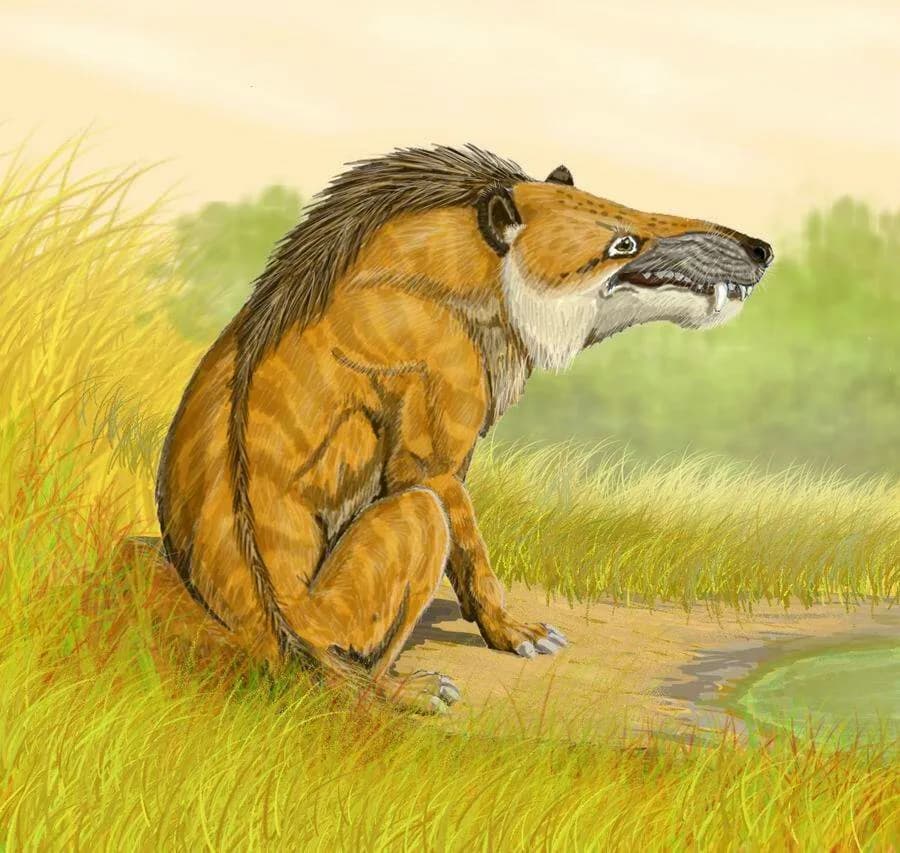
Sarkastodon was a predator of impressive dimensions, estimated at approximately 2.5 to 3 meters in total length and weighing between 400 and 800 kilograms, making it one of the largest terrestrial carnivorous mammals of all time. Its size was comparable to that of a large brown bear or Kodiak bear, although its morphology was very different. Its massive skull measured approximately 53 centimeters long, armed with powerful jaws capable of crushing bones. Its robust silhouette and stocky body evoked a gigantic badger or oversized wolverine more than a feline or canid, with relatively short but extraordinarily powerful limbs.
Sarkastodon was a hypercarnivore whose diet consisted almost exclusively of meat and bone. Its massive carnassial teeth, among the largest of all creodonts, were perfectly adapted for slicing flesh and crushing the long bones of large Eocene Asian mammals. It likely hunted brontotheres, primitive rhinoceroses, and large ungulates that populated the forests and savannas of Mongolia. Its bite force was estimated as superior to that of most large modern predators, allowing it to access nutrient-rich bone marrow. Like today's large predators, it certainly also scavenged when the opportunity arose.
Sarkastodon inhabited the forested environments and savannas of Central Asia during the late Eocene, in regions that are today arid and desert-like in Mongolia. The Irdin Manha geological formation, where its fossils were discovered, indicates a paleo-environment of subtropical forests and wooded savannas, watered by seasonal rivers and dotted with lakes. The climate was markedly warmer and more humid than today, with average temperatures well above those of modern Mongolia. Sarkastodon shared its territory with a diverse fauna including large brontotheres, primitive rhinoceroses, chalicotheres, and other smaller creodonts.
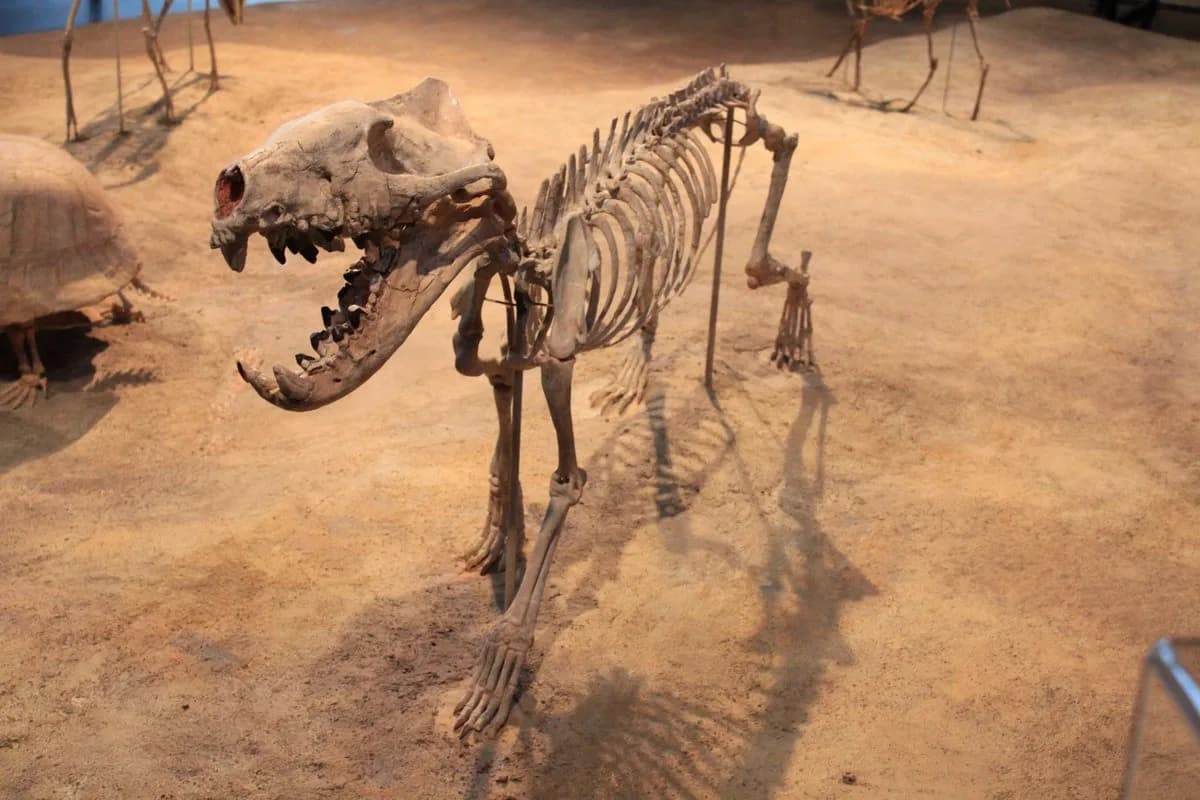
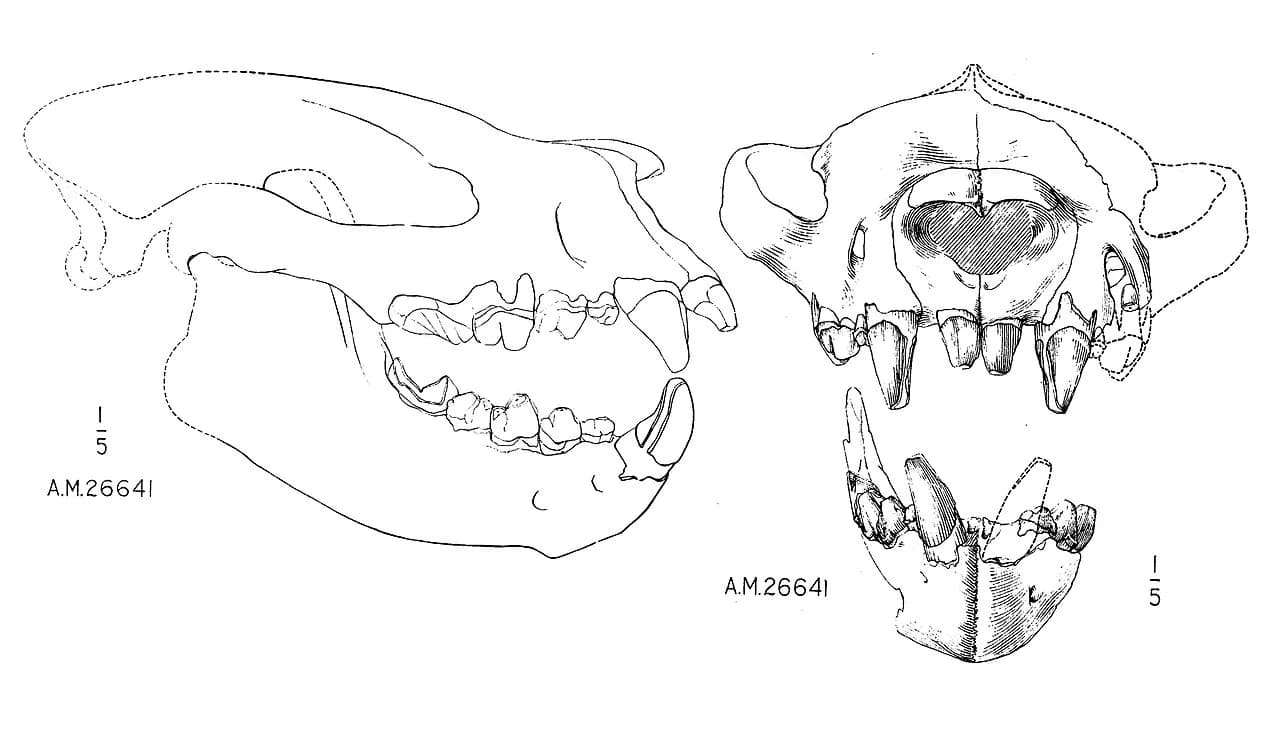
The anatomy of Sarkastodon is known primarily from its skull and jaws, which rank among the most impressive of all predatory mammals. Its 53-centimeter skull possessed enormous sagittal crests for anchoring massive temporal muscles, conferring devastating bite power. Its canines were robust and conical, designed to puncture and hold prey, while its carnassials, the teeth specialized for shearing meat, were among the largest in mammalian history. Unlike modern carnivores, creodonts like Sarkastodon used different pairs of teeth as carnassials, the result of convergent evolution with Carnivora.
The behavior of Sarkastodon is difficult to reconstruct with certainty due to the fragmentary nature of its fossils, but several hypotheses can be advanced. As a superpredator of considerable size, it likely maintained vast territories that it patrolled alone, similar to modern large bears. Its massive build and relatively short limbs suggest a hunting style based on ambush and brute force rather than prolonged pursuit. It could probably intimidate and displace smaller predators from their kills thanks to its imposing size, a kleptoparasitic behavior documented in many large modern predators.
The fossils of Sarkastodon were first discovered in Mongolia during Soviet-Mongolian paleontological expeditions in the Irdin Manha Formation, and the species was described by Granger in 1938. The type material consists primarily of a massive fragmentary skull accompanied by isolated teeth, housed at the American Museum of Natural History in New York. Despite the scarcity of postcranial remains, the skull alone was sufficient to reveal the extraordinary scale of this animal and place it among the largest terrestrial mammalian predators. Additional teeth and fragments were found during subsequent expeditions in Mongolia, confirming the presence of the species at several Eocene Asian localities.
| Period | Éocène supérieur / Late Eocene |
| Era | Cénozoïque / Cenozoic |
| Age | 38–33 millions d'années / 38–33 million years ago |
| Location | Mongolie (formation d'Irdin Manha) / Mongolia (Irdin Manha Formation) |
| Length | 2,5–3 m |
| Height | ~1,2 m au garrot / ~1.2 m at shoulder |
| Weight | 400–800 kg |
| Diet | Carnivore |
| Discovery | 1938 |
Sarkastodon mongoliensis was a mammal, not a dinosaur. It belonged to the extinct order Creodonta (oxyaenid), a group of placental mammals that dominated terrestrial ecosystems between roughly 65 and 7 million years ago. It lived during the Late Eocene (38–33 Ma) in Mongolia, long after non-avian dinosaurs had vanished, and is not classified among Carnivora.
Sarkastodon measured 2.5 to 3 meters with an estimated weight of 400 to 800 kg, comparable to a large Kodiak bear. Its 53-centimeter skull is one of the largest ever found in a terrestrial predatory mammal. It bore enormous sagittal crests to anchor massive temporal muscles, and its carnassial teeth rank among the most developed in mammalian history.
Creodonts dominated terrestrial ecosystems for roughly 30 million years but were progressively replaced by Carnivora — the order encompassing modern lions, wolves, and bears — during the Eocene and Oligocene. Carnivora displayed more specialized cursorial limbs and proportionally larger brains, giving them a long-term competitive advantage as climatic cooling transformed habitats.
Fossil skull of Sarkastodon mongoliensis at the American Museum of Natural History
Wikimedia Commons / AMNH
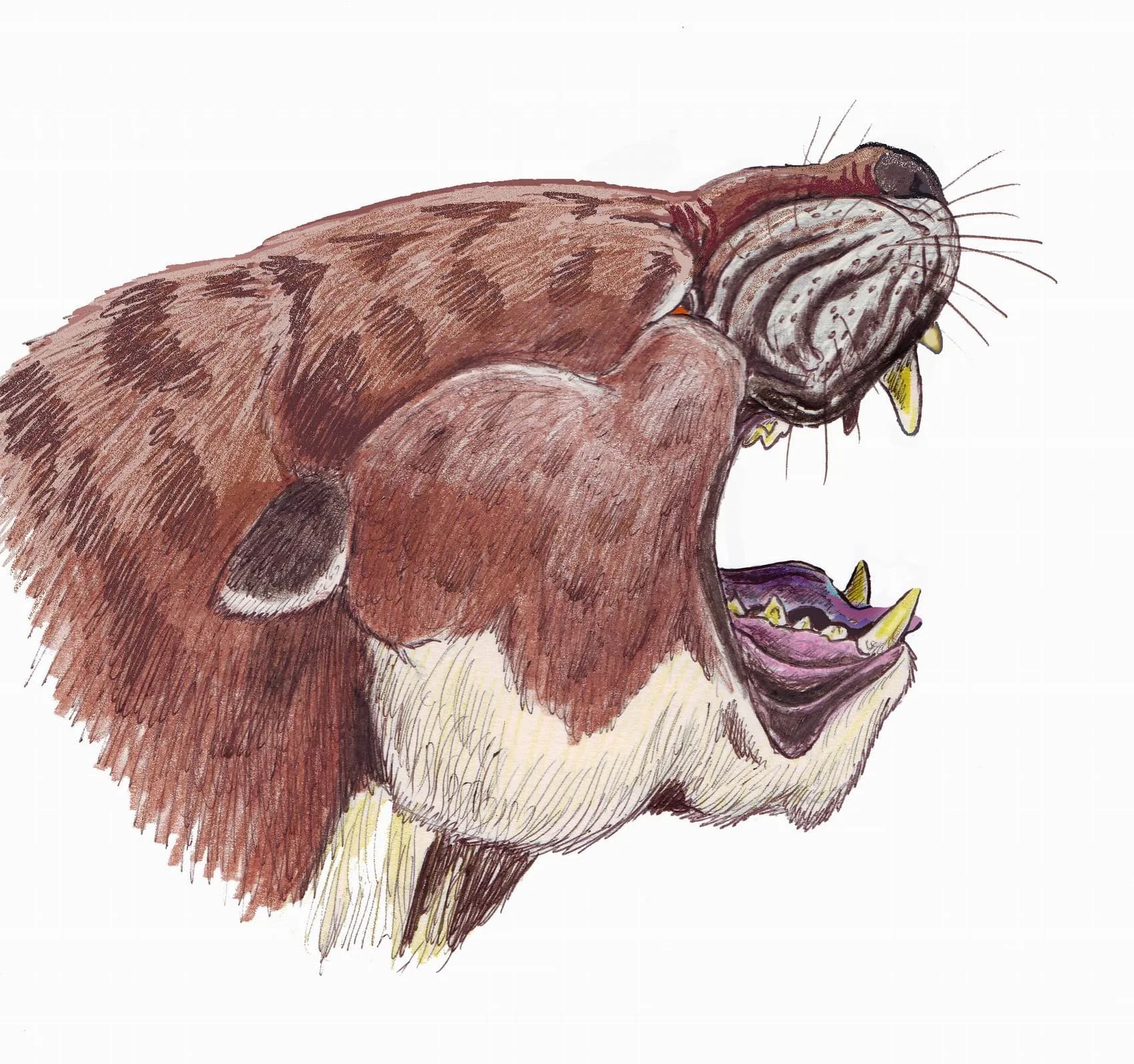
Artistic reconstruction of Sarkastodon, one of the largest terrestrial carnivorous mammals
Wikimedia Commons / Dmitry Bogdanov