Andrewsarchus
Andrewsarchus mongoliensis was a mammal from Mongolia described in 1923, present 45 to 36 million years ago. It is known from a single 83-centimetre skull: no body bones have ever been found, which makes its silhouette entirely hypothetical. Despite a predatory look, it is closer to hippos and whales than to wolves.
Andrewsarchus lived during the middle Eocene, approximately 45 to 36 million years ago, in what is now Mongolia. This mammal belongs to the order Artiodactyla, paradoxically making it a distant relative of whales and hippos rather than modern carnivores. It was named in 1924 by paleontologist Henry Fairfield Osborn in honor of Roy Chapman Andrews, the famous explorer and director of the American Museum of Natural History who led expeditions to Mongolia in the 1920s. The middle Eocene was characterized by a humid subtropical climate in Central Asia, with dense forests and marshy plains that provided habitat rich in prey and vegetation. Andrewsarchus represents one of evolution's last attempts to produce a terrestrial mega-predator among ungulates before true carnivorans (Carnivora) definitively dominated predator niches.
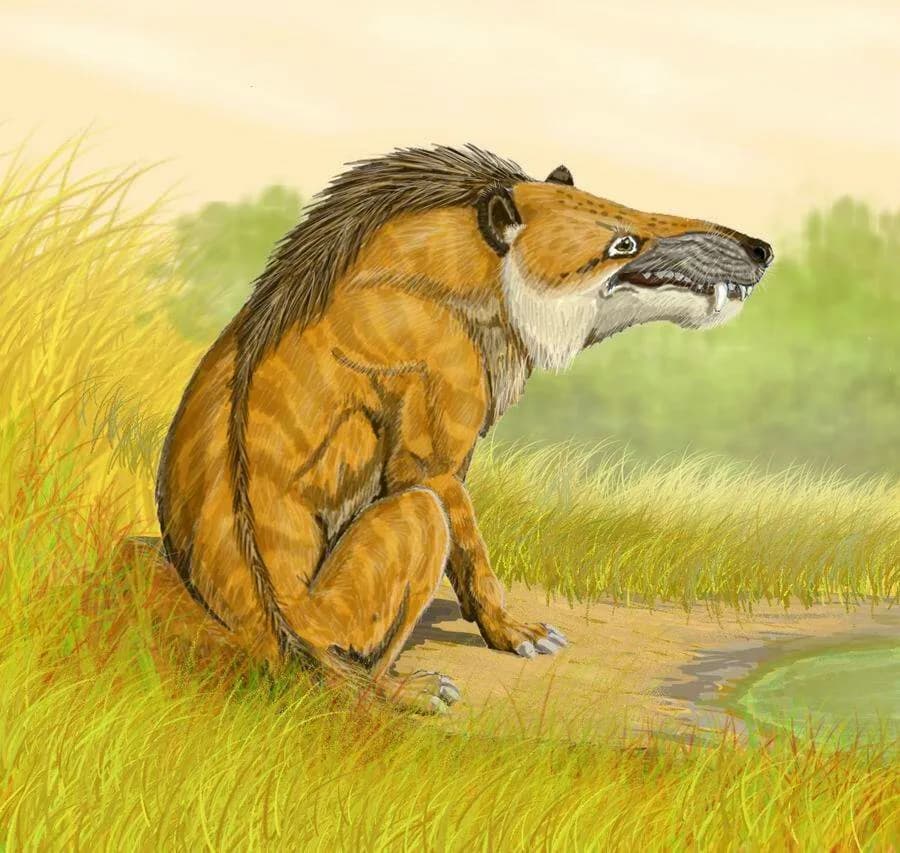
Andrewsarchus is often presented as the largest terrestrial carnivorous mammal that ever existed, though this estimate rests solely on a single skull and extrapolations. Its skull measures 83.4 centimeters long and 56 centimeters wide, making it the largest known skull among all terrestrial predatory mammals. By extrapolating from the proportions of its closest relatives, mesonychids and entelodonts, paleontologists estimate a total body length of approximately 3.5 to 4 meters and a shoulder height of 1.5 to 1.8 meters. Weight estimates vary considerably, ranging from 400 kg to over a tonne, depending on the body model used for reconstruction. The massive size of its skull suggests jaws of considerable power, likely capable of crushing the bones of large Eocene herbivores.
The diet of Andrewsarchus is the subject of intense scientific debate due to the lack of postcranial fossils. Analysis of its dentition reveals teeth that are both sharp and blunt, suggesting an omnivorous diet or an opportunistic scavenger-predator feeding mode. Its robust premolars and flattened molars were capable of crushing bones and shells, while its imposing canines indicate predatory capability. Some paleontologists propose that Andrewsarchus frequented the shorelines of the Tethys Sea, feeding on stranded whale carcasses, sea turtles, and mollusks. Others suggest terrestrial scavenging behavior, taking advantage of carcasses left by other predators or actively hunting medium-sized herbivores. Its relationship to entelodonts, themselves omnivores, reinforces the hypothesis of a varied and opportunistic diet.
Andrewsarchus lived in the Irdin Manha Formation of Inner Mongolia, a region that during the middle Eocene was covered in subtropical forests and coastal plains bordering the ancient Tethys Sea. The climate was significantly warmer and more humid than today, with average temperatures 10 to 15 degrees above current values. The probable habitat of Andrewsarchus included coastal zones rich in stranded marine resources, alluvial plains traversed by large herbivores, and open forests providing cover for ambush. Eocene Mongolia harbored diverse fauna including brontotheres, primitive rhinoceroses, and creodonts, forming a rich ecosystem where an opportunistic mega-predator could thrive. The gradual disappearance of the Tethys Sea and the drying of the Asian climate likely contributed to Andrewsarchus's extinction.
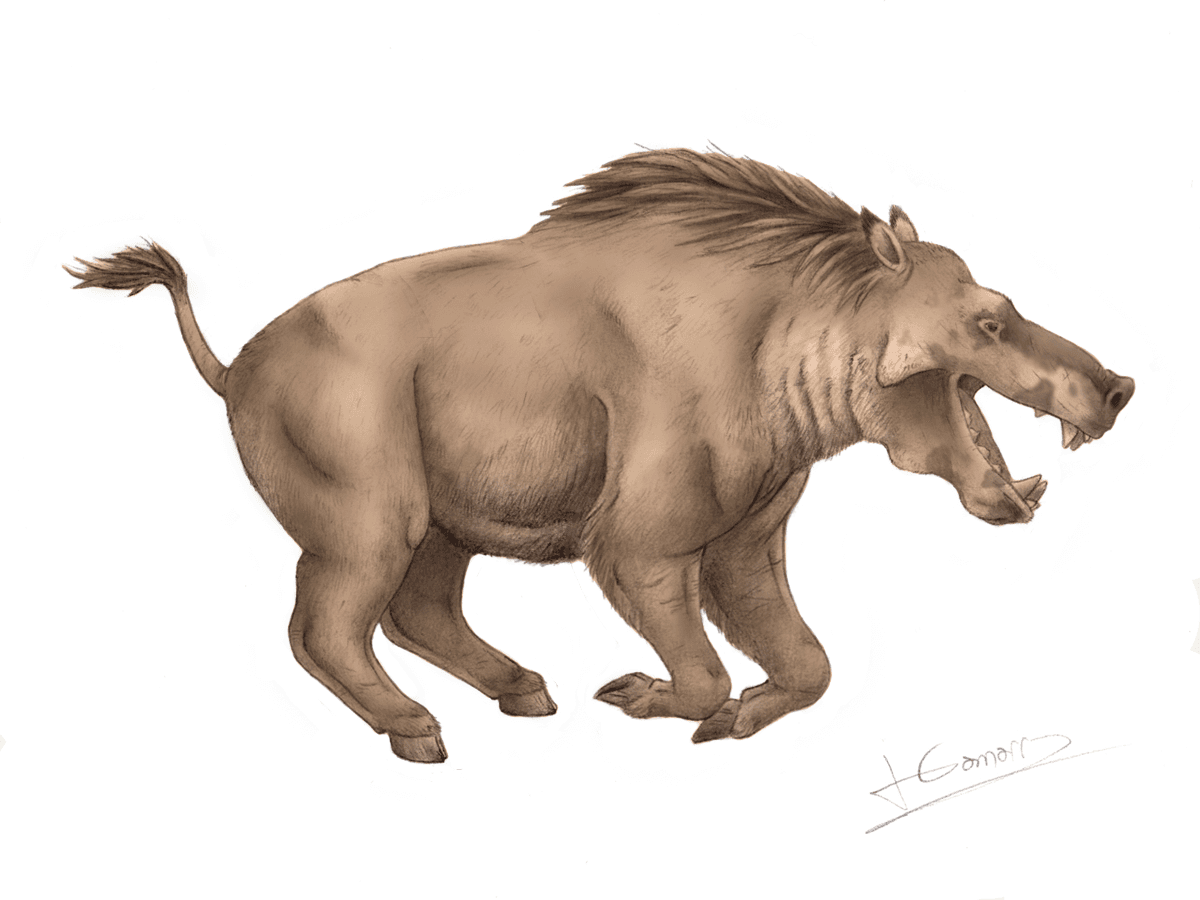
The anatomy of Andrewsarchus is known only from a single remarkably complete skull, discovered in 1923 during the American Museum of Natural History's Third Central Asiatic Expedition. This massive skull features a snout that is elongated and narrow at the front, widening considerably toward the rear at the zygomatic arches, indicating extremely powerful jaw muscles. The complete dental formula includes robust incisors, imposing canines, premolars adapted for crushing, and blunted molars typical of an omnivore or bone-crusher. The prominent sagittal crest atop the skull served as an anchor point for massive temporal muscles, considerably increasing bite force. The absence of any postcranial elements makes body reconstruction highly speculative, and artistic depictions vary enormously depending on whether mesonychids, entelodonts, or hippos are used as the model.
The behavior of Andrewsarchus remains largely hypothetical due to the absence of postcranial fossils and the discovery of only a single individual. Drawing on its closest relatives, entelodonts and mesonychids, paleontologists suggest a solitary or small family group lifestyle, roaming vast territories in search of food. Its omnivorous dentition indicates a highly adaptable animal, capable of modifying its diet according to seasons and resource availability. Like entelodonts, Andrewsarchus likely practiced kleptoparasitism, stealing prey from other predators thanks to its intimidating size. Its powerful jaws allowed access to bone marrow, a nutritious resource ignored by less specialized predators. The hypothesis of coastal behavior, comparable to the modern brown bear that fishes for salmon, is appealing but remains unconfirmed.
The sole known fossil of Andrewsarchus mongoliensis is a nearly complete skull discovered in 1923 by Kan Chuen Pao, a member of the Third Central Asiatic Expedition organized by the American Museum of Natural History under Roy Chapman Andrews's direction. The skull was found in the Irdin Manha Formation of Inner Mongolia, in sediments dating to the middle Eocene (approximately 45 million years ago). Henry Fairfield Osborn described and named the species in 1924, dedicating it to Andrews. The holotype specimen, catalogued as AMNH 20135, is housed at the American Museum of Natural History in New York, where it remains one of the most impressive fossil skulls on public display. Despite nearly a century of additional research in Mongolia and China, no other fossil has been attributed with certainty to Andrewsarchus. This extreme rarity makes its phylogenetic classification unstable: initially placed among mesonychids, it is now more often aligned with entelodonts or considered a basal artiodactyl.
| Period | Éocène moyen / Middle Eocene |
| Era | Cénozoïque / Cenozoic |
| Age | 45 - 36 Ma |
| Location | Mongolie (Asie centrale) / Mongolia (Central Asia) |
| Length | 3.5-4 m (estimé / estimated) |
| Height | 1.5-1.8 m (au garrot / at shoulder, estimé / estimated) |
| Weight | 400 kg - 1 000 kg (estimé / estimated) |
| Diet | Omnivore |
| Discovery | 1923 |
Andrewsarchus mongoliensis is known only from a skull measuring 83.4 cm long and 56 cm wide. Extrapolating from its relatives (entelodonts), paleontologists estimate a body length of 3.5 to 4 meters and a weight between 400 kg and 1 tonne. These figures remain speculative since no postcranial bones have ever been found.
No, Andrewsarchus mongoliensis was a mammal of the order Artiodactyla, appearing long after the extinction of non-avian dinosaurs, roughly 45 to 36 million years ago during the middle Eocene. It is paradoxically more closely related to hippos and whales than to true carnivores.
The classification of Andrewsarchus mongoliensis is unstable because only a single skull (specimen AMNH 20135) has been found since 1923, despite a century of fieldwork in Mongolia. Initially placed among mesonychids, it is now more often aligned with entelodonts or considered a basal artiodactyl. Without postcranial bones, phylogenies remain debated.
Information on this page is based on peer-reviewed scientific publications.
Artistic reconstruction of Andrewsarchus mongoliensis, the largest known terrestrial carnivorous mammal
Dmitry Bogdanov, Public domain
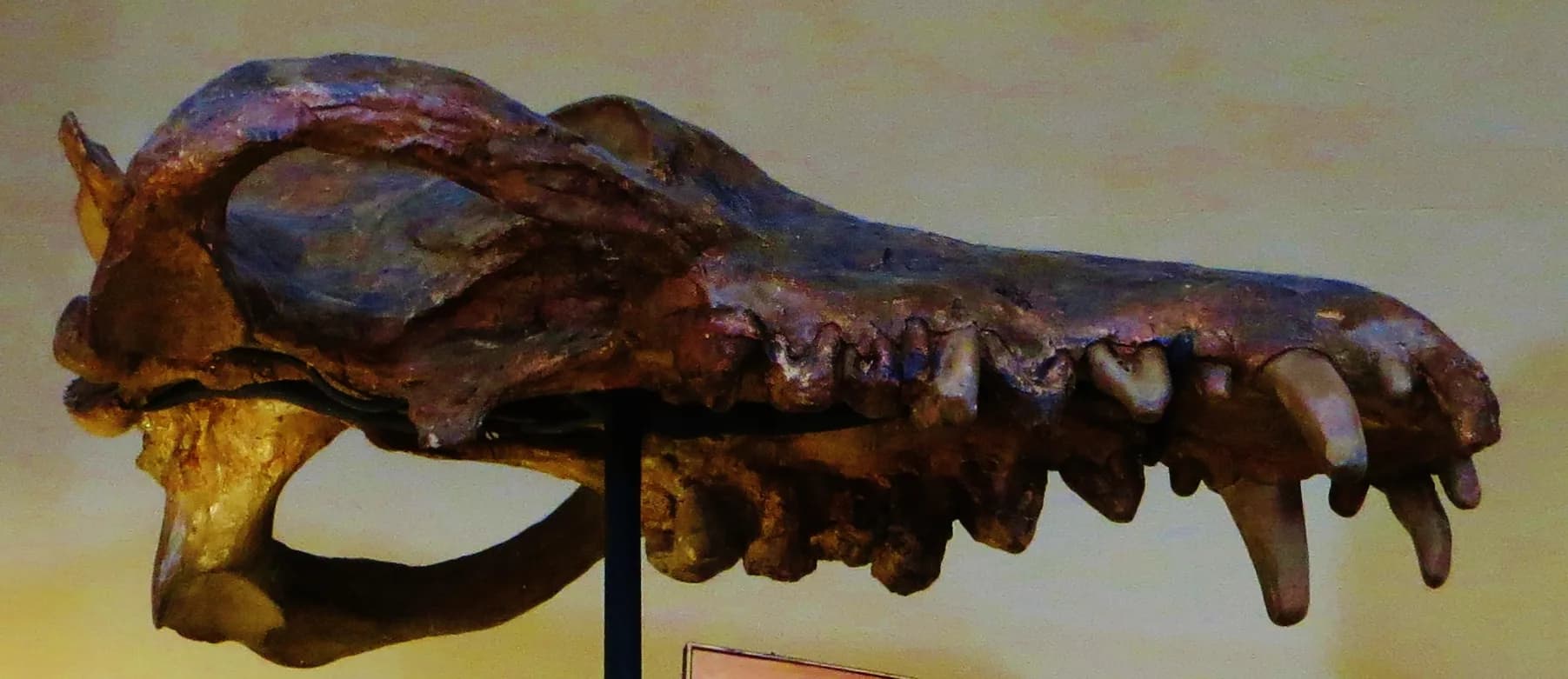
Skull of Andrewsarchus mongoliensis, the only known fossil of this species (AMNH)
Ghedoghedo, CC BY-SA 3.0