Cochon tueur
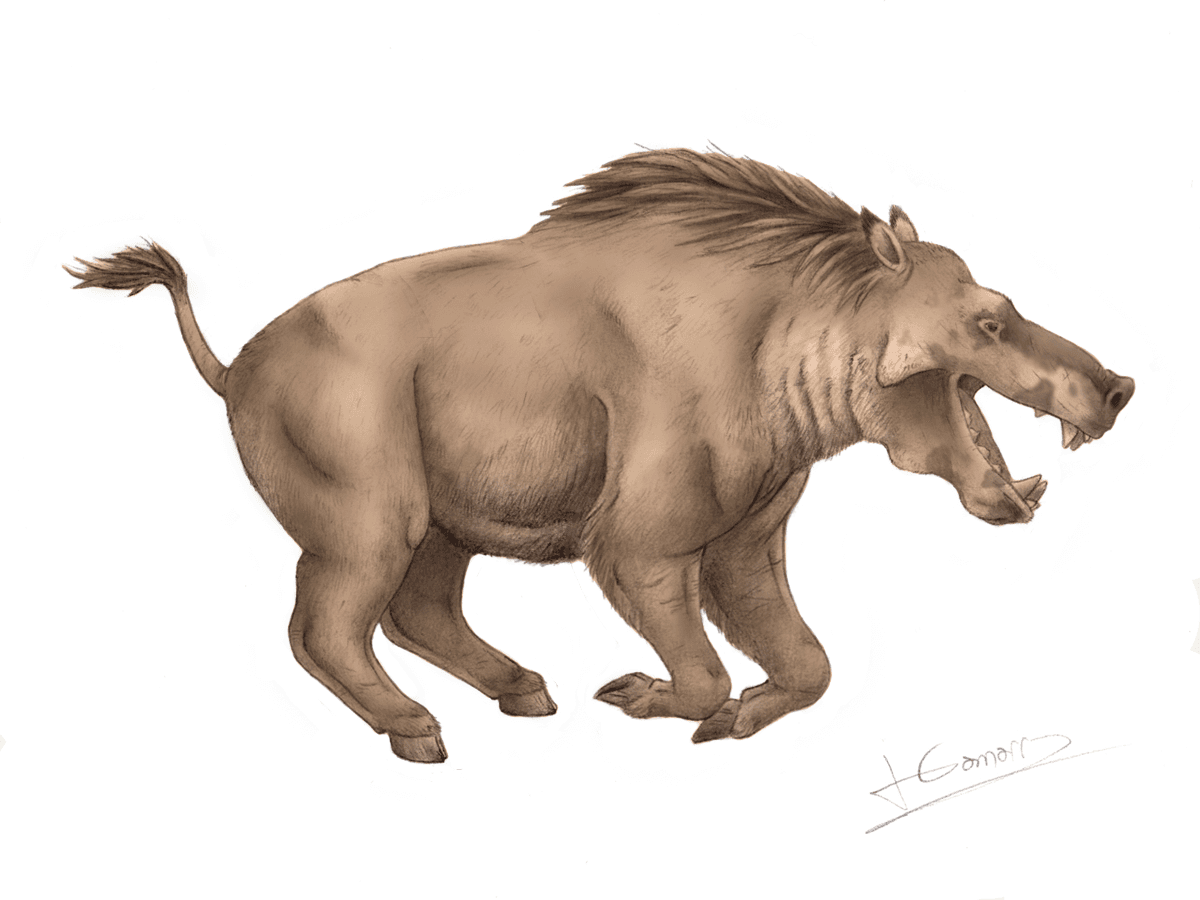
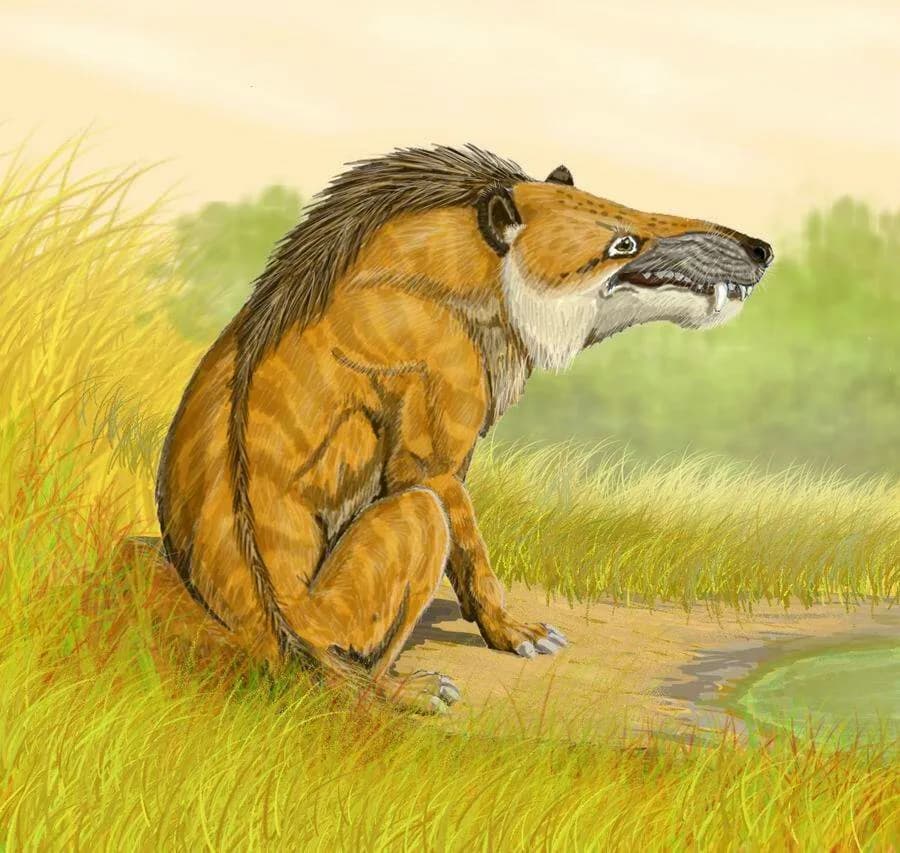
Archaeotherium mortoni, nicknamed the « killer pig », was no pig at all: this Oligocene entelodont was closer to hippos and whales. Described in 1850, it ran about 2 metres long at 150 to 270 kilograms and roamed South Dakota, Nebraska and Wyoming 38 to 25 million years ago. Its jaws opened wide enough to swallow a small rhino's head.
Archaeotherium lived during the late Eocene and early Oligocene epochs, approximately 38 to 25 million years ago, across North America. This mammal belonged to the family Entelodontidae, often nicknamed 'killer pigs' or 'hell pigs,' although they were only distantly related to modern pigs. Archaeotherium thrived in a world undergoing dramatic climate change, as the vast tropical forests of the Eocene gave way to open grasslands and temperate savannas. This period corresponds to the Grande Coupure, a major faunal turnover event that profoundly transformed North American terrestrial ecosystems and allowed entelodonts to become the dominant predators and scavengers of their era.
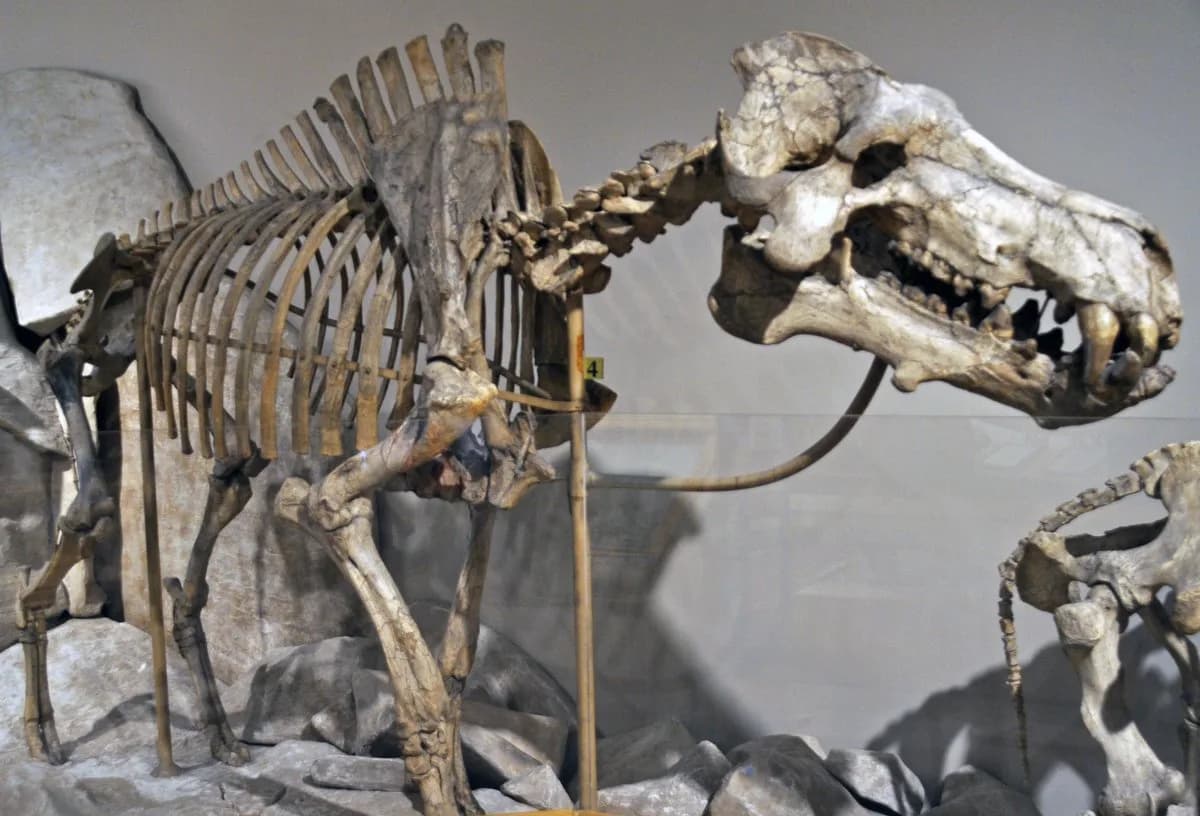
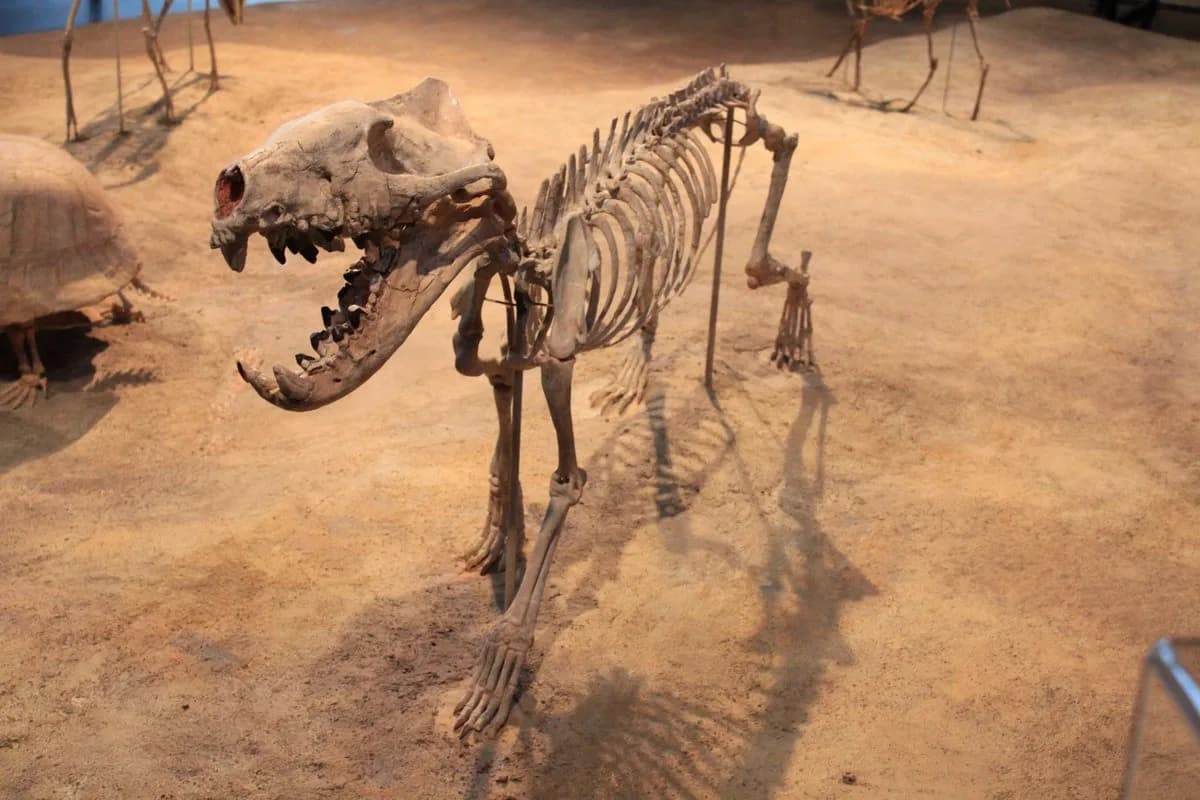
Archaeotherium stood approximately 1.2 meters tall at the shoulder and reached a total length of nearly 2 meters, with an estimated weight between 150 and 270 kilograms. Its head was disproportionately massive relative to its body, representing nearly one-third of its total length, and was adorned with characteristic bony protuberances beneath the eyes and on the lower jaw. The skull could measure up to 45 centimeters long, rivaling that of a modern bison despite a much smaller body. Its legs were relatively long and slender for an animal of this build, ending in two functional toes — an adaptation for running in open plains that clearly distinguished it from modern four-toed pigs.
Archaeotherium was an opportunistic omnivore equipped with extraordinarily powerful jaws, capable of crushing bones with a bite force rivaling that of today's large carnivores. Fossil analysis shows teeth combining sharp canines for tearing flesh and flattened molars for grinding plant material and bones. Bite marks attributed to Archaeotherium have been found on bones of various contemporary mammals, including primitive rhinoceroses and small camelids. It likely practiced a feeding strategy similar to modern hyenas, alternating between active hunting, scavenging, and plant consumption depending on seasonal availability and opportunities in its environment.
Archaeotherium inhabited the open plains and wooded savannas of North America during the Eocene-Oligocene transition, a period of global cooling. Its fossils have been found primarily in the geological formations of the Badlands of South Dakota, Nebraska, and Wyoming, in fluvial and lacustrine sediments indicating environments of meandering rivers bordered by riparian vegetation. It likely frequented watering holes, where it could both drink and hunt or scavenge carcasses of other animals. Its habitat comprised a mix of grassy prairies and sparse forests, a landscape rapidly evolving under the effects of global cooling that characterized the transition to the Oligocene.
The anatomy of Archaeotherium reveals an animal adapted to a predator-scavenger lifestyle on the plains. Its massive skull possessed enlarged temporal fossae, indicating extremely developed masticatory muscles capable of generating considerable bite pressure. The jugal and mandibular bony protuberances, typical of entelodonts, likely served as anchor points for soft tissues and played a role in intraspecific combat and visual communication. Its spine was robust and straight, supporting the considerable weight of the head through powerful nuchal ligaments anchored on tall cervical spinous processes. Both forelimbs and hindlimbs were adapted for efficient cursorial locomotion.
The behavior of Archaeotherium can be reconstructed through numerous fossil clues. Accumulations of broken and chewed bones found at certain sites suggest food-caching behavior similar to that of modern crocodilians, where the animal stored food remains in burrows or underwater. Bite marks on skulls of other Archaeotherium specimens indicate violent territorial fights between individuals, likely related to competition for resources or mating partners. Some paleontologists suggest a partially gregarious lifestyle, living in small family groups like modern warthogs, although direct evidence of sociality remains limited in the fossil record.
The first fossils of Archaeotherium were described by Joseph Leidy in 1850, from material collected in the Badlands of South Dakota, making it one of the first scientifically described prehistoric North American mammals. Since then, hundreds of specimens have been discovered across the American Great Plains, in formations dating from the late Eocene to early Oligocene, notably the White River and Brule formations. Several nearly complete skeletons allow accurate reconstruction of the animal, and remarkably well-preserved skulls have provided detailed information about facial musculature and jaw biomechanics. Footprints attributed to Archaeotherium have also been identified, confirming its rapid didactyl locomotion.
| Period | Éocène supérieur – Oligocène inférieur / Late Eocene – Early Oligocene |
| Era | Cénozoïque / Cenozoic |
| Age | 38–25 millions d'années / 38–25 million years ago |
| Location | Amérique du Nord (Dakota du Sud, Nebraska, Wyoming) / North America (South Dakota, Nebraska, Wyoming) |
| Length | ~2 m |
| Height | ~1,2 m au garrot / ~1.2 m at shoulder |
| Weight | 150–270 kg |
| Diet | Omnivore |
| Discovery | 1850 |
Archaeotherium mortoni reached 1.2 meters at the shoulder and 2 meters in length, weighing 150 to 270 kilograms. Despite its 'killer pig' nickname, it was not a true pig — entelodonts are phylogenetically closer to hippos and cetaceans. Its disproportionate skull represented nearly one-third of its total body length, with the skull itself measuring up to 45 cm.
Archaeotherium mortoni was likely an opportunistic omnivore combining active hunting, scavenging, and plant consumption — similar to modern hyenas. Bite marks attributed to this entelodont have been found on bones of primitive rhinoceroses and small camelids. Accumulations of broken and chewed bones at some sites also suggest food-caching behavior, comparable to modern crocodilians.
Archaeotherium mortoni lived between 38 and 25 million years ago, during the Eocene-Oligocene transition — a period of global climate cooling known as the Grande Coupure. Its fossils come mainly from the White River and Brule formations in the Badlands of South Dakota, Nebraska, and Wyoming. Joseph Leidy described it in 1850 from those same Badlands, making it one of the first scientifically described prehistoric North American mammals.
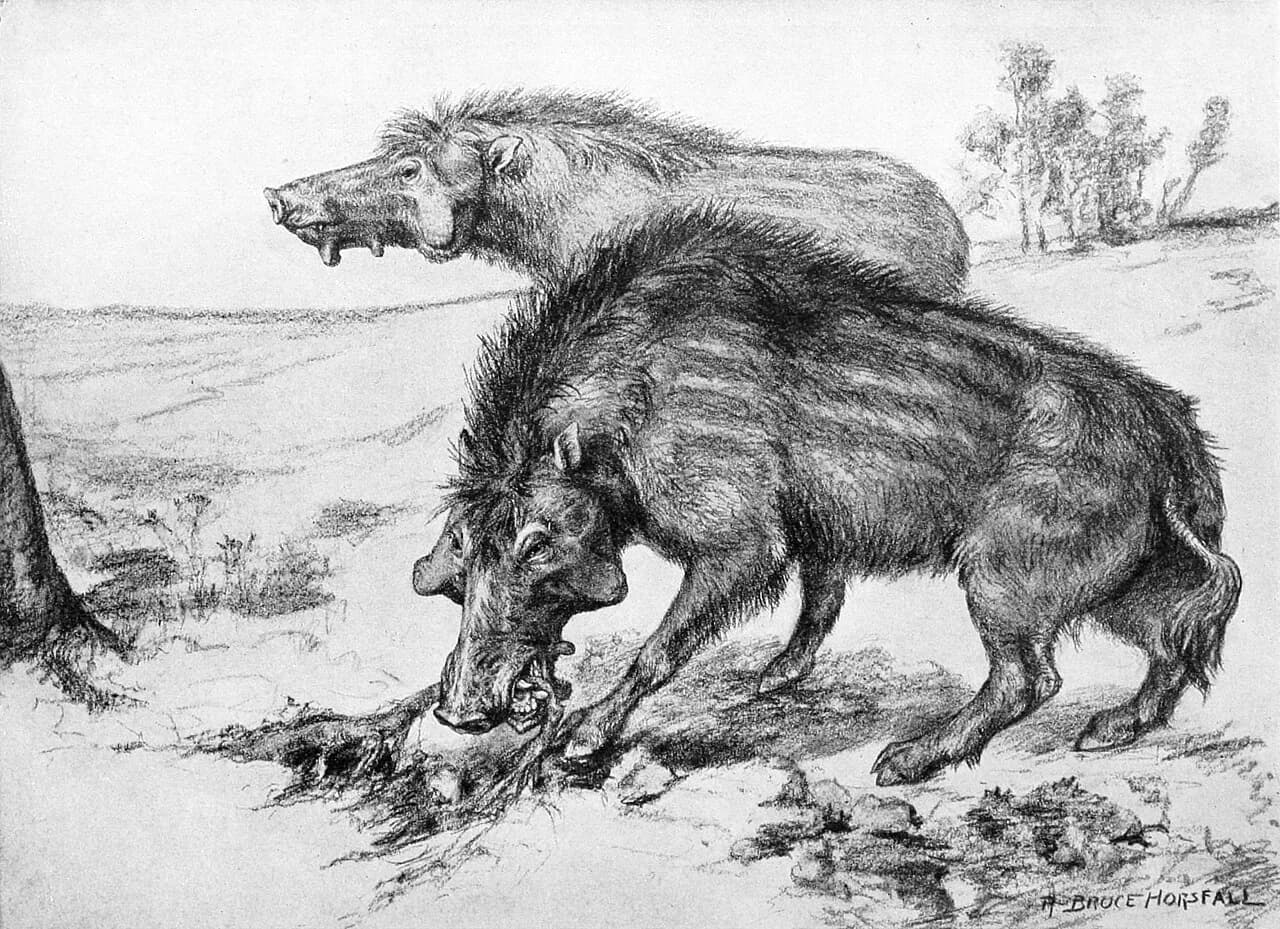
Reconstruction of Archaeotherium, the fearsome entelodont nicknamed 'killer pig'
Wikimedia Commons
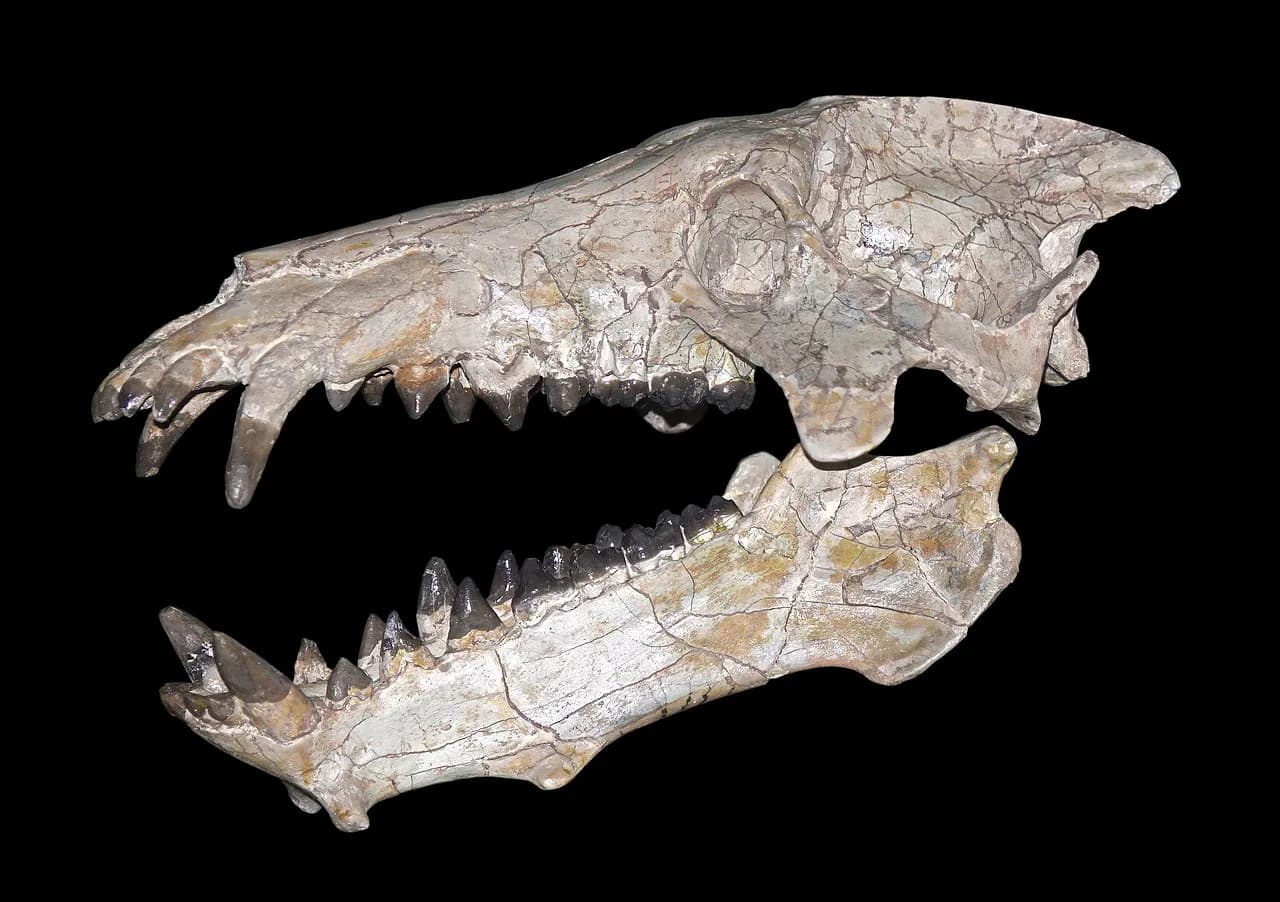
Fossil skull of Archaeotherium mortoni displayed in museum
Wikimedia Commons