Dent d'hyène
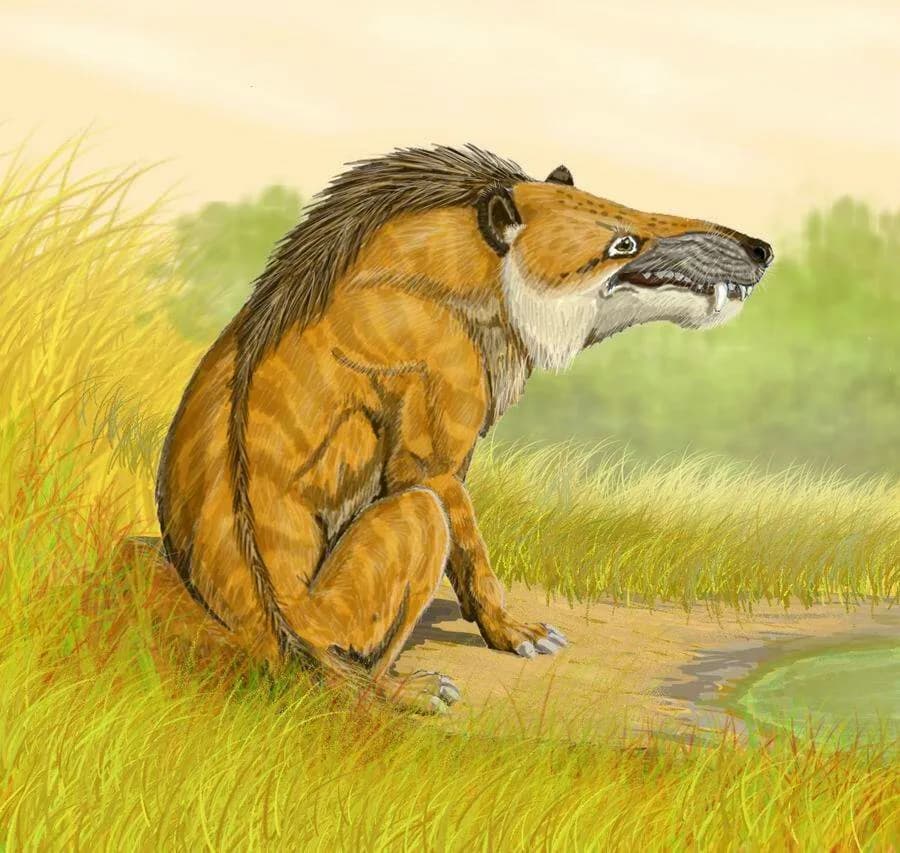
Hyaenodon gigas was a carnivore described in 1838, found across North America, Europe, Asia and Africa between 42 and 16 million years ago. Depending on the species it measured 1.2 to 3 metres and 50 to 500 kilograms. Despite the name it is unrelated to hyenas — a case of convergent evolution. It dominated as a predator for 26 million years.
Hyaenodon lived from the Late Eocene to the Early Miocene, approximately 42 to 15.9 million years ago, reigning as a dominant predator for nearly 26 million years. This carnivore belonged to the order Creodonta, a group of carnivorous mammals now entirely extinct and distinct from the modern order Carnivora. Hyaenodon first appeared in Asia before spreading to Europe, North America, and Africa, colonizing four continents via land bridges that existed at the time. Several species often coexisted within the same ecosystems, occupying different ecological niches based on their size. The gradual extinction of the genus during the Miocene coincides with the diversification and rise of true carnivores of the order Carnivora.
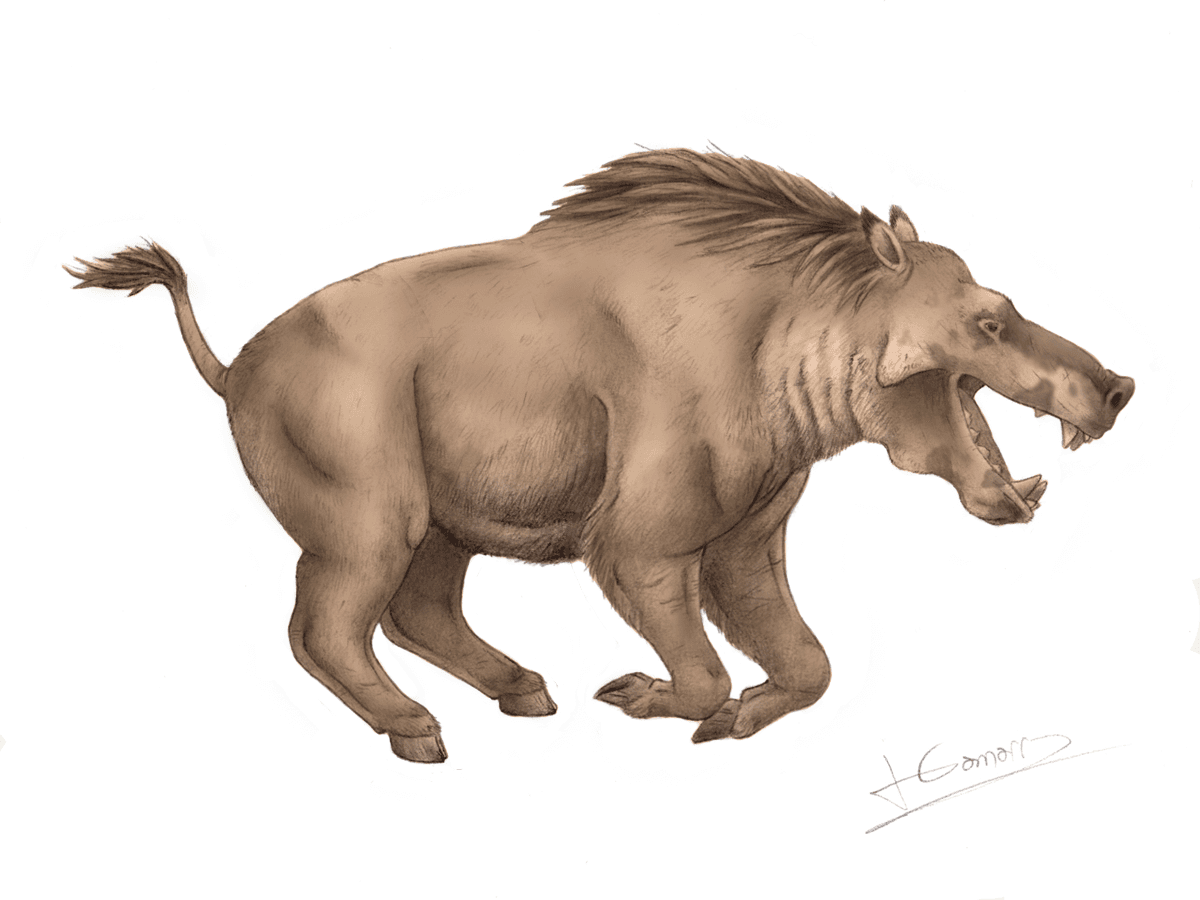
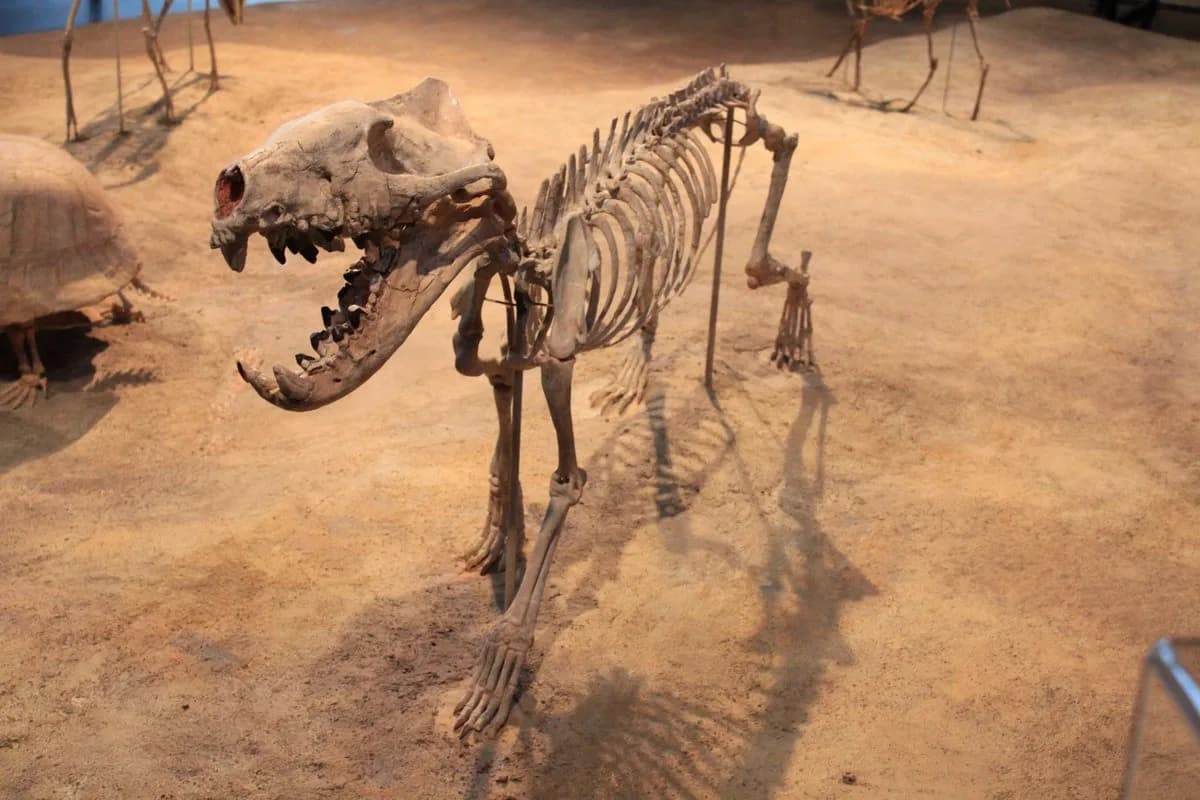
Hyaenodon displayed an extraordinary diversity of sizes across species, ranging from fox-sized animals to predators rivaling the largest bears. Hyaenodon gigas, the largest known species, measured up to 3 meters long and weighed between 400 and 500 kilograms, with a massive skull reaching 60 centimeters in length. The smallest species, such as Hyaenodon microdon, weighed only 5 to 10 kilograms. This considerable size variation within a single genus is remarkable in the history of carnivorous mammals and reflects the exceptional evolutionary adaptability of this group. The general morphology was that of a quadruped with relatively elongated limbs, a slender body, and a head disproportionately large relative to the torso.
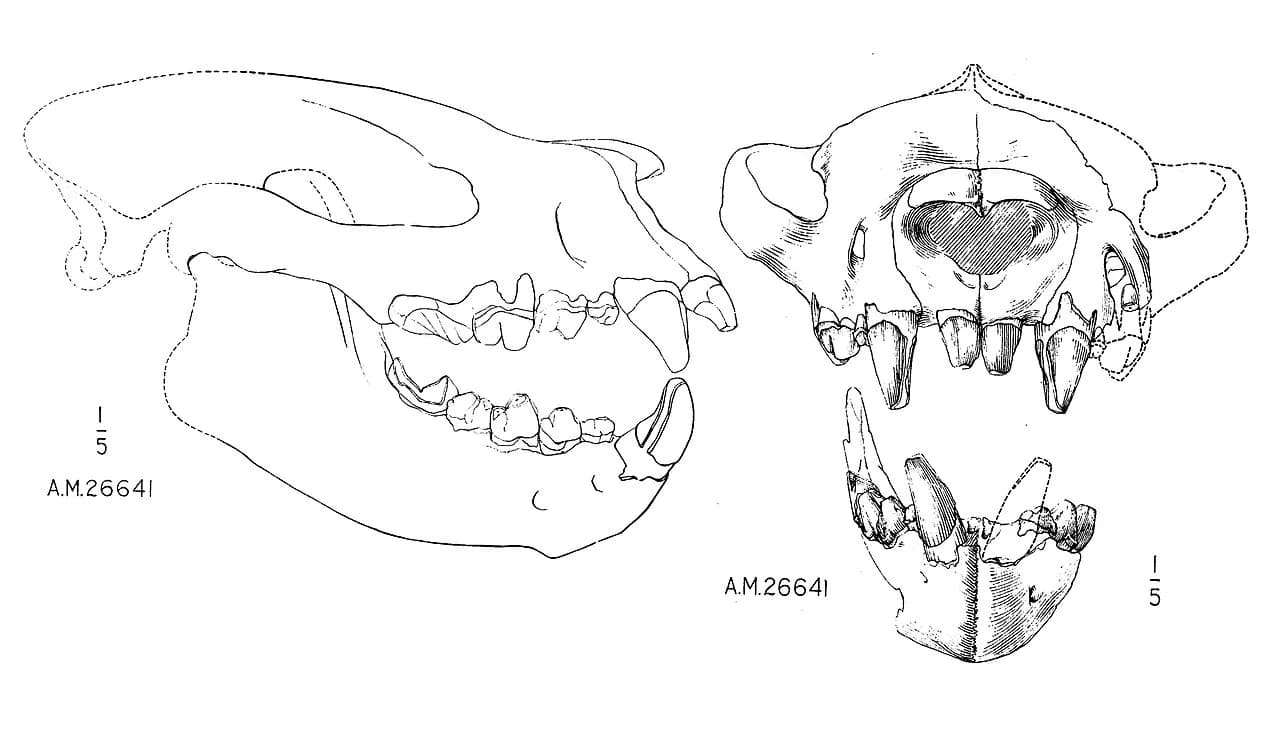
Hyaenodon was a formidable hypercarnivore whose powerful jaws could crush the bones of its prey with an efficiency comparable to that of modern hyenas, despite having no evolutionary relationship with them. Its carnassial teeth, exceptionally well developed, functioned as true bone shears capable of slicing through flesh and bone with equal ease. The largest species like H. gigas likely attacked large primitive ungulates, archaic rhinoceroses, and possibly the early proboscideans of their era. Smaller species hunted prey proportional to their size, including rodents, primitive rabbits, and small ungulates. Analysis of dental wear and isotopes suggests that some species also practiced scavenging, supplementing their active predator diet with carcass recovery.
Hyaenodon occupied a remarkable variety of habitats across four continents during its long 26-million-year existence. In North America, it inhabited the vast plains and savannas of the Late Eocene and Oligocene, sharing its territory with the earliest horses, titanotheres, and entelodonts. In Europe, it lived in the subtropical forests that covered the continent before the Oligocene cooling event. In Asia, its fossils have been discovered from Mongolia to China and Pakistan, in environments ranging from steppes to temperate forests. In Africa, certain species evolved in the savannas and open woodlands of the Eocene and Oligocene. This cosmopolitan distribution testifies to an exceptional ecological adaptability for a terrestrial predator of that era.
Hyaenodon's anatomy was that of a highly specialized terrestrial predator with a remarkably powerful skull. Its most distinctive feature was its disproportionately large head relative to its body, housing jaws with considerable bite force. Its carnassial teeth, positioned further back in the jaw than in modern carnivores, were the second upper molars and third lower molars, a configuration unique to creodonts. Its brain was proportionally small relative to its body size, which may have contributed to its extinction when faced with modern carnivores possessing more developed brains. Its limbs were semi-digitigrade, an intermediate posture between walking on toes and on the sole, giving it an efficient gait for medium-distance pursuit of prey.
Hyaenodon was very likely a solitary predator or one that hunted in pairs, using a combination of ambush and medium-distance pursuit to capture its prey. The largest species like H. gigas dominated Late Eocene ecosystems as undisputed apex predators, capable of attacking prey much larger than themselves. Bite marks found on fossils of other animals attest to the destructive power of its jaws. Several Hyaenodon species of different sizes often coexisted in the same regions, each targeting prey of corresponding size, thus reducing interspecific competition. Its relatively small brain suggests less complex behavior than modern carnivores, relying more on brute power than on cunning or elaborate social cooperation among pack members.
The genus Hyaenodon was first described in 1838 by French paleontologist Joseph Laizer and naturalist Henri de Parieu, based on fossils discovered in the phosphorites of Quercy in France. The name means 'hyena tooth' in Greek (hyaina 'hyena' + odous 'tooth'), referring to the superficial resemblance of its teeth to those of modern hyenas, although the two groups are unrelated. Since then, Hyaenodon fossils have been discovered on four continents: in North America (mainly in the Badlands of South Dakota and Nebraska), Europe (France, Germany, Spain), Asia (Mongolia, China, Pakistan), and Africa (Egypt, Libya, Kenya). The White River Badlands site in the United States has yielded some of the most complete specimens, including remarkably preserved skulls with intact dentition.
| Period | Éocène supérieur — Miocène inférieur / Late Eocene — Early Miocene |
| Era | Cénozoïque / Cenozoic |
| Age | 42 - 15.9 Ma |
| Location | Amérique du Nord, Europe, Asie, Afrique / North America, Europe, Asia, Africa |
| Length | 1.2-3 m (selon l'espèce / varies by species) |
| Height | 0.5-1.2 m |
| Weight | 50-500 kg |
| Diet | Carnivore |
| Discovery | 1838 |
No. Hyaenodon belonged to the extinct order Creodonta, entirely separate from modern hyenas which are Carnivora. The dental resemblance between both groups is a classic example of convergent evolution — two unrelated lineages independently developed bone-crushing teeth. Hyaenodon went extinct in the Early Miocene around 15.9 million years ago.
Hyaenodon gigas, the largest known species of the genus, measured up to 3 meters long and weighed between 400 and 500 kg, with a massive skull reaching 60 cm. This represents the extreme of a remarkable size range: the smallest species, Hyaenodon microdon, weighed only 5 to 10 kg.
Hyaenodon had a proportionally small brain compared to the later Carnivora predators. During the Miocene, these cognitively better-endowed newcomers — ancestors of cats, canids and bears — progressively outcompeted the creodonts. Despite this, Hyaenodon ruled for roughly 26 million years, from the Late Eocene (42 Ma) to the Early Miocene (15.9 Ma).
Hyaenodon fossil skull and skeleton on museum display
Wikipedia Commons
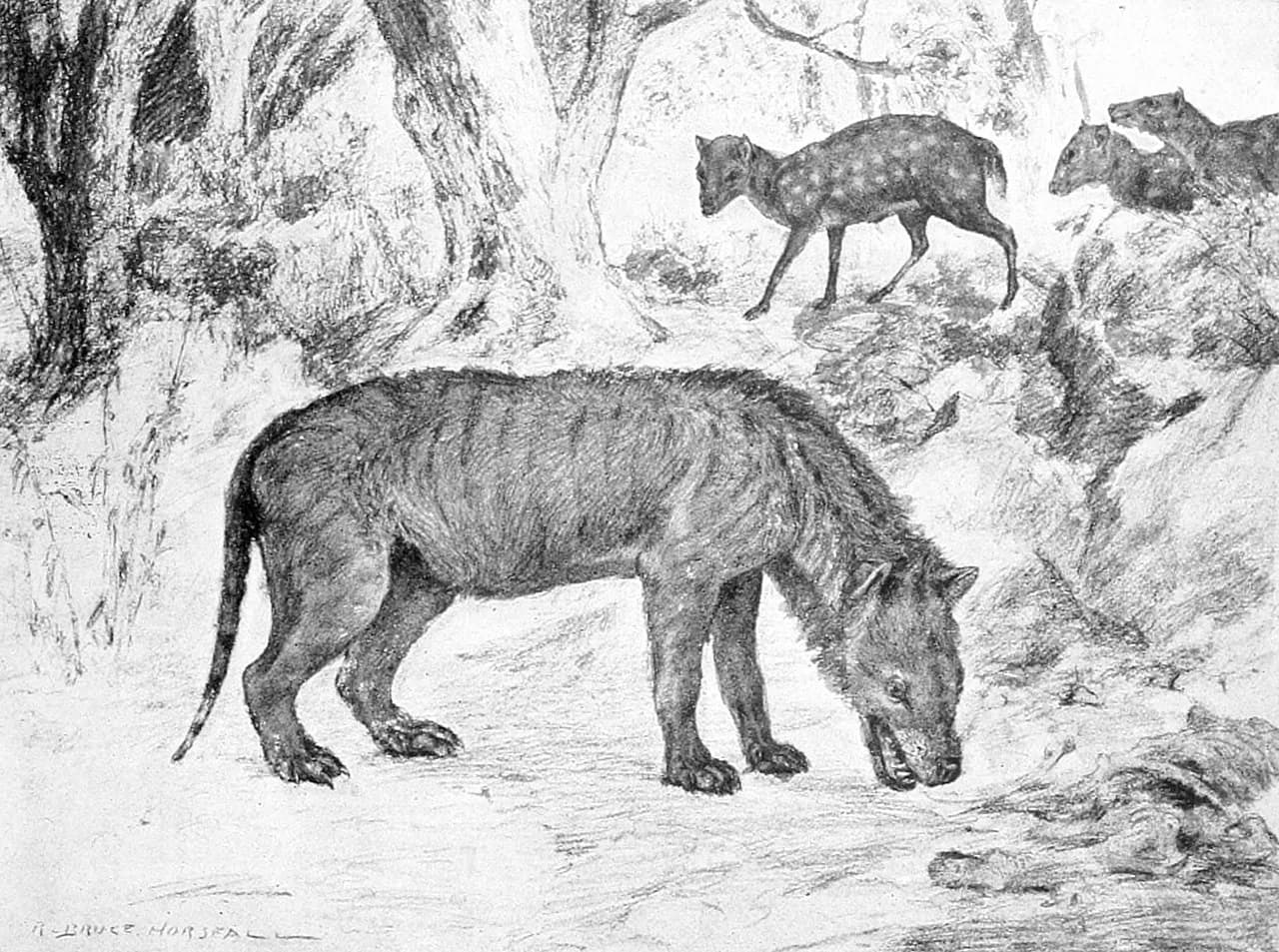
Illustration of Hyaenodon hunting a Leptomeryx on the Oligocene plains
Wikipedia Commons