Rhinocéros laineux
Coelodonta antiquitatis, the woolly rhinoceros, measured about 3.5 metres and 1.8 to 2.7 tonnes, ranging Europe and northern Asia between 3.6 million and 10,000 years ago. It is among the beasts our ancestors drew most: the caves of Chauvet and Lascaux show it precisely enough to make out its two horns and thick coat.
The woolly rhinoceros appeared at the beginning of the Pleistocene, approximately 3.6 million years ago, likely descending from Asian ancestors of the genus Coelodonta that had adapted to cold conditions on the Tibetan Plateau. It thrived throughout the Pleistocene across the vast Eurasian steppe-tundra, reaching its maximum range during the Last Glacial Maximum, 26,000 to 19,000 years ago, when populations extended from the Iberian Peninsula to eastern Siberia and even into Korea. Coelodonta antiquitatis coexisted with modern humans and Neanderthals for tens of thousands of years, and was depicted in famous cave paintings at Chauvet (36,000 years ago) and Lascaux (17,000 years ago). Populations declined rapidly at the end of the Pleistocene, and the species went extinct approximately 10,000 years ago, the victim of a combination of post-glacial warming that destroyed its steppe habitat and increasing hunting pressure from expanding human populations.
The woolly rhinoceros was a massive animal, comparable in size to the largest modern rhinoceroses. Adults measured approximately 3.5 meters in length from snout to tail base, with a shoulder height of 1.6 to 2 meters. Estimated weight ranged between 1,800 and 2,700 kilograms, with males being significantly heavier than females. Its silhouette was distinctive, with a low, stocky body, short powerful legs, and a massive head carried low, perfectly adapted for grazing on ground-level grasses. Compared to the modern white rhinoceros (Ceratotherium simum), which can reach 2,300 kg, Coelodonta was of similar build but slightly more compact and better insulated against the cold. Newborn calves probably weighed between 40 and 60 kg, as in modern rhinoceroses, reaching adult size in seven to ten years.
The woolly rhinoceros was a strict herbivore, specialized in grazing on low grasses and herbaceous plants of the steppe-tundra. Analysis of stomach contents from carcasses preserved in Siberian permafrost reveals a diet dominated by grasses (Poaceae), supplemented by sedges, wormwood (Artemisia), buttercups, and other cold-resistant herbaceous plants. Its wide, flattened upper lip — hence the name Coelodonta, meaning 'hollow tooth' in reference to its molars — was perfectly adapted for tearing up large tufts of grass at ground level, unlike the modern black rhinoceros whose prehensile lip is adapted for picking leaves and branches. Its highly hypsodont (high-crowned) molars with folded enamel resisted the intense wear caused by silica in grasses and dust particles from the arid steppe. An adult probably consumed 50 to 80 kg of vegetation per day.
The woolly rhinoceros inhabited the mammoth steppe, a vast now-vanished biome that stretched across the entire northern Eurasian landmass during glacial periods. This open landscape, dominated by nutritious grasses, herbs, and dwarf shrubs, provided ideal habitat for this specialized grazer. Its range covered an immense territory, from the Atlantic plains of western Europe (France, England, Germany) through the steppes of central Europe and Russia to eastern Siberia and northern China. Unlike the woolly mammoth, the woolly rhinoceros never crossed Beringia into North America — no fossils have been found on the American continent. It avoided densely forested areas and steep mountainous terrain, preferring vast grassy plains and open river valleys where low vegetation was abundant. During warmer interglacial periods, its range contracted northward and eastward, following the retreat of the steppe-tundra.
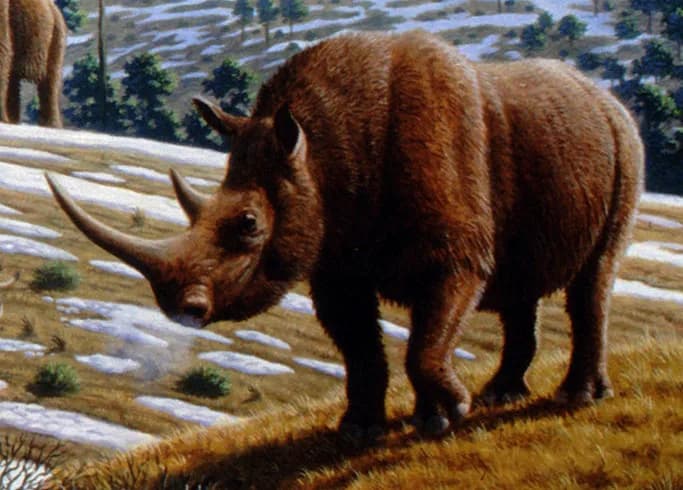
The woolly rhinoceros's anatomy was remarkably adapted to the extreme glacial conditions of the Pleistocene. Its coat consisted of two distinct layers: a dense woolly undercoat providing thermal insulation, covered by long coarse guard hairs reaching 15 to 20 centimeters in length, ranging from reddish-brown to dark brown as revealed by mummified specimens. Beneath the skin, a thick subcutaneous fat layer of 5 to 8 cm provided additional insulation and energy reserves for long winters. Its most distinctive feature was its two nasal keratin horns: the anterior horn, massive and laterally flattened, could measure up to one meter in length and curved backward; the posterior horn, smaller, measured approximately 20 to 30 centimeters. Its ears were short and rounded to minimize heat loss, and its tail was relatively short compared to tropical rhinoceroses. Its robust legs ended in three broad toes that distributed its weight across frozen and snow-covered ground.
The woolly rhinoceros was probably a solitary or semi-solitary animal, like most modern rhinoceroses. Adult males likely occupied individual territories, which they defended against rivals using their impressive nasal horns. Characteristic wear marks on the lateral surface of anterior horns suggest the animals also used them to sweep away snow to access buried vegetation in winter, a behavior comparable to that of modern musk oxen. Females probably raised a single calf at a time, with a gestation period estimated at 15-16 months by analogy with modern rhinoceroses. The cave paintings at Chauvet, dating to approximately 36,000 years ago, depict woolly rhinoceroses in motion, sometimes in pairs, providing direct testimony of the animal's behavior as observed by our ancestors. The species coexisted with numerous large megafaunal herbivores — mammoths, steppe bison, wild horses — sharing the resources of the productive steppe-tundra.
The woolly rhinoceros was first scientifically described by Johann Friedrich Blumenbach in 1799, based on fossil remains discovered in Germany. The genus name Coelodonta (from Greek koilos 'hollow' and odous 'tooth') refers to the deep cavities in its molars. The most spectacular discoveries come from Siberian permafrost, where entire carcasses have been preserved with their fur, skin, and sometimes intact stomach contents. In 2014, a baby woolly rhinoceros nicknamed 'Sasha,' approximately 7 months old and 34,000 years old, was discovered in the Yakutia region of Siberia — the best-preserved juvenile specimen ever found. In 2020, another remarkably preserved specimen, with its fur and horn intact, was extracted from permafrost in Yakutia. The species is also abundantly represented in Paleolithic cave art: the Chauvet (36,000 years) and Lascaux (17,000 years) caves contain detailed depictions that help confirm the living animal's appearance. Ancient DNA extracted from these specimens has confirmed that Coelodonta is the closest extinct relative of the Sumatran rhinoceros (Dicerorhinus sumatrensis).
| Period | Pléistocène / Pleistocene |
| Era | Cénozoïque / Cenozoic |
| Age | 3.6 Ma – 10 000 ans / 3.6 Ma – 10,000 years |
| Location | Europe et Asie du Nord / Europe and Northern Asia |
| Length | ~3.5 m |
| Height | 1.6–2 m (épaule / at shoulder) |
| Weight | 1 800–2 700 kg |
| Diet | Herbivore |
| Discovery | 1799 |
Coelodonta antiquitatis measured about 3.5 meters long, stood 1.6 to 2 meters at the shoulder, and weighed 1,800 to 2,700 kg. It differed from living rhinos through its two keratin horns — the front one exceeding one meter — and a thick double-layered reddish-brown coat adapted for glacial winters, a feature absent in all living rhinoceros species.
No Coelodonta antiquitatis fossil has ever been found on the American continent. The reasons remain debated, but the animal's morphology — adapted to Eurasian low grasslands — and possibly environmental barriers to crossing Beringia appear to have limited its range, unlike the woolly mammoth which successfully crossed this land bridge.
Complete Coelodonta antiquitatis carcasses have been preserved in Siberian permafrost, including the baby 'Sasha' discovered in Yakutia in 2014, dating to 34,000 years ago, with its reddish fur still intact. Cave paintings at Chauvet (36,000 years) and Lascaux (17,000 years) depict its two horns and coat, confirming the anatomical data drawn from mummified specimens.
Life reconstruction of Coelodonta antiquitatis
Mauricio Antón, CC BY 2.5, via Wikimedia Commons
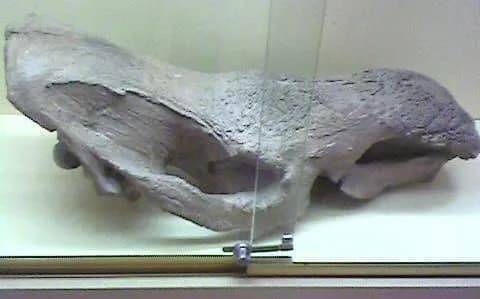
Woolly rhinoceros skeleton
FunkMonk, CC BY-SA 3.0, via Wikimedia Commons