Mégathérium
Megatherium americanum served as proof of one of the most subversive ideas of its time: in 1796, Cuvier used it to show that species could disappear, at a point when extinction seemed unthinkable. This giant sloth reached 6 metres upright and 3.5 to 4 tonnes, living in South America between 400,000 and 8,000 years ago.
Megatherium americanum lived during the Late Pleistocene, approximately 400,000 to 8,000 years ago, making it one of the last giants of the South American megafauna. This colossal xenarthran appeared in South America at a time when the continent harbored an extraordinarily diverse fauna of giant mammals, isolated from the rest of the world for millions of years. Its name, meaning 'great beast' in Greek (mega 'great' + therion 'beast'), was assigned by French naturalist Georges Cuvier in 1796. Megatherium disappeared toward the end of the Pleistocene, around 8,000 BCE, during the massive megafaunal extinction that struck the large mammals of the Americas. Probable causes include rapid climate changes at the end of the last ice age, fragmentation of forest habitats, and hunting pressure from the first human populations arriving in South America approximately 15,000 years ago.
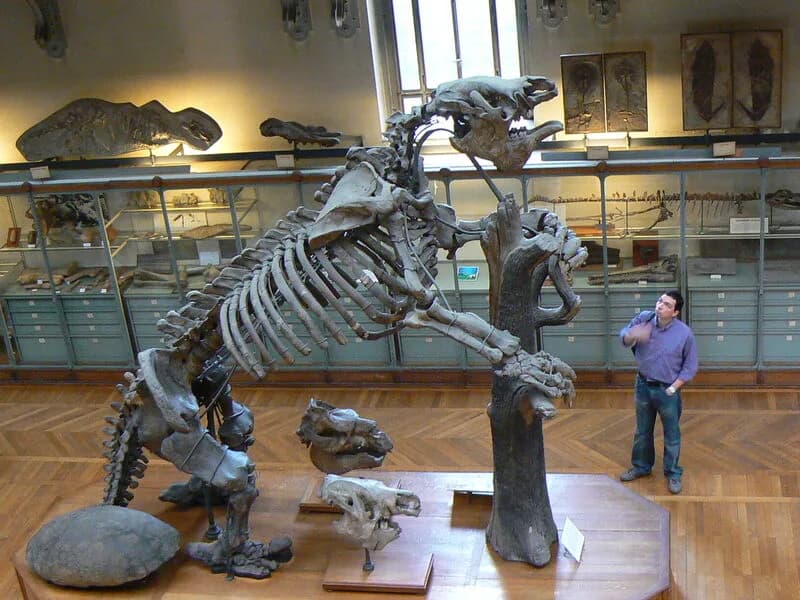
Megatherium americanum was the largest ground sloth that ever existed and one of the largest non-proboscidean terrestrial mammals of all time. In quadrupedal position, it stood about 3 meters at the shoulder, but could rear up on its powerful hind legs and massive tail to reach an impressive height of 5.5 to 6 meters, rivaling the height of a modern giraffe. Its estimated weight ranged between 3.5 and 4 tonnes, comparable to that of a female Asian elephant. Its total length from snout to tail tip reached approximately 6 meters. Its skull measured about 65 centimeters long. By comparison, modern two-toed and three-toed sloths weigh only 4 to 8 kilograms — Megatherium was therefore about 500 times heavier than its distant living relatives, illustrating the trend toward gigantism that characterized the Pleistocene megafauna of South America.
Megatherium was primarily herbivorous, feeding on leaves, branches, fruits, and tree bark from the forests and woodlands of South America. Its unique ability to rear up on its hind legs allowed it to reach vegetation over 5 meters high, a feeding niche inaccessible to most other herbivores of its time. Analysis of its tooth morphology — lobate molars without external enamel, with continuous growth — indicates a mixed vegetative diet including tender leaves and tougher plant materials. However, recent carbon and nitrogen isotopic studies of its bones have suggested that Megatherium may have been occasionally omnivorous, or even a scavenger. Its immense claws could have been used to strip flesh from carcasses. Some paleontologists even propose kleptoparasitic behavior, stealing prey from other predators thanks to its intimidating size. Its digestive system, likely similar to that of modern sloths, was probably slow and efficient at extracting maximum nutrients from a relatively poor plant-based diet.
Megatherium americanum primarily occupied grasslands, open woodlands, and forest edges across South America, from the Argentine Pampas to the subtropical regions of Brazil and Bolivia. Its range covered a large portion of the continent, with fossils found in Argentina, Uruguay, Brazil, Bolivia, and Paraguay. Unlike modern arboreal sloths that depend on dense tropical forests, Megatherium was perfectly adapted to terrestrial life in varied environments. During glacial periods, when forests contracted and grasslands expanded, it thrived in the vast South American pampas. Analysis of fossil sites suggests a preference for transitional zones between forest and grassland, where it could exploit shrubby vegetation and isolated trees. Spectacular fossil footprints discovered at Pehuén-Co in Argentina show that Megatherium also frequented coastal areas.
Megatherium's anatomy was extraordinarily specialized and radically different from that of its modern arboreal relatives. Its massive skeleton featured extremely dense and robust bones designed to support its colossal weight. Its hind limbs were particularly powerful, with a widened pelvis and massive femur, allowing it to rear up into a bipedal position and maintain this posture for extended periods. Its thick, muscular tail served as a third support point, forming a stable tripod with the hind legs. Its claws were truly spectacular: the forelimb claws could measure up to 30 centimeters in length, curved like sickles. These claws were so developed that the animal walked on the sides of its feet (inverted locomotion) to avoid wearing them down. Its jaw, lacking incisors and canines at the front, possessed a long and muscular prehensile tongue, similar to that of a giraffe, for stripping leaves from branches.
Megatherium was likely a solitary animal or one that lived in small family groups, unlike the large gregarious herbivores of the megafauna. Its great size provided natural protection against most predators of the era, with the possible exception of Smilodon populator packs or groups of human hunters. Analysis of its fossil footprints at Pehuén-Co, Argentina, reveals a slow, ponderous quadrupedal gait, with an estimated speed of about 2 to 3 km/h, typical of modern xenarthrans whose metabolism is naturally low. However, when it reared up on its hind legs to feed or defend itself, it became an impressive creature capable of inflicting lethal wounds with its giant claws. Its pace of life was probably slow and energy-efficient, like that of modern sloths, with long rest periods and prolonged digestion. Evidence suggests crepuscular or nocturnal activity, avoiding the heat of the hottest hours.
The first skeleton of Megatherium americanum was discovered in 1788 on the banks of the Río Luján, near Buenos Aires, Argentina, by Dominican friar Manuel Torres. This remarkably complete specimen was sent to the Royal Museum of Natural History in Madrid, where it was mounted and became one of the first prehistoric mammal fossil skeletons ever displayed to the public. In 1796, French naturalist Georges Cuvier studied drawings of the specimen and formally described it, using Megatherium to demonstrate the revolutionary concept of extinction — the idea, controversial at the time, that animal species could permanently disappear. Charles Darwin himself collected Megatherium fossils during his voyage on HMS Beagle in 1832-1835, strengthening his reflections on evolution and natural selection. Since then, fossils have been found throughout South America, including nearly complete skeletons, fossilized dung (coprolites), footprints, and even skin fragments with osteoderms (small bones embedded in the dermis) that formed a sort of natural armor beneath the fur.
| Period | Pléistocène supérieur / Late Pleistocene |
| Era | Cénozoïque / Cenozoic |
| Age | 400 000 - 8 000 ans |
| Location | Amérique du Sud (Argentine, Bolivie, Uruguay, Brésil, Paraguay) / South America (Argentina, Bolivia, Uruguay, Brazil, Paraguay) |
| Length | 6 m (debout / standing upright) |
| Height | 3 m (au garrot / at shoulder), 5.5-6 m (debout / standing) |
| Weight | 3.5-4 tonnes |
| Diet | Omnivore |
| Discovery | 1788 |
Megatherium americanum was the largest ground sloth that ever existed: approximately 6 meters in total length, 3 meters at the shoulder in quadrupedal position and up to 5.5–6 meters when standing, weighing 3.5 to 4 tonnes. It was roughly 500 times heavier than modern arboreal sloths (4–8 kg). Its front claws reached 30 centimeters, so large that it walked on the sides of its feet (inverted locomotion).
Megatherium americanum fed primarily on leaves, branches, and fruits using a long prehensile tongue. Its ability to rear up to 5.5 meters gave it access to foliage unavailable to other herbivores. However, recent isotopic studies (carbon and nitrogen) suggest occasional omnivorous or scavenging behavior: its giant claws could have stripped flesh from carcasses, and its intimidating mass allowed it to steal kills from predators (kleptoparasitism).
The first Megatherium americanum skeleton was discovered in 1788 on the Río Luján (Argentina) and sent to the Royal Museum in Madrid. In 1796, Georges Cuvier used it to demonstrate the revolutionary concept of extinction — the idea that a species could permanently disappear. Charles Darwin himself collected Megatherium fossils during his HMS Beagle voyage (1832–1835) in Argentina, which informed his thinking on evolution and natural selection.
Information on this page is based on peer-reviewed scientific publications.
Complete skeleton of Megatherium americanum, Gallery of Paleontology and Comparative Anatomy, Paris
Wikimedia Commons, CC BY-SA 3.0
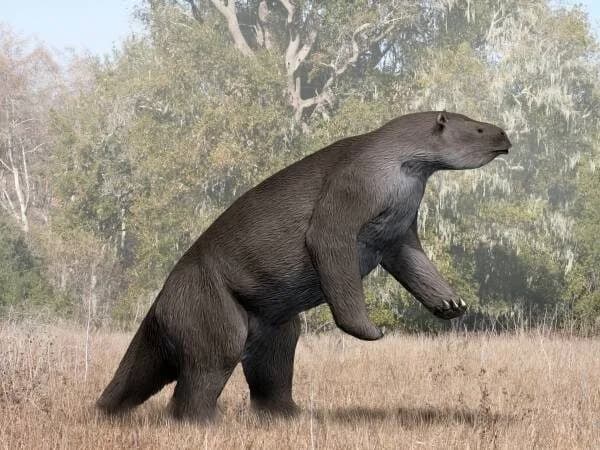
Artistic reconstruction of Megatherium americanum, the largest ground sloth
Nobu Tamura, CC BY-SA 4.0