Mastodonte américain
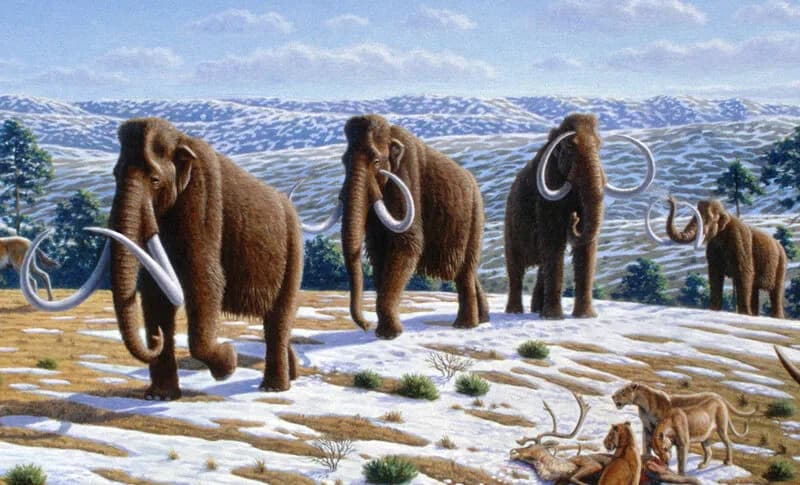
Mammut americanum, the American mastodon, was a herbivorous proboscidean of North America, present from 3.7 million years ago until 11,000 years before the present. Around 4.5 metres tall and 4 to 6 tonnes, it was not a mammoth: the two lineages split 25 million years ago. Its name means breast-shaped tooth, after its nipple-like molars.
The American mastodon (Mammut americanum) lived from the late Miocene to the late Pleistocene, spanning a period from approximately 3.7 million to 11,000 years ago. This primitive proboscidean appeared in North America long before mammoths arrived on the continent and was one of the pillars of North American megafauna for millions of years. Contrary to a very common misconception, the mastodon is NOT a mammoth: it belongs to the family Mammutidae, a lineage completely distinct from the Elephantidae that includes mammoths and modern elephants. The two families diverged approximately 25 million years ago, meaning the mastodon is as distantly related to the mammoth as a cat is to a dog. The mastodon went extinct around 11,000 years ago, at the end of the last ice age, victim of the combined effects of rapid climate warming and hunting pressure from Paleo-Indians of the Clovis culture, whose characteristic spear points have been found associated with mastodon bones at several archaeological sites.
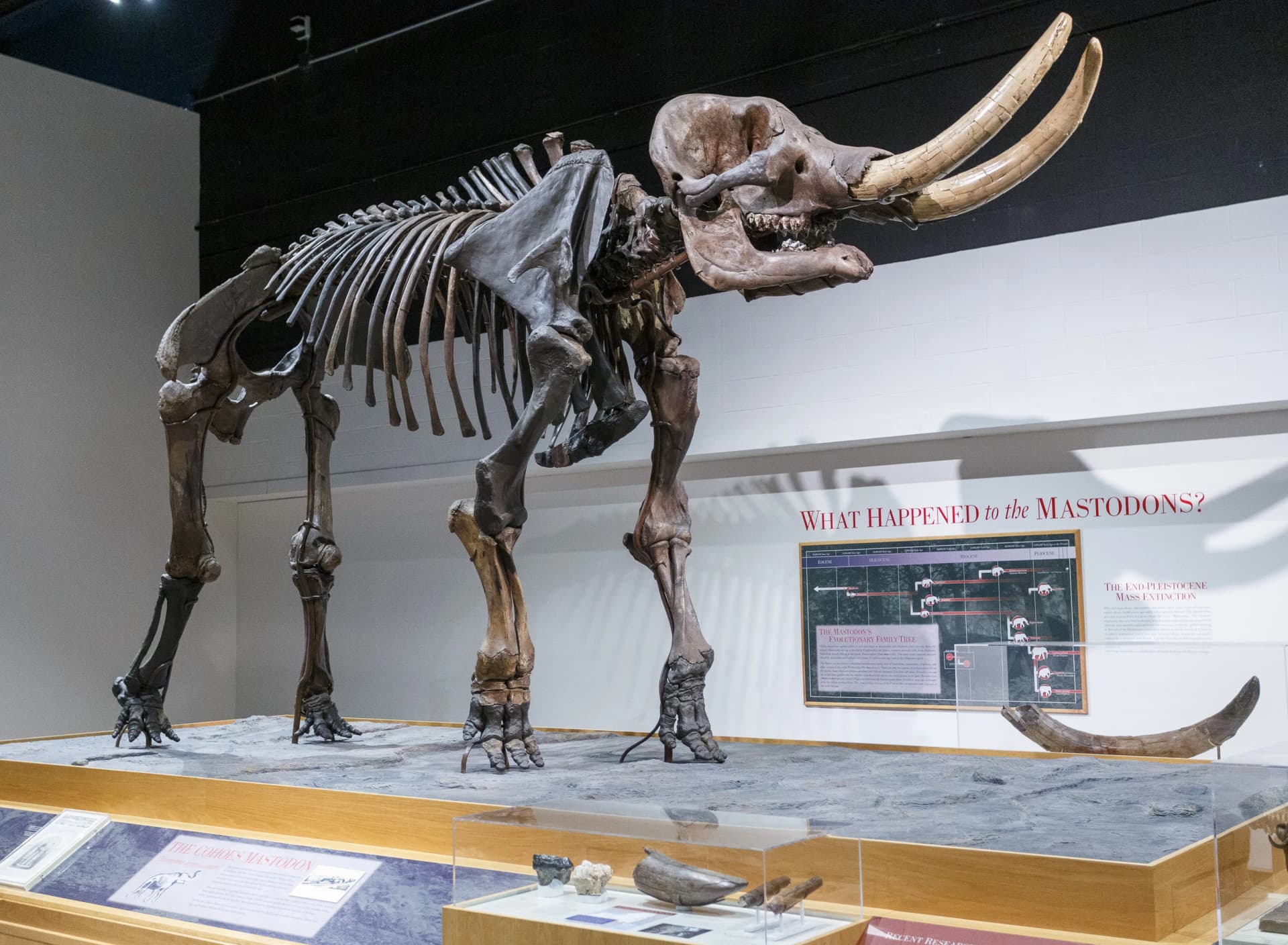
The American mastodon was a massive animal, though slightly smaller than its contemporary the woolly mammoth. Adult males reached a shoulder height of 2.5 to 3 meters, with an estimated weight between 4,000 and 6,000 kilograms, with exceptional individuals potentially approaching 8 tonnes. Total body length from head to tail was approximately 4.5 meters. Females were noticeably smaller, rarely exceeding 2.3 meters at the shoulder and weighing around 3,500 kg. Its tusks, less curved than those of the mammoth, were nonetheless impressive: in males, they could reach 2.5 meters in length and weighed up to 35 kilograms each. Some specimens also possessed small vestigial tusks on the lower jaw, a primitive trait inherited from older ancestors. Its build was stockier and lower-slung than that of mammoths, with proportionally shorter legs and a barrel-shaped body.
The American mastodon was a browsing herbivore, meaning it fed primarily on leaves, branches, bark, and fruits from trees and shrubs, unlike mammoths which were grazing herbivores specialized in consuming grasses. This fundamental dietary distinction is reflected in the morphology of its molars, which had conical nipple-shaped cusps — hence its scientific name Mammut, derived from the term 'mastodon' itself from the Greek mastos (breast) and odous (tooth), directly referencing the characteristic shape of these dental tubercles. Analysis of intestinal contents from specimens preserved in peat bogs and marshes, notably the famous Burning Tree mastodon discovered in Ohio in 1989, revealed a diet composed of spruce, pine, larch, mosses, and aquatic plants. Isotopic studies of dental enamel confirm a mixed forest diet that varied seasonally.
The American mastodon primarily occupied forests and woodlands of North America, from the boreal conifer forests of Canada to the mixed and swampy forests of the southeastern United States. Its preferred habitat included wetlands, lake margins, swamps, and the spruce forests that bordered glaciers during ice ages. This preference for forested environments clearly distinguished it from the woolly mammoth, which occupied open steppes and grasslands. The two species coexisted in North America for tens of thousands of years but occupied different ecological niches, thus limiting direct competition. The mastodon was particularly abundant in the Great Lakes region, New York State, Ohio, Michigan, and Indiana, where moisture conditions and forest cover were optimal. Fossils have also been found from Honduras to northern Alaska, demonstrating a considerable range covering nearly the entire North American continent.
The anatomy of the American mastodon differed significantly from that of mammoths and modern elephants, reflecting millions of years of separate evolution. Its most distinctive feature was its molars: unlike the compressed enamel plates of mammoths, the mastodon's molars had rows of conical nipple-shaped cusps, perfectly adapted for crushing woody plant material such as branches and bark. Its skull was more elongated and lower than that of the mammoth, lacking the latter's characteristic cranial dome. The mastodon was covered in a thick coat of coarse reddish-brown hair, as evidenced by fragments of skin and fur found on partially mummified specimens in peat bogs. Its trunk, although slightly shorter than the mammoth's, was equally functional and prehensile, used for stripping branches and bringing food to its mouth. Its skeleton reveals a massive bone structure with thick ribs and reinforced vertebrae, indicating powerful musculature adapted to life in dense forest environments.
The American mastodon likely lived in small matriarchal family groups, similar to modern elephants, with a dominant female guiding the herd composed of related females and their young. Adult males led a more solitary existence, joining female groups only during the breeding season. Analysis of tusks, which record annual growth like tree rings, reveals recurring stress periods in males, probably corresponding to the musth season — a state of hormonal overproduction and heightened aggression observed in modern male elephants. Fights between males must have been frequent, as evidenced by numerous broken tusks and healed injury marks found on fossil specimens. The mastodon probably undertook seasonal movements between lowland forests in winter and higher elevations in summer, following vegetation availability. Its estimated lifespan was 60 to 80 years, comparable to that of modern elephants.
The American mastodon holds the distinction of being the first vertebrate fossil scientifically documented in America. In 1705, a massive tooth was discovered at Claverack, New York State, by a Dutch farmer and sent to the colonial governor. This tooth, initially attributed to a biblical giant, marked the beginning of American paleontology. The name 'mastodon' was coined in 1817 by French naturalist Georges Cuvier, from the Greek mastos (breast) and odous (tooth), referring to the nipple-shaped cusps of the teeth. One of the most famous episodes in the history of paleontology was the excavation led by painter and naturalist Charles Willson Peale in 1801 at a peat bog in Ulster County, New York, immortalized in his celebrated painting 'The Exhumation of the Mastodon' (1806). This skeleton was the first prehistoric animal mounted and displayed to the public at Peale's Museum in Philadelphia. Thomas Jefferson, passionate about paleontology, studied mastodon bones and hoped the species still lived in the unexplored territories of the American West.
| Period | Miocène au Pléistocène / Miocene to Pleistocene |
| Era | Cénozoïque / Cenozoic |
| Age | 3.7 Ma – 11 000 ans / 3.7 Ma – 11,000 years |
| Location | Amérique du Nord / North America |
| Length | ~4.5 m |
| Height | 2.5–3 m (épaule / at shoulder) |
| Weight | 4 000–6 000 kg |
| Diet | Herbivore |
| Discovery | 1705 |
Mammut americanum (American mastodon) and mammoths belong to two separate families that diverged roughly 25 million years ago. The most visible difference is dental: mastodon molars bear conical nipple-shaped cusps (hence the Greek name mastos = breast), adapted for browsing leaves and branches. Mammoth molars form enamel ridged plates, adapted for grinding grass. The two families are no more related than a cat and a dog.
Mammut americanum went extinct around 11,000 BCE during the great Pleistocene megafaunal extinction. Two main factors are proposed: the rapid warming at the end of the last ice age, which transformed boreal forests into less suitable landscapes, and hunting pressure from Paleo-Indians of the Clovis culture, whose characteristic spear points have been found associated with mastodon bones at several North American archaeological sites.
Mammut americanum was a forest browser feeding on leaves, branches, bark, and aquatic plants. Analysis of the stomach contents of the Burning Tree mastodon (Ohio, 1989) revealed spruce, pine, larch, and mosses. Isotopic studies of dental enamel confirm this mixed forest diet, in contrast to mammoths which grazed open steppes and grasslands.
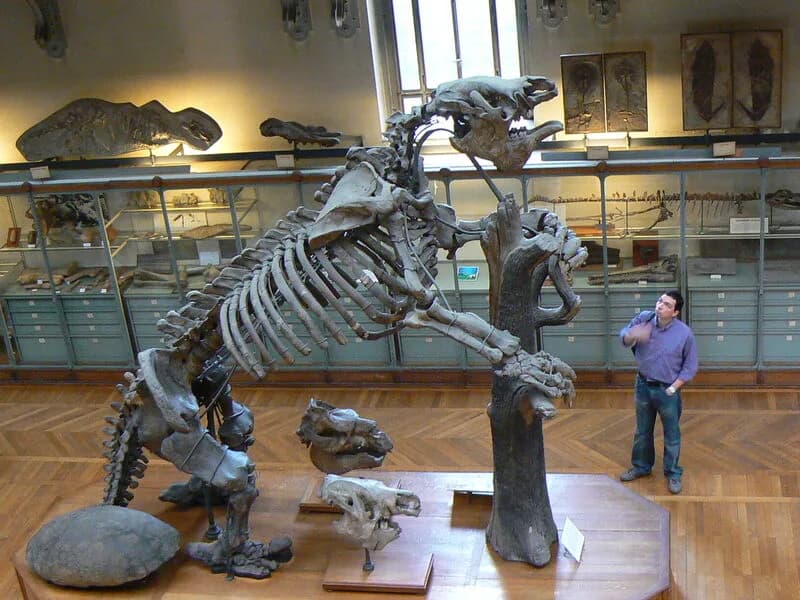
American mastodon skeleton (Mammut americanum) at the New York State Museum
New York State Museum, Public domain, via Wikimedia Commons
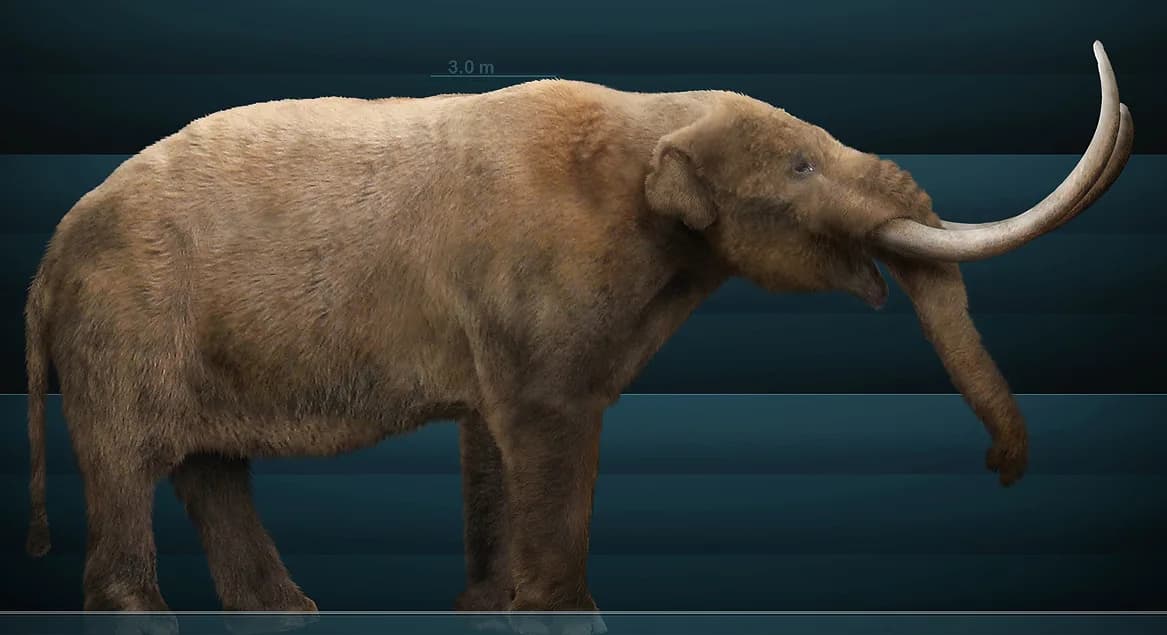
Life reconstruction of Mammut americanum
Sergiodlarosa, CC BY-SA 3.0, via Wikimedia Commons