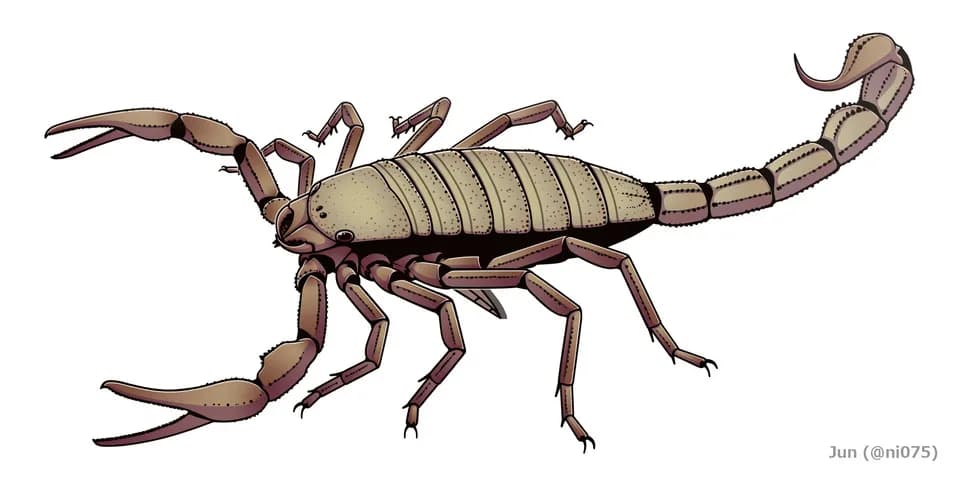
Pulmonoscorpius
Pulmonoscorpius kirktonensis was a giant scorpion from Scotland, described in 1994 from fossils at East Kirkton and dated to 336 to 326 million years ago. Over 70 centimetres long and around 2 kilograms, it reached the size of a cat. That stature was only possible with the 35% oxygen of the Carboniferous atmosphere.
Pulmonoscorpius lived during the Early Carboniferous (Visean), approximately 336 to 326 million years ago, in the tropical swamp forests that covered what is now Scotland. The Carboniferous was the golden age of giant arthropods: the atmosphere contained about 35% oxygen (compared to 21% today), allowing terrestrial invertebrates to reach gigantic sizes. Pulmonoscorpius is one of the largest scorpions that ever existed, discovered in the exceptional East Kirkton deposit in West Lothian, Scotland. This site, a former hot volcanic lake, preserved terrestrial fauna and flora of the Early Carboniferous in remarkable detail. Pulmonoscorpius reigned as one of the super-predators of these primitive terrestrial ecosystems, 100 million years before the first dinosaurs appeared.
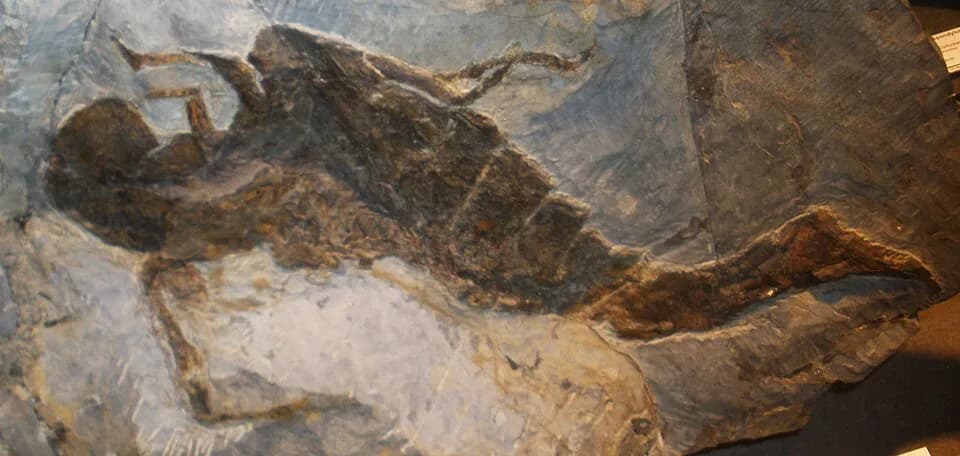
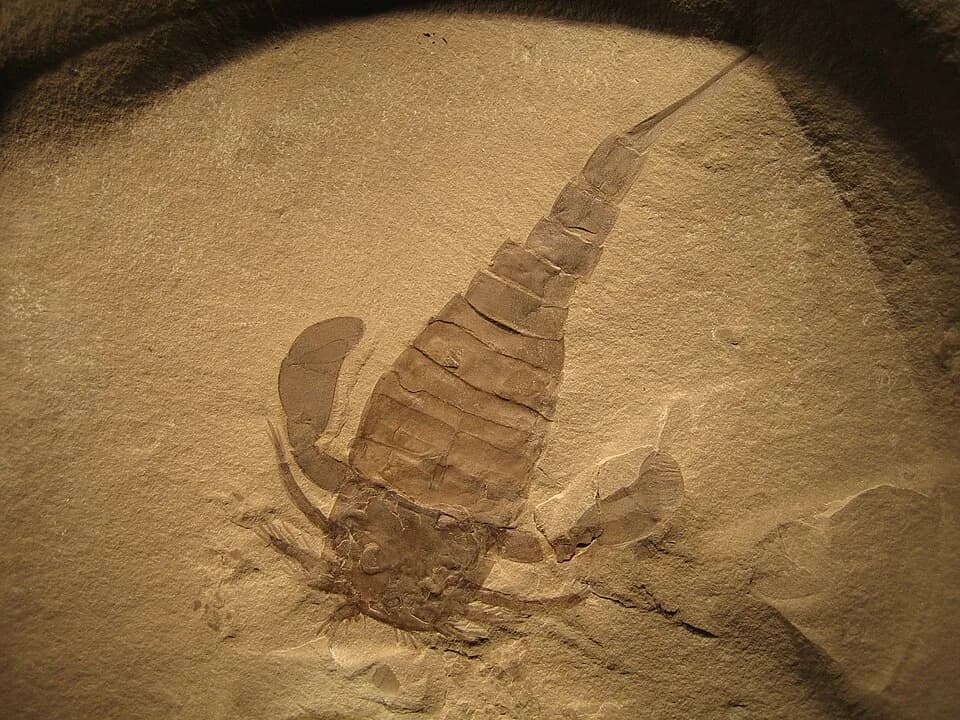
Pulmonoscorpius is one of the largest scorpions in Earth's history, with an estimated length exceeding 70 centimeters — about the size of a domestic cat. The best-preserved specimens, discovered at East Kirkton in Scotland, show a massive animal with robust pedipalps (pincers) and a segmented metasoma (tail) ending in a well-developed telson (stinger). Its body was covered in a thick chitinous exoskeleton that protected it and supported its considerable mass for a terrestrial arthropod. For comparison, the largest living scorpion, Heterometrus swammerdami, barely exceeds 23 centimeters — Pulmonoscorpius was thus three times larger than any scorpion alive today.
Pulmonoscorpius was a formidable terrestrial predator, probably the apex super-predator of its Carboniferous forest ecosystem. Its powerful pincers (pedipalps) served to capture and immobilize prey, while its venomous stinger (telson) could inject venom to paralyze them. Its diet likely included primitive amphibians, small tetrapods, other smaller arthropods (myriapods, arachnids, primitive insects), and possibly small primitive reptiles. Like modern scorpions, Pulmonoscorpius probably hunted at night, using its ventral combs (chemosensory organs) to detect vibrations and chemical traces of prey on the forest floor.
Pulmonoscorpius lived in the tropical swamp forests of the Early Carboniferous, in a warm, humid environment situated near the equator. The East Kirkton site in Scotland represents a former volcanic lake (maar) surrounded by dense forests of giant lycophytes (Lepidodendron), tree ferns, and giant horsetails (Calamites). The oxygen-rich atmosphere (about 35%) allowed terrestrial arthropods to reach gigantic sizes. Pulmonoscorpius shared its habitat with a diverse community including the first terrestrial tetrapods (like Westlothiana, one of the oldest known reptiliomorphs), giant myriapods, and various species of primitive amphibians.
Pulmonoscorpius' anatomy was fundamentally similar to modern scorpions, but at a considerably enlarged scale. Its prosoma (cephalothorax) bore a pair of chelicerae (mouthparts), a pair of massive pedipalps ending in robust pincers, and four pairs of walking legs. Its opisthosoma (abdomen) was divided into mesosoma (7 wide segments) and metasoma (5 narrow segments forming the 'tail'), ending in the telson containing venom glands and the stinger. Its book lungs, layered respiratory organs typical of arachnids, were probably particularly well-developed to exploit the hyperoxic Carboniferous atmosphere. The name Pulmonoscorpius actually means 'lung scorpion'.
Pulmonoscorpius was likely a nocturnal, solitary predator, like most modern scorpions. It probably hid in burrows or under plant debris during the day, emerging at night to actively hunt. Its ventral combs (pectines), sensory organs unique to scorpions, allowed it to detect ground vibrations and pheromones from potential prey in the darkness of the Carboniferous forest. Its hunting strategy probably combined ambush and active short-distance pursuit. Like modern scorpions, it was probably capable of surviving for long periods without food, and its thick carapace offered effective protection against predators.
Pulmonoscorpius kirktonensis was described in 1994 by Andrew Jeram, from exceptionally well-preserved fossils discovered at East Kirkton Quarry in West Lothian, Scotland. The genus name means 'lung scorpion' (Latin: pulmo 'lung' + Greek: skorpios 'scorpion'), referring to its well-preserved respiratory organs. The species name honors the village of Kirkton, near the discovery site. The East Kirkton deposit is remarkable because it represents one of the rare Early Carboniferous sites preserving a diverse terrestrial fauna. The exceptional fossilization conditions — a volcanic lake with hot, mineralized waters — allowed the conservation of fine anatomical details, including internal respiratory structures.
| Period | Carbonifère inférieur (Viséen) / Early Carboniferous (Visean) |
| Era | Paléozoïque / Paleozoic |
| Age | 336-326 Ma |
| Location | East Kirkton, West Lothian, Écosse / East Kirkton, West Lothian, Scotland |
| Length | 70+ cm |
| Height | 15 cm |
| Weight | ~2 kg (estimation) |
| Diet | Carnivore |
| Discovery | 1994 |
The Carboniferous atmosphere contained about 35% oxygen, compared to 21% today. Arthropods breathing through passive diffusion across their exoskeleton benefited from this O2 surplus to reach sizes without modern equivalent. Pulmonoscorpius kirktonensis exceeded 70 centimeters — three times the size of the largest living scorpion today, Heterometrus swammerdami (23 cm).
Pulmonoscorpius kirktonensis was described in 1994 by Andrew Jeram from fossils discovered at East Kirkton Quarry in West Lothian, Scotland. This site represents a former volcanic lake (maar) of the Early Carboniferous (336–326 Ma) where exceptional fossilization conditions preserved the terrestrial fauna in detail, including internal respiratory organs. The species name honors the nearby village of Kirkton.
Pulmonoscorpius kirktonensis was likely the apex predator of its Early Carboniferous forest ecosystem. Its powerful pincers (pedipalps) and venomous stinger allowed it to capture and paralyze primitive amphibians, small tetrapods, and other arthropods (myriapods, primitive insects). It shared its habitat with Westlothiana, one of the oldest known reptiliomorphs.
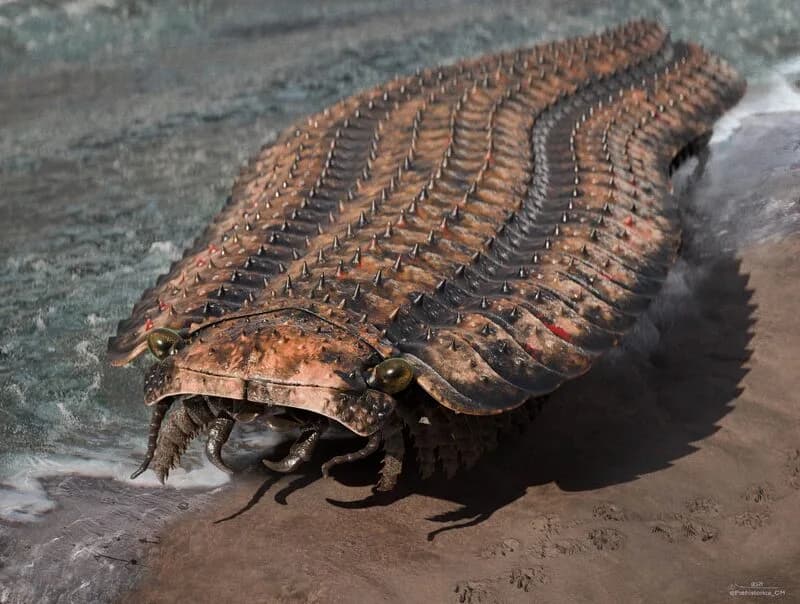
Reconstruction of Pulmonoscorpius kirktonensis, giant Carboniferous scorpion
Wikipedia Commons, CC BY-SA 4.0
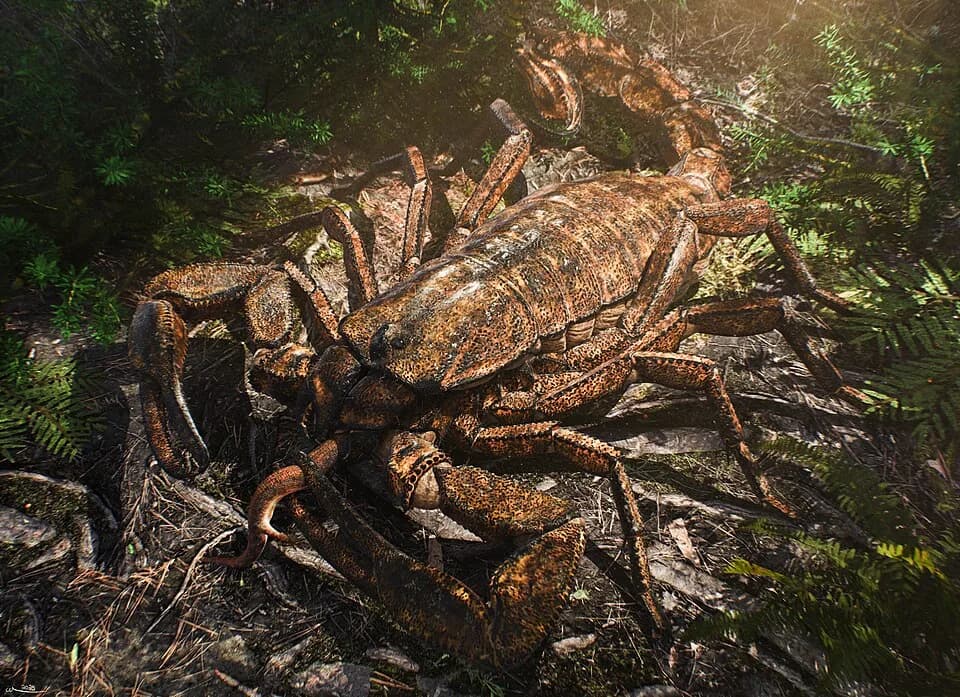
Pulmonoscorpius kirktonensis fossil, East Kirkton, Scotland
Wikipedia Commons