Jaekelopterus
Jaekelopterus rhenaniae is the largest arthropod of all time: 2.5 metres, longer than a grown adult lying down. Its size is extrapolated from a single fossil claw of 46 centimetres, unearthed in Rhineland-Palatinate and described in 2008. This sea scorpion hunted 390 million years ago in fresh or brackish water, for an estimated mass of some fifty kilograms.
Jaekelopterus lived during the Early Devonian, approximately 390 million years ago, in the freshwater lakes and rivers of what is now Germany. The Devonian is sometimes called the 'Age of Fishes,' but it was also the heyday of eurypterids — sea scorpions — of which Jaekelopterus was the largest representative ever discovered. With an estimated size of 2.5 meters, Jaekelopterus is the largest known arthropod of all time, surpassing even Arthropleura. These giant predators dominated freshwater and brackish aquatic ecosystems long before sharks and large bony fish took over. Jaekelopterus belonged to the family Pterygotidae, the most specialized eurypterids for active predation.
Jaekelopterus is the largest arthropod that ever existed, with an estimated length of about 2.5 meters — longer than an adult human. This estimate is based on a 46-centimeter chelicera (mouth pincer) fossil discovered in Germany in 2007. By extrapolating the known proportions of related eurypterids, scientists calculated a total size of about 233 to 259 centimeters. Its segmented, flattened body bore six pairs of appendages, the first pair modified into enormous prehensile chelicerae armed with teeth. Its large compound eyes, probably among the most performant of their time, allowed it to spot prey in the murky waters of Devonian lakes.
Jaekelopterus was the absolute apex super-predator of Early Devonian freshwater ecosystems. Its massive chelicerae, 46 centimeters long and armed with sharp teeth, were formidable weapons for capturing and crushing prey. Its diet probably included primitive fish (the first jawed vertebrates were beginning to diversify), smaller eurypterids, trilobites, marine worms, and any aquatic organism within reach. The size of its chelicerae suggests it could capture prey of considerable size — potentially fish 30 to 50 centimeters long. Jaekelopterus occupied the same ecological niche as modern large crocodilians.
Jaekelopterus lived in the freshwater to brackish lakes and rivers of the Early Devonian, in what is now the Rhineland in Germany. The species name 'rhenaniae' actually refers to this region. During the Devonian, this area was in the tropics, with a hot, humid climate. Continental freshwater environments hosted a diverse fauna including primitive jawed fish (gnathostomes), jawless fish (agnathans), other eurypterids, freshwater trilobites, and various invertebrates. Jaekelopterus dominated these ecosystems as an unrivaled predator, the Devonian equivalent of a giant crocodile.
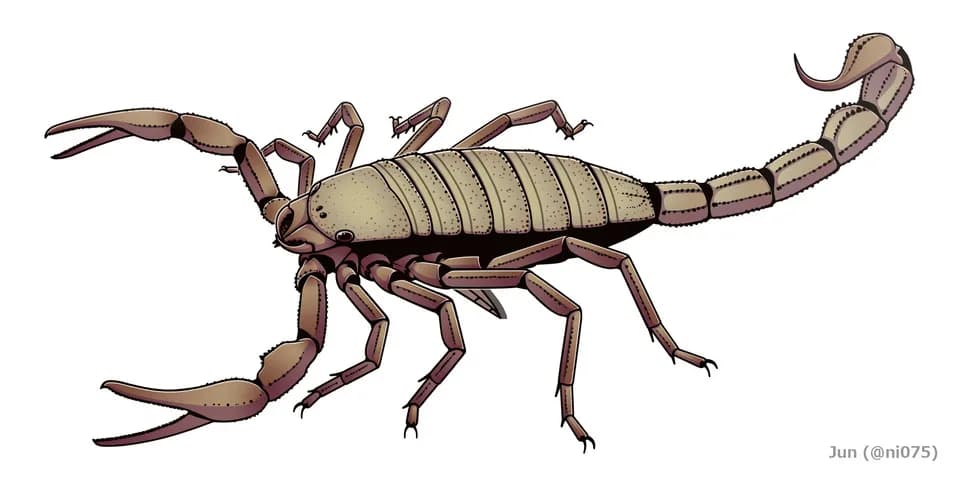
Jaekelopterus' anatomy is characteristic of pterygotids, the most specialized family of eurypterids. Its segmented body was divided into a prosoma (cephalothorax) bearing six pairs of appendages, and an opisthosoma (abdomen) of 12 segments ending in a telson (tail). Its most spectacular feature was its first pair of appendages modified into giant chelicerae — prehensile pincers armed with pointed teeth, 46 cm long in the German specimen. Its compound eyes were large and well-developed, suggesting binocular vision for active hunting. The last pair of legs was broadened into swimming paddles for propulsion in water. Its cuticle (exoskeleton) was reinforced to support its enormous mass.
Jaekelopterus was an active predator of Devonian freshwaters, probably combining ambush hunting and active pursuit. Its posterior swimming paddles allowed rapid acceleration in water, while its giant chelicerae served to capture and immobilize prey. Its vision, based on large compound eyes probably capable of binocular vision, was adapted for detecting moving prey. Like modern eurypterid relatives (horseshoe crabs, their closest living relatives), Jaekelopterus probably molted regularly to grow, abandoning its outgrown exoskeleton. These fossil molts are actually the most frequently found specimens, as each individual produced many exuviae during its lifetime.
Jaekelopterus rhenaniae was described in 2008 by Markus Poschmann, Simon Braddy, and Olivier Tetlie, in a groundbreaking article published in Biology Letters. The holotype is an isolated 46-centimeter chelicera discovered in a quarry in the Willwerath Formation (Early Devonian, Emsian) in Rhineland-Palatinate, Germany. The genus name honors German paleontologist Otto Jaekel (1863-1929), a pioneer in eurypterid studies. The discovery caused a sensation as it established Jaekelopterus as the largest arthropod ever discovered, dethroning Pterygotus and Arthropleura. The publication was widely covered under the catchy headline of the '2.5-meter giant sea scorpion.' Only one complete chelicera specimen is known, but it is sufficient to establish the extraordinary size of this animal.
| Period | Dévonien inférieur (Emsien) / Early Devonian (Emsian) |
| Era | Paléozoïque / Paleozoic |
| Age | 390 Ma |
| Location | Rhénanie-Palatinat, Allemagne / Rhineland-Palatinate, Germany |
| Length | 2.5 m |
| Height | 30 cm |
| Weight | ~50 kg (estimation) |
| Diet | Carnivore |
| Discovery | 2008 |
Jaekelopterus rhenaniae was a eurypterid, often called a 'sea scorpion' by analogy, but not a true scorpion. It was more closely related to modern horseshoe crabs (Limulus) than to terrestrial scorpions. Moreover, it lived in freshwater, not the sea. At an estimated 2.5 meters, it remains the largest known arthropod of all time.
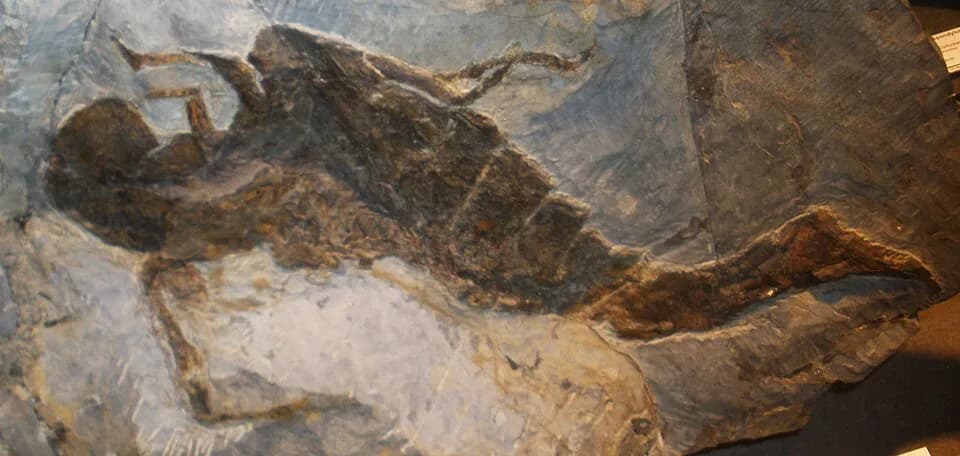
Jaekelopterus rhenaniae's size is based on a single 46-centimeter chelicera (mouth pincer) fossil discovered in 2007 in a Rhineland-Palatinate quarry, Germany. By applying known proportions of related eurypterids (Pterygotidae), scientists Poschmann, Braddy and Tetlie calculated a total length of 233 to 259 centimeters. The formal description was published in 2008 in Biology Letters.
Jaekelopterus rhenaniae lived about 390 million years ago in the Early Devonian (Emsian), in freshwater to brackish lakes and rivers of present-day Rhineland, Germany. Its species name rhenaniae refers to this region. It dominated these freshwater ecosystems as apex predator, long before sharks and large bony fish took over.
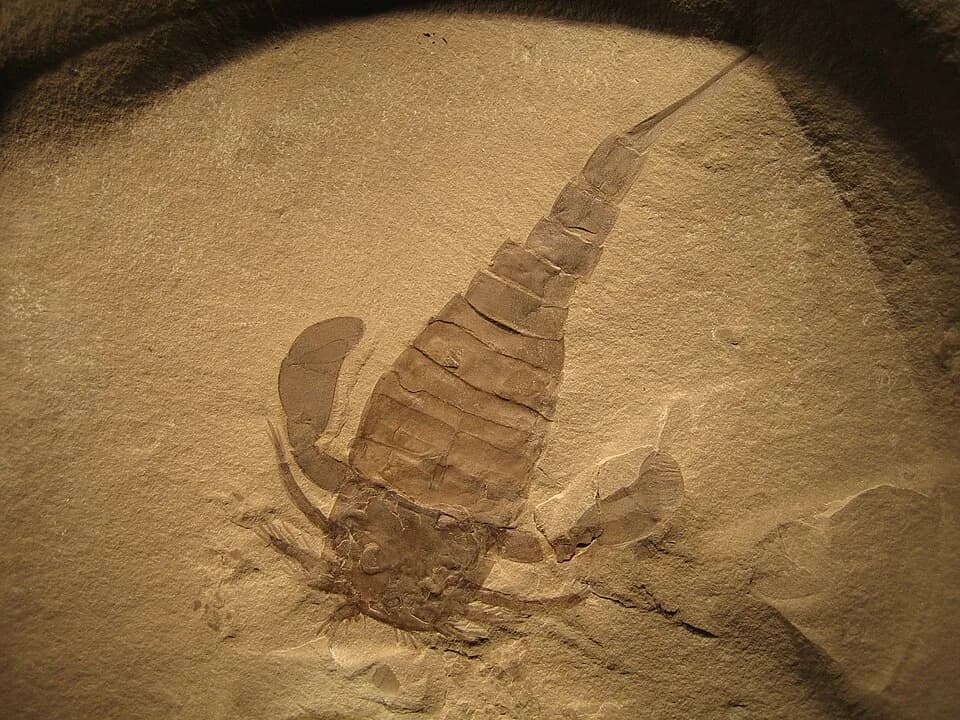
Jaekelopterus rhenaniae chelicera fossil, the 46 cm pincer
Wikipedia Commons
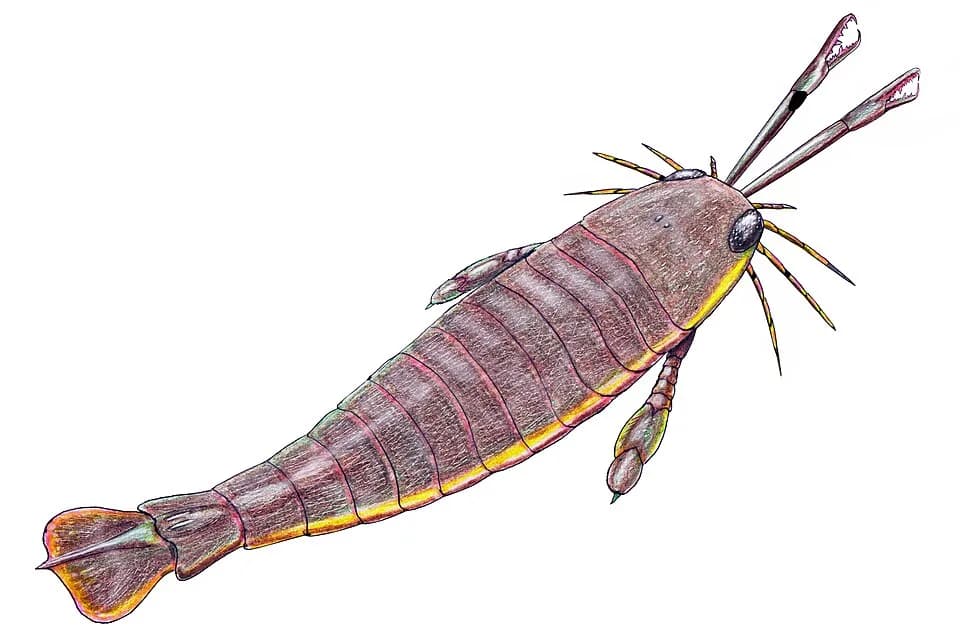
Reconstruction of Jaekelopterus rhenaniae showing its impressive size
Wikipedia Commons