Meganeura
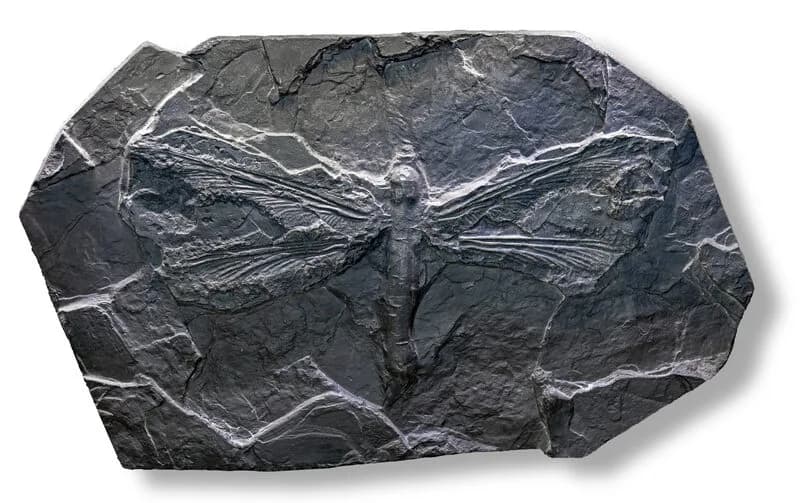
Meganeura monyi was a griffinfly — an extinct order related to dragonflies but distinct from them — that flew 305 to 299 million years ago. Described in 1885 from fossils at Commentry in France, it had a body around 30 centimetres long and a wingspan of 70 centimetres. That size was only possible with 35% oxygen in the air; today there is just 21%.
Meganeura lived during the Late Carboniferous (Stephanian), approximately 305 to 299 million years ago. At that time, Earth's atmospheric conditions were radically different from today: oxygen concentration reached 35%, compared to 21% now. This hyperoxia enabled gigantism in arthropods, whose tracheal respiratory system is directly limited by passive oxygen diffusion. Meganeura is a griffinfly (order Meganisoptera), an extinct group of flying insects related to modern dragonflies (Odonata) but forming a distinct order. It evolved in the immense forests of tree ferns and giant lycophytes (Lepidodendron, Sigillaria) that formed the coal deposits of the Carboniferous — the period that gave carbon its name.
Meganeura monyi had a wingspan of 65 to 70 centimeters — comparable to a modern crow — making it one of the largest flying insects that ever existed. Only Meganeuropsis permiana, a close relative from the Early Permian, slightly exceeded it at 71 cm wingspan. Its elongated body measured approximately 30 centimeters in length. Its mass is estimated at about 150 grams, a remarkable weight for a flying insect. Its four membranous wings were long, narrow, and rigid, optimized for fast and maneuverable flight. The wing venation, extremely dense and complex, provided exceptional structural resistance despite the thinness of the membranes.
A formidable aerial predator, Meganeura hunted other insects, small amphibians, and possibly young primitive reptiles while in flight. Like modern dragonflies, it possessed exceptional vision thanks to large compound eyes and captured prey in flight using its spiny forelegs forming a catching basket. Its large size gave it a decisive advantage over other flying insects of its era, placing it firmly at the top of the aerial food chain. The robust denticulated mandibles allowed dismembering and chewing prey of considerable size. Biomechanical studies suggest flight speeds reaching 50 to 70 km/h, making it an extraordinarily efficient aerial hunter in the Carboniferous forests. No other airborne predator of the period could rival its combination of speed, size, and sensory acuity.
Meganeura inhabited the tropical swamp forests of the Late Carboniferous in Laurussia (present-day Europe). The immense forests of giant lycophytes (Lepidodendron reaching up to 40 meters) and tree ferns created a warm, humid, oxygen-rich environment — ideal for giant arthropods. The vast swamps, lakes, and waterways of these forests likely served as breeding sites, with aquatic larvae developing in warm, stagnant waters, similar to modern dragonfly nymphs. The dense canopy and forest clearings provided ideal hunting corridors for aerial predation. The main fossil site is located in the coal basins of Commentry (Allier, France), where fossilization conditions in bituminous shale were exceptional. Additional specimens from England confirm its presence across the equatorial belt of Late Carboniferous Euramerica.
Meganeura's anatomy presents intermediate characteristics between primitive insects and modern dragonflies. Its four membranous wings could not fold at rest — they remained spread laterally, like modern dragonflies. The wing venation, more archaic than that of modern Odonata, featured a dense network of cross-veins. Its large compound eyes covered most of the head, providing a nearly panoramic visual field essential for aerial hunting. The massive thorax housed the powerful flight muscles needed to propel a 150-gram body in sustained flight. Its tracheal respiratory system — a network of branching tubes conducting oxygen directly to tissues — was the limiting factor on its size, made viable only by Carboniferous hyperoxia.
Meganeura was most likely a territorial diurnal aerial predator, patrolling clearings and swamp edges in the Carboniferous forests. Like modern dragonflies, it hunted on the wing, using exceptional vision to spot and intercept prey in midair. Males likely defended breeding territories along waterways, where females laid eggs in aquatic vegetation or on the water surface. The life cycle almost certainly included an extended aquatic larval stage (nymph), followed by incomplete metamorphosis to the winged adult stage. The aquatic larvae, already predatory, must themselves have reached impressive sizes. The coexistence with other giant arthropods (Arthropleura, 70 cm scorpions) formed an ecosystem where invertebrates occupied megafauna ecological niches.
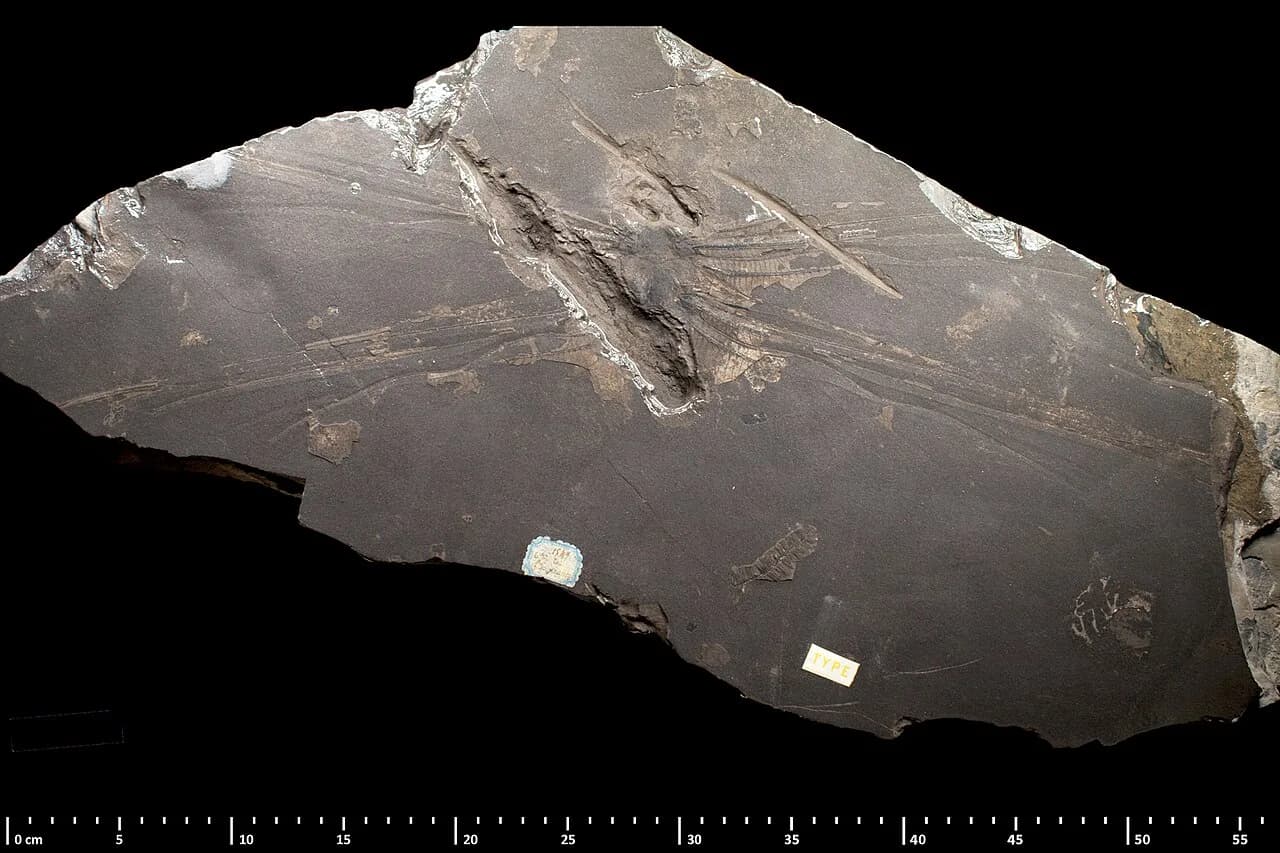
Meganeura monyi was first described by French paleontologist Charles Brongniart in 1885, from a remarkably complete specimen discovered in the coal shales of Commentry in the Allier department of France. This type specimen, preserved at the Museum national d'Histoire naturelle in Paris, is one of the most famous insect fossils in the world. Exceptional preservation in bituminous shale allowed conservation of fine details of wing venation and body morphology. Additional specimens have been discovered in England (Derby coal basin). The genus Meganeura comprises two valid species: M. monyi (France) and M. brongniarti (England). The study of Meganeura played a key role in understanding the link between atmospheric oxygen and arthropod gigantism.
| Period | Carbonifère supérieur / Late Carboniferous |
| Era | Paléozoïque / Paleozoic |
| Age | 305-299 Ma |
| Location | France (Commentry), Angleterre / France (Commentry), England |
| Length | ~30 cm (corps / body) |
| Height | N/A |
| Weight | ~150 g |
| Diet | Insectivore |
| Discovery | 1885 |
No. Meganeura monyi belonged to the order Meganisoptera (griffinfly), an extinct group of flying insects distinct from modern dragonflies (Odonata). Although related and morphologically similar, these two orders constitute separate lineages. Meganeura lived during the Late Carboniferous (305–299 Ma) in the swamp forests of present-day France (Commentry, Allier) and England, when the atmosphere contained approximately 35% oxygen.
Meganeura monyi had a wingspan of 65 to 70 centimeters — comparable to a crow — with a body about 30 centimeters long and a mass of ~150 grams. This record size was made possible by Carboniferous atmospheric oxygen levels (~35% versus today's 21%). The insect tracheal respiratory system relies on passive oxygen diffusion; hyperoxia allowed sustaining a far larger body volume.
Meganeura monyi was described in 1885 by French paleontologist Charles Brongniart from an exceptional specimen found in the coal shales of Commentry (Allier, France). This type fossil is preserved at the Muséum national d'Histoire naturelle in Paris. Additional specimens were found in the Derby coal basin (England), confirming a second species, M. brongniarti.
Meganeura monyi fossil at the Museum national d'Histoire naturelle in Paris
Wikipedia Commons
Artistic reconstruction of Meganeura in flight in a Carboniferous forest
Nobu Tamura, CC BY-SA 3.0