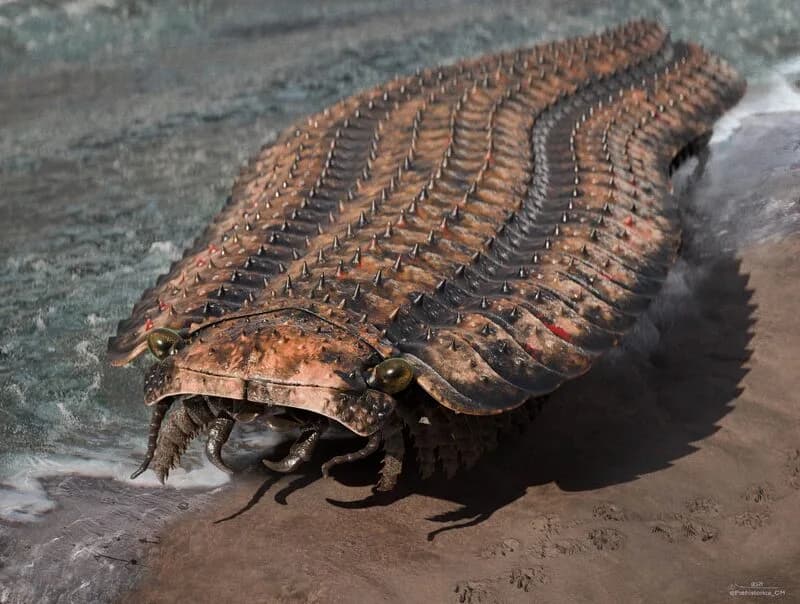
Arthropleura
Arthropleura armata is the largest land invertebrate ever recorded: a millipede 2 to 2.6 metres long weighing about 50 kilograms, longer than a Smart car. It crossed the fern forests of Europe and North America between 345 and 290 million years ago, in air far richer in oxygen than today's. Described in 1854, this detritivore with roughly 60 legs fed on rotting leaves and spores.
Arthropleura lived from the Late Carboniferous to the Early Permian, approximately 345 to 290 million years ago (Visean-Sakmarian). This period spans nearly 55 million years, a remarkable taxonomic longevity. The animal evolved during the golden age of giant arthropods, when atmospheric oxygen concentrations peaked between 30 and 35%, conditions that allowed terrestrial invertebrates to reach sizes unmatched before or since. Arthropleura is the largest terrestrial invertebrate that ever existed — an absolute record in the history of life on Earth. It disappeared in the Early Permian when climatic aridification and the gradual decline of oxygen reduced the tropical swamp forests that constituted its habitat.
Arthropleura armata could reach 2 to 2.6 meters in length and weigh approximately 50 kilograms, making it the largest terrestrial arthropod — and the largest terrestrial invertebrate — of all time. Its segmented body had approximately 30 segments, each protected by lateral dorsal plates (tergites) and a central plate. Its body width reached 45 to 50 centimeters. For comparison, the largest living myriapod — the Amazonian giant centipede (Scolopendra gigantea) — barely exceeds 30 centimeters. Arthropleura was therefore nearly ten times longer. Fossil trackways (ichnofossils) discovered in Scotland in 2021 indicate a specimen of 2.63 meters, the largest measured to date.
Unlike modern predatory centipedes (Chilopoda), Arthropleura was most likely a herbivore or detritivore. Analysis of fossilized gut contents (associated coprolites) reveals fragments of lycophyte spores, fern leaves, and decaying plant debris. Its mouthparts, less specialized than those of predators, were adapted for grinding plant matter rather than capturing live prey. This herbivorous/detritivorous diet is logical in the context of Carboniferous forests, where decaying plant biomass was extraordinarily abundant across the marshy forest floors. Some researchers suggest a mixed diet occasionally including small invertebrates, but direct evidence overwhelmingly supports the herbivore-detritivore hypothesis. Its ecological role was comparable to that of large modern terrestrial herbivores, recycling enormous quantities of dead plant material and contributing to nutrient cycling in the Carboniferous ecosystem.
Arthropleura inhabited the tropical to equatorial swamp forests of the Carboniferous and Early Permian in Laurussia (present-day Europe and North America). These dense forests of giant lycophytes (Lepidodendron, Sigillaria), calamites (tree horsetails), and tree ferns formed a warm, humid habitat with a thick litter of plant debris — an ideal food source for a giant detritivore. The forest floor was probably covered with a layer of decomposing organic matter several centimeters thick, creating a virtually unlimited buffet for this massive invertebrate. Fossils have been discovered in Germany, Scotland, England, France, and North America, testifying to a remarkably broad geographic distribution across the equatorial forests of Pangaea. Its wide range suggests it was a highly successful organism well adapted to the dominant terrestrial ecosystem of its era.
Arthropleura belonged to the Arthropleurida, an extinct order of myriapods (millipedes in the broad sense), but its exact phylogenetic position remains debated: some authors place it closer to Diplopoda (millipedes), others closer to Chilopoda (centipedes). Its body was composed of approximately 30 articulated segments, each bearing two pairs of legs — roughly 60 legs in total. Each segment was dorsally protected by three plates (one central and two lateral), forming a rigid but flexible articulated armor. The chitinous plates were mineralized, offering protection against predators. Its tracheal respiratory system, like all terrestrial arthropods, was the size-limiting factor — made viable only by Carboniferous hyperoxia at 30-35% O2.
Arthropleura was a slow terrestrial animal, roaming the forest floor of Carboniferous woodlands in search of decaying vegetation and plant matter. Fossil trackways (Diplichnites-type ichnofossils) show regular rectilinear locomotion, suggesting a methodically walking animal rather than one fleeing predators. Its imposing size likely gave it few natural predators — only the largest amphibians and primitive reptiles could have attacked it. The segmented armor of mineralized chitinous plates offered additional protection. Like modern millipedes, it could probably curl into a spiral to protect its vulnerable ventral parts. Its periodic molting must have been a spectacular event, with the abandoned exuvia resembling a hollow tree trunk over 2 meters long.
Arthropleura was first described by Hermann Jordan and Hermann von Meyer in 1854, from fossil fragments discovered in Carboniferous coal deposits in Germany. Since then, specimens have been found in Scotland, England, France, and North America. The most spectacular recent discovery is an ichnofossil (locomotion trace) found in 2018 on a beach at Howick, Northumberland (England), described by Davies et al. in 2022 in the Journal of the Geological Society. This trackway, 2.63 meters long, is the largest ever attributed to an invertebrate. Body fossils are rare because the chitinous exoskeleton decomposes rapidly; most specimens are isolated tergite fragments. The Senckenberg Naturmuseum in Frankfurt and the National Museum of Scotland house the best specimens.
| Period | Carbonifère supérieur - Permien inférieur / Late Carboniferous - Early Permian |
| Era | Paléozoïque / Paleozoic |
| Age | 345-290 Ma |
| Location | Europe, Amérique du Nord / Europe, North America |
| Length | 2-2.6 m |
| Height | ~30 cm |
| Weight | ~50 kg |
| Diet | Détritivore |
| Discovery | 1854 |
Arthropleura armata reached 2 to 2.6 meters in length and approximately 50 kilograms, making it the largest terrestrial invertebrate of all time. Ichnofossils discovered in 2018 at Howick (England) and described by Davies et al. in 2022 indicate a specimen of 2.63 meters. Its gigantic size was made possible by atmospheric oxygen concentrations of 30 to 35% during the Carboniferous, which allowed terrestrial arthropods to reach unmatched sizes.
No — unlike modern predatory chilopods (centipedes), Arthropleura armata was most likely a herbivore or detritivore. Analysis of associated coprolites reveals lycophyte spore fragments, fern leaves, and plant debris. Its mouthparts adapted for grinding plant material and its ecological role comparable to large modern terrestrial herbivores definitively distance it from the status of a dangerous predator.
Arthropleura armata lived from the Late Carboniferous to the Early Permian, approximately 345 to 290 million years ago, in tropical swamp forests of Laurussia (present-day Europe and North America). First described in 1854 by Jordan and von Meyer from German coal deposits, specimens have also been found in Scotland, England, France, and North America. The Senckenberg Naturmuseum in Frankfurt and the National Museum of Scotland hold the finest specimens.
Arthropleura reconstruction at the Senckenberg Naturmuseum in Frankfurt
Wikipedia Commons
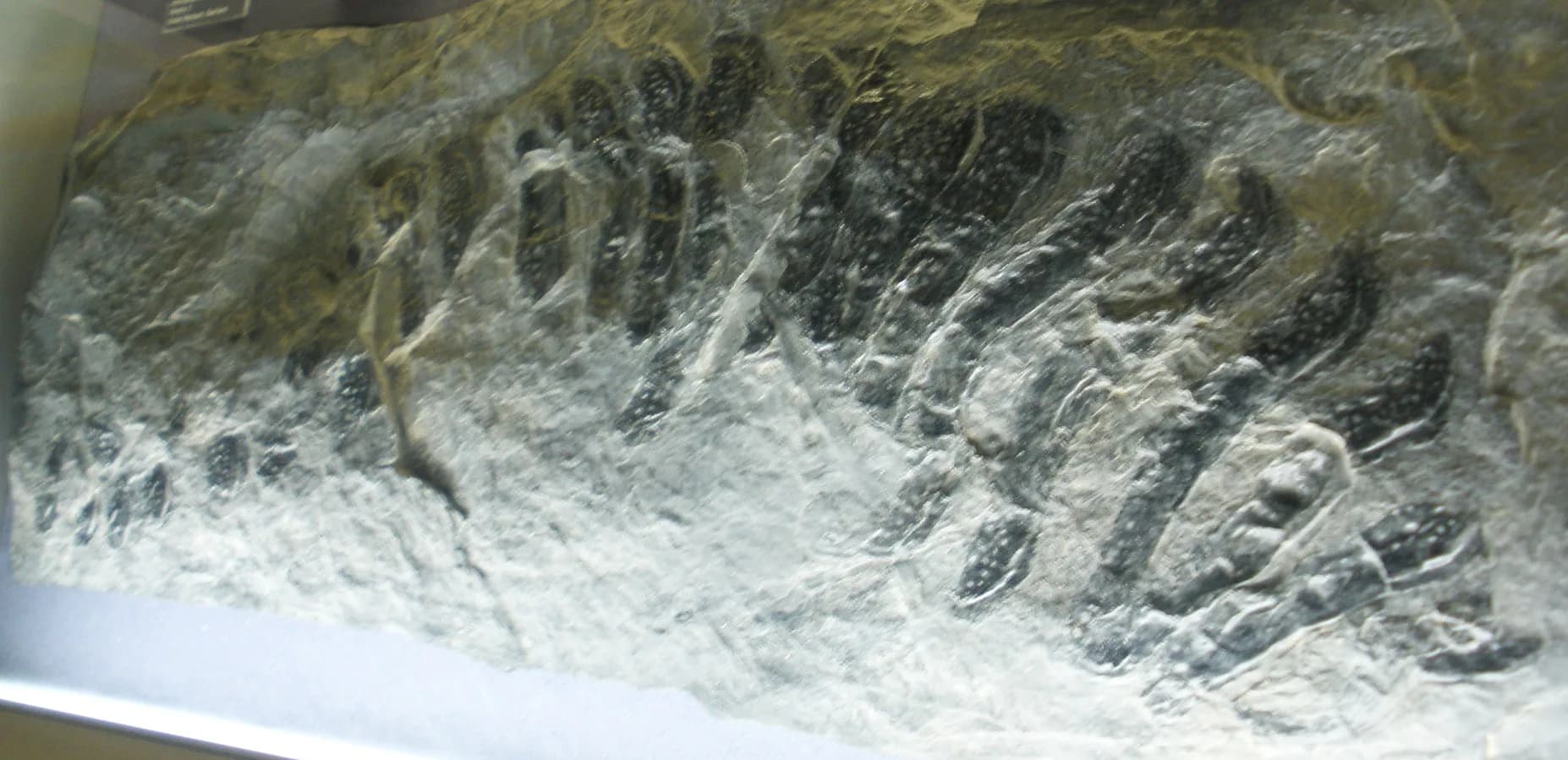
Arthropleura ichnofossil (fossil trackway) discovered at Howick, England
Davies et al. 2022, Journal of the Geological Society