Euryptérus
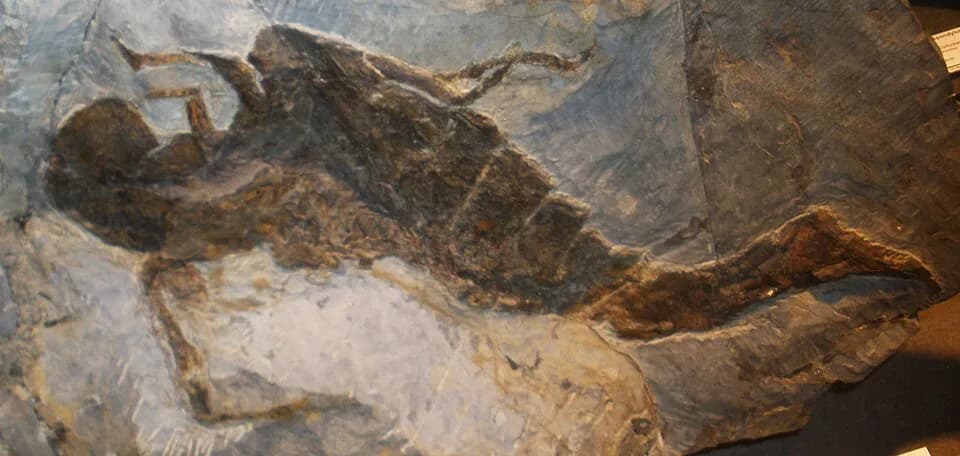
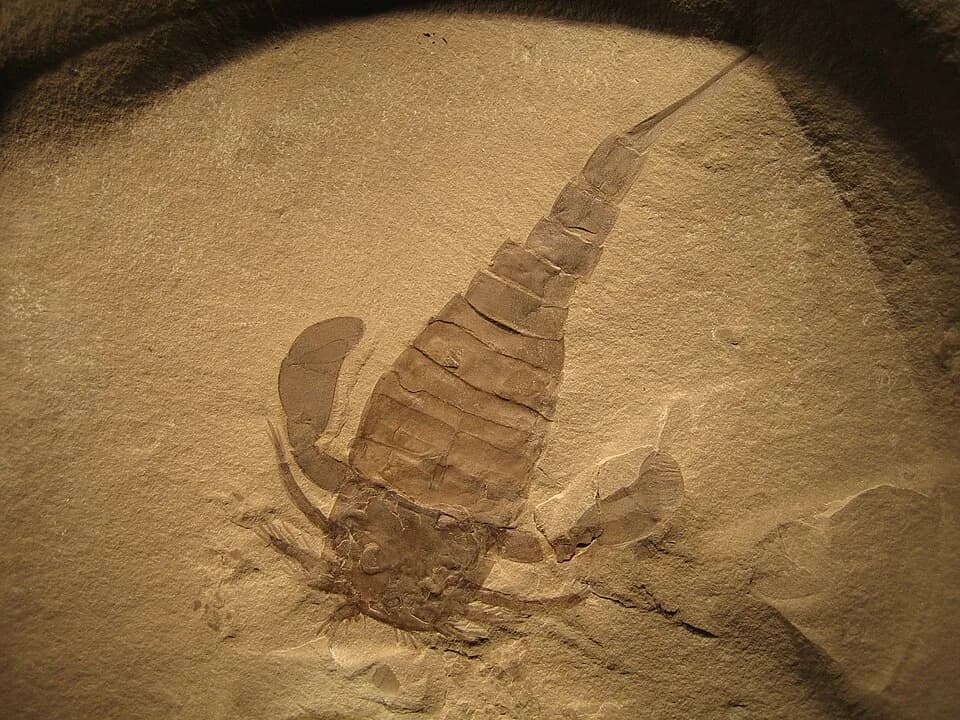
Eurypterus remipes, a « sea scorpion » 13 to 50 centimetres long, has been the official fossil of New York State since 1984. Described in 1825 from the Bertie Formation, it lived 432 to 418 million years ago. More than 90 % of all eurypterids ever collected belong to this genus, and most specimens are not corpses but shed moults.
Eurypterus lived during the Late Silurian, approximately 432 to 418 million years ago, in the shallow seas and brackish lagoons that covered parts of what is now eastern North America. The Silurian was a recovery period after the end-Ordovician mass extinction, and eurypterids — sea scorpions — were experiencing their peak diversification. Eurypterus is the most abundant and best-known eurypterid genus, with thousands of specimens collected, primarily from the Silurian dolostones and limestones of New York State. It has been the official state fossil of New York since 1984. Eurypterus is considered one of the most common chelicerates of the Paleozoic.
Eurypterus was a moderately-sized eurypterid, averaging 13 to 23 centimeters in length, although some exceptional specimens may have reached 50 centimeters. Its dorso-ventrally flattened body was divided into a prosoma (cephalothorax) bearing six pairs of appendages, and an opisthosoma (abdomen) of 12 segments ending in a pointed telson. The sixth pair of appendages was broadened into characteristic swimming paddles that earned it its name (Eurypterus = 'broad wings'). Its compound eyes were positioned on top of the prosoma, giving it good upward vision — useful for a benthic animal watching for predators above.
Eurypterus was probably an opportunistic predator-scavenger of the Silurian seafloor, occupying a generalist feeding niche in its coastal lagoon ecosystem. Unlike the large predatory eurypterids such as Jaekelopterus and Pterygotus, which possessed powerful chelicerae for capturing large prey, Eurypterus' appendages were not specialized for seizing sizable victims. Its small chelicerae and spiny walking legs were instead adapted for methodically probing sediments and capturing small invertebrates, worms, larvae, and organic debris from the seafloor. Some scientists believe Eurypterus fed in a manner quite similar to modern horseshoe crabs, systematically raking the bottom in search of mollusks, worms, and small crustaceans. Its diet probably also included carrion and decomposing organic matter whenever available.
Eurypterus lived in shallow marine to brackish environments of the Late Silurian, primarily in lagoons, protected bays, and epicontinental seas. The thousands of specimens found in the Fiddlers Green and Bertie formations in New York State suggest these environments were mass molting or breeding grounds. These lagoons were warm, shallow, and sometimes hypersaline, with sandy to muddy bottoms. Associated fauna included other eurypterids, brachiopods, gastropods, ostracods, and primitive fish. Eurypterus shared these environments with its main predator, the larger eurypterid Pterygotus.
Eurypterus' anatomy is characteristic of eurypterids, the most common and diverse family of eurypterids. Its semi-circular prosoma bore a pair of small chelicerae (appendage I), four pairs of walking legs with small spines (appendages II-V), and a pair of large swimming paddles (appendage VI) — its most distinctive feature. The prosoma also bore a pair of dorsal compound eyes and a pair of median ocelli. The opisthosoma had 12 segments: the first 6 (mesosoma) bore ventral opercular plates covering book gills, while the last 6 (metasoma) were narrower. The terminal telson was a simple point (not paddle-shaped), probably serving as a rudder.
Eurypterus was primarily a benthic animal that walked on the seafloor using its four pairs of walking legs, but it could also swim using its large posterior swimming paddles. Biomechanical studies have shown that Eurypterus' paddles functioned with an efficient rowing motion, producing enough thrust for rapid displacement when fleeing. The large number of specimens found together in certain geological layers suggests gregarious behavior, perhaps related to mass migrations for molting or reproduction — comparable to the annual migrations of modern horseshoe crabs. Exuviae (molts) constitute the majority of fossil specimens, as each individual molted many times during its lifetime.
Eurypterus remipes was described in 1825 by James Ellsworth De Kay, making it one of the first eurypterids ever scientifically recognized. The name means 'broad wing with oar feet' (Greek: eury 'broad' + pteron 'wing' + Latin: remi 'oar' + pes 'foot'). Over 90% of all eurypterid specimens ever collected belong to the genus Eurypterus, totaling thousands of individuals primarily from Silurian formations in New York State. In 1984, Eurypterus remipes was designated as the official state fossil of New York. The Bertie Formation deposits, in particular, have produced dolostone slabs covered with dozens of specimens, suggesting mass mortality events in shallow lagoons drying out. Some specimens preserve exceptional anatomical details, including book gills and internal structures.
| Period | Silurien supérieur / Late Silurian |
| Era | Paléozoïque / Paleozoic |
| Age | 432-418 Ma |
| Location | Formation Bertie, État de New York, USA / Bertie Formation, New York State, USA |
| Length | 13-50 cm |
| Height | 5 cm |
| Weight | ~0.5 kg (estimation) |
| Diet | Carnivore |
| Discovery | 1825 |
Eurypterus measured between 13 and 50 centimeters long depending on species, with an estimated weight of ~0.5 kg. This Late Silurian eurypterid (~430-418 Ma) lived in the Bertie Formation of New York State. Described in 1825, it has been New York State's official fossil since 1984 and is the best-documented eurypterid in its group.
Eurypterus was primarily aquatic, living in shallow Silurian brackish lagoons. Some researchers suggest it could make brief forays onto land, like modern horseshoe crabs, particularly for reproduction. Its arthropod morphology — with six pairs of appendages including one pair of paddle-like flippers — made it better adapted to water than land.
Eurypterus was carnivorous, hunting invertebrates, small fish, and trilobites in Silurian lagoons. Despite its modest size (up to 50 cm), its chelicerae (pincer mouthparts) allowed it to seize and shred prey. Its group, the eurypterids, includes giant species like Jaekelopterus (~2.5 m), but Eurypterus itself remained medium-sized.
Eurypterus remipes fossil, official state fossil of New York
Wikipedia Commons
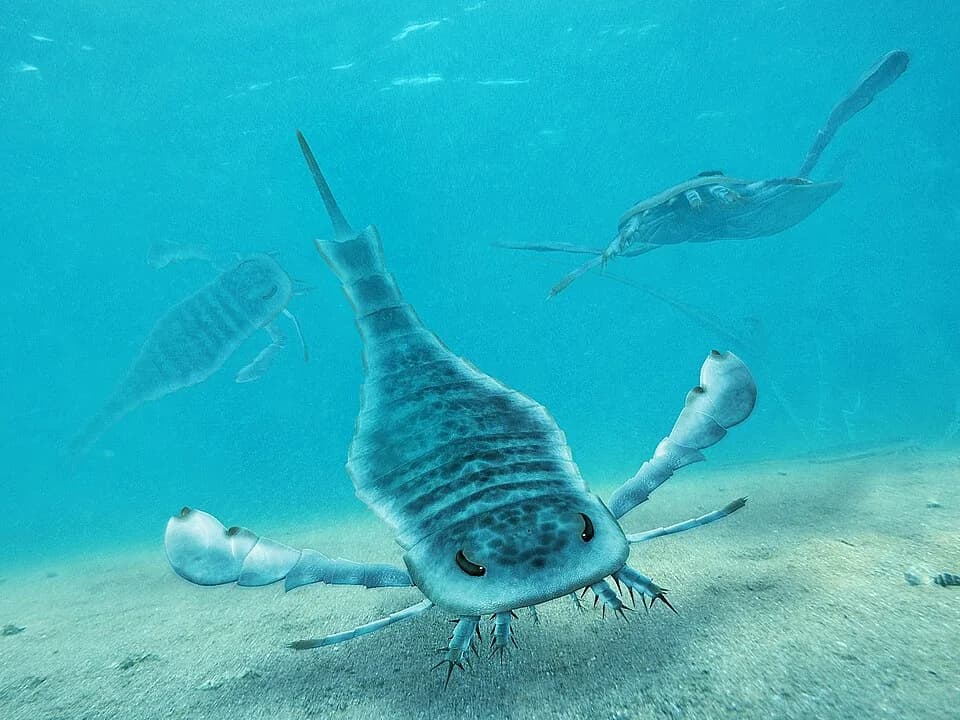
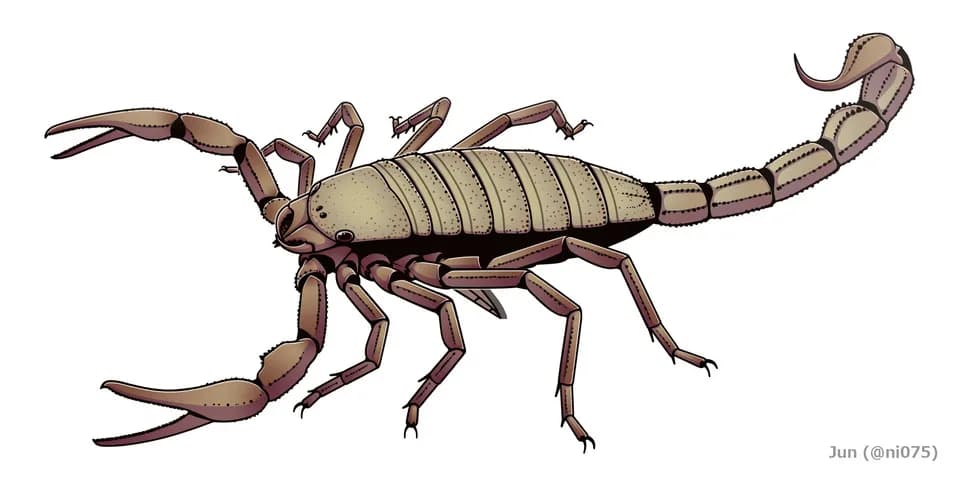
Artistic reconstruction of Eurypterus in its Silurian lagoon environment
Wikipedia Commons