Doigt ailé
Pterodactylus antiquus is the first pterosaur scientifically described, in 1784, and it is the source of the everyday word « pterodactyl ». Its body measured just 30 centimetres, for 1 to 5 kilograms. More than forty species have been attached to it over the centuries: only one remains valid, the others being juveniles.
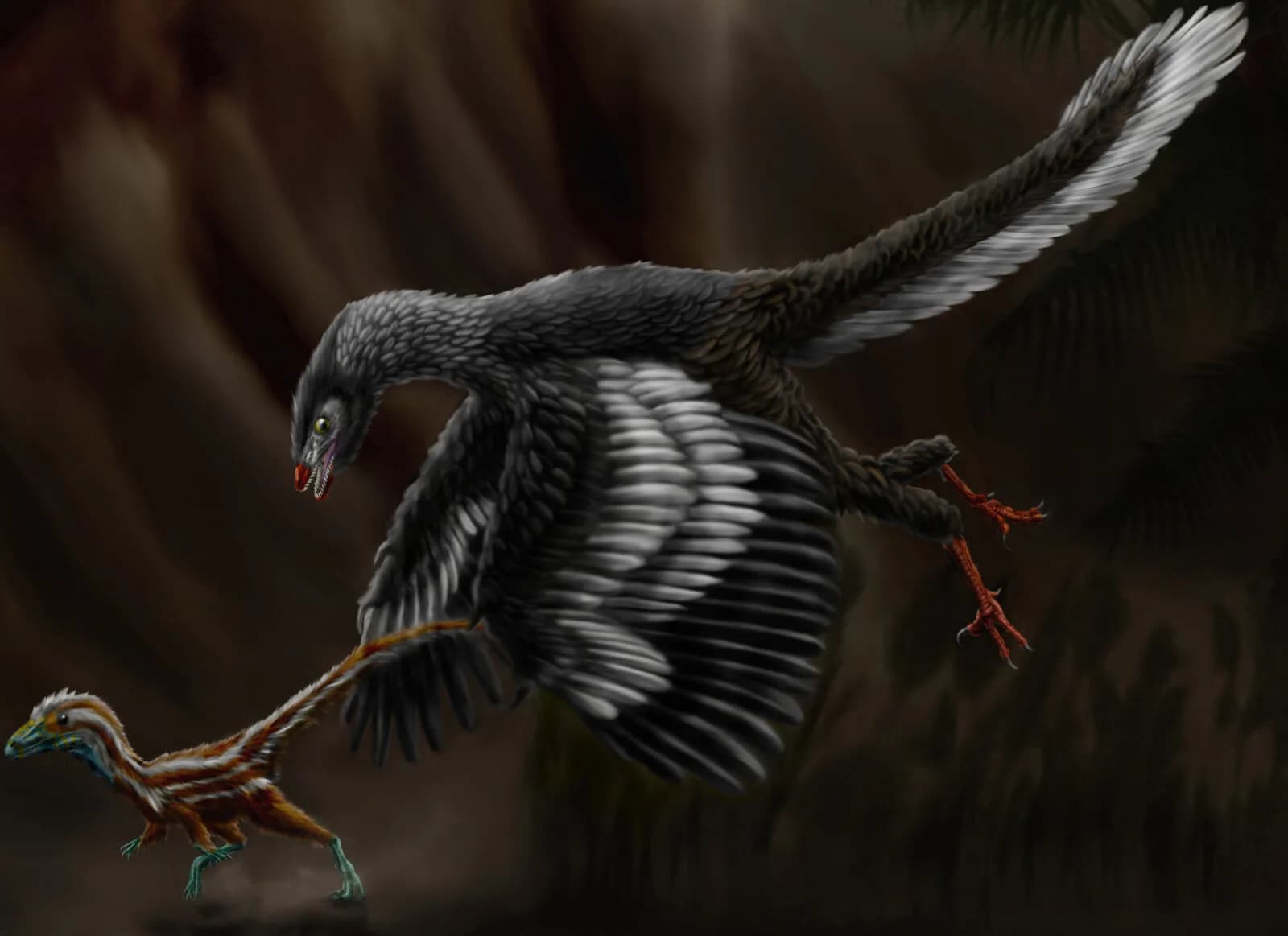
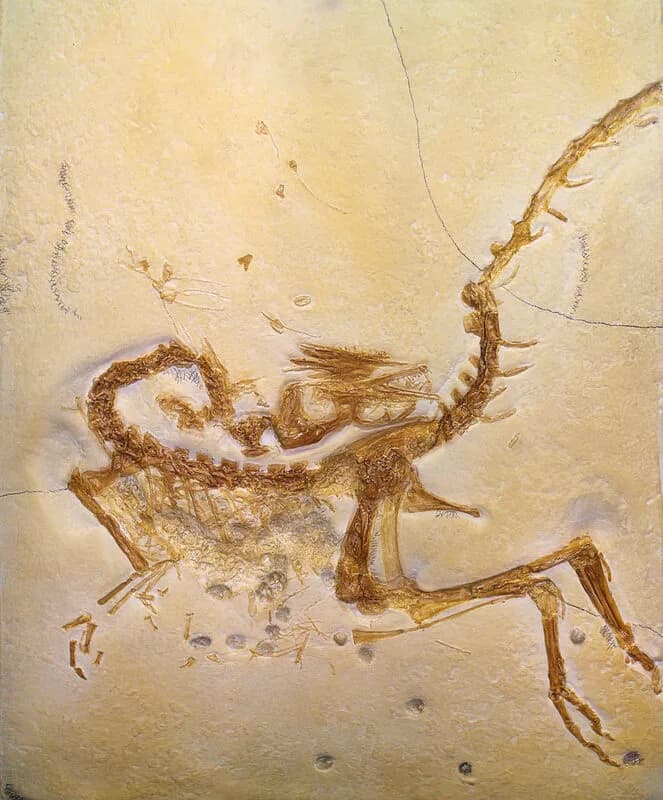
Pterodactylus lived during the Late Jurassic period, approximately 150.8 to 148.5 million years ago, during the Tithonian stage. This period corresponds to the same age as the famous Solnhofen deposits in Bavaria, where most specimens have been discovered. Pterodactylus is historically the first pterosaur to have been identified and scientifically described, marking a turning point in the understanding of prehistoric flying reptiles. It lived in a European tropical archipelago environment, where low limestone islands were surrounded by warm, shallow lagoons rich in marine life. The climate was equatorial, with high temperatures and constant humidity. Pterodactylus shared its ecosystem with other pterosaurs like Rhamphorhynchus, as well as the dinosaur Compsognathus and the proto-bird Archaeopteryx, making Solnhofen one of the most remarkable fossil deposits in the world.
Pterodactylus was a modestly sized pterosaur, with wingspan varying considerably depending on the age of specimens. Adults reached a wingspan of approximately 1 to 1.5 meters, while the smallest juveniles measured only 25 centimeters in wingspan. The body measured approximately 30 centimeters from snout to tail base, with an estimated weight between 1 and 5 kilograms for adults. The skull was elongated and relatively narrow, measuring about 6 to 9 centimeters, with a pointed snout bearing approximately 90 conical teeth in the upper and lower jaws. Adults possessed a small rounded crest of soft tissue on top of the skull, visible only in the best-preserved specimens. The tail was short compared to more primitive pterosaurs like Rhamphorhynchus, a characteristic defining the suborder Pterodactyloidea of which Pterodactylus is the type genus.
An opportunistic carnivore, Pterodactylus fed primarily on small fish, aquatic invertebrates, insects, and possibly small terrestrial vertebrates. Its conical, pointed teeth, numbering approximately 90 distributed between both jaws, were perfectly adapted for grasping slippery prey like small fish in shallow lagoon waters. The shape of its beak, elongated and relatively thin, suggests a feeding strategy similar to modern herons and egrets, combining shallow-water fishing with catching insects and small terrestrial animals. Cranial morphology analyses indicate Pterodactylus possessed a developed hyoid apparatus, suggesting a mobile tongue and ability to manipulate prey in the oral cavity. Its eclectic diet, adapted to the variable resources of an island environment, made it a dietary generalist rather than a specialized piscivore like Pteranodon.
Pterodactylus inhabited the limestone islands and lagoon shores of the European Late Jurassic archipelago, primarily in what is now Bavaria in Germany. The environment was that of a tropical archipelago situated at approximately 15 degrees north latitude, comparable to the modern Bahamas. The Solnhofen lagoons were shallow basins with calm waters, separated from the open sea by coral reef barriers. The bottom of these lagoons was anoxic (oxygen-free), which allowed the exceptional preservation of fossils in an extremely fine-grained limestone. The surrounding islands offered varied habitats: beaches, rocky areas, and vegetation of conifers and ferns. Pterodactylus likely frequented the edges of these lagoons, hunting in shallow waters and on beaches, as well as in the low vegetation of the islands. The proximity of the open sea, beyond the reefs, also offered open-water fishing opportunities for individuals capable of sustained flight.
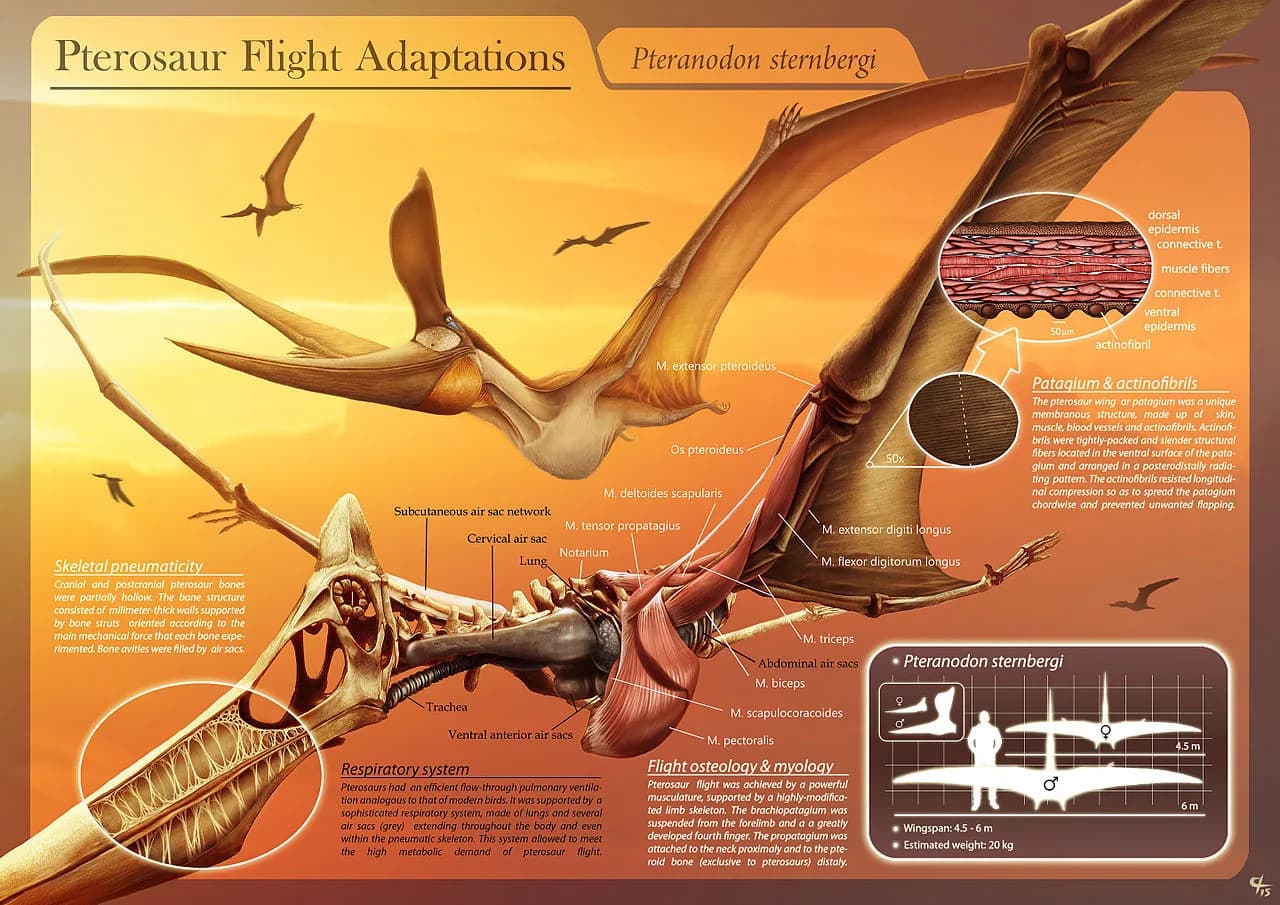
Pterodactylus anatomy reveals a generalist pterosaur, adapted for both flight and terrestrial locomotion. The skull possessed elongated jaws lined with conical teeth of decreasing size toward the rear, without a toothless gap (diastema) unlike some more derived pterosaurs. Adults sported a cranial crest composed of soft tissue, probably covered by a colored skin membrane used for visual communication and individual recognition. The eyes, relatively large, were equipped with sclerotic rings suggesting acute diurnal vision. The wings, formed by a skin membrane (patagium) connecting the disproportionately elongated fourth finger to the body and hindlimbs, were proportionally shorter and wider than those of specialized soaring pterosaurs, suggesting more active and maneuverable flight. The first three hand fingers, free and equipped with claws, allowed grasping and climbing. The feet were plantigrade with five toes, adapted for quadrupedal walking on the ground. Analyses of exceptionally preserved fossils have revealed the presence of pycnofibers (hair-like filamentous structures) covering the body, providing thermal insulation for thermoregulation.
Pterodactylus was probably a diurnal and gregarious animal, living in groups near coastal lagoons. The discovery of numerous specimens of different ontogenetic ages at the same site suggests individuals gathered in colonies, possibly for breeding and mutual protection. Detailed ontogenetic studies by Bennett (2013) demonstrated that cranial morphology changed drastically during growth, with progressive development of the cranial crest and elongation of the snout in adults. This morphological change had led to the erroneous creation of numerous distinct species that turned out to be simple growth stages of the same animal. Pterodactylus flight was probably a mix of active flapping and short glides, adapted for hunting in coastal environments. On the ground, it moved in a quadrupedal posture, using the three claws of its folded hands as support points, as in all derived pterosaurs. The cranial crest of adults likely served for individual recognition and sexual selection, functioning as a colored visual signal.
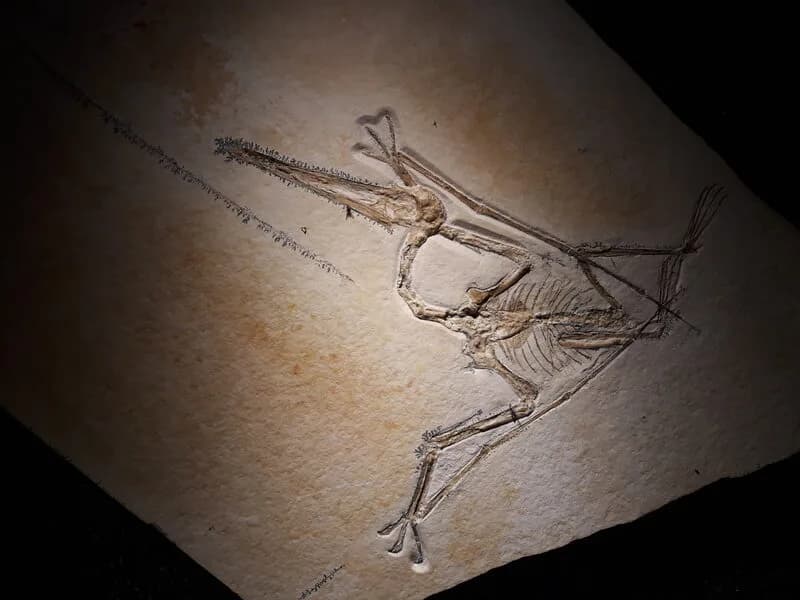
Pterodactylus antiquus was the first pterosaur ever scientifically described, from a specimen discovered in the Solnhofen lithographic limestone in Bavaria, Germany. The holotype specimen was initially described in 1784 by Italian naturalist Cosimo Alessandro Collini, curator of the cabinet of curiosities of Prince-Elector Charles Theodore of Bavaria. Collini did not understand the animal's nature and described it as a marine creature. It was not until 1801 that Georges Cuvier correctly identified the animal as a flying reptile, and the name Pterodactylus (from Greek pteron 'wing' and daktulos 'finger') was created in 1812. Since then, more than 30 specimens have been discovered, primarily in the Solnhofen limestones, but also at Canjuers in France and in England. The taxonomic history of Pterodactylus is extremely complex: over 40 species have been named over the centuries, but Bennett's (2013) revision recognizes only one as valid, P. antiquus, with others being synonyms based on different ontogenetic stages or distinct genera. The holotype specimen is housed at the Bayerische Staatssammlung fur Palaontologie und Geologie in Munich, and Pterodactylus remains one of the most famous and influential fossils in the history of paleontology.
| Period | Jurassique supérieur / Late Jurassic |
| Era | Mésozoïque / Mesozoic |
| Age | 150.8-148.5 Ma |
| Location | Europe (Allemagne, France) / Europe (Germany, France) |
| Length | 0.30 m (corps / body) |
| Height | N/A |
| Weight | 1-5 kg |
| Diet | Piscivore |
| Discovery | 1784 |
No. Pterodactylus antiquus was a pterosaur, a flying reptile of the Late Jurassic (150.8–148.5 Ma), distinct from dinosaurs. Pterosaurs form their own order (Pterosauria) within archosaurs. Pterodactylus, with a wingspan of about 1 meter, is the type pterosaur of the suborder Pterodactyloidea, but it is not a dinosaur — nor a bird.
Only one: Pterodactylus antiquus. Over 40 species were named over the centuries, but Bennett's exhaustive 2013 revision reduces them all to synonyms based on different growth stages of the same animal. Cranial morphology changed considerably with age — crest development and snout elongation — misleading earlier researchers into perceiving distinct species.
Naturalist Cosimo Alessandro Collini described the first specimen in 1784 without understanding its nature — he took it for a marine animal. It was not until 1801 that Georges Cuvier correctly identified it as a flying reptile, and the name Pterodactylus (Greek: pteron 'wing' + daktulos 'finger') was created in 1812. The holotype specimen is housed at the Bayerische Staatssammlung für Paläontologie und Geologie in Munich.
Information on this page is based on peer-reviewed scientific publications.
Pterodactylus antiquus fossil from Solnhofen limestone
Wikipedia Commons
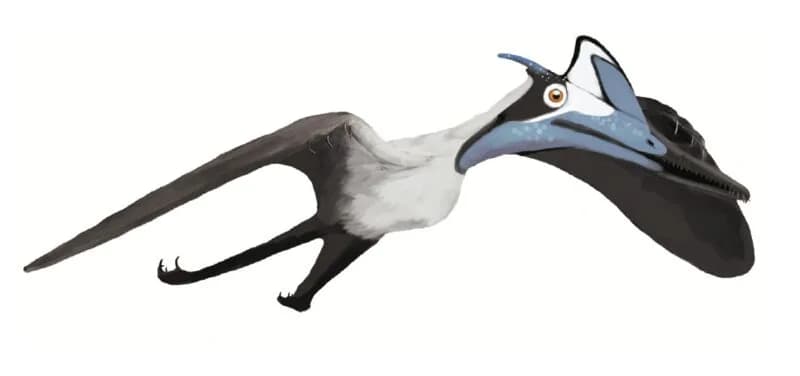
Pterodactylus antiquus life reconstruction
Matt Martyniuk, CC BY-SA 4.0