Compsognathus
Compsognathus longipes is a theropod 0.89 to 1.25 metres long and under 3.5 kilograms, described in 1859 in Germany and also found in France. For over a century it held the title of smallest known dinosaur. One specimen preserves a whole lizard, a Bavarisaurus, in its stomach: direct evidence of its last meal. It shared its islands with Archaeopteryx.
Compsognathus lived during the Late Jurassic period, approximately 150 million years ago, during the Tithonian stage. This period corresponds to the zenith of the dinosaur era in Europe, when the continent was an archipelago of tropical islands bathed by the Tethys Sea. The climate was warm and humid, with shallow lagoons and coral reefs bordering the limestone islands of what is now southern Germany and southeastern France. Compsognathus shared its island environment with Archaeopteryx, the famous feathered dinosaur considered one of the earliest birds, as well as with pterosaurs like Rhamphorhynchus. The Solnhofen lithographic limestone deposits, where the first specimens were discovered, offer an exceptional glimpse into this Late Jurassic lagoon ecosystem, preserving fossils of remarkable detail thanks to the anoxic conditions on the sea floor.
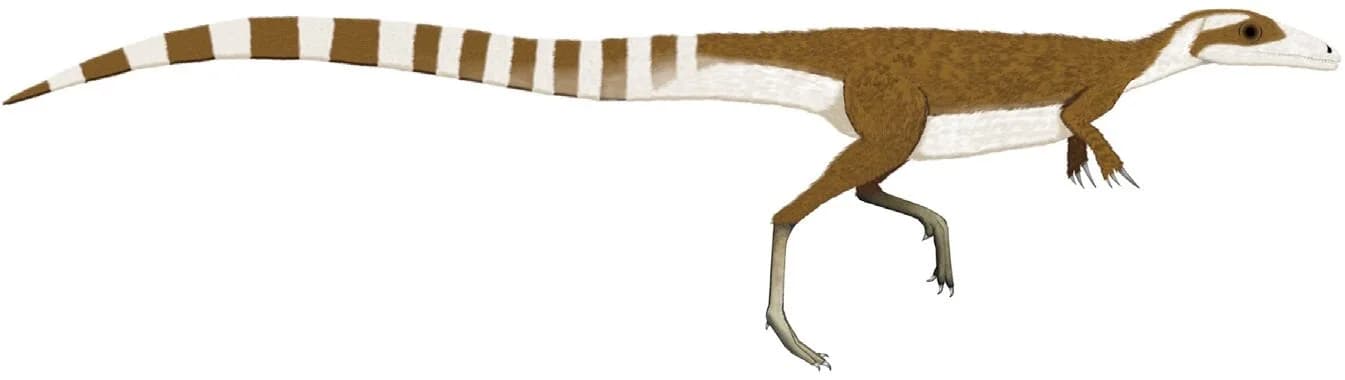
Compsognathus was one of the smallest known non-avian dinosaurs, measuring approximately 1 meter in total length for the German adult specimen, including a long tail that accounted for more than half of this length. The French specimen, discovered later, is slightly larger, reaching approximately 1.25 meters. Its hip height was about 25 to 30 centimeters, and its weight is estimated between 0.83 and 3.5 kilograms depending on the estimation method used. The skull was proportionally small and elongated, measuring about 8 centimeters long, with a tapered snout and small, pointed teeth. The forelimbs were short but functional, equipped with three fingers of which two were particularly developed. The hindlimbs were proportionally long and gracile, adapted for rapid running, with elongated tridactyl feet typical of cursorial theropods. The tail, long and rigid, served as a counterbalance during rapid movement.
A carnivorous insectivore and hunter of small vertebrates, Compsognathus fed primarily on lizards, insects, and other small prey available in its island environment. The most direct evidence of its diet comes from the German holotype specimen, whose stomach contained the perfectly preserved remains of a small lizard identified as Bavarisaurus macrodactylus, swallowed whole. This exceptional discovery constitutes one of the oldest and most direct pieces of evidence of feeding behavior in a theropod dinosaur. Its teeth, small and slightly curved, were perfectly adapted for grasping and retaining agile but small-sized prey. The morphology of its jaw suggests a hunting strategy based on speed and precision rather than brute force. In the Late Jurassic European island ecosystem, Compsognathus likely occupied the ecological niche of an opportunistic small-fauna predator, comparable to modern small predatory lizards.
Compsognathus inhabited the limestone islands of the European Late Jurassic archipelago, in what is now southern Germany (Bavaria) and southeastern France (Nice region). The environment was that of a tropical archipelago situated between 15 and 20 degrees north latitude, comparable to today's Bahamas islands. The islands were bordered by shallow lagoons with calm, oxygen-poor bottom waters, which allowed the exceptional preservation of fossils in the lithographic limestone. The island vegetation included conifers, cycads, and ferns, forming moderate plant cover on a limestone substrate. Compsognathus likely lived along the edges of these lagoons, hunting in transition zones between dry land and coastal marshes. The insularity of this habitat probably influenced its small size, a phenomenon known as insular dwarfism, although this hypothesis remains debated for this species.
The anatomy of Compsognathus reveals an extremely gracile and agile theropod, perfectly adapted for hunting small prey. The skull, elongated and light, possessed large orbits suggesting good vision, essential for detecting and pursuing fast lizards and insects. The teeth, small and pointed with fine serrations, were arranged in regular rows in both upper and lower jaws. The neck was relatively long and flexible, allowing rapid head movements to capture elusive prey. The forelimbs possessed three fingers, although the third finger was very reduced and non-functional in some specimens. The wrist featured a semi-lunate structure allowing some flexibility, useful for grasping. The hindlimbs, proportionally very long relative to the body, with elongated metatarsals and gracile phalanges, clearly indicate adaptation for rapid running. The tail contained approximately 40 caudal vertebrae and was stiffened by ossified tendons, serving as a dynamic stabilizer. The cervical and dorsal vertebrae were pneumatized, reducing skeletal weight while maintaining structural strength.
Compsognathus was likely a diurnal and solitary hunter, using its exceptional speed and agility to track small prey through the low vegetation of Jurassic islands. Biomechanical estimates suggest it could reach remarkable running speeds for its size, potentially up to 40 km/h thanks to its long hindlimbs and light morphology. Its hunting strategy probably relied on short, explosive pursuits, similar to those of modern cursorial birds like the roadrunner. The presence of a whole lizard in the holotype specimen's stomach indicates it swallowed prey whole or in large pieces, rather than tearing them apart. Its territorial behavior is unknown, but its small size and diet suggest a relatively restricted home range, suited to the limited dimensions of its island habitat. The coexistence with Archaeopteryx on the same islands raises remarkable questions about ecological competition between these two small theropods, which potentially occupied similar but probably differentiated food niches through their mode of locomotion.
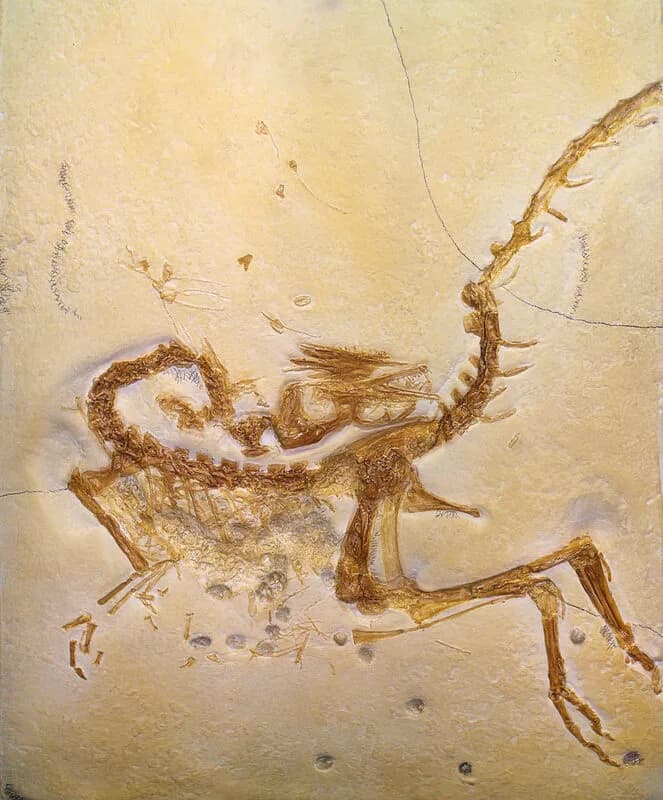
The first Compsognathus specimen was discovered in 1859 in the Solnhofen lithographic limestone in Bavaria, Germany. This holotype specimen (BSP AS I 563), described by Johann Andreas Wagner that same year, is an almost complete skeleton of a sub-adult individual approximately 89 centimeters long. The exceptional preservation in fine-grained limestone allowed not only bones to be distinguished, but also the impression of stomach contents containing a Bavarisaurus lizard. In 1972, a second, larger specimen was discovered in the Tithonian limestones of Canjuers, near Nice in France, measuring approximately 1.25 meters. This French specimen, initially attributed to a distinct species (C. corallestris), is now generally considered an adult of C. longipes. For over a century, Compsognathus held the title of smallest known dinosaur, before discoveries in China and North America revealed even smaller species. The genus plays a crucial role in systematics, lending its name to the family Compsognathidae, which includes several other small theropods such as Sinosauropteryx and Juravenator. The two specimens are today preserved respectively at the Bayerische Staatssammlung in Munich and the Museum national d'Histoire naturelle in Paris.
| Period | Jurassique supérieur / Late Jurassic |
| Era | Mésozoïque / Mesozoic |
| Age | 150 Ma |
| Location | Europe (Allemagne, France) / Europe (Germany, France) |
| Length | 0.89-1.25 m |
| Height | 0.25-0.30 m |
| Weight | 0.83-3.5 kg |
| Diet | Insectivore |
| Discovery | 1859 |
The Compsognathus longipes holotype specimen, found in 1859 in the Solnhofen lithographic limestone in Bavaria, preserves in its stomach the perfectly preserved remains of a small lizard identified as Bavarisaurus macrodactylus, swallowed whole. This discovery constitutes one of the most direct and oldest pieces of evidence for theropod feeding behavior. It confirms a carnivorous diet centered on small lizards and vertebrates, likely supplemented by insects in the Jurassic island environment.
Compsognathus longipes measured about 89 cm for the German holotype (sub-adult) and up to 1.25 m for the French adult, weighing 0.83 to 3.5 kg. Its small size is remarkable for a theropod dinosaur. The insular dwarfism hypothesis — reduced size in response to limited resources on an island habitat — has been proposed but remains debated. Its environment was a tropical archipelago in the Tethys Sea, in what is now Bavaria and southeastern France, approximately 150 million years ago.
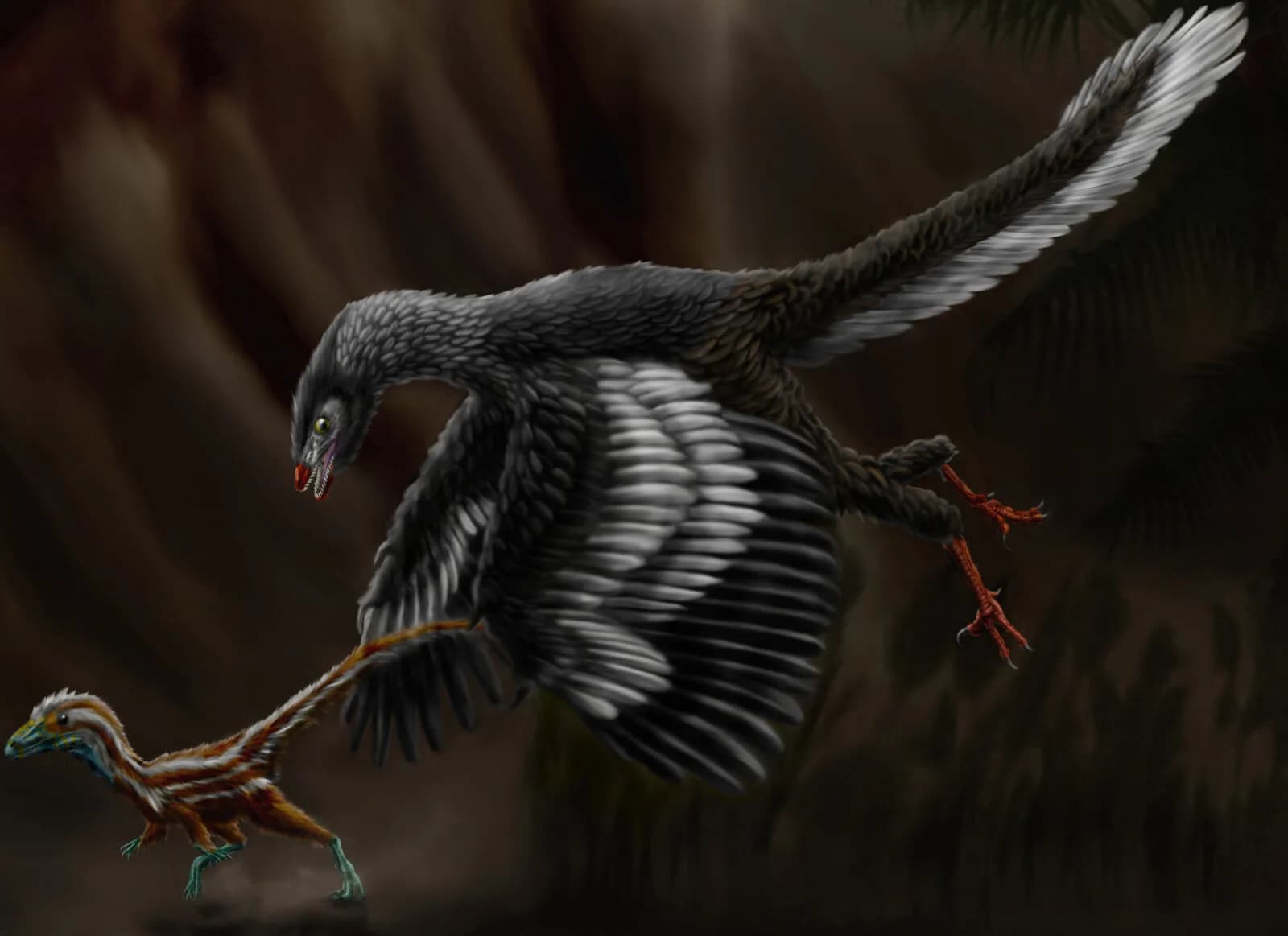
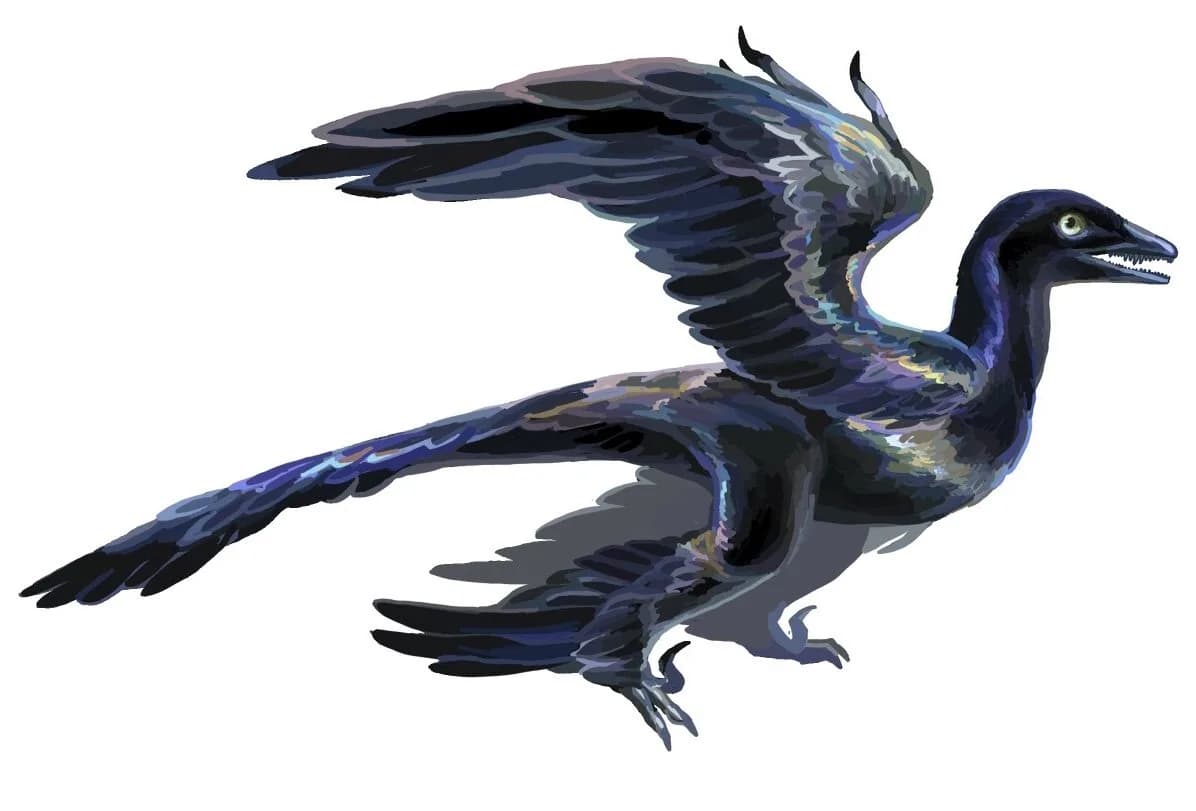
Compsognathus longipes and Archaeopteryx lithographica coexisted on the same Jurassic archipelago in the Tethys Sea, on the same islands preserved in the Solnhofen limestone. Two small theropods of similar size occupying the same island environment raise questions about their ecological competition. They likely exploited niches differentiated by locomotion mode: Compsognathus, a terrestrial runner, and Archaeopteryx, a tree-climber and glider, hunting similar prey from different environments.
Compsognathus longipes fossil, holotype specimen
Wikipedia Commons
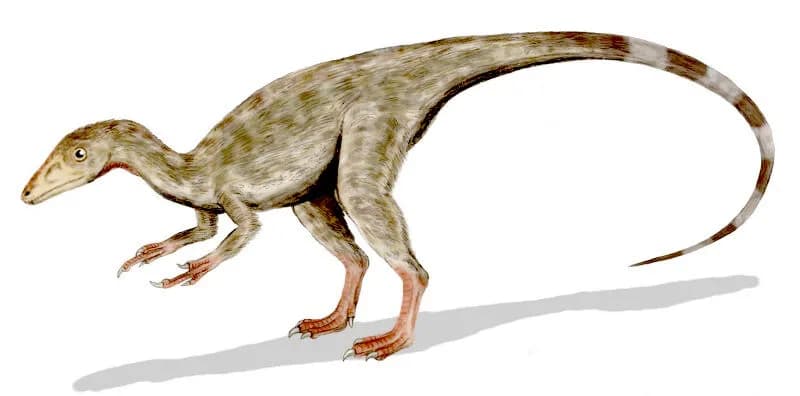
Compsognathus longipes life reconstruction
Nobu Tamura, CC BY-SA 3.0