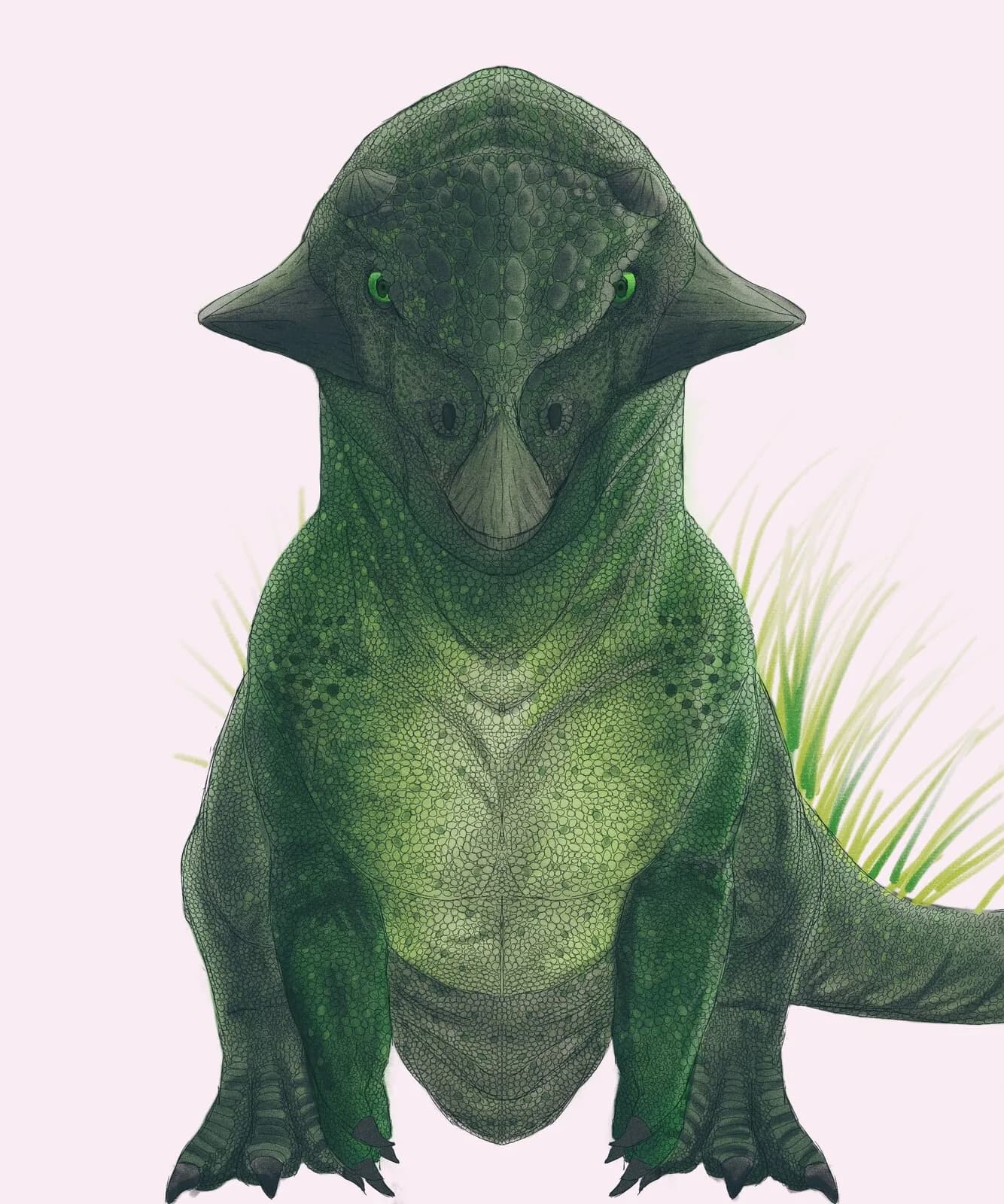
Psittacosaure
Psittacosaurus mongoliensis is among the best represented dinosaurs in the fossil record, with more than four hundred known specimens. Its name means « parrot lizard », after its beak. One Chinese fossil preserved stiff bristles on the tail, integumentary structures unknown elsewhere among ceratopsians. It measured 1 to 2 metres and 5 to 20 kilograms.
Psittacosaurus lived during the Early Cretaceous, approximately 126 to 101 million years ago, during the Aptian to Albian stages of the Mesozoic era. It is one of the longest-lived dinosaur genera known to science, with a documented presence spanning approximately 25 million years across multiple species. Asia at this time offered highly varied environments, ranging from temperate forests to semi-arid zones, supporting diverse ecological communities. Psittacosaurus is one of the most abundant dinosaurs in the Asian fossil record, and the exceptional preservation conditions of the famous Jehol biota in northeastern China have revealed unprecedented details about its external appearance and daily lifestyle.
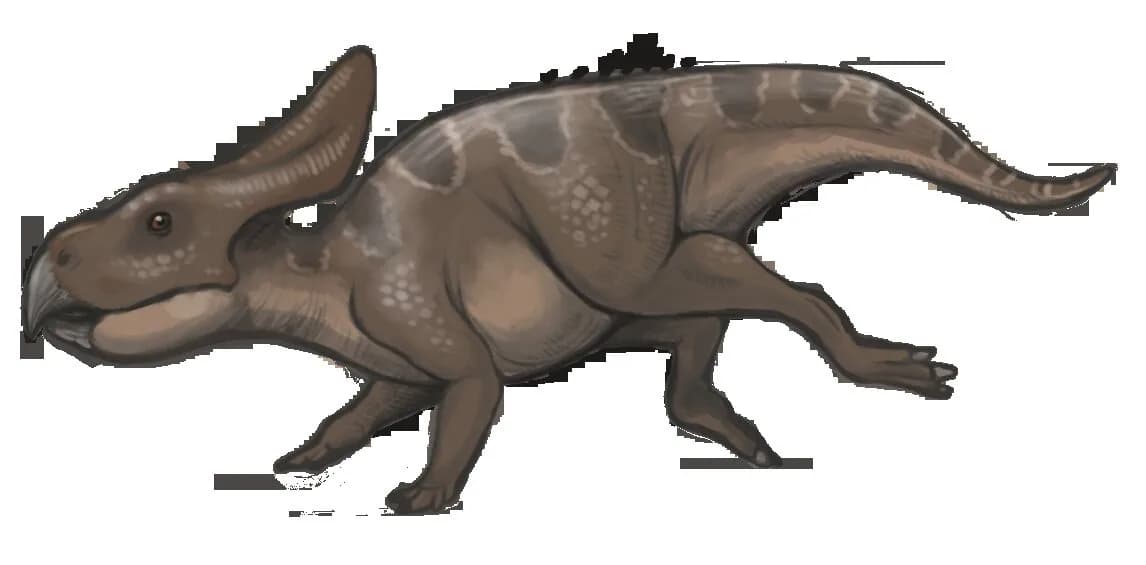
Psittacosaurus varied considerably in size across its many species (10 to 12 recognized species to date), but most individuals measured between 1 and 2 meters long with a weight ranging from 20 to 80 kilograms. The largest species, P. lujiatunensis, reached about 2 meters in total length. Its skull was characteristically short and tall, with a prominent parrot-like beak (hence its evocative name meaning parrot lizard) and wide cheeks bearing characteristic lateral bony projections called jugal horns that gave its face a distinctive squared appearance. It was primarily a bipedal animal, walking and running mainly on its muscular hind legs.
Psittacosaurus was a herbivore equipped with a remarkably powerful parrot-like beak for its modest size, capable of cracking hard nuts, tough seeds, and cutting thick stems that other small herbivores could not process. Its teeth were well-adapted for shearing vegetation, and the presence of gastroliths (stomach stones) in numerous specimens confirms it actively used these swallowed stones to grind plant material in its muscular gizzard, functioning much like the crop of modern birds. One remarkable specimen contained over 50 individual gastroliths of varying sizes. Its diet was probably quite diverse and opportunistic, including leaves, seeds, fruits, and possibly occasional insects or other small invertebrates.
Psittacosaurus had a remarkably wide geographic distribution across Asia, with fossils found in China, Mongolia, Russia, and Thailand. It inhabited a variety of environments, from the humid temperate forests of the Jehol biota to the more arid zones of Mongolia. Lacustrine and fluvial environments seem to have been its preferred habitats. Its great ecological adaptability probably explains its exceptional longevity as a genus and its vast geographic distribution. It coexisted with a diverse fauna including feathered theropods, mammals, and pterosaurs.
Psittacosaurus anatomy is exceptionally well known thanks to hundreds of specimens, some with preserved soft tissues. Its characteristic box-shaped skull bore a toothless parrot beak at the front and shearing teeth at the back. Its 'jugal horns' — bony projections on the cheeks — varied in size across species. An extraordinary specimen (P. sp. SMF R 4970) preserves the skin, showing scales of different sizes and, remarkably, a row of long rigid filamentous structures on top of the tail, possibly proto-feathers or unique integumentary structures. Its skin showed countershading camouflage.
Psittacosaurus was probably a social animal, as strongly suggested by several remarkable specimens found preserved in groups. The most extraordinary fossil discovery shows an adult surrounded by 34 juveniles, interpreted as evidence of creche behavior or communal parental care — a single adult guarding the young offspring of multiple parents simultaneously. Juveniles began life as quadrupeds before transitioning to bipedal locomotion as they grew older, an ontogenetic change well-documented by the progressive changes in limb proportions observed across growth stages. Its countershading camouflage pattern (dark pigmentation on the back, lighter coloring on the belly) was reconstructed through detailed melanosome analysis, strongly suggesting it inhabited dense forest environments where such camouflage would be most effective.
Psittacosaurus was described in 1923 by Henry Fairfield Osborn from a specimen collected in Mongolia during the American Museum of Natural History expeditions. Since then, hundreds of specimens have been discovered, making Psittacosaurus one of the most abundant non-avian dinosaurs in the fossil record. Jehol biota specimens are particularly remarkable for their preservation: the Frankfurt specimen (SMF R 4970) preserves skin with microscopic detail, including the caudal filamentous structures and coloration pattern. In 2016, camouflage analysis by Vinther et al. allowed reconstruction of Psittacosaurus's external appearance with an unprecedented level of detail for a dinosaur.
| Period | Crétacé inférieur / Early Cretaceous |
| Era | Mésozoïque / Mesozoic |
| Age | 126–101 Ma |
| Location | Asie / Asia (Chine, Mongolie, Sibérie, Thaïlande) |
| Length | 1–2 m |
| Height | ~0.5 m |
| Weight | 5–20 kg |
| Diet | Herbivore |
| Discovery | 1923 |
In 2016, Vinther et al. analyzed the melanosomes of the Frankfurt specimen (SMF R 4970, Jehol biota), which preserved skin with scales and a row of rigid filamentous structures on the tail. The analysis revealed countershading camouflage (dark back, light belly) typical of forest-dwelling animals. It is the most precise color reconstruction ever achieved for a non-avian dinosaur.
Psittacosaurus mongoliensis and its 10 to 12 species measured between 1 and 2 meters long, weighing 20 to 80 kilograms depending on the species. The genus existed from 126 to 101 Ma (Aptian–Albian), a span of approximately 25 million years — among the longest for any non-avian dinosaur genus. Over 400 specimens are known, from embryo to adult.
A remarkable Psittacosaurus fossil shows an adult surrounded by 34 juveniles, interpreted as crèche behavior — a single adult guarding the young of multiple parents. Juveniles were initially quadrupedal before becoming bipedal as they grew. The presence of gastroliths (over 50 in one specimen) confirms mechanical grinding digestion, as in modern birds.
Life reconstruction of Psittacosaurus mongoliensis
PaleoEquii, CC BY-SA 4.0, via Wikimedia Commons
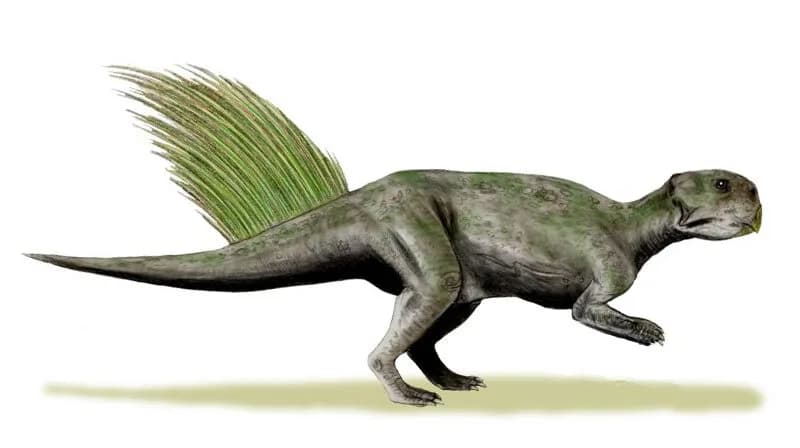
Psittacosaurus mongoliensis life reconstruction
Nobu Tamura, CC BY 3.0