Postosuchus
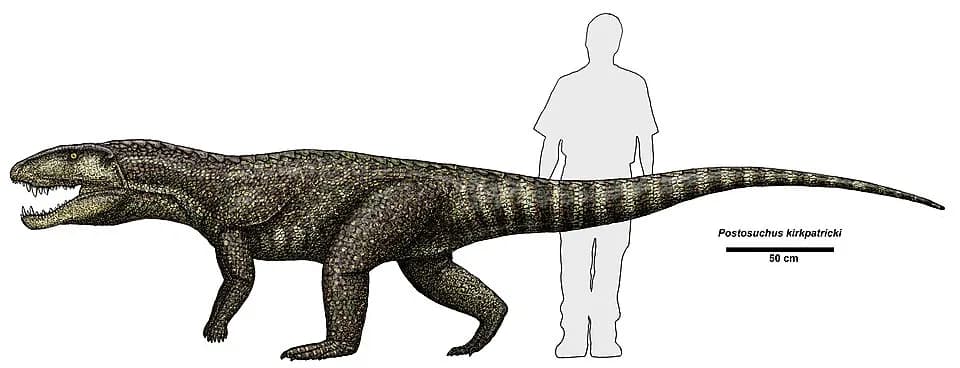
Postosuchus kirkpatricki was not a dinosaur but a rauisuchian, an archosaur on the crocodile branch. Four to 5 metres long and 250 to 300 kilograms, described in 1985 in the American southwest, it dominated its ecosystem 228 to 202 million years ago. Its forelimbs, far shorter than its hind limbs, keep a debate about its gait alive.
Postosuchus lived during the Late Triassic (Norian), approximately 228 to 202 million years ago, in what is now the southwestern United States. Like Saurosuchus in South America, Postosuchus was the apex super-predator of its North American ecosystem, dominating the first dinosaurs that were just beginning to diversify. The Late Triassic was the final chapter of an era of pseudosuchian (crocodilian lineage) dominance over terrestrial ecosystems. Postosuchus belonged to the rauisuchids, a group of large predatory archosaurs that occupied the ecological niche later filled by theropods like Allosaurus and Tyrannosaurus. The end-Triassic mass extinction (201 Ma), probably caused by massive volcanism of the Central Atlantic Magmatic Province, ended the rauisuchian reign and paved the way for dinosaur dominance.
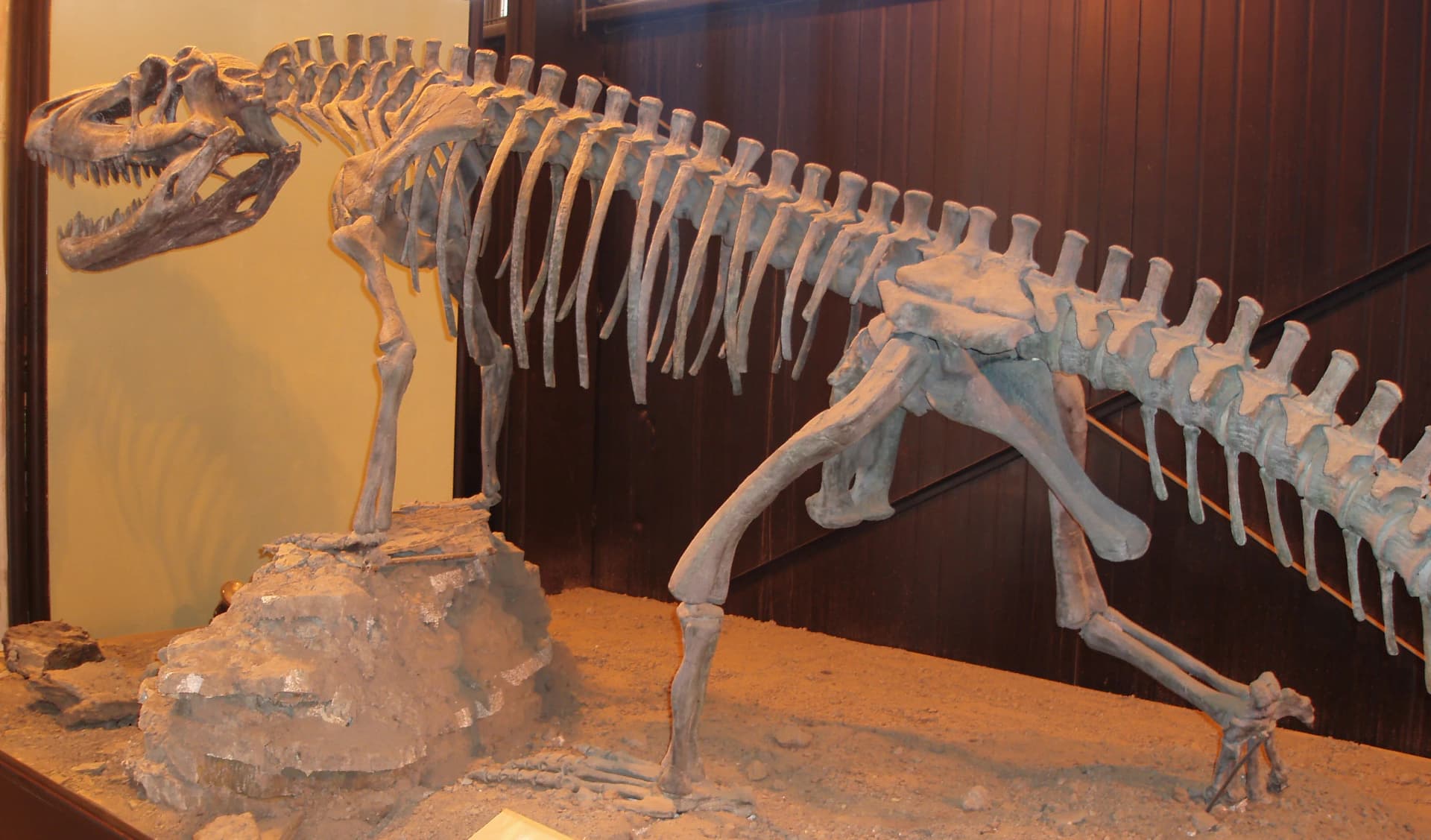
Postosuchus was one of the largest terrestrial predators of the Triassic in North America, measuring about 4 to 5 meters in total length with an estimated weight of 250 to 300 kg. Its skull measured about 55 centimeters in length, with deep, powerful jaws armed with large blade-shaped teeth, laterally compressed and finely serrated. Its body was robust and elongated, carried on forelimbs noticeably shorter than the hindlimbs — a feature that sparked debate about its posture: quadrupedal, facultatively bipedal, or both? The most recent studies favor primarily quadrupedal locomotion with possible occasional bipedality.
Postosuchus was the dominant predator of the Chinle and Dockum ecosystems in the Late Triassic of North America. Its massive ziphodont teeth — some measuring over 7 cm — were formidable weapons capable of slicing flesh, tendons, and even piercing the bony armor of its prey. Its diet probably included armored aetosaurs (like Desmatosuchus and Typothorax), phytosaurs (crocodile-like archosaurs), dicynodonts, metoposaurids (giant amphibians), and the first small dinosaurs. Its jaw strength allowed it to attack prey of considerable size. Bite marks attributed to Postosuchus have been identified on aetosaur bones.
Postosuchus inhabited the semi-arid floodplains of the Late Triassic in North America, in environments now represented by the Chinle Formation (Arizona, New Mexico, Utah) and the Dockum Group (Texas). These regions were then situated near the equator in the western part of Pangaea, with a hot, seasonal climate marked by monsoons. The landscape was dominated by conifer forests (Araucarioxylon — ancestors of the petrified forests at Petrified Forest National Park), ferns, and cycads. Postosuchus shared its environment with a rich fauna including phytosaurs (semi-aquatic predators), armored aetosaurs, the small dinosaur Coelophysis, and giant metoposaurids in waterways.
Postosuchus' anatomy reveals a highly adapted terrestrial predator. Its deep, narrow skull possessed large antorbital and temporal fenestrae, lightening the structure while maintaining bite power. Its teeth, among the largest of all rauisuchians, were ziphodont — laterally compressed with serrated keels, convergent with theropods. One of Postosuchus' most remarkable features is the disproportion between its limbs: the forelimbs were significantly shorter and lighter than the powerful hindlimbs, suggesting at minimum facultative bipedality. Its body was protected by dorsal osteoderms forming two parallel rows along the spine. Its rib cage was broad and deep, probably housing efficient lungs.
Postosuchus was an active terrestrial predator, probably capable of surprising bursts of speed thanks to its powerful hindlimbs. Its more erect posture compared to modern crocodiles allowed efficient and sustained terrestrial locomotion. It probably hunted by ambush, using vegetation and terrain for concealment before pouncing on prey with explosive acceleration. Its massive teeth and powerful jaw allowed a deep, devastating bite strategy, probably sufficient to neutralize prey in a single assault. Postosuchus was likely solitary and territorial, each individual dominating a vast hunting territory. Its extinction, along with other rauisuchians at the end of the Triassic, left an ecological void that theropod dinosaurs quickly filled in the Early Jurassic.
Postosuchus kirkpatricki was described in 1985 by paleontologist Sankar Chatterjee, from fossils discovered in the Dockum Group (Cooper Canyon Formation) near Post, Texas. The name means 'crocodile from Post' referring to this Texas town. The holotype included a partial but informative skeleton, and additional specimens have since been discovered in Arizona, New Mexico, and North Carolina. A second species, P. alisonae, was described in 2011 from North Carolina fossils. Postosuchus became one of the most famous Triassic archosaurs thanks to its appearance in the BBC documentary series 'Walking with Dinosaurs' (1999), where it was presented (with some liberties) as the super-predator of the Late Triassic in North America.
| Period | Trias supérieur (Norien) / Late Triassic (Norian) |
| Era | Mésozoïque / Mesozoic |
| Age | 228-202 Ma |
| Location | Formation Dockum et Chinle, sud-ouest des États-Unis / Dockum and Chinle Formations, southwestern USA |
| Length | 4-5 m |
| Weight | 250-300 kg |
| Diet | Carnivore |
| Discovery | 1985 |
Neither. Postosuchus kirkpatricki was a rauisuchid, an archosaur of the crocodilian lineage (Pseudosuchia), distinct from both dinosaurs and true crocodiles. It lived during the Late Triassic (228–202 Ma) in North America and went extinct during the end-Triassic mass extinction, ceding the apex terrestrial predator role to theropod dinosaurs.
Postosuchus measured 4 to 5 meters long and weighed 250 to 300 kilograms. Its skull reached 55 centimeters, armed with ziphodont teeth exceeding 7 centimeters. It hunted armored aetosaurs like Desmatosuchus, phytosaurs, and the first small dinosaurs. Bite marks attributed to Postosuchus have been identified on aetosaur bones.
The debate remains open. Postosuchus kirkpatricki had forelimbs noticeably shorter than its hindlimbs, prompting hypotheses about facultative bipedality. The most recent studies favor primarily quadrupedal locomotion with a semi-erect posture, more efficient than the sprawl of modern crocodiles, but without permanent bipedality.
Mounted Postosuchus kirkpatricki skeleton showing its semi-erect posture
Wikipedia Commons
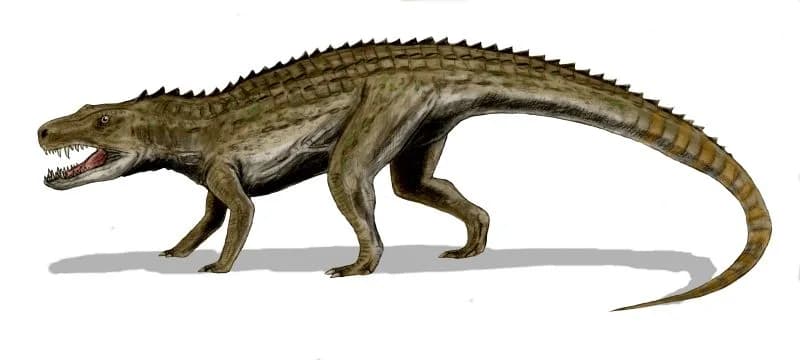
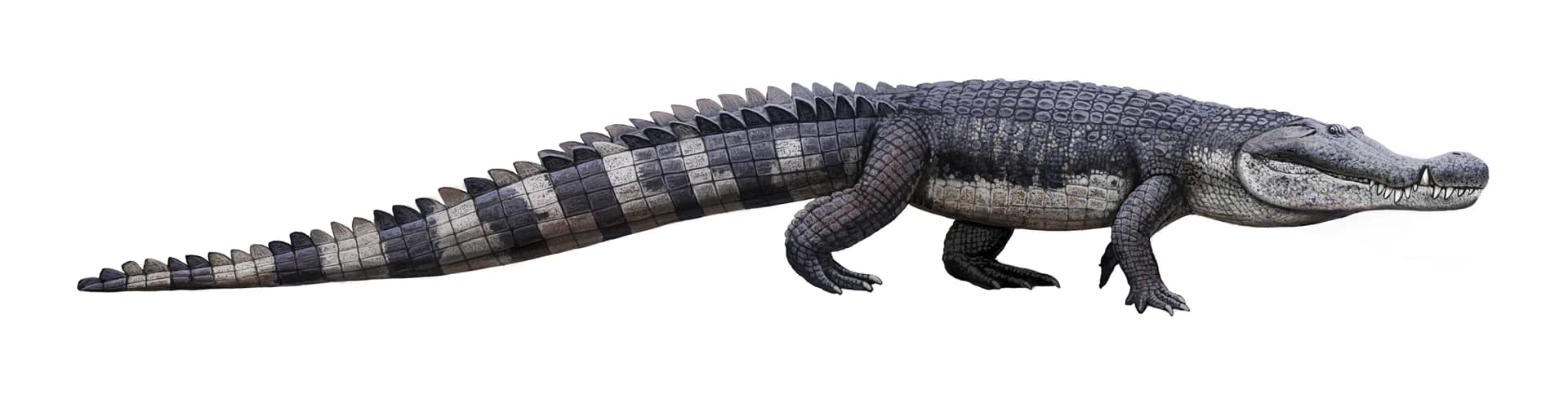
Artistic reconstruction of Postosuchus kirkpatricki, a Triassic rauisuchian
Nobu Tamura, CC BY-SA 3.0