Platybelodon
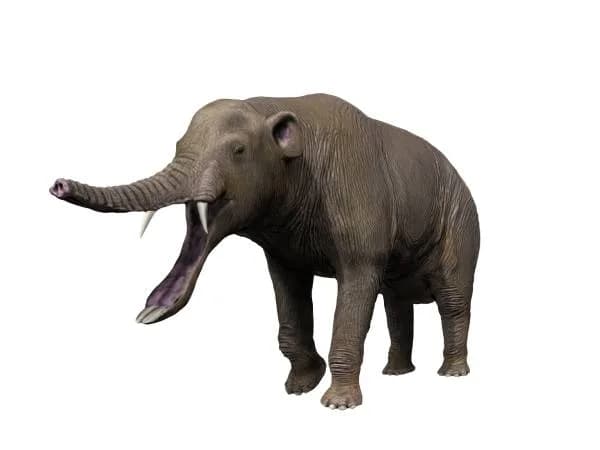
Platybelodon grangeri was a herbivorous proboscidean that lived 15 to 4 million years ago across China, Mongolia and Africa. At 3 metres and around 2 tonnes, it stands out for a lower jaw flattened into a shovel — a shape found nowhere else in the animal kingdom, living or extinct. That look has earned it the nickname shovel-tusker.
Platybelodon lived during the Miocene epoch, approximately 15 to 4 million years ago, a period characterized by a globally warmer and more humid climate than today. This geological epoch, part of the Cenozoic era, saw the emergence of many modern mammal families as well as the spectacular diversification of proboscideans across the Old World. The Middle Miocene was particularly favorable for large herbivores thanks to the expansion of grasslands and wetlands in Central Asia, offering habitats rich in aquatic and riparian vegetation. Platybelodon thrived in these environments for several million years before disappearing toward the end of the Miocene, probably due to climate changes that progressively dried out the wetlands on which it depended for food and survival throughout its evolutionary history.
Platybelodon grangeri was an imposing animal, comparable in size to a modern Asian elephant. It measured approximately 3 meters long from snout to tail base and reached a shoulder height of about 2 meters, with an estimated weight of around 2 tonnes. Its massive, stocky body rested on four robust, columnar limbs typical of proboscideans. Its head was proportionally large relative to its body, owing to its considerably widened and elongated lower jaw that constituted its most distinctive feature. Although smaller than modern elephants and its contemporary gomphotheres, Platybelodon remained one of the largest mammals in its Miocene ecosystem, dominating most other herbivores sharing its habitat of wetlands and riverbanks across Central Asia during this warm geological period of Earth's history.
Platybelodon was a specialized herbivore that used its extraordinarily flattened and widened shovel-shaped lower jaw to scrape and tear aquatic and semi-aquatic vegetation. Contrary to what was long believed, recent studies based on microscopic wear traces on its teeth suggest that it did not use its jaw as a dredge to scoop mud, but rather as a cutting tool to slice through the stems and roots of aquatic plants with remarkable efficiency. Its diet likely included rushes, reeds, water lilies, riparian plants, and various herbaceous species growing in marshy areas. The flattened lower incisors functioned as blades, while the molars then ground the plant material into a digestible pulp. This extreme dietary specialization explains why Platybelodon was so closely tied to wetland habitats and why it ultimately disappeared when these environments became increasingly scarce across its range.
Platybelodon primarily inhabited wetlands, marshes, riverbanks, and floodplains of Central Asia during the Miocene epoch. Its fossils have been discovered in abundance in what is today northern China, Mongolia, and certain regions of Africa — territories that at the time harbored vast expanses of moist grasslands and waterways bordered by lush vegetation. The Miocene climate, warmer and more humid than today, favored the existence of large river and lake systems surrounded by marshy zones rich in aquatic plants, exactly the type of environment on which Platybelodon depended for its specialized feeding habits. This animal likely spent a large portion of its time in shallow water or on muddy banks, wading through marshes to access its preferred food sources including aquatic plants and riverbank vegetation. The progressive disappearance of these wetland habitats toward the end of the Miocene likely contributed to the decline and eventual extinction of the species.
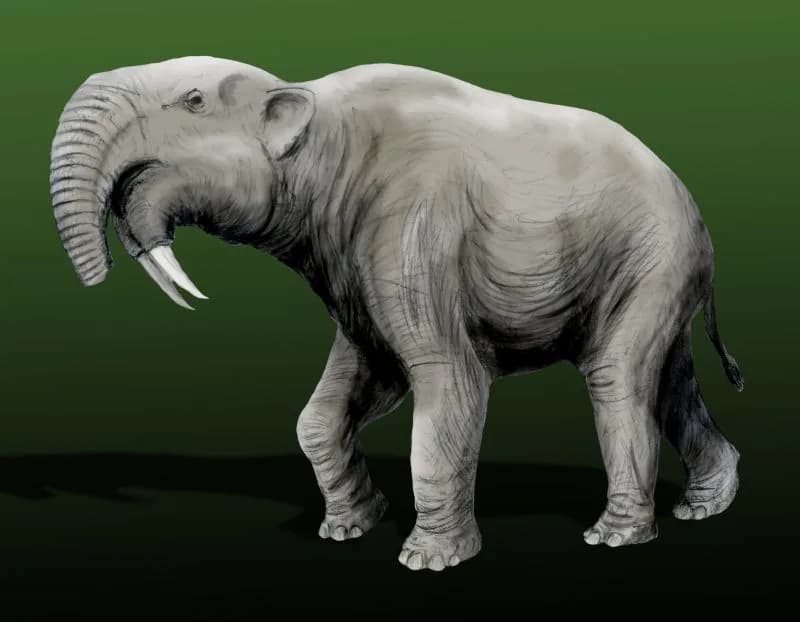
Platybelodon's anatomy was dominated by its most striking and bizarre feature: an extraordinarily flattened and widened lower jaw forming a veritable bony shovel at the front of its head. This mandible, unique in the animal kingdom, was composed of two fused and flattened lower incisors that extended horizontally to a considerable width, creating a biological tool with no equivalent in any other living or extinct mammal known to science. Unlike modern elephants with their long prehensile trunks, Platybelodon possessed a relatively short and stubby trunk that terminated above this mandibular shovel. Its body resembled that of a primitive elephant with four robust columnar legs and a massive torso built for supporting considerable weight. Its upper tusks were small or absent depending on the species within the genus, because it was the lower jaw, not the tusks, that served as the animal's primary tool for feeding and interacting with its environment. This extraordinary cranial morphology has long intrigued paleontologists and continues to fascinate the general public worldwide.
Platybelodon likely adopted a semi-aquatic lifestyle, spending a large portion of its days wading in the shallow waters of marshes, rivers, and lakes to feed on aquatic vegetation growing abundantly in these wetland environments. Its primary feeding technique consisted of plunging its shovel-shaped lower jaw beneath the water surface or into the mud of riverbanks, then scraping and slicing aquatic plants by raising its head with a powerful scooping motion that efficiently harvested large quantities of vegetation. This feeding behavior is reminiscent of modern hippopotamuses or tapirs, although the harvesting method was entirely different and unique to this group of proboscideans among all known mammals. Like modern elephants, Platybelodon probably lived in family herds composed of females and their young, while adult males led a more solitary existence away from the main group. Herds likely moved along waterways and between wetland areas according to seasons and the availability of aquatic vegetation throughout the year.
The first fossils of Platybelodon were discovered in the 1920s during paleontological expeditions to Mongolia and northern China, and the genus was formally described by American paleontologist Henry Fairfield Osborn in 1929. The name Platybelodon means 'flat javelin tooth' (from Greek platys 'flat' + belos 'javelin, arrow' + odous 'tooth'), in reference to its remarkably flattened lower incisors that formed the distinctive shovel shape. The richest deposits are found in Miocene formations of Inner Mongolia in China and in the Gobi Desert of Mongolia, where skulls and partial skeletons have been unearthed and studied extensively by researchers. Platybelodon has become a true celebrity on social media, particularly on TikTok and Instagram, where its bizarre appearance — often described as an 'elephant with a shovel for a mouth' — has generated millions of views and shares across platforms worldwide. This unexpected virality has made Platybelodon one of the most recognizable prehistoric animals among the general public, far more so than many scientifically more important species that lack its visually striking and immediately memorable appearance.
| Period | Miocène / Miocene |
| Era | Cénozoïque / Cenozoic |
| Age | 15-4 Ma |
| Location | Chine, Mongolie, Afrique / China, Mongolia, Africa |
| Length | 3 m |
| Height | 2 m |
| Weight | 2 tonnes |
| Diet | Herbivore |
Not directly. Platybelodon grangeri belongs to the family Amebelodontidae, a lateral branch of proboscideans distinct from the lineage that led to modern elephants (Elephantidae). It was a distant cousin sharing the order Proboscidea. It lived during the Miocene, 15 to 4 million years ago, in China, Mongolia and Africa, before going extinct without direct descendants among current elephants.
Contrary to the popular mud-dredging image, dental microwear studies on specimens from Inner Mongolia reveal that Platybelodon grangeri used its flattened lower jaw as a blade to slice through stems and roots of aquatic plants. It plunged the mandible into the water then raised its head in a cutting motion, harvesting rushes, reeds, and herbaceous plants from marshy areas.
Platybelodon grangeri experienced unexpected popularity on TikTok and Instagram thanks to its extraordinary appearance: a lower jaw flattened like a giant shovel, unique in the entire animal kingdom. Often nicknamed the 'shovel elephant,' this Miocene proboscidean became one of the most recognized prehistoric animals among the general public, far beyond its scientific notoriety.
Platybelodon grangeri illustration
Nobu Tamura, Wikimedia Commons
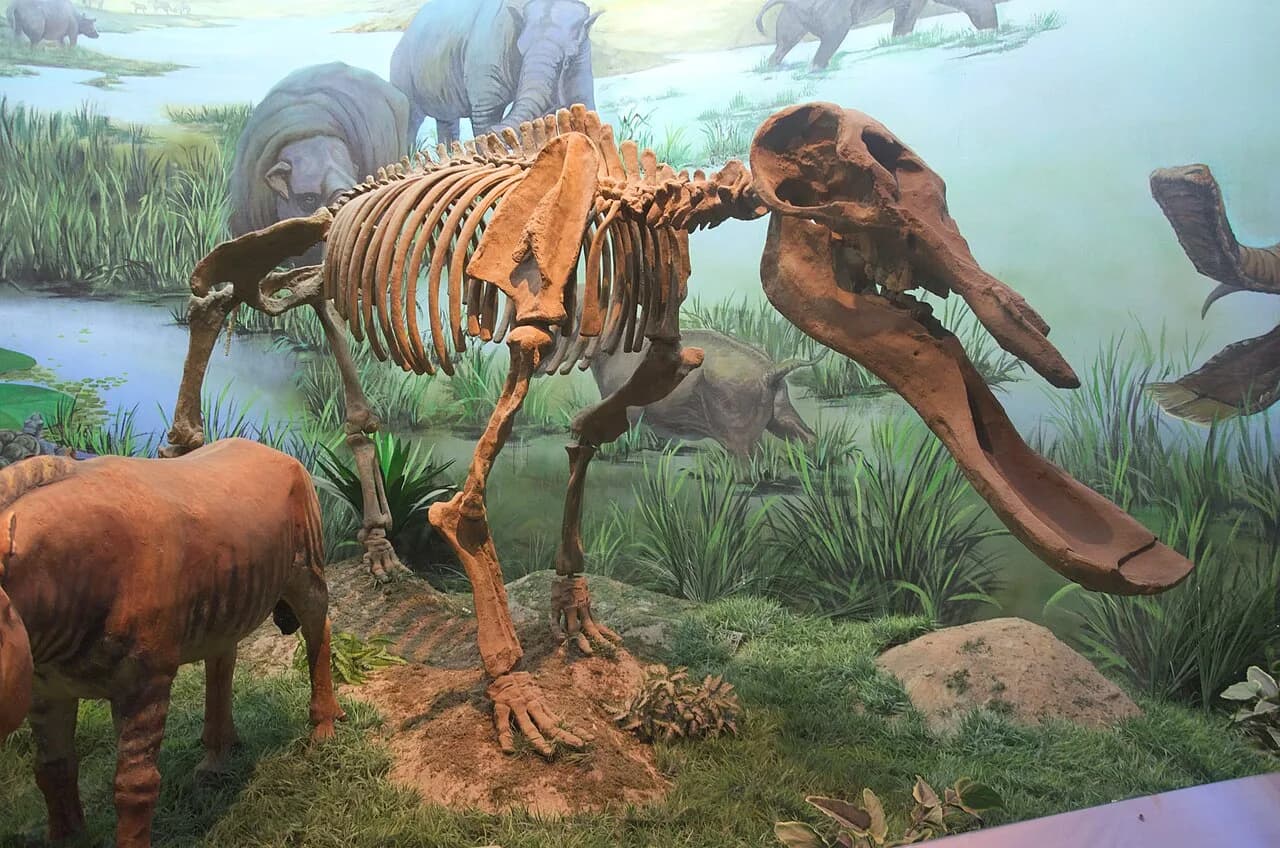
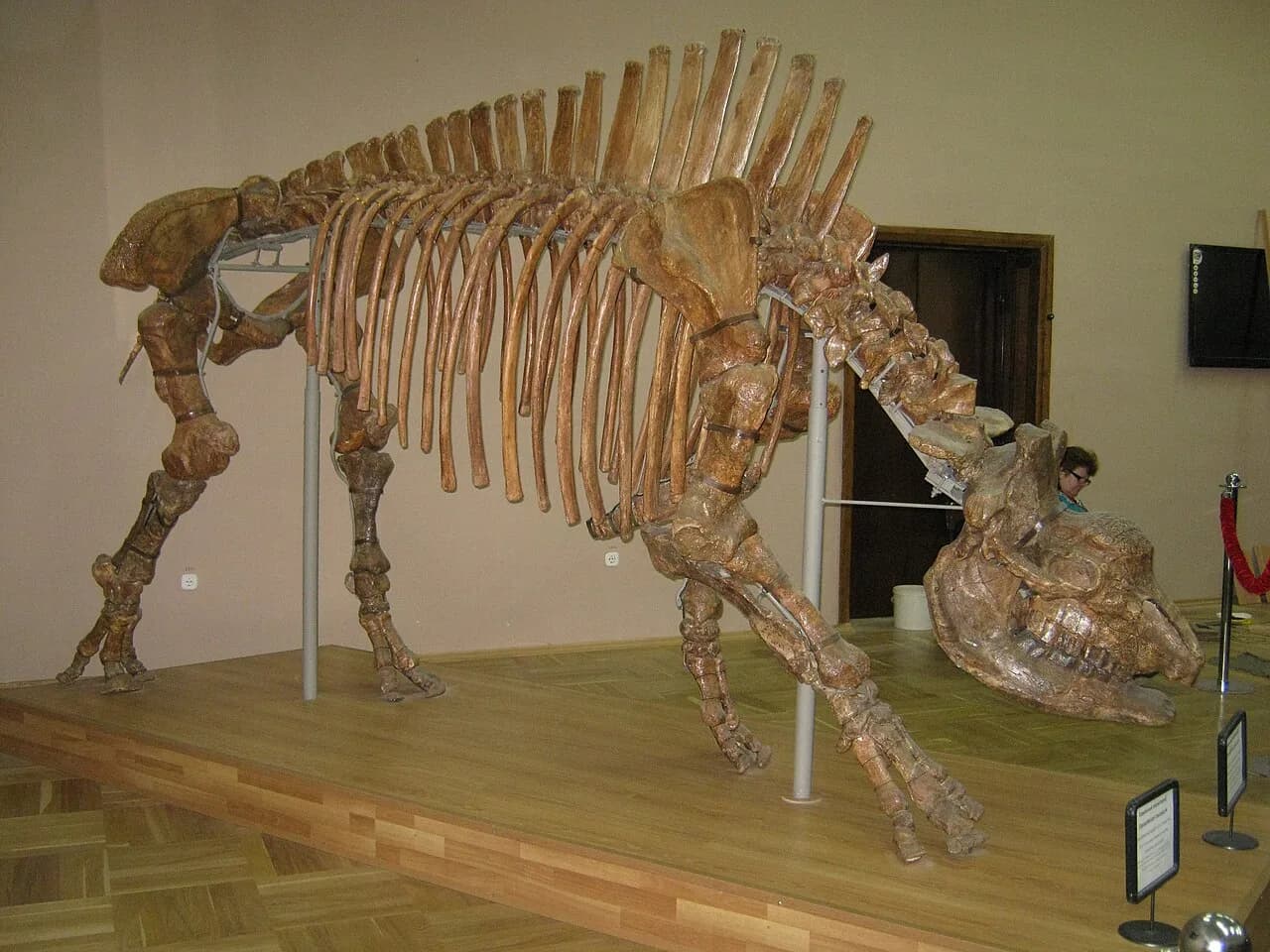
Platybelodon skeleton at Inner Mongolia Museum
Wikimedia Commons