Élasmothérium
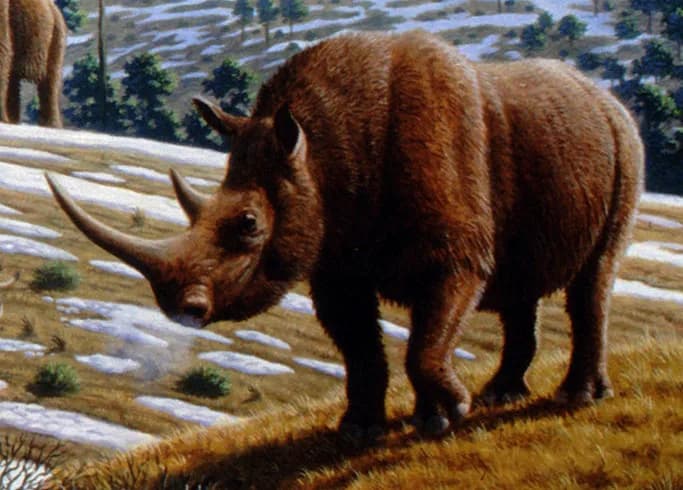
Elasmotherium sibiricum, nicknamed the « Siberian unicorn », is a rhinoceros 5 metres long and 3.5 to 5 tonnes that ranged the Eurasian steppes between 2.6 million and 29,000 years ago. Its single brow horn has never been found fossilised, since keratin decays. Its size is inferred from the massive bony dome that carried it on the skull.
Elasmotherium lived during the Pleistocene, an era marked by intense glacial cycles that reshaped the landscapes of Eurasia. This giant rhinoceros first appeared approximately 2.6 million years ago and survived far longer than scientists initially believed. For decades, its extinction was estimated at around 200,000 years ago, but radiocarbon dating published in 2018 pushed this date back to only 29,000 years before present, placing Elasmotherium among the late Ice Age megafauna. It therefore coexisted with early modern Homo sapiens populating the Eurasian steppes, as well as with other giants such as the woolly mammoth, woolly rhinoceros, and steppe bison. Its extinction coincides with a period of rapid climate change and fragmentation of the grassy steppe habitats upon which it critically depended for survival.
Elasmotherium was one of the largest rhinoceroses ever to have existed, rivaling some modern elephants in size. It measured approximately 5 meters in length from snout to tail and reached a shoulder height of about 2 meters, significantly larger than the modern white rhinoceros, which is itself the largest living rhino. Its weight is estimated between 3.5 and 5 tonnes, with some paleontologists proposing estimates as high as 7 tonnes for the largest individuals. To put this mass in perspective, an adult Elasmotherium weighed as much as a female Asian elephant. Its silhouette was imposing and distinctive, with surprisingly long and slender limbs for a rhinoceros, giving it an almost horse-like appearance. This colossal stature made it one of the largest terrestrial mammals in the Eurasian Pleistocene megafauna, surpassed in mass only by mammoths and certain proboscideans.
A strict herbivore, Elasmotherium was a specialized grazer perfectly adapted to consuming the tough grasses of the Eurasian steppes. Its hypsodont teeth — meaning high-crowned and continuously growing — were a remarkable adaptation for grinding abrasive grasses laden with silica and dust. Unlike modern rhinoceroses with lophodont teeth adapted to a mixed diet, Elasmotherium's molars featured complex enamel folds that maximized the grinding surface, a convergent characteristic shared with horses and bison. Dental wear observed on fossils confirms a diet almost exclusively composed of grasses, with very little foliage or browse. This extreme dietary specialization made it vulnerable to environmental changes: when grassy steppes became fragmented in favor of tundra and forests, Elasmotherium lost its feeding habitat, likely contributing to its extinction.
Elasmotherium inhabited the vast grassy steppes that stretched across Eurasia during the Pleistocene, from Eastern Europe to western China. Its primary range covered the steppes of southern Russia, Kazakhstan, Uzbekistan, and southern Western Siberia, with populations extending to Ukraine, Moldova, and the Caucasus in the west, and to Mongolia and northwestern China in the east. This habitat was characterized by large open grasslands, relatively dry and cold, dotted with seasonal wetlands and crossed by rivers and streams. The steppes provided an abundance of nutritious grasses essential to its specialized diet. Unlike the woolly rhinoceros which adapted to the harshest Arctic environments, Elasmotherium preferred temperate to continental steppes, avoiding the most northern regions. The gradual disappearance of these open grasslands during postglacial warming drastically reduced its available habitat.
Elasmotherium's anatomy was unique among rhinoceroses, combining archaic traits with highly specialized adaptations. Its most distinctive feature was an enormous bony dome protruding from the forehead, composed of thickened, roughened bone, which likely served as the attachment base for a massive horn. Although no horn has been found fossilized (keratin does not fossilize), the size and rugosity of this dome suggest a potentially gigantic horn, possibly exceeding one meter in length. Its legs were remarkably long and straight for a rhinoceros, with joints adapted for running, enabling it to gallop over long distances across the open steppes. Its continuously growing hypsodont teeth — a rare characteristic among rhinoceroses — testified to its adaptation to a diet of abrasive grasses. Its elongated, lowered skull positioned the mouth close to the ground, facilitating intensive grazing of the short steppe grasses.
Elasmotherium's behavior remains largely hypothetical, but paleontologists have formulated several inferences based on its anatomy, ecology, and comparison with modern rhinoceroses. Its long legs and running-adapted morphology suggest an animal capable of moving rapidly despite its imposing mass, possibly at speeds of 35 to 40 km/h over short distances, making it a remarkably fast runner for its size. This locomotory capability indicates significant seasonal movements, following the most productive pastures across the immense Eurasian steppes. By analogy with modern large rhinoceroses, Elasmotherium likely lived as solitary individuals or in loose small groups, with males defending territories and females raising their young independently. Its massive horn likely served for intraspecific combat over mates, defense against predators, and possibly for clearing snow covering grasses in winter.
The genus Elasmotherium was first described in 1808 by German naturalist Johann Fischer von Waldheim, based on a lower jaw discovered in Siberia. The name means 'plate beast' (Greek: elasmos 'plate' + therion 'beast'), referring to the lamellar enamel folds of its molars. Since its initial discovery, fossils have been unearthed across Eurasia, notably in southern Russia, Kazakhstan, Ukraine, Georgia, and China. The popular nickname 'Siberian unicorn' has engaged public imagination, with some researchers even suggesting that unicorn legends in Central Asia and Russia may have originated from late observations of this animal or the discovery of its single-horned skulls. In 2018, a groundbreaking study using radiocarbon dating and ancient DNA analysis revolutionized our understanding of the species: Elasmotherium sibiricum survived until approximately 29,000 years before present, far more recently than previously thought. This study also revealed that the Elasmotherium lineage had diverged from that of modern rhinoceroses approximately 40 million years ago.
| Period | Pléistocène / Pleistocene |
| Era | Cénozoïque / Cenozoic |
| Age | 2,6 Ma - 29 000 ans |
| Location | Steppes d'Eurasie / Eurasian steppes |
| Length | 5 m |
| Height | 2 m (au garrot / at shoulder) |
| Weight | 3,5-5 tonnes |
| Diet | Herbivore |
| Discovery | 1808 |
Elasmotherium sibiricum reached about 5 meters long, 2 meters at the shoulder, and weighed between 3.5 and 5 tonnes — comparable to a female Asian elephant. It was one of the largest rhinoceroses ever, surpassing the modern white rhinoceros. Some paleontologists estimate the largest individuals at up to 7 tonnes.
For decades, Elasmotherium sibiricum was thought to have gone extinct around 200,000 years ago. A 2018 study using radiocarbon dating and ancient DNA pushed this date to only 29,000 years ago, placing it among the late Ice Age megafauna and making it a contemporary of early modern Homo sapiens.
Elasmotherium sibiricum had high-crowned, continuously growing hypsodont teeth — a rare trait in rhinoceroses — enabling it to grind silica-rich, abrasive grasses. Its elongated skull kept the mouth close to the ground for intensive grazing. The disappearance of Eurasian steppes during postglacial warming likely contributed to its extinction.
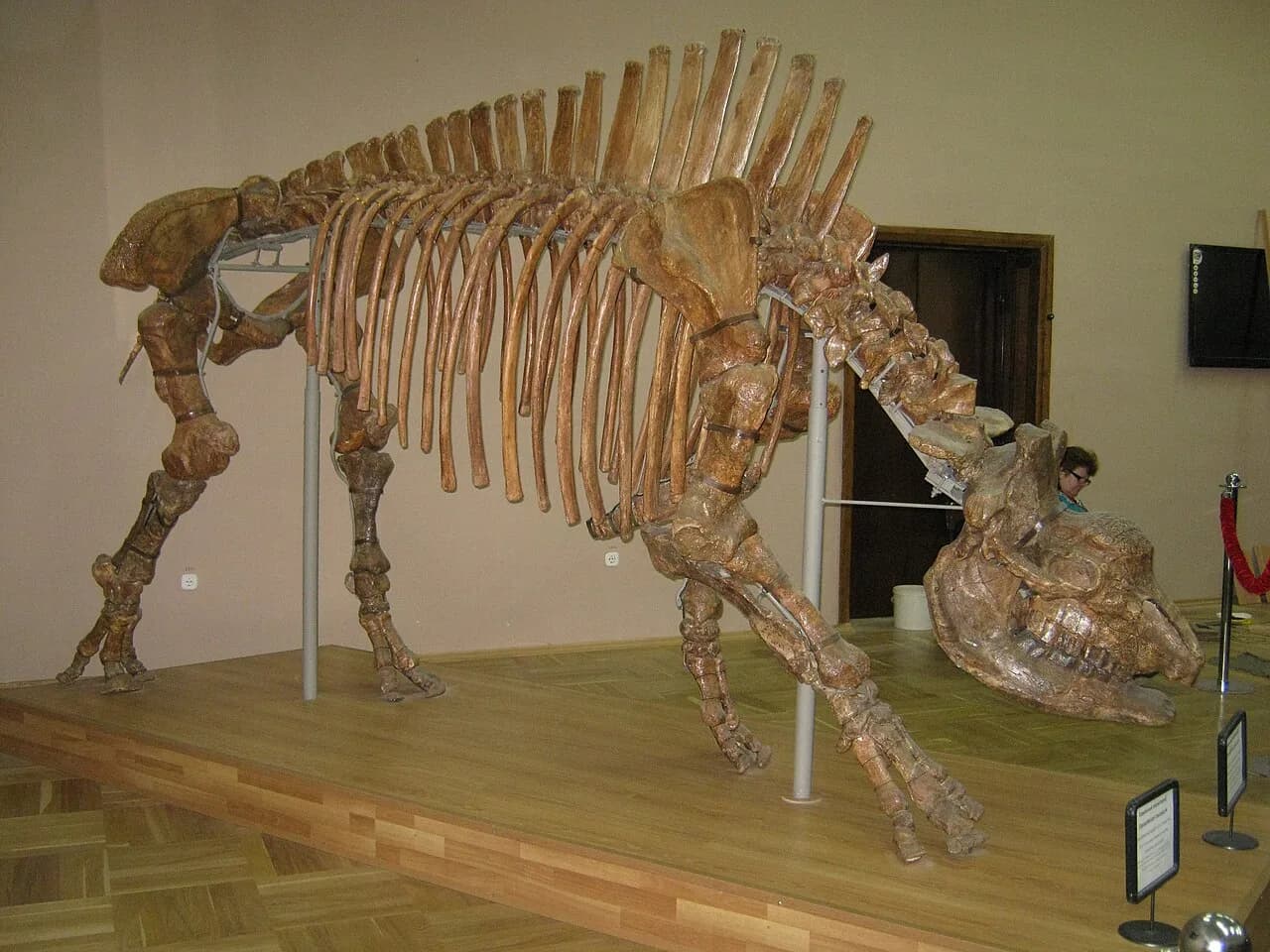
Elasmotherium caucasicum skeleton
Wikimedia Commons
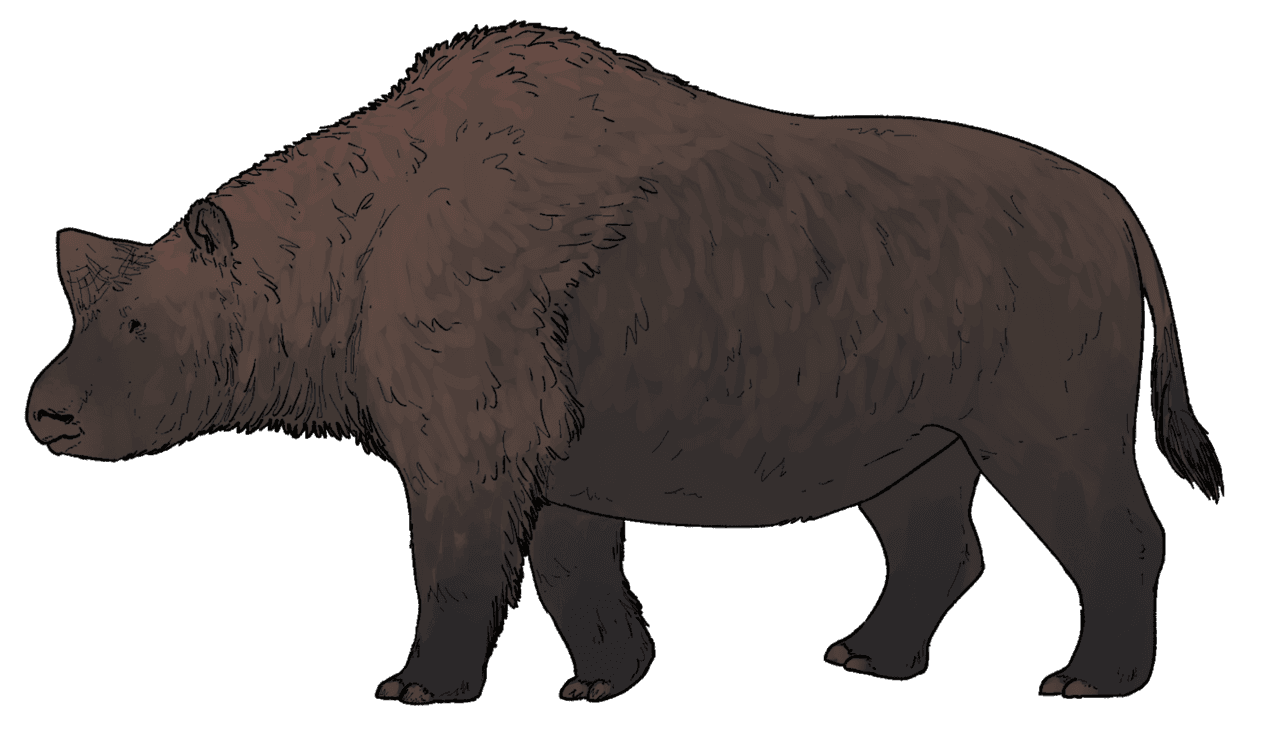
Elasmotherium sibiricum restoration
Wikimedia Commons