Déinotherium
Deinotherium giganteum is the only known proboscidean whose tusks grow from the lower jaw, curving downward like hooks. Standing 4 metres and weighing 10 to 14 tonnes, it ranged across Africa, Europe and South Asia between 11 and 1 million years ago. In East Africa its fossils come out of the same sites as those of Australopithecus and Homo habilis.
Deinotherium giganteum lived from the late Middle Miocene to the early Pleistocene, approximately 11 million to 1 million years ago, making it one of the longest-lived proboscideans. This giant appeared in Africa during the Middle Miocene and then dispersed into Eurasia, colonizing southern Europe, the Middle East, and South Asia between 8 and 5 million years ago. Three species are recognized: D. giganteum (the largest, Euro-Asian), D. indicum (South Asia), and D. bozasi (East Africa). In Africa, Deinotherium coexisted with early hominids, and fossils of D. bozasi have been found at the same sites as remains of Australopithecus and Homo habilis at Olduvai in Tanzania. European and Asian populations went extinct at the end of the Pliocene, while D. bozasi persisted in East Africa until the early Pleistocene, approximately 1 million years ago.
Deinotherium giganteum ranked among the largest terrestrial mammals of all time. The most recent estimates attribute a shoulder height of 3.5 to 4.5 meters and a weight of 8 to 12 tonnes, rivaling the largest mammoths and Palaeoloxodon. Some exceptional specimens from the Late Miocene of Greece and Romania may have approached 5 meters at the shoulder. Its skull, proportionally shorter and taller than modern elephants, could measure over one meter long. The downward-curving lower tusks added a spectacular dimension to its already imposing silhouette. Females were significantly smaller than males, with sexual dimorphism comparable to modern elephants. Despite its colossal size, Deinotherium had relatively gracile limbs for its mass, suggesting the animal may have been lighter than the highest estimates.
Deinotherium was a specialized browsing herbivore, feeding primarily on leaves, branches, bark, and fruits from trees and shrubs. Unlike modern elephants that are mixed feeders (browsers and grazers), dental microwear analyses of Deinotherium show patterns characteristic of a strict browser, consuming little to no grass. Its bilophodont molars (with two transverse ridges), structurally different from elephants' lamellar molars, were adapted for shearing leaves and tender plant material rather than grinding abrasive grasses. Its downward-curving lower tusks probably served to strip bark from tree trunks, dig up roots, or excavate soil in search of underground water. The trunk, though its exact morphology is speculative, was certainly an essential prehensile organ for grasping branches out of mouth reach and bringing them to the molars.
Deinotherium occupied warm forested and wooded environments, from the tropical and subtropical forests of Africa to the Mediterranean and warm-temperate forests of Europe. Its adaptation to leaf browsing tied it closely to arboreal habitats, and its geographic distribution followed the distribution of forests and woodlands across the Old World. In Europe, the main fossils come from Greece (Pikermi site), Romania, Germany, and Spain, associated with Late Miocene subtropical forest faunas. In Africa, D. bozasi is documented at paleoanthropological sites in the Rift Valley: Olduvai in Tanzania, Koobi Fora in Kenya, and the Omo Valley in Ethiopia, in contexts of wooded savannas and gallery forests along waterways. The Pliocene climatic cooling and the expansion of grasslands at the expense of forests are considered the primary factors in its progressive decline.
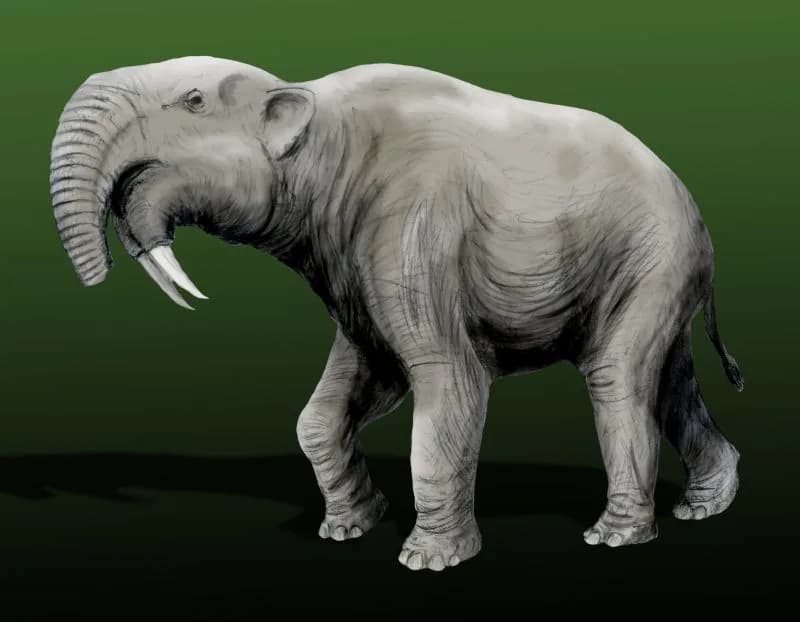
Deinotherium's anatomy radically distinguished it from other proboscideans through the unique position of its tusks. Unlike elephants and mammoths whose tusks (modified upper incisors) point forward and upward, Deinotherium possessed tusks on its lower mandible, curving downward and backward, forming a spectacular hook. The upper jaw was entirely devoid of tusks, a unique characteristic among advanced proboscideans. The skull was shorter and taller than elephants', with a flattened forehead and massive zygomatic arches. Its bilophodont molars, with two pairs of transverse ridges, represent a primitive dental plan compared to the complex lamellar molars of elephants and mammoths. The postcranial skeleton was robust but with proportions different from elephantids: the limbs were relatively longer compared to the trunk, and the spine was more horizontal, giving the animal a different profile from modern elephants.
Deinotherium's behavior can be inferred by analogy with modern elephants, its closest living relatives, though the evolutionary divergence between the two lineages dates back over 20 million years. Its large size and browsing diet suggest an animal requiring vast forested territories and regular movements to find sufficient food. Modern forest elephants (Loxodonta cyclotis) travel considerable distances daily between feeding areas, and Deinotherium likely followed a similar pattern. Its social structure was probably matriarchal, as in all studied proboscideans, with herds of females and young guided by an experienced matriarch. Adult males probably led solitary lives or formed small groups, associating with females only during the breeding period. The lower tusks may have served as visual signals during social interactions and confrontations between rival males.
Deinotherium was first described in 1829 by German naturalist Johann Jakob Kaup from a partial skull discovered in Hesse, Germany. The name means 'terrible beast' (Greek: deinos 'terrible' + therion 'beast'), given due to the impressive size and unusual appearance of the animal. Deinotherium fossils are distributed across Africa, southern Europe, and South Asia, with major sites in Greece (Pikermi, classic Late Miocene site), Romania, Germany, Kenya (Koobi Fora), Tanzania (Olduvai Gorge), and Ethiopia (Omo Valley). The largest known skull, discovered in Crete, measures 1.2 meters long. Remarkably complete skeletons have been unearthed in Romania and Greece. In East Africa, D. bozasi fossils are often found in association with stone tools and hominid remains, providing crucial environmental context for understanding human evolution. Molecular phylogeny confirms that Deinotheriidae form a sister group to Elephantidae, having diverged very early in proboscidean history.
| Period | Miocène — Pléistocène inférieur / Miocene — Early Pleistocene |
| Era | Cénozoïque / Cenozoic |
| Age | 11 - 1 Ma |
| Location | Afrique, Europe, Asie du Sud / Africa, Europe, South Asia |
| Length | 4 m |
| Height | 4.5 m (au garrot / at shoulder) |
| Weight | 10-14 tonnes |
| Diet | Herbivore |
| Discovery | 1829 |
Deinotherium giganteum is the only advanced proboscidean whose tusks grew from the lower jaw, curving downward and backward like hooks. The upper jaw was entirely tuskless. These lower hooks probably served to strip bark from trees, dig soil, or unearth roots in the forests of Africa, Europe, and South Asia.
Deinotherium giganteum reached 3.5 to 4.5 meters at the shoulder and weighed 8 to 14 tonnes, ranking among the largest known land mammals. Some Late Miocene specimens from Greece and Romania likely approached 5 meters at the shoulder. The largest known skull, discovered in Crete, measures 1.2 meters long.
The African species Deinotherium bozasi coexisted with Australopithecus and Homo habilis in East Africa. Its fossils have been found at the same paleoanthropological sites of Olduvai (Tanzania), Koobi Fora (Kenya), and the Omo Valley (Ethiopia). This species went extinct approximately 1 million years ago, in the early Pleistocene.
Deinotherium giganteum, a proboscidean with downward-curving tusks
Wikimedia Commons
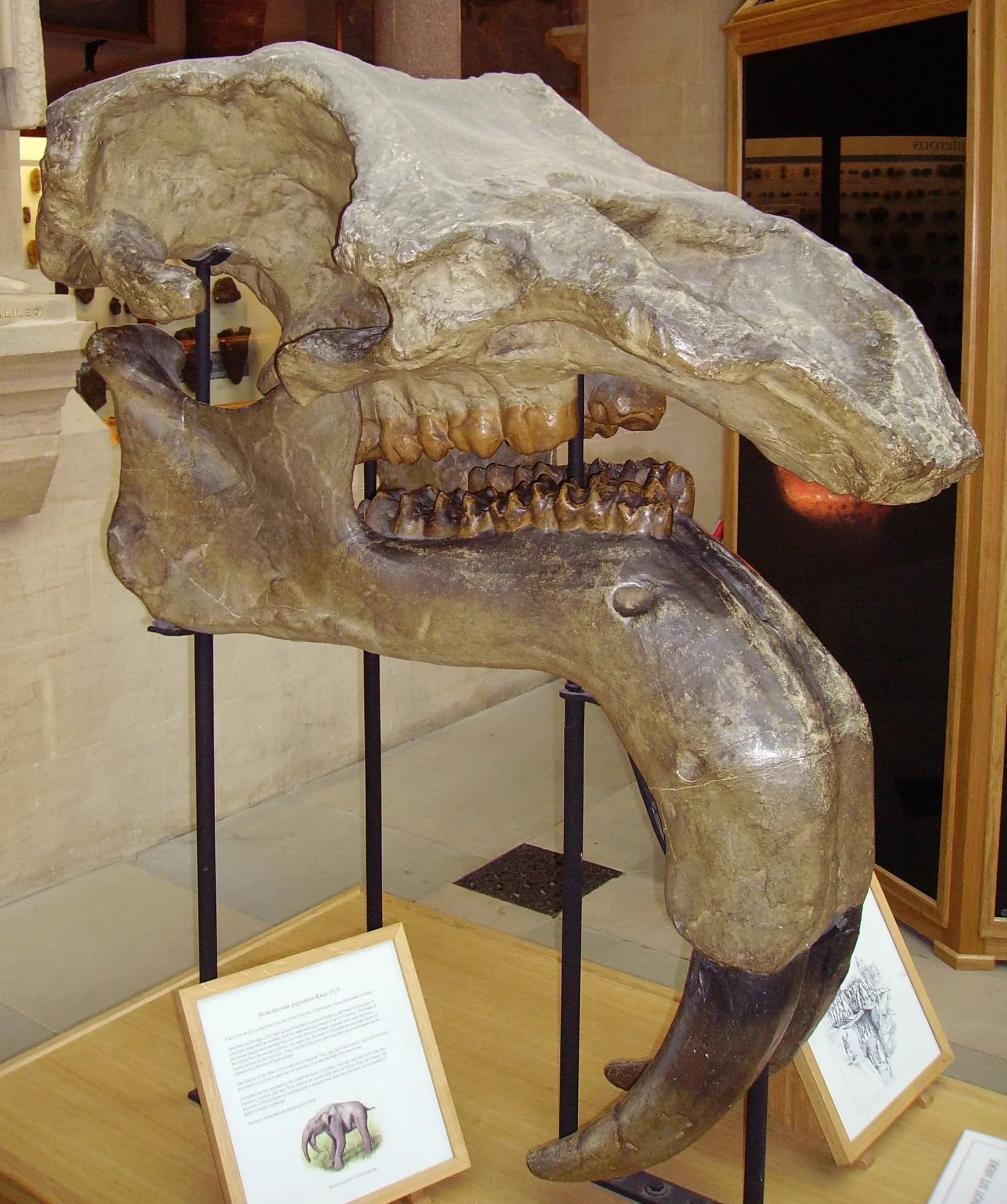
Deinotherium giganteum, a giant cousin of modern elephants
Wikimedia Commons