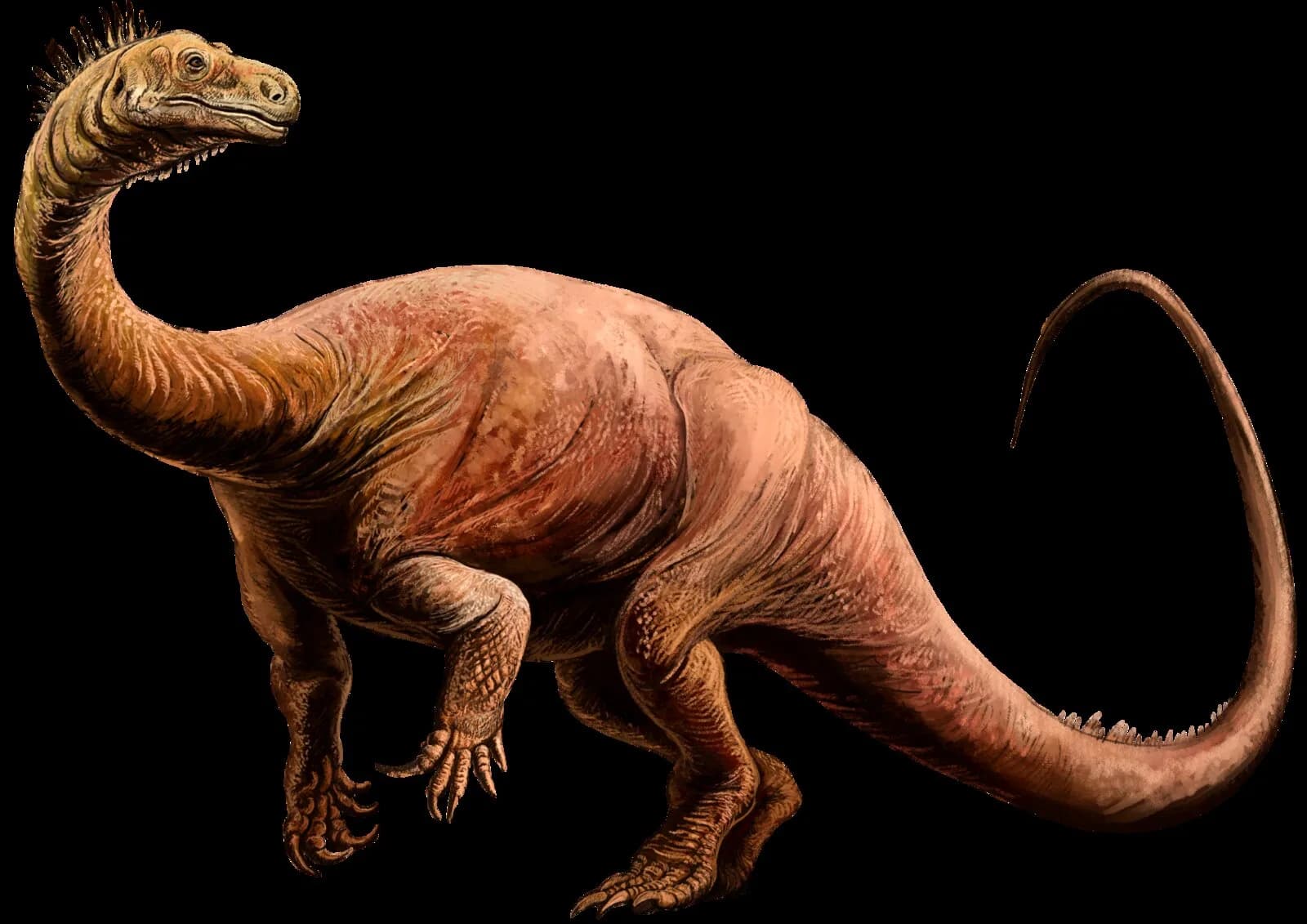
Plateosaure
Plateosaurus engelhardti ranks among the first large dinosaurs: up to 10 metres and 600 kilograms to 4 tonnes, an outsized build for the Triassic. Described in 1837, it lived 214 to 204 million years ago in Germany, France and Switzerland. More than a hundred skeletons have been recovered, making it one of the best documented Triassic dinosaurs.
Plateosaurus lived in the Late Triassic, approximately 214 to 204 million years ago, during the Norian stage. It is one of the oldest and largest herbivorous dinosaurs of this period, belonging to the prosauropod group that foreshadowed the giant sauropods of the Jurassic. It lived at a time when Pangaea was still largely intact, allowing an extensive geographic distribution across Europe. Plateosaurus was contemporary with the end-Triassic extinction, one of the five great mass extinction events in Earth's history. Its ecological dominance in Late Triassic European ecosystems heralds the era of great herbivorous dinosaurs.
Plateosaurus was a respectably sized dinosaur for the Triassic: 5 to 10 meters long and weighing 600 kg to 4 tonnes. This large size variation is due to the indeterminate growth observed in this species — some individuals continued growing throughout their lives while others stopped earlier. It was by far the largest land animal of its time in Europe. Its long neck allowed it to reach vegetation between 1 and 4 meters high, a competitive advantage over smaller herbivores. The robustness of its postcranial bones indicates a solidly built animal, capable of supporting considerable weight.
A strict herbivore, Plateosaurus was adapted for consuming tough vegetation such as conifers, cycads, and tree ferns. Its frontal horny beak could cut vegetation, while its spatulate teeth with serrated edges ground plant fibers. Gastroliths (swallowed stones to aid digestion) have been found associated with some specimens, suggesting a digestive system similar to modern herbivorous birds. Its digestive system must have been voluminous to ferment cellulose, contributing to its characteristic pot-bellied silhouette. It could probably rear up on its hind legs to reach tall vegetation, combining ground-level and elevated feeding.
Plateosaurus inhabited the plains and deserts of central and northern Europe, in what today corresponds to Germany, Switzerland, France, and Norway. The European Late Triassic climate was arid, with oases of vegetation around water sources and seasonal rivers. The environment was comparable to modern semi-arid savannas, with sparse vegetation dominated by conifers and ferns. Mass death sites, like Trossingen in Germany, suggest that entire herds perished during crossings of muddy areas or prolonged droughts. The Löwenstein Formation and Trossingen Formation in Germany are the main sources of fossils.
A typical prosauropod, Plateosaurus had a long neck, massive body, short forelimbs armed with a large thumb claw, and powerful hind legs. This sharp thumb claw (ungual I-1) likely served both for defense against predators and for stripping tree bark for feeding. It could rear up on its hind legs to reach tall vegetation, a facultative bipedal posture confirmed by biomechanical analysis of its joints. Its relatively small skull compared to its body contained lateral eyes offering a wide field of vision for predator detection. The vertebral column featured robust vertebrae adapted to support the weight of a body that could reach several tonnes. Rapidly growing bone structures (fibrolamellar bone) have been identified, indicating an elevated metabolism for a reptile.
Probably gregarious, Plateosaurus moved in seasonal herds, migrating between grazing areas with the seasons. Massive fossil accumulations at certain European sites support this hypothesis of social behavior. Recent studies on Plateosaurus growth have revealed a notable phenomenon of developmental plasticity: some individuals reached adult size in just a few years, while others continued growing for over a decade. This variation may reflect environmental differences (food availability, stress) rather than genetic ones. As the largest herbivore in its ecosystem, adult Plateosaurus probably had few natural predators, while juveniles were vulnerable to theropods like Liliensternus.
Plateosaurus is one of the most abundant European dinosaurs, with dozens of complete skeletons found in Germany, Switzerland, and France. The Trossingen site in Germany is particularly famous, having yielded hundreds of specimens since the first excavations in 1911 by Friedrich von Huene. Other major sites include Frick in Switzerland and Halberstadt in Germany. First described in 1837 by Hermann von Meyer, it is one of the earliest dinosaurs to have been named. The exceptional preservation conditions at some sites have preserved complete articulated skeletons, providing a detailed view of this animal's anatomy. The wealth of fossil material has made Plateosaurus one of the most studied Triassic dinosaurs in the world, with over 100 known specimens.
| Period | Trias supérieur / Late Triassic (Norien) |
| Era | Mésozoïque / Mesozoic |
| Age | 214–204 Ma |
| Location | Europe (Allemagne, France, Suisse) / Europe (Germany, France, Switzerland) |
| Length | 4–10 m |
| Height | ~2–3 m |
| Weight | 600–4 000 kg |
| Diet | Herbivore |
| Discovery | 1837 |
Plateosaurus engelhardti showed notable developmental plasticity: some individuals reached adult size (4–5 m) within a few years, others continued growing for over a decade, reaching 10 meters. Osteological studies show this variation is not genetic but reflects environmental conditions — food availability and seasonal stress in the semi-arid plains of European Triassic environments.
Sites like Trossingen (Germany) have yielded hundreds of Plateosaurus engelhardti skeletons since Friedrich von Huene's excavations beginning in 1911. These accumulations likely resulted from drought episodes or bogging in clay plains, with entire herds perishing at the same location. Over 100 known specimens make Plateosaurus one of the best-documented Triassic dinosaurs.
Plateosaurus engelhardti was a facultative biped. Biomechanical analysis of its joints confirms it could rear up on its hind legs to reach vegetation between 1 and 4 meters high. On flat ground, it likely alternated between bipedal and quadrupedal locomotion depending on speed. Its large thumb claw (ungual I-1) served for defense and stripping tree bark.
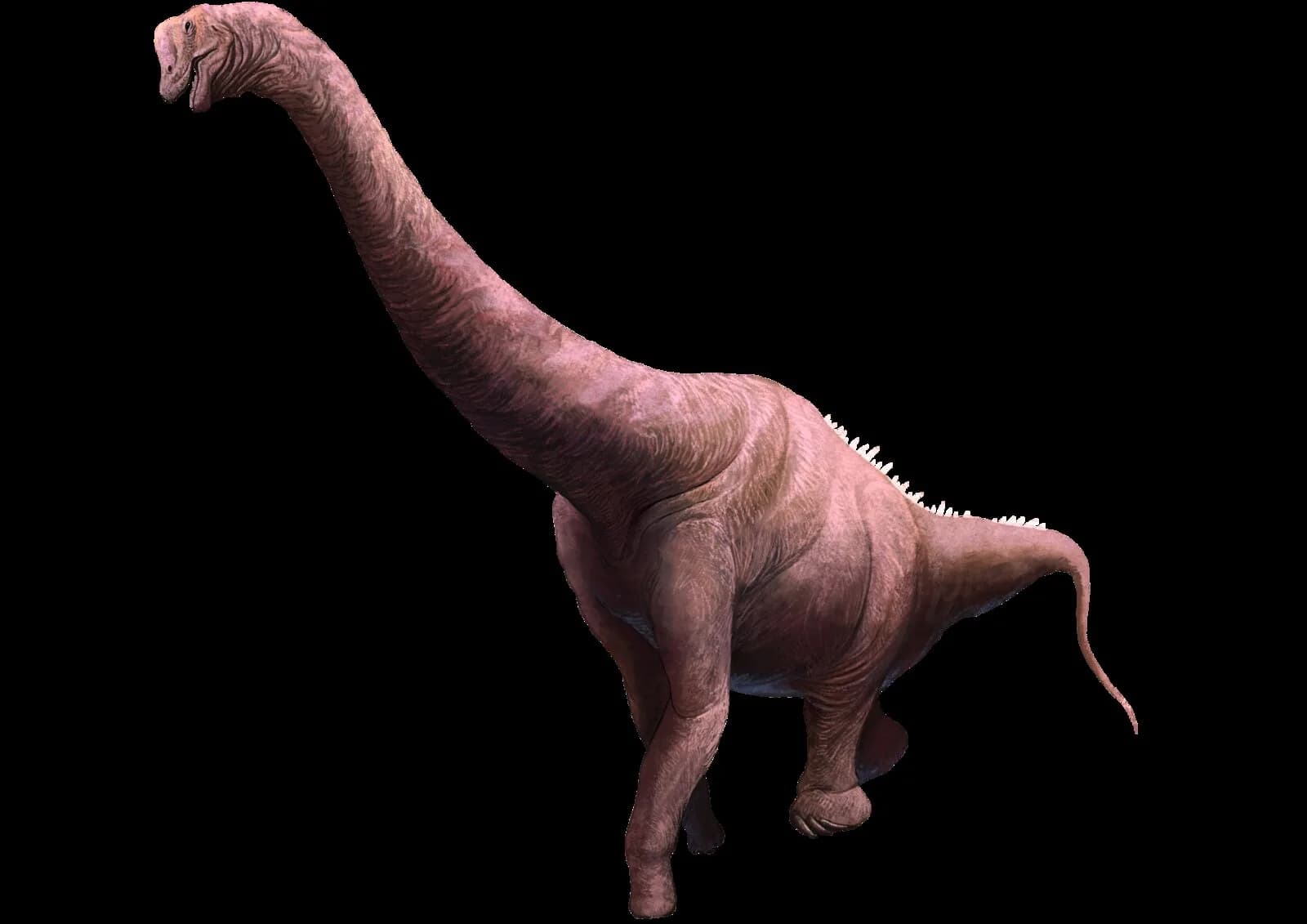
Life reconstruction of Plateosaurus engelhardti
DBCLS, CC BY 4.0, via Wikimedia Commons
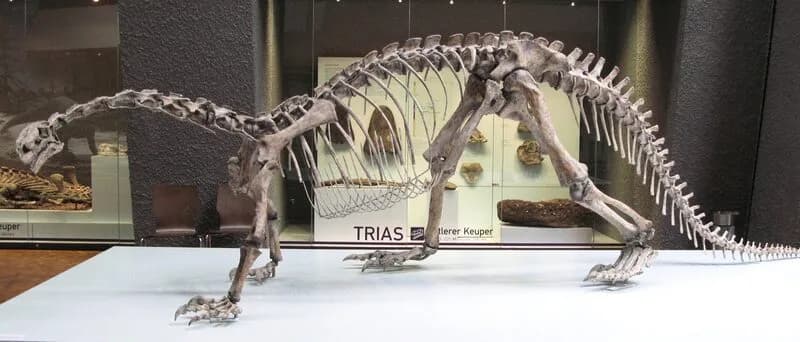
Plateosaurus engelhardti skeleton, Triassic
Ra'ike, CC BY-SA 3.0